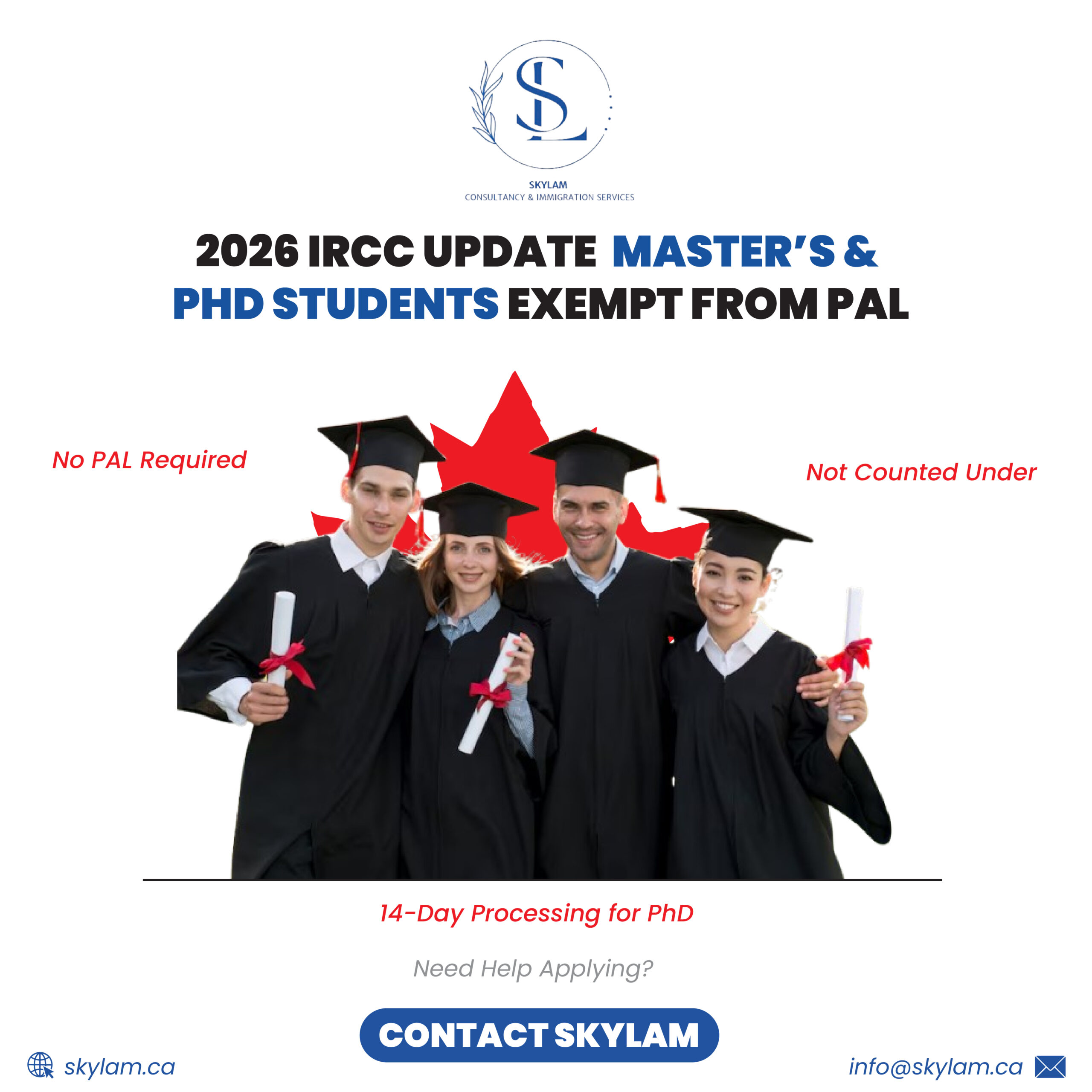
Canada has introduced a major and much-anticipated update for international graduate students. Starting January 1, 2026, Master’s and PhD students enrolling at public post-secondary institutions will no longer need a Provincial Attestation Letter (PAL) to apply for a study permit. This policy change represents one of the most significant steps taken by Immigration, Refugees and Citizenship Canada (IRCC) to support advanced research education and strengthen Canada’s global competitiveness.
In addition, IRCC has launched a new 14-day study permit processing standard for PhD applicants applying from outside Canada. This fast-track benefit also extends to the applicant’s accompanying family members, making Canada an even more attractive destination for research scholars and their families.
This blog explores the full details of the new policy, why it matters, who benefits, and what future graduate students can expect moving into 2026 and beyond.
1. Background: Why Canada Introduced the PAL Requirement
In early 2024, IRCC introduced the Provincial Attestation Letter (PAL) as part of a broader plan to manage the rising number of international student applications. Under this system, provinces were given specific quotas for how many student applicants they could support each year. Colleges and universities had to issue PALs to confirm that a student’s application fell within the provincial allocation.
The PAL system had three primary goals:
- To address the rapid growth in international student enrollment
- To ensure provinces had the infrastructure capacity to support students
- To increase accountability and reduce the misuse of study permits
However, graduate-level programs — especially Master’s and PhD degrees — were never the primary cause of system strain. These programs attract mature academic candidates, contribute heavily to Canadian research, and often lead to valuable industry innovations.
As a result, IRCC decided to remove PAL requirements entirely for graduate students to streamline the process and minimize delays for high-skilled applicants.
2. New Rule: Master’s & PhD Students Exempt from PAL Requirements
Effective January 1, 2026, students applying to Master’s and PhD programs at public institutions in Canada are:
✔ Exempt from the Provincial Attestation Letter (PAL)
They no longer need a PAL issued by the province to submit their study permit application.
✔ Excluded from the Federal Study Permit Cap
Graduate-level students will not be counted in Canada’s overall annual cap for study permits.
✔ Free to Apply Anytime Without Provincial Limits
Applications will not be delayed or rejected due to provincial quota restrictions.
This change not only removes a major administrative hurdle but also ensures that graduate applicants are not indirectly penalized by the rising demand for undergraduate and college programs.
3. Who Is Eligible for the PAL Exemption?
The exemption applies to:
- Students applying for Master’s degree programs
- Students applying for PhD (doctoral) programs
- Applicants enrolled in public universities or public colleges offering graduate programs
Important points to note:
- The exemption does not apply to private institutions, unless the private school is a recognized part of a public university offering an accredited graduate program.
- Graduate diplomas, postgraduate certificates, and professional programs may or may not qualify depending on the institution’s license and provincial policies.
- Students must still meet all academic, financial, and immigration requirements.
This clarity ensures that the PAL exemption remains aligned with Canada’s research and innovation priorities.
4. Why IRCC Made This Change
The Canadian government has identified graduate students as essential contributors to:
✔ Research and Innovation
Master’s and PhD candidates support scientific discovery, technology development, healthcare research, and numerous academic fields.
✔ Economic Growth
Graduate-level talent helps fill labour market gaps, particularly in engineering, IT, health sciences, biotechnology, data science, and environmental sectors.
✔ Long-Term Immigration Success
Research shows that Master’s and PhD graduates have high employment rates, strong earning potential, and excellent long-term outcomes when transitioning to permanent residency.
By exempting graduate students, IRCC is sending a clear signal:
Canada wants to attract and retain high-skilled academic talent.
5. Fast-Track Processing: 14-Day Study Permit for PhD Applicants
One of the most significant parts of the update is the new 14-day processing standard for incoming PhD students.
What’s included?
- PhD applicants applying from outside Canada
- Spouses/common-law partners accompanying them
- Dependent children
What does 14-day processing mean?
This does not guarantee an automatic approval; instead, it ensures that complete applications are processed within two weeks.
This is designed to:
- Reduce long waiting times
- Help students plan travel and housing
- Support timely academic enrollment
- Provide faster reunification for families
Many PhD programs have strict start dates, research schedules, and supervisor arrangements. Delayed permits often disrupt these timelines. The 14-day standard solves this problem.
6. New IRCC Webpage Dedicated to Graduate Students
To make the transition even smoother, IRCC has launched a special webpage focusing exclusively on graduate students.
This resource includes:
- PAL exemption details
- Eligibility rules
- Documentation checklists
- Processing timelines
- Policy updates
- Guidance for family members
- FAQs for Master’s and PhD programs
The webpage aims to provide a single, centralized place where students can find reliable and up-to-date information.
7. How This Update Helps Future International Students
1. Faster Application Process
Without PAL requirements, the study permit application becomes much simpler and more predictable.
2. Reduced Bureaucracy
No more waiting for PAL letters from institutions. No delays due to provincial caps.
3. Higher Approval Chances
Graduate-level applicants historically have higher approval rates due to stronger academic profiles and clearer intentions.
4. Better Family Support
PhD families receive faster processing, reducing stress and uncertainty.
5. Increased Flexibility
Students can apply earlier, plan better, and secure housing sooner.
6. Stronger Pathway to Permanent Residency
Graduate-level education has direct connections to long-term immigration routes such as:
- Canadian Experience Class (CEC)
- Provincial Nominee Programs (PNP)
- Express Entry pathways
- Post-Graduation Work Permit (PGWP) eligibility
These pathways remain very favorable for Master’s and PhD graduates.
8. Impact on Universities and the Canadian Education System
The policy change will have a positive impact on the Canadian academic landscape.
Universities Benefit By:
- Attracting more research-focused talent
- Filling critical gaps in labs and research programs
- Improving global rankings by enrolling strong applicants
- Enhancing international diversity in classrooms
- Strengthening partnerships with industries and government programs
Students Benefit By:
- Faster access to research environments
- More predictable immigration timelines
- Reduced paperwork and stress
- Better integration with supervisors and research teams
Across the board, this policy is expected to increase Canada’s competitiveness as a top global education destination.
9. Does This Affect Undergraduates and College Students?
No — this new exemption applies only to graduate-level degree programs.
Undergraduate and college-level applicants must still follow:
- PAL requirements
- Provincial quota restrictions
- Regular processing times
However, this policy does reduce some pressure on the overall system, which could indirectly help wait times for other students.
10. Requirements That Still Apply to Graduate Students
Even with the PAL exemption, Master’s and PhD students must still provide:
1. Proof of Acceptance
An official Letter of Acceptance (LOA) from a public institution.
2. Proof of Financial Support
Funds to cover:
- Tuition
- Living expenses
- Travel
- Dependent family members
Minimum financial amounts depend on the province.
3. Strong Academic Background
Graduate admissions committees expect:
- Relevant bachelor’s degree
- Research background (for thesis programs)
- Statement of purpose
- Supervisor approval (for PhD)
4. Genuine Intent to Study
IRCC still evaluates whether the student is applying genuinely for academic purposes.
5. Supporting Documents
Passport, forms, biometrics, medical exam (if required), etc.
The PAL exemption does not remove the fundamental immigration requirements; it simply removes one major administrative hurdle.
11. What This Means for 2026 Study Permit Applicants
If you are planning to begin a Master’s or PhD program in 2026 or later, this update works strongly in your favor.
Master’s Students Can Expect:
- Faster approvals
- More predictable timelines
- Reduced stress from provincial limitations
- Easier planning for travel, accommodation, and funding
PhD Students Can Expect:
- Ultra-fast processing (14 days)
- Faster family visa approvals
- Smooth coordination with research supervisors
- Greater confidence when accepting program offers
These improvements make Canada one of the most welcoming destinations for graduate education.
12. The Policy Strengthens Canada’s Long-Term Immigration Strategy
Canada’s long-term immigration vision includes attracting:
- Highly educated individuals
- Research scientists
- Innovators
- Academic scholars
- Professionals in emerging sectors
Master’s and PhD graduates frequently move into roles where Canada has strategic shortages, such as:
- AI and machine learning
- Cybersecurity
- Engineering
- Health sciences
- Renewable energy
- Data science
- Advanced manufacturing
By making it easier for graduate students to come to Canada, IRCC is ensuring that the country continues to grow economically, academically, and technologically.
13. Will This Policy Help Canada Compete Globally?
Absolutely.
Countries like the United States, Australia, and the UK have become increasingly competitive when attracting graduate scholars. However, Canada’s new reforms provide clear advantages:
Canada Now Offers:
- Simplified process (no PAL for graduates)
- Faster processing (14-day standard for PhD)
- Strong immigration pathways after graduation
- High quality of research programs
- Publicly funded institutions with strong reputations
This policy positions Canada as a top global destination for advanced studies.
14. How Skylam Immigration Services Supports Graduate Applicants
At Skylam Immigration Services, we work closely with students to ensure a smooth and successful study permit experience.
Our Services Include:
- Study permit application preparation
- Graduate school guidance
- Document review and compliance checks
- SOP (Statement of Purpose) writing guidance
- Family visa support for spouses and children
- Post-arrival support and consultation
- PGWP and PR pathway planning
We help simplify the complex process so students can focus on their education and career goals.
15. Final Thoughts: A New Era for Graduate Students in Canada
The 2026 IRCC update marks a major milestone in Canada’s international education system. By removing the PAL requirement and introducing faster processing for PhD applicants, Canada is demonstrating a strong commitment to supporting research talent and advanced academic education.
For Master’s and PhD students worldwide, this is the perfect time to consider Canada as a study destination.
These changes reflect Canada’s long-term strategy:
**✔ Attract high-skilled students
✔ Support research and innovation
✔ Strengthen immigration pathways
✔ Build a future-ready workforce**
If you’re planning to study in Canada in 2026 or beyond, this update has made your journey clearer, simpler, and more welcoming.
Need Expert Help With Your Study Permit?
Skylam Immigration Services offers personalized and professional support to help you navigate Canada’s study permit system with confidence.
📩 Contact us for guidance and application support.
📞 Get expert one-on-one consultation.
Your study journey in Canada starts here.