


Canada is entering a new chapter in its immigration policy. With the Immigration, Refugees and Citizenship Canada (IRCC) unveiling the 2026–2028 Immigration Levels Plan, the country is shifting from volume-growth toward balanced, sustainable, and strategically targeted immigration. Canada+2Canada+2
In this blog we’ll explore the key elements of the plan, examine why the shift is happening, highlight what it means for skilled workers, students, provinces and territories as well as communities across Canada, and discuss the opportunities (and challenges) the plan presents.
Why the change?
Over the past decade Canada’s immigration system expanded markedly. While immigration has been central to build Canada’s workforce, fill labour shortages, support innovation, and contribute to long-term growth, rapid increases in temporary residents (students, workers) raised concerns around infrastructure, housing, social services, and regional capacity. AP News+1
The 2026–2028 plan reflects a recognition that more is not always better unless it is sustainable, well-aligned with labour market needs, and manageable by communities. As the official IRCC page explains:
“We are focusing immigration on where it delivers the greatest impact — filling labour gaps, strengthening key sectors of the economy and supporting communities across the country. Our balanced and sustainable approach will support Canada’s own workforce, while attracting and keeping the world’s best talent with the skills and experience needed to grow the economy.” Canada
In other words: the intent is to recalibrate. Rather than broad increases, the emphasis now is on quality, complementarity, and regional fit.
What are the headline numbers?
Here are some of the major targets and changes for the 2026–2028 plan. Canada+1
Temporary Residents
- In 2026: 385,000 new temporary resident arrivals (students + workers) targeted. Canada
- In 2027-2028: target set at 370,000 each year (range 360-380k) for new temporary residents. Canada Immigration Services+1
- Breakdown (2026):
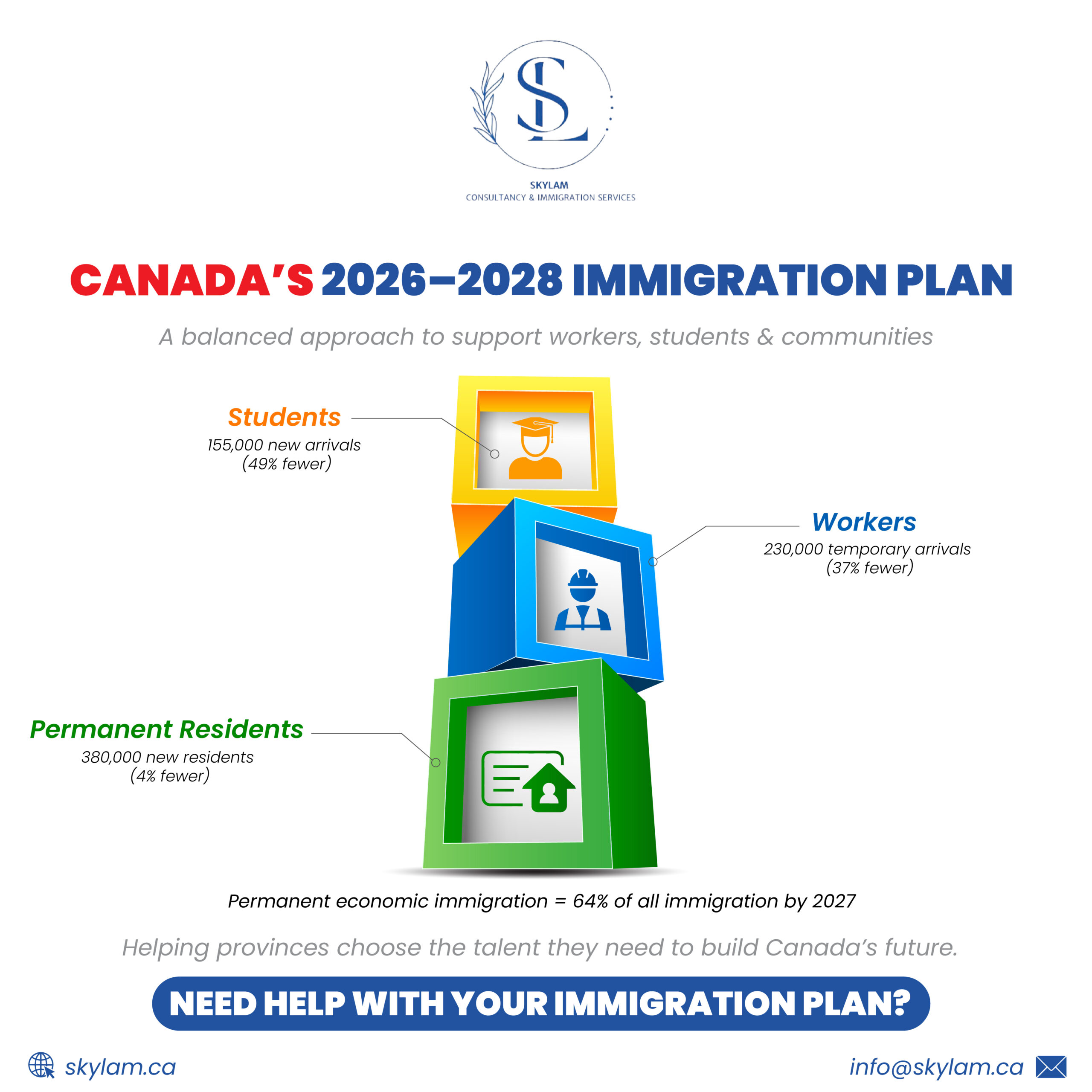
- Workers (both International Mobility Program + Temporary Foreign Worker Program) targeted at 230,000. Canada Immigration Services
- Students targeted at 155,000 new student arrivals. Canada+1
- One major goal: reduce the temporary resident population to less than 5% of Canada’s total population by end 2027. Canada+1
Permanent Residents
- The overall permanent resident target will be 380,000 each year from 2026 to 2028. Canada Immigration Services+1
- Of that, the economic class (skilled workers, trades, provincial nominees) will account for 64% of admissions in 2027/2028 – the highest proportion in decades. Canada+1
- More spaces for the Provincial Nominee Program (PNP) – increasing the capacity for provinces and territories to choose the immigrants they need. Canada
One-time initiatives
- A two-year one-time initiative to regularize approximately 115,000 protected persons in Canada, granting permanent residence. Canada
- Another two-year initiative to transition up to 33,000 skilled temporary workers (who are already contributing in Canada) into permanent residents in 2026-27. Trenity Immigration Consultants+1
What are the key strategic priorities?
The plan is more than just numbers. It signals deeper strategic priorities:
- Filling labour gaps and strengthening key sectors
Canada is targeting immigrants with the skills and experience to fill specific labour market needs in sectors such as emerging technologies, health care, skilled trades, and other in-demand areas. Canada+1 - Supporting provinces, territories & regional labour needs
By giving more spaces to PNPs and working closely with provinces/territories, Canada is shifting toward a regional labour-market responsive approach: “Providing more spaces for provinces and territories to choose the immigrants they need will help build the sectors that are critical in that area.” Canada This focus means communities outside large urban centres, rural and remote zones, and Francophone minority communities are also part of the picture. Canada - Quality over quantity — long-term settlement focus
The reduction in temporary resident numbers and stabilization of permanent admissions is a move toward settlement rather than transient stay: people coming to build, stay and contribute. The economic class emphasis (64%) reinforces this. - Humanitarian commitments & family reunification remain integral
Despite a focus on economic immigration, Canada remains committed to refugees, protected persons, and family class admissions: about 13% of all admissions will still go to refugees/protected persons. Canada Immigration Services+1
What this means for specific groups
For Skilled Workers and Professionals
If you are a skilled worker looking to immigrate, this plan has some promising signals:
- The increased share for economic class means more opportunity, especially through PNPs and federal high-skilled programs. Canada Immigration Services+1
- The one-time initiative to fast-track PR for 33,000 skilled temporary workers provides a pathway for people already in Canada contributing in key sectors. Trenity Immigration Consultants
- Employers in key sectors (technology, health, skilled trades, rural/remote communities) will be increasingly influential in shaping demand.
For International Students
The numbers suggest a major recalibration in the student stream:
- Student arrival target drops to 155,000 in 2026 (significantly fewer than previous years). Canada Immigration Services+1
- For education institutions and students, this implies heightened competition and greater emphasis on alignment with labour market outcomes (not just study for study’s sake).
- Graduates who can transition into meaningful employment and permanent residency will remain in strong position given the emphasis on permanent settlement.
For Provinces, Territories & Local Communities
- The PNP’s growing role signals that local decision-makers will have more say in selecting immigrants who match regional labour and economic needs.
- Rural and remote regions, as well as Francophone minority communities, are explicitly addressed in the plan, opening opportunities for settlement outside major urban centres. Canada
- The shift away from sheer volume means infrastructure, housing, healthcare and services in host communities have more time to adjust and integrate newcomers sustainably.
For Employers and Businesses
- This is a signal to employers: immigration will continue being an important tool for workforce development — but there will be greater alignment with labour market needs and regional priorities.
- Businesses will need strategic workforce planning, partnering with provincial nomination streams, aligning roles with key sector categories, and preparing for possible tighter competition for international talent. Lexology
Potential Benefits of the Plan
- Better alignment with labour market needs — targeting skilled talent for the sectors where gaps exist will increase economic productivity.
- Improved sustainability of immigration growth — by managing temporary resident inflows and working toward less than 5% of population being temporary residents, infrastructure and housing pressures may ease. Canada
- Greater regional development — more control for provinces/territories means immigrants can be directed where they are most needed rather than concentrated in a few urban areas.
- Strengthened pathways to permanent residency — one-time initiatives show a commitment to transition those already contributing in Canada into permanent status.
- Continued humanitarian leadership — the plan keeps refugee and protection commitments intact, reinforcing Canada’s reputation as a welcoming country.
Challenges and Considerations
While the plan has many strong points, there are a number of considerations to keep in mind.
- Short-term labour shortages — reducing temporary resident intake may create gaps in sectors reliant on seasonal or temporary labour (agriculture, food processing, service sectors). Canada Immigration Services
- Impact on post-secondary institutions — many universities and colleges rely heavily on international student tuition revenue. Fewer student arrivals may impact institutional budgets and local economies.
- Competition for key spots will increase — with fewer overall temporary resident spaces, the race for student and worker permits may become more intense, and eligibility criteria may tighten.
- Implementation and regional coordination — giving more power to provinces/territories and PNPs is positive, but it requires robust coordination, infrastructure and settlement supports to make it work in rural/remote areas.
- Uncertainty for candidates — transitions (such as the 33,000-worker PR initiative) will have eligibility criteria and selection rules; staying informed and prepared is critical.
- Balancing humanitarian and economic priorities — ensuring the refugee/protected person quota remains robust while emphasizing economic admissions will require careful management.
What Should Aspiring Immigrants and Stakeholders Do?
If you are a skilled worker, student, or employer thinking of Canada under the 2026-2028 plan, here are some action steps:
- Maintain awareness of program changes — Immigration rules, eligibility criteria, quotas and pathways are evolving. Keep up-to-date with IRCC announcements.
- Align your profile with labour-market needs — Focus on sectors prioritized in the plan (tech, health, trades, regional labour shortages). Highlight how you fill a gap.
- Consider regional and provincial opportunities — PNPs are increasingly important. Research provinces/territories with demand in your field.
- Think long-term settlement, not just entry — Canada is focusing on economic immigration with potential for permanent residency. Make sure your plan reflects staying and contributing, not just temporary stay.
- For students: aim for alignment with employment and PR pathways — Given lower student targets, choosing a program that leads to employment, and then to PR, is increasingly important.
- For employers: anticipate planning ahead — Workforce planning, partnering with regional nomination programs, and building roles aligned with the strategic priorities will give you an edge.
- Work with trusted advisors — Immigration pathways are complex; consulting with experienced advisors or agencies will help navigate changes and opportunities.
The Bigger Picture — Immigration’s Role in Canada’s Future
Immigration has long been a central pillar of Canada’s growth strategy—demographically, economically and socially. With aging populations, low fertility rates and regional labour gaps, attracting skilled and motivated newcomers remains essential.
However, this latest plan emphasizes a recalibrated approach. Rather than maximizing numbers indiscriminately, Canada is looking to:
- Match talent with need, ensuring newcomers fill meaningful roles and stay.
- Ensure communities are equipped to support newcomers via housing, services, infrastructure.
- Encourage regional distribution, spreading benefits beyond major metropolitan centres.
- Support global competitiveness, particularly in innovation, technology and high-growth sectors.
In essence, the 2026-28 plan puts sustainability, impact, and strategic alignment at the core of immigration policy — not just immigration for its own sake.
Conclusion
The 2026-2028 Immigration Levels Plan marks a noteworthy shift in Canadian immigration policy. It balances ambition with pragmatism, seeking to continue welcoming newcomers while ensuring that immigration aligns with labour market demands, regional realities and long-term settlement. For newcomers, students, skilled workers, employers and communities, it signals both opportunity and a new set of expectations: to contribute meaningfully, integrate well and align with Canada’s future priorities.
If you’re considering immigrating to Canada, this is a moment of change — one that rewards preparation, alignment with strategic fields, and a mindset of long-term settlement. With the right planning and guidance, the new immigration era offers a clearer, more stable path toward building a future in Canada.