


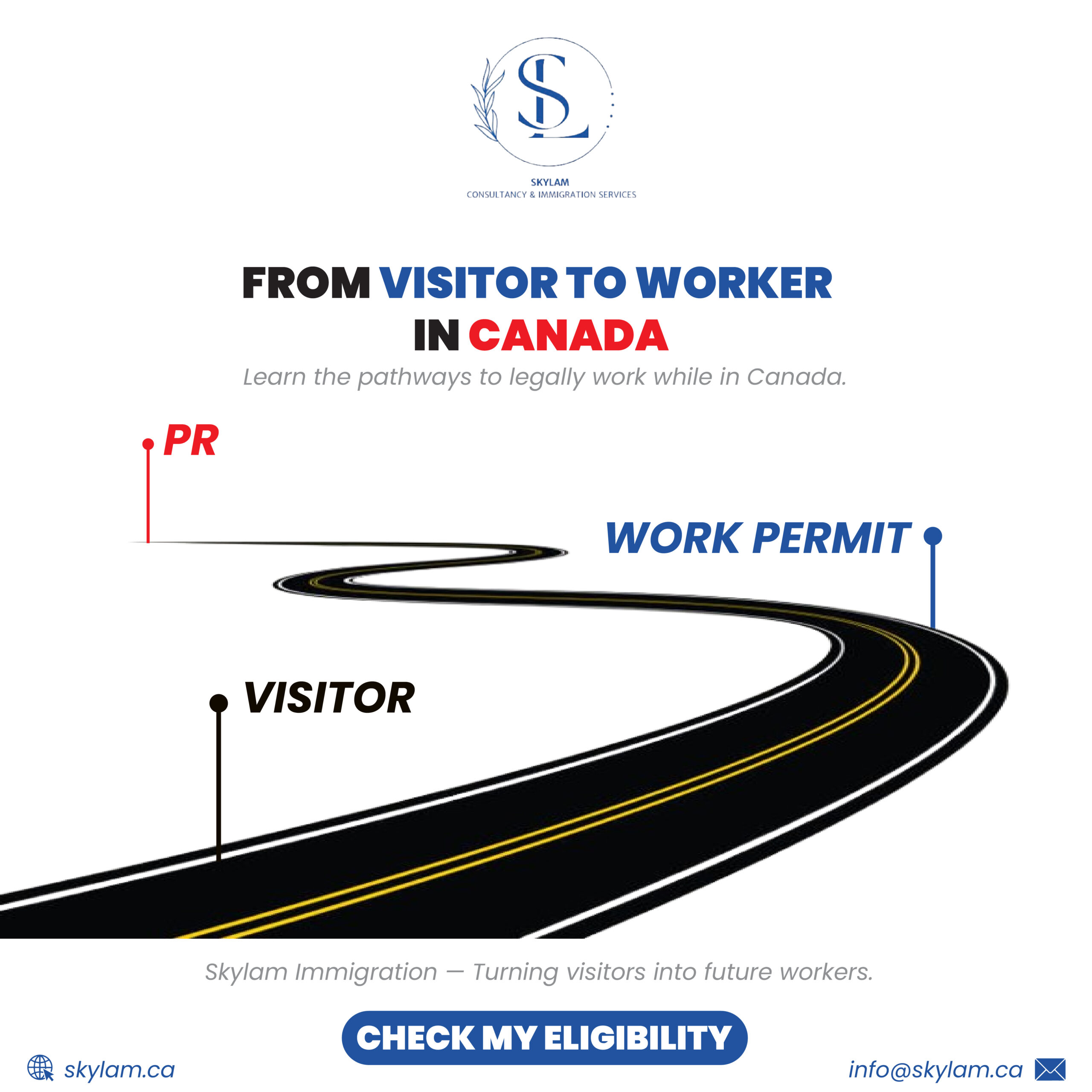
Many people visit Canada each year to explore the country, meet family, attend events, or simply enjoy the experience of traveling abroad. But what happens when a visitor falls in love with the opportunities Canada offers and wants to take the next step—transitioning into a legal worker?
In recent years, more visitors have considered switching to a Canadian work permit while staying inside the country. This process can be realistic, but it requires proper understanding, careful planning, and a clear knowledge of what is allowed under Canadian immigration rules.
This blog explains everything in simple terms:
✔ who can apply
✔ which programs allow it
✔ LMIA rules
✔ open vs. employer-specific permits
✔ student pathways
✔ documents you need
✔ procedural steps
✔ PR options after getting a work permit
This guide is written for everyday readers — newcomers, visitors, international families, and individuals planning their future in Canada. Let’s begin.
1. Why Visitors Want to Become Workers in Canada
Canada is known for its strong job market, stable economy, and welcoming immigration system. Many visitors notice:
- better career opportunities
- safer communities
- higher salaries in certain fields
- chances to grow professionally
- the possibility of future permanent residency
After experiencing the environment firsthand, they often ask:
“Can I stay and work legally without leaving Canada?”
The good news: in many situations, yes — but it must be done correctly. Visitors cannot simply start working immediately; they must first obtain a proper work permit.
Understanding the available options is the first step toward making an informed decision.
2. Can a Visitor Apply for a Work Permit Inside Canada?
Yes, but only under specific conditions.
Canada allows certain visitors to apply for a work permit from inside the country, but this depends on the program they qualify for. Some pathways allow direct in-Canada applications, while others require more steps.
Here are the main categories where a visitor can become a worker:
1️⃣ Employer-specific work permit with LMIA
2️⃣ LMIA-exempt work permit (international agreements, special exemptions)
3️⃣ Certain open work permit categories
4️⃣ Student-to-work options (study → PGWP → work)
5️⃣ Spousal-based open work permits (if eligible)
Each pathway has different eligibility rules, so understanding them clearly is essential.
3. Visitor-to-Work Permit Pathways Explained
Transitioning from visitor to worker requires choosing the right pathway. Below is a simple explanation of the most common options.
A. Employer-Specific Work Permit (Job Offer Required)
This is the most common route.
A visitor finds a Canadian employer willing to hire them. However, the employer must meet certain requirements.
What Is an Employer-Specific Work Permit?
It is a work permit tied to one employer. It includes:
- your employer’s name
- job location
- job title
- duration of employment
You can only work for the employer listed on the permit.
How to Qualify:
✔ You must have a valid job offer
✔ The employer must complete the required documents
✔ You must submit a full work permit application
✔ You must maintain legal status while applying
This is ideal if:
- you have skills that Canadian employers need
- an employer is willing to support your application
- you understand that LMIA may be required
B. LMIA-Based Pathway
The Labour Market Impact Assessment (LMIA) is one of the most common and important parts of the process.
What Is LMIA?
An LMIA is a document from Employment and Social Development Canada (ESDC). It verifies that:
- a Canadian worker could not be found
- hiring a foreign worker is necessary
- the employer followed proper recruitment steps
When Is LMIA Needed?
Most employer-specific work permits require LMIA unless the job falls under an exemption.
Examples of fields that commonly use LMIA:
- construction
- trucking
- caregiver jobs
- manufacturing
- agriculture
- some tech roles
When LMIA Is Not Required?
LMIA exemptions exist for:
- international agreements
- specific research/academic jobs
- positions that provide significant benefit to Canada
- certain post-graduate programs
- religious or cultural roles
Proper guidance helps determine whether LMIA applies to your situation.
C. Open Work Permit Options
Unlike employer-specific permits, an open work permit allows you to work for almost any employer in Canada.
Visitors may qualify for open work permits in limited circumstances, such as:
- spousal open work permit (if spouse is a worker/student)
- certain humanitarian categories
- bridging work permits (specific PR applicants)
These do not require LMIA or a job offer.
D. Student and Graduate Pathways
Visitors sometimes choose to study in Canada first and then transition to a work permit.
1. Study Permit → Work Permit (PGWP Route)
After completing an eligible program at a Designated Learning Institution (DLI), you may qualify for a Post-Graduation Work Permit (PGWP).
A PGWP is an open work permit.
Benefits:
- work for any employer
- gain Canadian work experience
- create a strong PR profile
2. Student Work Opportunities
During your study period, you may be eligible to work part-time or full-time under certain rules.
This route is ideal if:
- you want to build a long-term future in Canada
- you prefer academic growth before entering the workforce
E. Spousal-Based Options
If your spouse or partner is in Canada under an eligible work or study program, you may qualify for a spousal open work permit, even if you initially entered as a visitor.
This can allow you to work:
- full-time
- for any employer
- without needing LMIA
4. Eligibility Requirements for a Successful Transition
To legally become a worker from visitor status, you must meet certain conditions.
You typically need:
✔ A valid visitor status in Canada
✔ No violations of immigration or work rules
✔ A suitable work permit category
✔ A job offer or LMIA (if applicable)
✔ A complete application with correct documents
✔ Ability to maintain status until approval
✔ Proof of funds if required
✔ A clean travel and immigration history (helps your application)
Submitting accurate information is extremely important to avoid delays or refusal.
5. Documents You Usually Need
The exact documents depend on the program, but commonly include:
Personal Documents
- Passport
- Digital photo
- Visitor record or entry stamp
- Proof of legal stay in Canada
Employer Documents (Employer-Specific Permit)
- Job offer letter
- Employment contract
- Employer compliance information
- LMIA approval (if required)
Financial & Support Documents
- Proof of funds (if needed)
- Any supporting papers for exemptions
Providing organized, structured documents helps speed up the process and reduces issues.
6. How to Apply for a Work Permit From Inside Canada
Here is the general step-by-step flow of how visitors usually transition to workers:
Step 1: Identify the correct pathway
Check whether you qualify for:
- LMIA route
- LMIA-exempt program
- open work permit category
- student-to-work options
Choosing the wrong pathway leads to delays or refusals.
Step 2: Maintain legal visitor status
You must stay legal in Canada at all times.
This means:
- extending your visitor status before expiry
- ensuring no gap in status
- keeping visitor conditions
Step 3: Secure a job offer (if required)
The employer must provide:
- job offer
- position details
- duties and salary
- proof of recruitment (for LMIA)
Step 4: Employer completes their requirements
For LMIA:
- employer submits LMIA application
- employer provides supporting recruitment details
For LMIA-exempt:
- employer submits the job offer through the Employer Portal
Step 5: Submit your work permit application
You provide:
- forms
- identity documents
- employer documents
- biometrics (if needed)
- proofs related to your eligibility
Applications are done online through IRCC.
Step 6: Wait for a decision
Processing times vary based on the program. Maintaining valid status during this period is crucial.
Step 7: Receive your work permit
If approved, your work permit:
- states your employer (for employer-specific)
- states your conditions
- allows you to begin working legally
7. Common Mistakes to Avoid
Many applicants face delays because of avoidable errors. The following issues commonly cause problems:
1. Applying under the wrong category
Not all visitors qualify for in-Canada applications.
2. Submitting incomplete documents
Missing employer information is a common reason for refusal.
3. Working without authorization
Working without a permit is a serious violation.
4. Misunderstanding LMIA rules
Some jobs require LMIA; assuming exemption can lead to refusal.
5. Not extending visitor status on time
If visitor status expires, the transition becomes risky.
Seeking professional assistance helps avoid these mistakes.
8. How a Visitor-to-Worker Transition Can Lead to PR
Getting a work permit opens new opportunities. Many Canadian immigration pathways reward applicants who already have Canadian work experience.
Here are the most common PR routes:
1. Express Entry (CEC & FSW)
Canadian Experience Class (CEC) especially benefits work permit holders.
2. Provincial Nominee Programs (PNP)
Every province has its own streams for workers.
3. Employer-Driven PR Streams
Some provinces allow PR applications directly through employers.
4. Student-to-PR Pathway
Study → PGWP → Canadian work experience → PR
5. Job Offer-Based PR
Some PR programs give extra points for valid job offers.
Your future PR opportunity strongly depends on the work permit category you receive.
9. Why Professional Guidance Matters
Transitioning from visitor to worker is possible — but the system is complex.
Professional assistance provides benefits such as:
- correct program selection
- document preparation
- employer guidance
- avoiding mistakes
- faster, organized applications
- understanding immigration rules
- improving approval chances
A small error can delay an application for months. Having expert support helps ensure every step is accurate and on time.
10. Final Thoughts
Becoming a worker in Canada while starting as a visitor is a meaningful and achievable goal. With the right pathway, the right employer, and accurate documentation, applicants can take a major step toward building their future in Canada.
Whether you choose an employer-specific permit, open work permit route, LMIA pathway, or study-to-work option, transitioning legally protects your future immigration opportunities — including permanent residency.
If you are unsure which option is best, asking for professional help can guide you toward the most successful outcome.
Need help with your visitor-to-worker application?
Skylam Immigration Services can review your documents, assess your eligibility, help you understand LMIA rules, and guide you through each step of the transition.
📌 Book a consultation today to start your journey.