


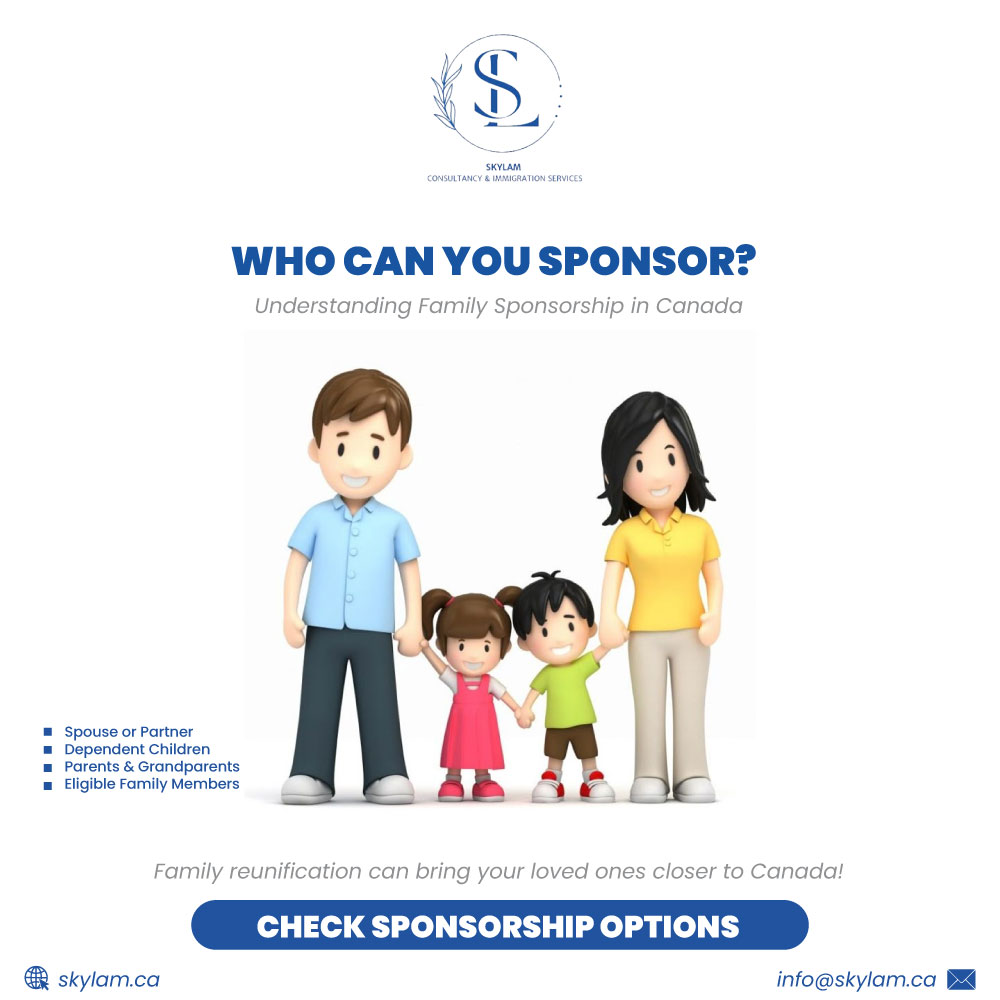
Canada’s family sponsorship programs allow eligible Canadian citizens and permanent residents to sponsor certain family members for permanent residence. For many families, sponsorship can provide an important opportunity to reunite with loved ones in Canada.
However, not every family member can automatically be sponsored. Canadian immigration law sets specific rules about who can be sponsored, who can act as a sponsor, financial responsibilities, relationships, and other eligibility requirements.
Understanding these rules before beginning an application can help families prepare the right documents and choose the appropriate pathway.
This guide explains the major family sponsorship categories in Canada, who may generally qualify, what sponsors need to know, common mistakes to avoid, and how to prepare for the process in 2026.
Important: Family sponsorship requirements can change, and eligibility depends on individual circumstances. This article provides general information and should not be treated as legal advice or a guarantee of approval. Always verify the current requirements with Immigration, Refugees and Citizenship Canada (IRCC).
What Is Family Sponsorship in Canada?
Family sponsorship is an immigration pathway that allows eligible Canadian citizens and permanent residents to sponsor certain family members to become permanent residents of Canada.
The program is designed around family reunification.
Depending on the specific category, an eligible sponsor may be able to sponsor:
- A spouse
- Common-law partner
- Conjugal partner
- Dependent children
- Parents
- Grandparents
- Certain other eligible relatives in limited circumstances
The eligibility rules are different for each category.
For example, sponsoring a spouse is not the same process as sponsoring parents or grandparents.
Who Can Be a Sponsor?
Generally, a person may be eligible to sponsor a family member if they meet the applicable requirements.
A sponsor is generally required to be:
- A Canadian citizen or permanent resident
- At least 18 years old
- Living in Canada, subject to specific rules for Canadian citizens living abroad
- Able to meet the financial and other requirements that apply to the sponsorship category
There are additional rules and exceptions depending on the relationship being sponsored.
For example, Canadian citizens living outside Canada may be able to sponsor certain family members if they demonstrate that they intend to live in Canada when the sponsored family member becomes a permanent resident.
Permanent residents generally need to be living in Canada to sponsor.
Who Can You Sponsor?
The main family sponsorship categories include:
1. Spouse
A legally married spouse may generally be eligible for sponsorship if the relationship meets the applicable requirements.
2. Common-Law Partner
A common-law partner may qualify when the couple meets Canada’s definition of a common-law relationship.
3. Conjugal Partner
Conjugal partner sponsorship exists for specific circumstances and has strict requirements.
4. Dependent Children
Eligible dependent children may generally be sponsored by their parent.
5. Parents and Grandparents
Canadian citizens and permanent residents may potentially sponsor parents and grandparents through the applicable program, subject to program availability and requirements.
6. Other Relatives
In very specific situations, a Canadian citizen or permanent resident may be able to sponsor another relative.
This is often called the “other relative” or “last remaining relative” provision and has very specific eligibility conditions.
Sponsoring Your Spouse
One of the most common family sponsorship pathways is sponsorship of a spouse.
A spouse is generally someone to whom you are legally married.
The marriage must be legally valid according to the applicable Canadian requirements and the laws where the marriage took place.
The application generally needs to demonstrate that:
- The marriage is genuine
- The relationship was not entered into primarily for immigration purposes
- The applicant and sponsor meet the applicable requirements
- Required documents are provided
Relationship evidence can be important.
Examples can include:
- Marriage certificate
- Photos
- Communication records
- Travel records
- Joint financial documents
- Evidence of shared activities
- Other evidence demonstrating the genuine nature of the relationship
The exact evidence needed depends on the circumstances.
Sponsoring a Common-Law Partner
Canada also recognizes common-law relationships for immigration purposes.
A common-law partner generally needs to meet the applicable definition of a common-law relationship.
IRCC generally considers a couple common-law when they have lived together in a conjugal relationship for at least 12 consecutive months.
Evidence may include:
- Joint lease
- Shared utility bills
- Joint bank accounts
- Government correspondence
- Insurance documents
- Mail showing the same address
- Photographs
- Travel records
- Other evidence of the relationship
The goal is to demonstrate that the relationship meets the legal definition rather than simply showing that two people are dating.
What About a Conjugal Partner?
A conjugal partner is different from a spouse or common-law partner.
This category is intended for certain couples who have had a committed and mutually interdependent relationship for at least one year but cannot live together or marry because of exceptional circumstances.
The requirements are strict.
Simply being in a long-distance relationship does not automatically make someone eligible as a conjugal partner.
Applicants need to demonstrate why marriage or cohabitation has not been possible.
Sponsoring Dependent Children
Parents may be able to sponsor eligible dependent children for permanent residence.
Canada’s definition of a dependent child generally focuses on age and dependency.
Under current rules, a child can generally qualify as a dependent if they are:
- Under 22 years old and do not have a spouse or common-law partner; or
- 22 or older and have depended substantially on their parents for financial support since before reaching the applicable age because of a physical or mental condition.
The exact rules and exceptions should be checked before applying.
Can You Sponsor an Adopted Child?
Canada’s family sponsorship system can also include adopted children in appropriate circumstances.
However, adoption cases can involve additional immigration requirements.
The process may require consideration of:
- Adoption laws
- The child’s country of origin
- Provincial or territorial requirements
- Immigration requirements
- Evidence concerning the adoption
An adoption should therefore not be treated exactly like a biological child sponsorship application.
Families should review the requirements for international adoption and immigration before proceeding.
Sponsoring Parents and Grandparents
Many Canadian families are interested in bringing their parents or grandparents to Canada permanently.
The Parents and Grandparents Program (PGP) allows eligible Canadian citizens and permanent residents to sponsor their parents and grandparents when the program is open and the applicant is invited to apply.
However, the PGP is different from spouse sponsorship.
The program can have:
- Intake limits
- Invitations
- Income requirements
- Sponsorship undertakings
- Additional eligibility conditions
Because the program can change from year to year, families should check the latest IRCC announcements before making plans.
What Is the Super Visa?
The Super Visa is another important option for parents and grandparents.
However, it is not permanent residence.
A Super Visa can allow eligible parents and grandparents of Canadian citizens or permanent residents to visit Canada for extended periods, subject to the applicable rules.
This can be an alternative for families who want their parents or grandparents to spend substantial time in Canada but do not currently have access to a permanent residence sponsorship intake.
The Super Visa and Parents and Grandparents Program should therefore not be confused.
PGP
- Permanent residence pathway
- Subject to program availability and invitation requirements
- Sponsorship undertaking applies
Super Visa
- Temporary resident visa
- Designed for longer visits
- Does not provide permanent residence
Sponsoring Other Relatives
Canada has a very limited provision for sponsoring certain other relatives.
In specific circumstances, a Canadian citizen or permanent resident may be able to sponsor one relative of any age if they do not have another living relative they could sponsor under the family class and do not have certain close relatives who are Canadian citizens or permanent residents.
This is sometimes referred to as the “last remaining relative” provision.
The rules are strict.
Applicants should carefully verify whether their family circumstances meet the requirements.
Financial Responsibilities of a Sponsor
Family sponsorship is not simply about completing immigration forms.
Sponsors generally take on a significant financial responsibility.
This is called a sponsorship undertaking.
The sponsor promises to provide financial support to the sponsored family member for a specified period and ensure that the sponsored person does not need certain forms of social assistance.
The length of the undertaking depends on:
- The relationship
- The age of the sponsored person
- The province
- The applicable program
For example, the undertaking period for a spouse or partner is generally different from the undertaking period for parents or grandparents.
Why the Sponsorship Undertaking Matters
The undertaking is legally significant.
A sponsor should understand their responsibilities before submitting an application.
Even if the relationship changes after the person becomes a permanent resident, the sponsor’s financial undertaking may continue.
This is an important reason why sponsorship should not be treated as a simple form-filling exercise.
Who Cannot Sponsor?
Not everyone who is a Canadian citizen or permanent resident will automatically qualify as a sponsor.
A person may be ineligible because of circumstances such as:
- Certain financial assistance situations
- Certain criminal convictions
- Failure to meet previous sponsorship obligations
- Outstanding immigration-related debts
- Bankruptcy circumstances
- Certain other legal or financial situations
The specific rules depend on the sponsorship category.
Therefore, potential sponsors should check their eligibility before starting the application.
What If You Receive Social Assistance?
Receiving certain types of social assistance can affect sponsorship eligibility.
However, there are important exceptions.
For example, disability-related benefits are treated differently under the sponsorship rules than certain other forms of social assistance.
The exact circumstances matter.
If you currently receive government benefits, do not assume automatically that you are either eligible or ineligible.
Check the specific IRCC requirements applicable to your case.
Sponsorship and Income Requirements
Income requirements vary depending on the sponsorship category.
For some family sponsorship categories, the sponsor must demonstrate that they have sufficient financial resources.
For example, parents and grandparents sponsorship generally involves income requirements and specific documentation.
In contrast, sponsorship of a spouse or dependent child generally has different financial rules, although the sponsor still has a financial undertaking.
This is why applicants should not use one sponsorship category’s income rules for another category.
What Documents Are Usually Required?
The document requirements depend on who is being sponsored.
However, documents may include:
Sponsor Documents
- Proof of Canadian citizenship or permanent residence
- Identity documents
- Address information
- Financial documents where required
- Previous sponsorship information
- Other supporting documents
Sponsored Person’s Documents
- Passport
- Birth certificate
- Marriage certificate, if applicable
- Police certificates, where required
- Medical examination, where required
- Identity documents
- Family information
Relationship Evidence
Depending on the category:
- Marriage certificate
- Photos
- Communication records
- Joint financial documents
- Lease agreements
- Travel evidence
- Insurance documents
- Other relationship evidence
Applicants should follow the specific document checklist provided by IRCC.
Relationship Evidence: What Makes It Useful?
For spouse and partner sponsorship applications, relationship evidence can help demonstrate that the relationship is genuine.
There is no universal number of photographs or messages that guarantees approval.
Quality and relevance matter more than simply submitting a huge amount of paperwork.
For example, useful evidence may demonstrate:
- How the relationship developed
- How the couple communicates
- Time spent together
- Shared responsibilities
- Family involvement
- Financial or household connections
- Significant events
- Future plans
The evidence should be truthful and representative of the relationship.
What Happens After You Submit a Sponsorship Application?
Once an application is submitted, IRCC may review:
- Whether the application is complete
- Sponsor eligibility
- Relationship eligibility
- Applicant admissibility
- Required background information
- Medical requirements
- Security requirements
- Criminality requirements
- Other applicable factors
Depending on the case, IRCC may request additional documents.
Applicants should monitor their application and respond within the specified deadline when additional information is requested.
Medical Examinations
Family sponsorship applicants may be required to complete an immigration medical examination.
The medical examination is performed by an approved physician.
Not every applicant will necessarily follow exactly the same process.
The instructions provided by IRCC should be followed carefully.
Police Certificates
Police certificates may be required depending on the applicant’s age, travel history, country of residence, and other circumstances.
The purpose is to assess admissibility.
Applicants should obtain the correct certificates according to the instructions for their application.
Using the wrong document or an outdated certificate can create delays.
Common Family Sponsorship Mistakes
Mistake 1: Assuming Every Family Member Can Be Sponsored
Canadian family sponsorship is based on specific legal definitions.
Being related to a Canadian citizen does not automatically mean you qualify.
Mistake 2: Confusing Spouse and Common-Law Categories
Marriage and common-law relationships have different legal definitions.
Applicants should use the category that accurately describes their circumstances.
Mistake 3: Treating the Super Visa as PR
A Super Visa is a temporary resident visa.
It is not permanent residence.
Mistake 4: Ignoring the Sponsorship Undertaking
Sponsors should understand their financial obligations before signing the undertaking.
Mistake 5: Providing Weak Relationship Evidence
For spouse and partner applications, applicants should provide relevant evidence that genuinely reflects the relationship.
Mistake 6: Providing False Information
Never create fake relationship evidence, altered documents, or false statements.
Misrepresentation can have serious immigration consequences.
Mistake 7: Using Old PGP Information
The Parents and Grandparents Program can have different intake procedures and requirements.
Always check the latest official announcement.
Mistake 8: Forgetting Family Members
Applicants must provide complete and accurate family information.
Leaving out required family members can cause serious problems later.
Can a Canadian Citizen Living Outside Canada Sponsor a Family Member?
In certain circumstances, yes.
A Canadian citizen living outside Canada may be able to sponsor a spouse, partner, dependent child, parent, or grandparent, depending on the program and requirements.
However, the sponsor generally needs to demonstrate an intention to live in Canada when the sponsored family member becomes a permanent resident.
Permanent residents generally must be living in Canada to sponsor.
This distinction is important for Canadian citizens who currently live abroad.
Can a Permanent Resident Sponsor Family From Outside Canada?
A permanent resident generally needs to be living in Canada to act as a sponsor.
Therefore, someone who has permanent resident status but is living permanently outside Canada may face eligibility issues.
The sponsor’s actual circumstances should be assessed carefully.
Family Sponsorship and Processing Times
Processing times can vary.
They can depend on:
- Sponsorship category
- Application completeness
- Number of applications
- Background checks
- Medical processing
- Security checks
- Requests for additional information
- Applicant’s circumstances
- Changes in program capacity
Applicants should use the official IRCC processing-time tool for the most current estimate rather than relying on an old article or social media post.
A processing-time estimate is not a guarantee.
Can a Sponsored Person Work in Canada While Waiting?
This depends on the person’s immigration status and whether they qualify for a separate work permit.
Submitting a family sponsorship application does not automatically give someone permission to work in Canada.
If the applicant is already in Canada, they may potentially qualify for an open work permit under applicable rules.
The specific circumstances should be checked before beginning employment.
Family Sponsorship vs Other Immigration Pathways
Family sponsorship is only one way to immigrate to Canada.
Depending on your situation, other pathways may include:
- Express Entry
- Provincial Nominee Programs
- Study permits
- Work permits
- Regional immigration programs
- Business immigration
- Other economic programs
For example, a person with a Canadian spouse may explore family sponsorship, while a skilled worker without a qualifying family sponsor may explore an economic immigration pathway.
Choosing the correct pathway depends on the applicant’s circumstances.
A Simple Family Sponsorship Preparation Checklist
Before beginning your application, consider the following.
Sponsor
- Confirm Canadian citizenship or PR status
- Confirm age requirement
- Check residency requirements
- Review financial obligations
- Check previous sponsorship history
- Confirm there are no applicable sponsorship bars
Sponsored Family Member
- Confirm relationship category
- Check passport validity
- Collect birth certificate
- Collect marriage documents where applicable
- Review police certificate requirements
- Review medical examination requirements
Application
- Complete forms accurately
- Gather relationship evidence
- Gather financial evidence where required
- Check document translations
- Review signatures
- Check application completeness
- Keep copies of submitted documents
How to Prepare a Strong Family Sponsorship Application
There is no guaranteed formula for approval, but good preparation can reduce avoidable problems.
1. Choose the Correct Category
Make sure you understand whether the person is being sponsored as a:
- Spouse
- Common-law partner
- Conjugal partner
- Dependent child
- Parent or grandparent
- Other eligible relative
2. Be Consistent
Names, dates, addresses, relationship history, and other information should be consistent throughout the application.
3. Provide Genuine Evidence
Submit documents that accurately demonstrate the relationship and circumstances.
4. Explain Unusual Circumstances
If there are significant gaps, previous refusals, unusual relationship circumstances, or other important facts, provide a truthful explanation where appropriate.
5. Follow the Current Checklist
Use the current IRCC checklist rather than an old checklist downloaded from another website.
How Skylam Immigration Services Can Help
Family sponsorship can involve significant documentation and legal responsibilities.
Skylam Immigration Services offers personalized support to help clients understand the Canadian immigration process and organize their applications.
Support may include:
- Understanding sponsorship categories
- Reviewing general eligibility
- Identifying required documents
- Organizing relationship evidence
- Reviewing application information
- Explaining sponsorship responsibilities
- Helping clients understand the application process
Every family is different.
The appropriate sponsorship pathway depends on the specific relationship, the sponsor’s circumstances, the sponsored person’s circumstances, and the rules in effect when the application is submitted.
Skylam does not guarantee approval. The final decision is made by Canadian immigration authorities.
Frequently Asked Questions
Can I sponsor my brother or sister to Canada?
Usually, siblings cannot simply be sponsored because they are siblings. There is a very limited “other relative” provision that may apply in specific circumstances.
Can I sponsor my parents?
Eligible Canadian citizens and permanent residents may potentially sponsor their parents or grandparents through the applicable program when intake requirements are met.
Can I sponsor my spouse?
A Canadian citizen or permanent resident may generally be able to sponsor an eligible spouse if the applicable requirements are satisfied.
Can I sponsor my common-law partner?
Yes, if the relationship meets Canada’s definition of a common-law partnership and other eligibility requirements are satisfied.
What is the difference between spouse and common-law partner?
A spouse is legally married to the sponsor. A common-law partner must meet the applicable cohabitation and relationship requirements.
Is family sponsorship permanent residence?
Yes. Family sponsorship is generally a pathway through which eligible family members can become permanent residents.
Is the Super Visa permanent residence?
No. The Super Visa is a temporary resident visa for eligible parents and grandparents.
Does sponsorship guarantee PR?
No. The sponsored person must still meet the applicable admissibility and immigration requirements.
Does the sponsor have financial responsibilities?
Yes. Sponsors generally sign an undertaking agreeing to provide financial support for a specified period.
Can sponsorship applications be refused?
Yes. Applications can be refused if eligibility or admissibility requirements are not met or if there are other grounds for refusal.
Final Thoughts
Canada’s family sponsorship programs provide an important pathway for eligible families who want to reunite in Canada.
However, family sponsorship is not one single program with one set of rules.
The requirements depend on the relationship between the sponsor and the person being sponsored.
A spouse sponsorship application is different from a common-law application. Sponsoring a dependent child is different from sponsoring parents or grandparents. Sponsoring an “other relative” is subject to particularly strict conditions.
Before applying, make sure you understand:
- Who qualifies as a sponsor
- Which family members can be sponsored
- Which relationship category applies
- Financial responsibilities
- Required documents
- Medical and security requirements
- Sponsorship undertakings
- Current program availability
- Current IRCC procedures
If you are planning to sponsor a family member in 2026, preparation should begin with eligibility, not simply paperwork.
A carefully organized application with accurate information and genuine supporting evidence can help you approach the process more confidently.
At Skylam Immigration Services, personalized guidance can help families understand their options and prepare for the Canadian immigration process.
Family reunification starts with understanding the right pathway. 🇨🇦❤️