


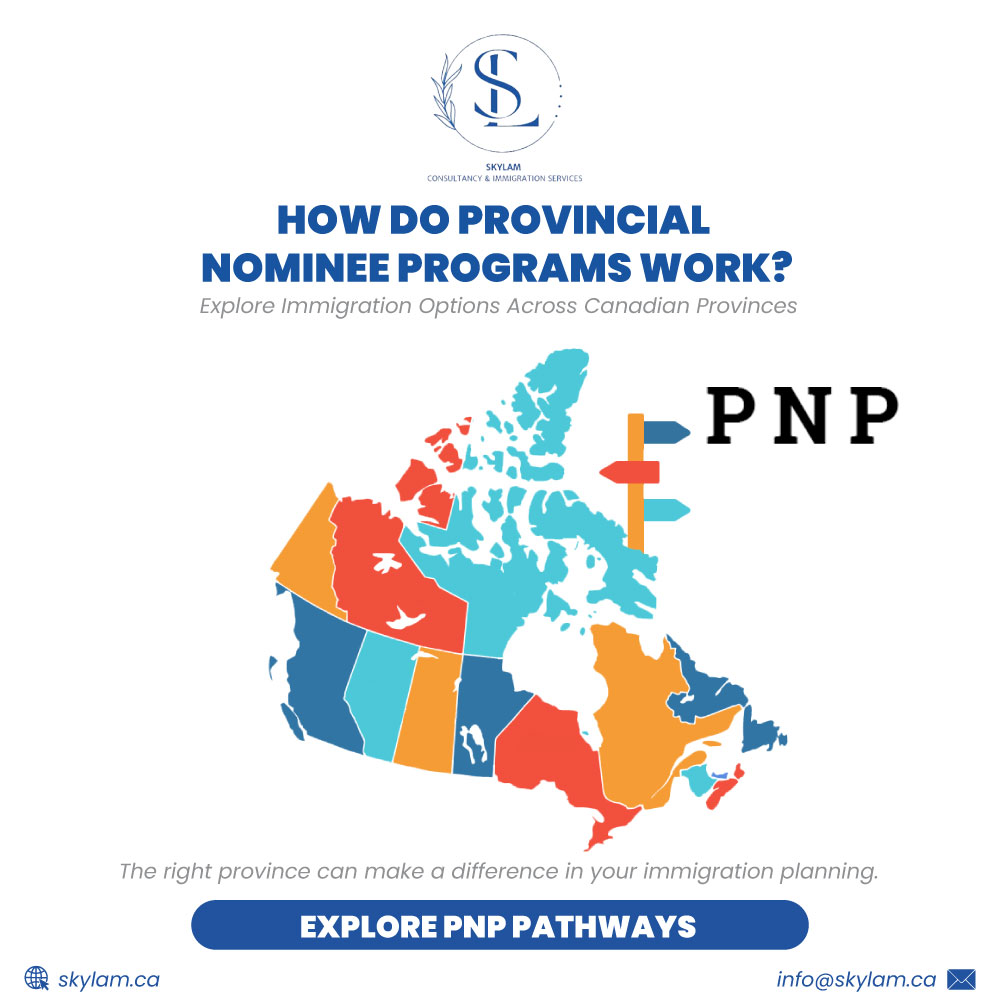
Provincial Nominee Programs: How PNPs Work in Canada in 2026
Canada is one of the world’s most popular destinations for skilled workers, entrepreneurs, international graduates and other newcomers. While many people are familiar with federal immigration programs such as Express Entry, another major part of Canada’s economic immigration system is the Provincial Nominee Program (PNP).
Provincial Nominee Programs allow participating provinces and territories to nominate individuals who have the skills, education, work experience or other characteristics needed in their local economies.
The basic idea is straightforward: instead of having all economic immigrants selected only through federal programs, provinces and territories can select candidates who they believe are suited to their regional labour-market and economic needs.
For applicants interested in Canadian permanent residence, a provincial nomination can therefore be an important immigration option.
However, PNPs are not one single program with identical requirements across Canada. Each participating province or territory has its own immigration streams, eligibility requirements, application procedures and nomination allocations.
As of 2026, the federal government identifies PNP programs in provinces and territories including Alberta, British Columbia, Manitoba, New Brunswick, Newfoundland and Labrador, Nova Scotia, Ontario, Prince Edward Island, Saskatchewan, the Northwest Territories and Yukon. Quebec and Nunavut do not have Provincial Nominee Programs. Quebec has its own immigration system, while Nunavut does not operate a PNP.
This guide explains what PNPs are, how they work, who may qualify, how Express Entry and non-Express Entry PNPs differ, what applicants should consider before choosing a province, and how a provincial nomination can contribute to a permanent residence application.
What Is the Provincial Nominee Program?
The Provincial Nominee Program, commonly called the PNP, allows participating Canadian provinces and territories to nominate individuals for permanent residence.
According to Immigration, Refugees and Citizenship Canada (IRCC), PNPs are designed to allow provinces and territories to nominate people who have skills, education and work experience that can contribute to their economies and who want to live in that province or territory.
In simple terms:
Province or territory identifies candidates → candidate receives nomination → candidate applies for Canadian permanent residence through the applicable federal process.
The province or territory determines whether an applicant meets its nomination requirements.
IRCC then handles the federal permanent residence application and determines whether the applicant meets federal requirements, including admissibility.
This means a provincial nomination is an important part of the process, but it is not the same thing as permanent residence approval.
Why Were Provincial Nominee Programs Created?
Canada is a large country with significant differences between provinces and territories.
Labour-market needs can vary considerably from one region to another.
For example, one province may have a stronger demand for workers in a particular occupation, while another may focus on attracting entrepreneurs, international graduates or workers willing to settle in smaller communities.
PNPs allow participating provinces and territories to select immigrants based partly on their regional needs.
This makes Canada’s economic immigration system more responsive to local labour markets.
IRCC explains that the PNP helps provinces and territories nominate people who can contribute to their economies and who intend to live in the nominating province or territory.
Which Provinces and Territories Have PNPs?
As of 2026, IRCC lists PNP programs for the following provinces and territories:
| Province/Territory | PNP |
|---|---|
| Alberta | Yes |
| British Columbia | Yes |
| Manitoba | Yes |
| New Brunswick | Yes |
| Newfoundland and Labrador | Yes |
| Nova Scotia | Yes |
| Northwest Territories | Yes |
| Ontario | Yes |
| Prince Edward Island | Yes |
| Saskatchewan | Yes |
| Yukon | Yes |
| Quebec | No |
| Nunavut | No |
Quebec does not participate in the PNP system because it has its own immigration programs and selection process.
Nunavut also does not operate a Provincial Nominee Program.
The programs and streams within participating provinces can change over time, so applicants should always check the current provincial requirements.
How Does a PNP Work?
The exact process depends on the province and stream, but the general concept can be divided into several stages.
Step 1: Choose a Province or Territory
An applicant first needs to determine which province or territory may be appropriate based on their circumstances.
This is not simply a matter of choosing the province with the lowest requirements.
Applicants should consider:
- Occupation
- Work experience
- Education
- Language ability
- Job offer
- Canadian work experience
- Previous Canadian study
- Connection to the province
- Settlement plans
- Family connections
- Provincial labour-market needs
Most importantly, applicants need to genuinely intend to live in the province or territory that nominates them.
Step 2: Identify an Appropriate PNP Stream
Each participating province or territory can have multiple immigration streams.
Depending on the province, streams may target groups such as:
- Skilled workers
- International graduates
- Workers with Canadian experience
- Workers with job offers
- Entrepreneurs
- Business applicants
- Certain occupations
- Candidates with French-language skills
- Candidates connected to specific regions
- Other targeted groups
Not every stream is available to every applicant.
A person should compare their profile against the specific stream requirements rather than simply applying to a province because they have heard that it is “easier.”
Step 3: Apply for Provincial Nomination
Once an applicant identifies an appropriate stream, they must follow the province’s application process.
The province or territory reviews the application according to its own requirements.
The assessment can consider factors such as:
- Education
- Work experience
- Language proficiency
- Employment
- Job offer
- Age
- Adaptability
- Connections to the province
- Settlement plans
- Other stream-specific factors
Some programs operate through an expression-of-interest system, while others may have different application procedures.
Applicants should carefully review the current process for the specific province and stream.
Step 4: Receive a Provincial Nomination
If the province approves the application, the applicant receives a provincial nomination.
What happens next depends on whether the nomination is connected to Express Entry.
There are two major routes:
- Express Entry PNP
- Non-Express Entry PNP
IRCC confirms that applicants can apply through either route depending on whether they qualify for the provincial stream and the relevant federal Express Entry program.
What Is an Express Entry PNP?
An Express Entry PNP is a provincial nomination connected to Canada’s federal Express Entry system.
To use this route, the applicant must generally qualify for both:
- The province or territory’s relevant PNP stream
- At least one federal Express Entry program
Express Entry manages several federal economic immigration programs, including:
- Canadian Experience Class
- Federal Skilled Worker Program
- Federal Skilled Trades Program
If a province nominates an eligible Express Entry candidate, the nomination can provide 600 additional Comprehensive Ranking System (CRS) points.
IRCC states that a provincial nomination gives an Express Entry candidate 600 additional points.
These additional points can significantly increase a candidate’s ranking in the Express Entry pool.
How Does the 600-Point PNP Bonus Work?
The CRS is the ranking system used for candidates in the Express Entry pool.
Candidates receive points based on factors such as:
- Age
- Education
- Language ability
- Canadian work experience
- Foreign work experience
- Spouse or partner factors
- Transferability factors
- Certain additional factors
A provincial nomination provides 600 additional CRS points.
For example, imagine an Express Entry candidate has:
CRS score before nomination: 430
After receiving a provincial nomination:
430 + 600 = 1,030 CRS points
The nomination therefore provides a major increase in the candidate’s ranking.
However, receiving a nomination does not itself mean the permanent residence application has already been approved.
The candidate still needs to receive an invitation to apply when applicable and submit the required permanent residence application.
IRCC confirms that 600 is the maximum additional CRS points awarded for a provincial nomination.
What Happens After an Express Entry Nomination?
Once a candidate receives a provincial nomination through the Express Entry system, they need to follow the instructions provided through their IRCC account.
IRCC states that a candidate has 30 calendar days to accept or reject the nomination after receiving the nomination message.
If the candidate accepts the nomination, the additional CRS points are added to their profile.
The candidate may then receive an invitation to apply for permanent residence in an Express Entry invitation round if they meet the applicable requirements and are selected.
After receiving an invitation, the applicant must submit the permanent residence application within the applicable deadline.
What Is a Non-Express Entry PNP?
Not every PNP stream is connected to Express Entry.
The non-Express Entry PNP process is designed for people who qualify for a provincial or territorial PNP stream but do not qualify for the applicable federal Express Entry programs.
The process generally involves:
- Choosing a province or territory
- Applying through an eligible non-Express Entry PNP stream
- Receiving a provincial nomination
- Applying to the federal government for permanent residence
- Completing the required federal processing
IRCC explains that applicants first apply to the province or territory for nomination. Once nominated, they can apply for permanent residence through the federal process.
Express Entry PNP vs Non-Express Entry PNP
Understanding the difference is important.
| Express Entry PNP | Non-Express Entry PNP |
|---|---|
| Connected to Express Entry | Separate from Express Entry |
| Candidate must qualify for an Express Entry program | Candidate does not necessarily need to qualify for Express Entry |
| Nomination provides 600 additional CRS points | No Express Entry CRS bonus |
| PR application follows the Express Entry process after invitation | PR application follows the applicable non-Express Entry process |
| Usually involves an Express Entry profile | Does not require an Express Entry profile |
The better option depends on the applicant’s profile and the requirements of the provincial stream.
Who Can Qualify for a PNP?
There is no single PNP eligibility standard for the entire country.
Each province and territory sets its own requirements.
However, many PNP streams consider factors such as:
Education
Some streams require a certain level of education or a credential relevant to the applicant’s occupation.
Work Experience
Work experience can be an important factor, especially for skilled-worker streams.
The amount and type of experience required varies by program.
Language Ability
English and/or French language proficiency may be required.
Applicants may need an approved language test depending on the stream.
Job Offer
Some PNP streams require a qualifying job offer from an employer in the province.
Other streams may not require a job offer.
Canadian Experience
Some provincial streams are designed specifically for people who have already studied or worked in Canada.
Provincial Connection
Some programs may give preference to candidates with existing connections to the province, depending on the stream.
Settlement Intention
Applicants are generally expected to genuinely intend to live and establish themselves in the province that nominates them.
Do You Need a Job Offer for a PNP?
Not necessarily.
This is one of the most important things to understand about PNPs.
Some provincial streams require a job offer.
Others may allow candidates to qualify without one.
The answer depends on:
- Province
- Stream
- Occupation
- Applicant’s background
- Current provincial rules
Therefore, saying “PNP always requires a job offer” would be incorrect.
Likewise, saying “PNP never requires a job offer” would also be incorrect.
Applicants should identify the exact stream before determining whether an employment offer is necessary.
Can International Students Use PNPs?
International graduates can be eligible for certain provincial immigration streams.
Some provinces operate pathways designed to retain graduates who studied in the province and have skills needed in the local economy.
Eligibility can depend on factors such as:
- Institution
- Program
- Graduation
- Job offer
- Occupation
- Work experience
- Language ability
- Province
- Immigration status
Studying in Canada does not automatically guarantee a provincial nomination.
Students should consider immigration eligibility before selecting a study program, but they should not choose a program solely because they expect it to guarantee permanent residence.
Can Temporary Foreign Workers Apply Through a PNP?
Yes, certain temporary foreign workers may qualify for provincial nomination.
Some PNP streams are specifically designed for workers already employed in the province.
A worker’s eligibility may depend on:
- Valid work authorization
- Employer
- Occupation
- Work experience
- Wage
- Job offer
- Duration of employment
- Language ability
- Education
- Provincial requirements
Again, holding a Canadian work permit does not automatically make someone eligible for a PNP.
Why Is Provincial Intention Important?
A PNP is based partly on the province’s interest in attracting immigrants who intend to contribute to that province’s economy and community.
IRCC’s non-Express Entry PNP guidance specifically states that provinces and territories assess whether applicants genuinely plan to live in the province or territory.
This means applicants should have a realistic settlement plan.
For example, someone applying through a provincial stream should be prepared to explain why they selected that province and how their employment, education, skills or other circumstances connect to the province.
Applicants should never provide false information simply to qualify for a program.
Can You Move to Another Province After Becoming a Permanent Resident?
Canadian permanent residents generally have mobility rights in Canada.
However, PNP applicants should still take their original intention seriously.
When applying for a provincial nomination, the applicant is expected to genuinely intend to settle in the nominating province.
The purpose of a PNP is not to obtain a nomination from one province while secretly planning from the beginning to settle somewhere else.
Applicants should therefore make decisions honestly and based on their real circumstances.
How Competitive Are PNPs?
PNP streams can be competitive because provinces have limited nomination spaces.
Canada’s 2026–2028 Immigration Levels Plan includes significant allocations for the Provincial Nominee Program. The plan lists PNP admission targets of 91,500 for 2026, 92,500 for 2027, and 92,500 for 2028, with ranges also provided in the plan.
These national targets do not mean that every applicant will receive a nomination.
Each province and territory has its own allocation and selection processes.
The number of available spaces, labour-market priorities and provincial policies can affect opportunities from year to year.
Why PNP Rules Can Change
Canadian immigration planning is influenced by:
- Labour-market needs
- Economic conditions
- Immigration levels
- Regional population needs
- Government priorities
- Provincial allocations
- Program demand
Federal and provincial immigration ministers have continued discussions about sustainable immigration, regional needs, labour shortages and the role of PNPs. In June 2026, federal and provincial/territorial ministers specifically discussed PNP allocations and regional, rural and northern immigration priorities.
As a result, a PNP stream that is available today may change its eligibility requirements, pause intake, introduce new criteria or adjust its application process later.
Common PNP Categories
Although individual provinces use different names and structures, PNP pathways often fall into broad categories.
Skilled Worker Streams
These are designed to attract workers whose skills and experience match provincial labour-market needs.
International Graduate Streams
These can target graduates of eligible institutions who meet the province’s requirements.
Employer-Based Streams
These can focus on workers who have qualifying employment or job offers from employers in the province.
Entrepreneur Streams
Some provinces operate business or entrepreneur pathways for eligible applicants who want to establish or operate businesses.
Regional Streams
Some programs focus on specific communities or areas within a province.
The exact availability and requirements must always be checked with the relevant provincial government.
PNP and Express Entry: What Applicants Should Know
PNP and Express Entry are not competing immigration systems.
They can work together.
A candidate may enter the Express Entry system and later receive a provincial nomination.
Alternatively, a person may first pursue a provincial nomination and then proceed through the applicable federal process.
The important distinction is whether the provincial stream is aligned with Express Entry.
If it is, the nomination can provide 600 additional CRS points.
If it is not, the applicant generally follows the non-Express Entry PNP process.
Common PNP Mistakes to Avoid
Mistake 1: Choosing a Province Only Because It Seems Easier
There is no universally “easiest” PNP.
A program that looks attractive may not fit your occupation, education, experience or settlement plans.
Mistake 2: Ignoring the Province’s Requirements
Applicants sometimes focus on federal Express Entry requirements while overlooking the separate provincial criteria.
Both can matter.
Mistake 3: Assuming Every PNP Gives 600 CRS Points
Only PNP nominations connected to Express Entry provide the additional 600 CRS points.
A non-Express Entry nomination does not add CRS points because the applicant is not using the Express Entry ranking system.
Mistake 4: Applying Without Checking Intake Status
Provincial streams can have limited intakes, invitations or temporary pauses.
Always check the current provincial website before submitting.
Mistake 5: Providing Inaccurate Information
Applicants should never exaggerate work experience, education, job offers or provincial connections.
False information can create serious immigration consequences.
Mistake 6: Choosing a Province Without a Genuine Settlement Plan
A PNP applicant should genuinely intend to live in the nominating province.
Documents Commonly Used for PNP Applications
The required documents vary by stream, but applicants may be asked for:
Identity Documents
- Passport
- Birth certificate
- Civil-status documents
Education Documents
- Degree or diploma
- Transcripts
- Educational credential assessment, where applicable
Employment Documents
- Reference letters
- Employment contracts
- Pay records
- Work permits
- Job offer documents
Language Documents
- Approved English or French language test results
Financial Documents
- Bank statements
- Proof of settlement funds where required
- Other financial evidence
Provincial Documents
- Expression of interest information
- Provincial application forms
- Employer forms
- Settlement plan
- Other stream-specific documents
Applicants should always follow the exact checklist for their selected province and stream.
How to Improve Your PNP Profile
There is no universal strategy that guarantees a nomination.
However, applicants can generally improve their readiness by:
Improving language ability
Strong English or French results can help meet eligibility requirements and may strengthen a profile depending on the program.
Building relevant work experience
Work experience in an occupation connected to provincial labour-market needs may be useful.
Maintaining valid documentation
Keep employment, education and immigration documents organized.
Researching provincial requirements
Understand what each province actually needs rather than relying on social media rumours.
Exploring suitable provinces
Your occupation and experience may align better with one province than another.
Preparing a realistic settlement plan
Understand where you would actually live, work and establish yourself.
Can PNP Lead to Canadian Permanent Residence?
Yes.
A successful provincial nomination can be part of the pathway to Canadian permanent residence.
However, the nomination itself is not the same as permanent residence.
After nomination, the applicant generally needs to complete the federal permanent residence process.
IRCC still assesses matters such as:
- Completeness
- Eligibility
- Admissibility
- Security
- Medical requirements
- Background information
- Other federal requirements
Therefore, applicants should think of the PNP as one stage of a larger permanent residence process.
PNP vs Express Entry
It is useful to understand that Express Entry and PNP are not exactly equivalent concepts.
Express Entry is a federal system used to manage applications for certain economic immigration programs.
PNP is a provincial/territorial nomination system.
They can interact.
For example:
PNP nomination → Express Entry → 600 CRS points → Invitation to Apply → PR application
But another pathway can be:
PNP nomination → Non-Express Entry process → PR application
The correct route depends on the provincial stream and the applicant’s federal eligibility.
Frequently Asked Questions About PNP Canada
What does PNP mean in Canada?
PNP stands for Provincial Nominee Program. It allows participating provinces and territories to nominate individuals for permanent residence based on their economic and regional immigration needs.
How many provinces have PNPs?
IRCC currently lists PNP programs in 11 provinces and territories. Quebec and Nunavut do not have PNPs.
Does every province have a PNP?
No. Quebec and Nunavut do not operate Provincial Nominee Programs.
Do I need a job offer for PNP?
Not necessarily. Some PNP streams require a job offer, while others do not.
Can I apply for PNP without Express Entry?
Yes. Some provincial streams use the non-Express Entry PNP process.
How many CRS points does a PNP give?
An Express Entry-linked provincial nomination provides 600 additional CRS points.
Does PNP guarantee permanent residence?
No. A nomination is an important step, but the applicant must still complete the applicable federal permanent residence process and meet federal requirements.
Can international students apply for PNP?
Some provincial streams are specifically designed for eligible international graduates. However, requirements vary by province and stream.
Can a temporary foreign worker apply for PNP?
Yes, certain workers can qualify for specific PNP streams. Eligibility depends on the province, occupation, employment and other requirements.
Can I choose any province I want?
You can research different provincial programs, but you need to meet the requirements of the stream you apply to and genuinely intend to live in the nominating province.
Is PNP better than Express Entry?
Neither is automatically better. A PNP may be particularly useful for someone whose profile matches a provincial stream, while another applicant may qualify directly through a federal Express Entry program.
Final Takeaway: How PNPs Work in Canada
Provincial Nominee Programs are an important part of Canada’s economic immigration system.
They allow participating provinces and territories to select immigrants who can contribute to their regional economies and who intend to establish themselves in the nominating province or territory.
The key thing to remember is that there is no single PNP application for all of Canada.
Each participating province and territory has its own programs, streams, requirements and selection processes.
The two main pathways are:
Express Entry PNP
A provincial nomination connected to Express Entry can provide 600 additional CRS points, significantly increasing an eligible candidate’s ranking in the Express Entry pool.
Non-Express Entry PNP
Applicants who qualify for a provincial stream but do not qualify for an Express Entry program can potentially use the non-Express Entry process to pursue permanent residence.
For applicants considering a PNP, the most important step is to identify the province and stream that genuinely match their background.
Education, work experience, language ability, job offers, Canadian experience, occupation, provincial connections and settlement intentions can all be relevant depending on the program.
Most importantly, applicants should verify the current requirements before applying because provincial immigration programs can change as labour-market priorities, allocations and immigration policies evolve.
How Skylam Immigration Services Can Help
Choosing the right Canadian immigration pathway can be difficult because PNP requirements vary from one province to another.
Skylam Immigration Services can provide personalized guidance to applicants who are exploring provincial nomination and other Canadian immigration options.
Support may include helping applicants understand:
- Their potential PNP options
- Provincial eligibility requirements
- Express Entry and non-Express Entry pathways
- Required documents
- Language and education requirements
- Work experience requirements
- Job-offer considerations
- General application procedures
Every applicant has a different profile, so a pathway that works for one person may not be suitable for another.
Skylam Immigration Services does not guarantee nomination or permanent residence approval. Applicants should make decisions based on their individual circumstances and the latest official immigration requirements.
If you are considering Canadian permanent residence through a PNP, start by understanding your profile, identifying suitable provincial streams, and checking the current official requirements before taking the next step.