


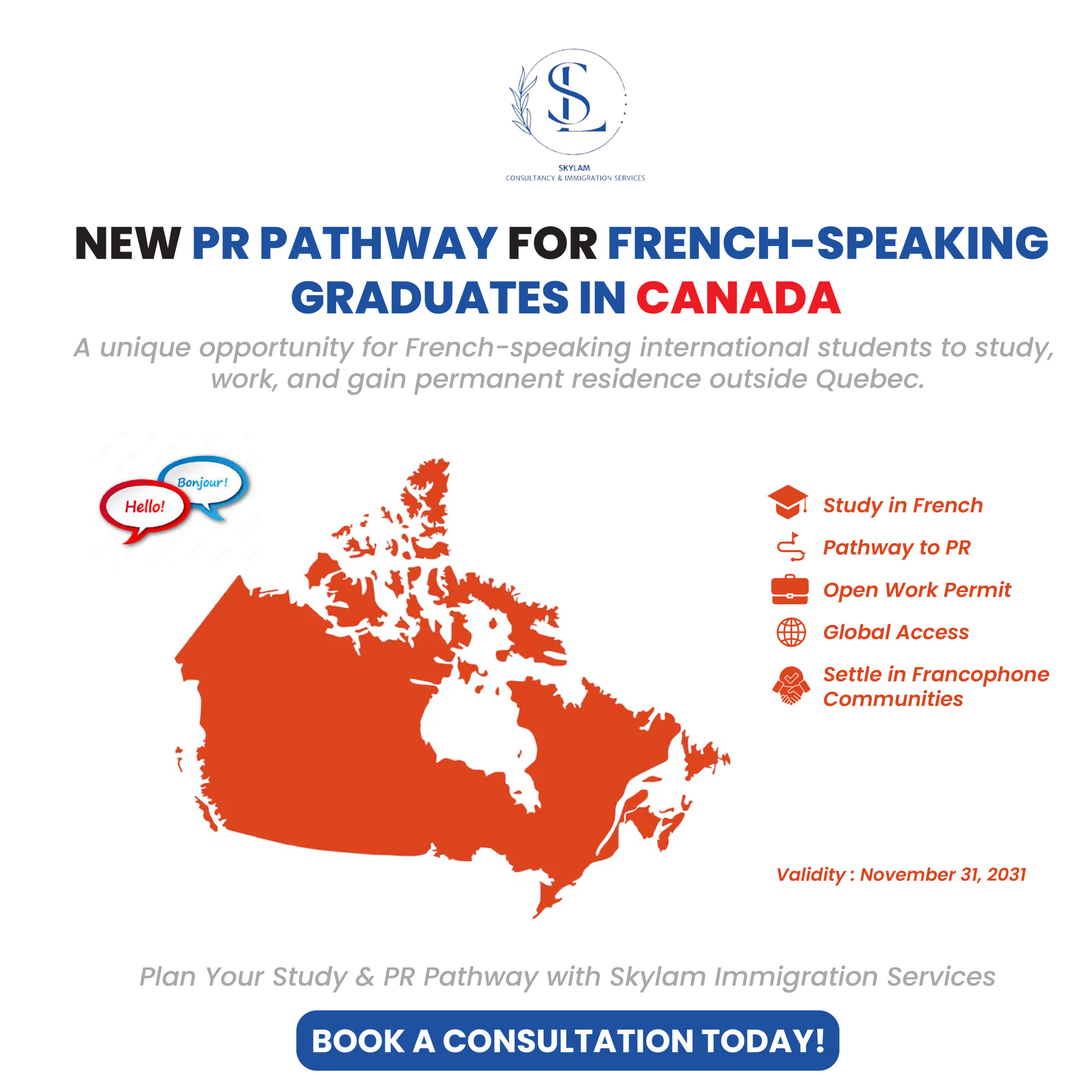
Canada has introduced a major update in its immigration policy — a new public policy that facilitates permanent residence (PR) for French-speaking international students who studied in Francophone minority communities outside Quebec. This initiative builds on the Francophone Minority Communities Student Pilot (FMCSP) and aims to strengthen French-language vitality while addressing labour shortages in key sectors across Canada.
🎯 Background: Supporting Francophone Minority Communities
The Government of Canada has reinforced its commitment to supporting Francophone and Acadian minority communities through the modernized Official Languages Act. Immigration, Refugees and Citizenship Canada (IRCC) recognizes that immigration is essential to maintaining the demographic weight, vitality, and economic growth of these communities.
To achieve this, IRCC’s Policy on Francophone Immigration focuses on:
- Increasing the number of French-speaking international students studying outside Quebec.
- Reducing barriers that affect study permit approval rates, especially for applicants from regions like Africa, the Middle East, and the Americas.
- Creating new pathways to permanent residency for graduates who studied primarily in French.
These efforts are based on recommendations from recent parliamentary and senate committee reports emphasizing the need for a bold and equitable approach to Francophone immigration.
🧭 What is the Francophone Minority Communities Student Pilot (FMCSP)?
The FMCSP is a special initiative that allows French-speaking international students to pursue postsecondary education in designated learning institutions (DLIs) outside Quebec.
Through this pilot, students gain access to:
- Canadian education in French,
- Settlement services funded by IRCC during their studies, and
- A direct pathway from temporary residence to permanent residence after graduation.
This program not only boosts Francophone student enrollment but also ensures that graduates can remain and contribute to the long-term prosperity of their communities.
🏡 The New Public Policy: From Study to Permanent Residence
Under this new public policy, eligible French-speaking international graduates who participated in the FMCSP can apply for permanent residency once they successfully complete their studies.
✅ Key Eligibility Criteria:
To qualify, applicants must:
- Have obtained a study permit through the Francophone Student Pilot.
- Have completed a full-time program of at least two years, taught primarily in French (50%+ French instruction), at a participating DLI outside Quebec.
- Be residing in Canada (outside Quebec) with a valid temporary status (student, worker, or visitor).
- Submit a PR application with proof of graduation (degree, diploma, or completion letter).
- Be admissible under Canadian immigration law.
👨👩👧 Family Members Can Also Apply
The policy extends to family members of eligible applicants — both inside and outside Canada.
Spouses, common-law partners, and dependent children can be included in the PR application, provided they meet admissibility requirements.
💼 Open Work Permits While Waiting for PR
A key benefit of this new public policy is that graduates can apply for an open work permit (valid for up to 3 years) while their PR application is being processed.
This allows them to work full-time, gain Canadian experience, and contribute to the economy without interruption.
Family members (inside or outside Canada) can also apply for open work permits under this policy, enabling them to join or support the principal applicant.
⚖️ Exemptions and Special Provisions
To simplify the process, IRCC will grant certain regulatory exemptions, such as:
- The requirement to prove intent to leave Canada after studies (dual intent).
- The need to belong to a specific immigration class when applying for PR.
- Some restrictions related to previous unauthorized work or study.
These exemptions make it easier for graduates and their families to transition smoothly from temporary to permanent status.
💰 Fees and Validity
Applicants must pay all standard processing fees, including those for:
- Permanent residence applications,
- Work permits,
- Biometrics, and
- The Right of Permanent Residence Fee (RPRF).
The new public policy took effect upon signature and will remain valid until November 31, 2031, unless revoked earlier. It replaces the previous version signed on October 3, 2024.
🌍 Why This Matters
This policy represents a major step forward in Canada’s strategy to:
- Strengthen Francophone presence across the country,
- Attract and retain skilled French-speaking talent, and
- Enhance diversity and bilingualism in communities outside Quebec.
By creating clear pathways for French-speaking international students to become permanent residents, Canada is investing in linguistic diversity, community growth, and long-term economic development.
📢 Final Takeaway
If you’re a French-speaking international student studying in Canada (outside Quebec), this new public policy opens the door to permanent residence and career growth within vibrant Francophone communities.
Stay connected with Skylam Immigration Services for updates, eligibility reviews, and professional guidance on how to apply under this new pathway.