Many visitors arrive in Canada for tourism, family visits, or short business trips. However, after experiencing the country’s opportunities, safety, and quality of life, a common question arises:
Can I legally stay in Canada and become a worker or student without leaving the country?
The short answer is: Yes — in certain situations.
Canada allows eligible visitors to apply for a change of status from inside the country, provided all immigration rules are followed.
This guide explains:
- When it is possible
- Which pathways exist
- Legal requirements
- Risks and mistakes to avoid
- How this can lead to permanent residence
Understanding Immigration Status in Canada
Every person in Canada holds a legal status:
- Visitor
- Student
- Worker
- Permanent Resident
Changing from one to another is called a status change or status restoration/extension, depending on circumstances.
Visitor Status: What It Allows
Visitor status permits:
- Temporary stay (usually up to 6 months)
- Tourism
- Family visits
- Short business activities
It does not allow:
- Working
- Studying long-term
To work or study, you must obtain the appropriate permit.
Visitor to Work Permit: Is It Possible?
Yes, under specific programs and conditions.
Pathway 1: Employer-Sponsored Work Permit
If a Canadian employer offers you a job, you may qualify for:
- Employer-specific work permit
- Usually supported by an LMIA
What is an LMIA?
A Labour Market Impact Assessment (LMIA) proves that:
- No qualified Canadian worker is available
- Hiring a foreign worker is justified
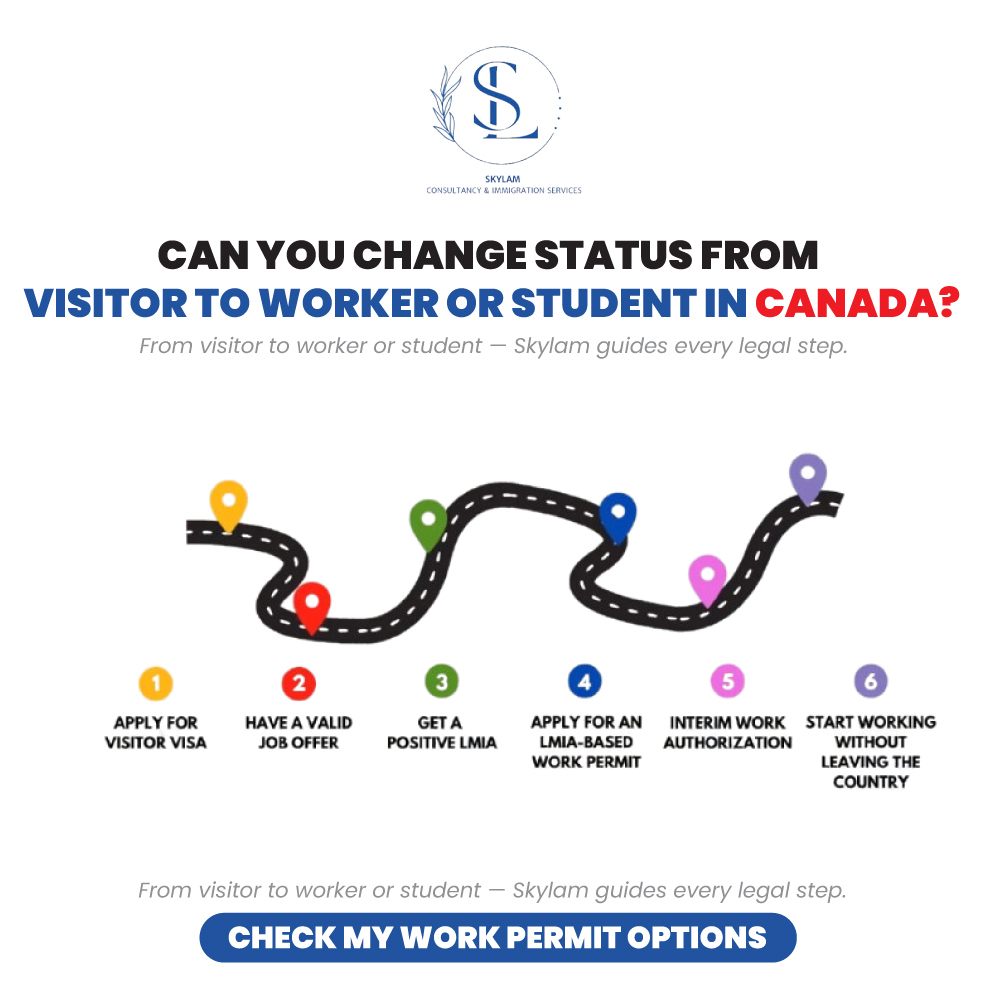
Process Overview:
- Employer applies for LMIA
- Receives approval
- You apply for work permit from inside Canada
- IRCC processes the application
- You receive work authorization
Important Notes:
- You must maintain valid visitor status
- You cannot start working until approved
- Not all jobs qualify
- Processing time varies
Temporary Public Policies
Canada has introduced temporary policies allowing visitors to apply for work permits from within Canada under certain conditions.
These policies are subject to change and eligibility requirements.
Professional guidance is recommended to avoid mistakes.
Visitor to Study Permit: Is It Allowed?
Yes, in many situations.
When Can a Visitor Apply for a Study Permit?
If you:
- Are accepted by a Designated Learning Institution (DLI)
- Have valid visitor status
- Can prove financial ability
- Meet IRCC requirements
Process:
- Apply to a Canadian college/university
- Receive Letter of Acceptance
- Apply for study permit inside Canada
- Wait for IRCC decision
Benefits of Applying from Inside Canada
- No travel costs
- Faster transition
- Easier document submission
- Legal continuity of stay
Risks & Limitations
Not everyone qualifies.
Potential issues:
- Expired visitor status
- Weak job offer
- Incomplete documentation
- Intent misrepresentation
- Financial insufficiency
Maintained Status (Implied Status)
If you apply before your visitor status expires, you may:
- Remain in Canada legally
- Wait for a decision
However:
- You cannot work or study until approved
Visitor to Work Permit Without LMIA
Some permits are LMIA-exempt:
- International agreements
- Intra-company transfers
- Spousal open work permits
- Certain public policy streams
Can This Lead to Permanent Residence?
Yes.
Work or study experience in Canada can help you qualify for:
- Canadian Experience Class
- Provincial Nominee Programs
- Employer-sponsored PR pathways
Common Mistakes to Avoid
❌ Working illegally
❌ Overstaying visa
❌ Submitting false documents
❌ Using unverified job offers
❌ Ignoring permit conditions
These mistakes can lead to:
- Refusal
- Removal orders
- Future bans
Financial Requirements
Applicants must show:
- Living expenses
- Tuition (for students)
- Return funds if required
Document Checklist
- Passport
- Visitor record
- Job offer or admission letter
- LMIA (if required)
- Proof of funds
- Police certificates (if applicable)
- Medical exam (if required)
Processing Times
Processing varies based on:
- Application type
- Country of origin
- Volume of applications
Case Scenario Example
Visitor enters Canada → receives job offer → employer obtains LMIA → applies for work permit → begins employment → gains Canadian experience → applies for PR.
Visitor to Student Pathway Example
Visitor applies to college → receives acceptance → applies for study permit → studies → applies for PGWP → works → applies for PR.
Is Changing Status Always Recommended?
Not always.
Some cases require:
- Applying from outside Canada
- Returning home to reapply
A professional assessment is critical.
How Skylam Helps
Skylam Immigration Services provides:
- Eligibility assessment
- Employer offer verification
- Study permit strategy
- Document preparation
- Status extension guidance
- PR pathway planning
Final Thoughts
Changing your status from visitor to worker or student can be:
- Legal
- Strategic
- Life-changing
But it must be done correctly.
Canadian immigration law is strict. Mistakes can be costly.
Professional guidance ensures:
- Compliance
- Higher success rates
- Long-term immigration planning