Introduction
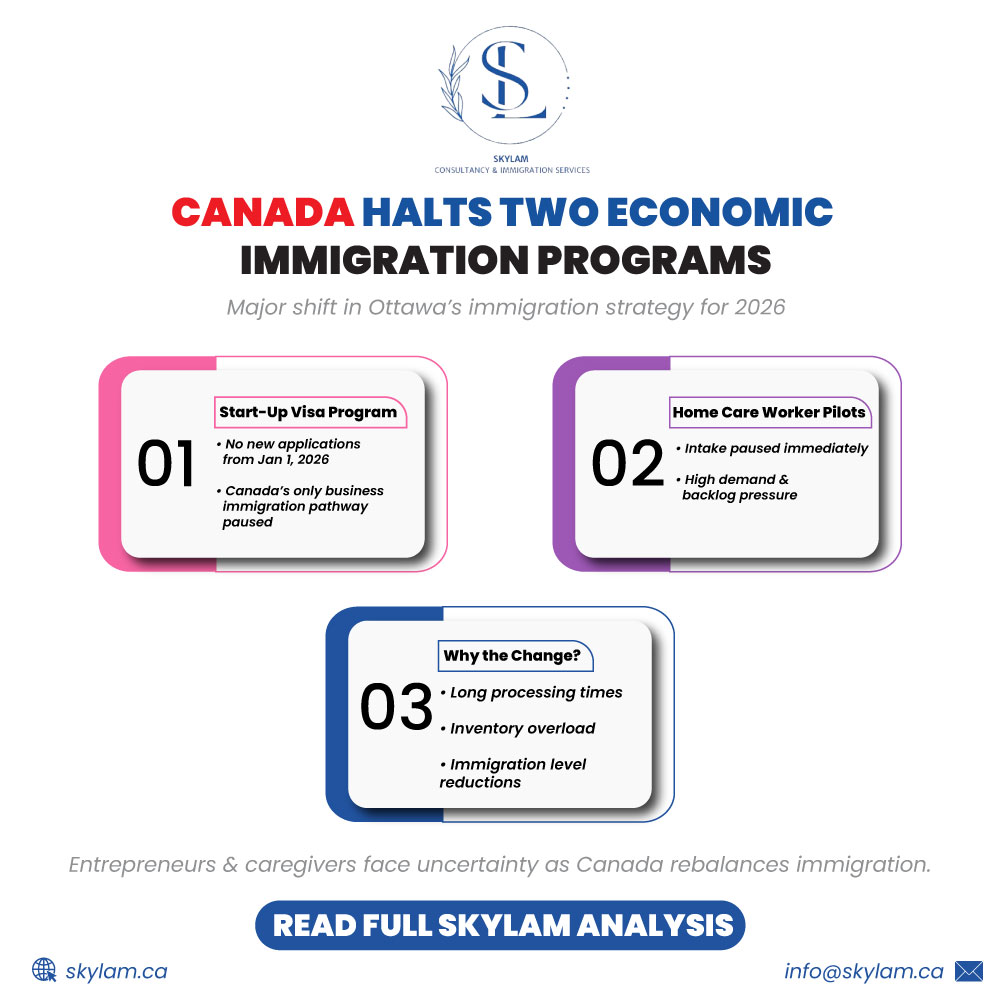
Canada’s immigration system is undergoing one of its most significant recalibrations in decades. On December 19, 2025, Immigration, Refugees and Citizenship Canada (IRCC) confirmed that it will stop accepting new applications for two major economic immigration streams:
- The Start-Up Visa (SUV) Program, effective January 1, 2026
- The Home Care Worker Immigration Pilots, paused immediately
This announcement signals a major shift in federal immigration priorities as Ottawa attempts to manage backlogs, long processing times, and public pressure to reduce immigration levels.
For entrepreneurs, caregivers, employers, and immigration professionals, the news raises urgent questions about Canada’s economic strategy, labour shortages, and long-term competitiveness.
This blog provides a complete breakdown of:
- Why these programs were paused
- What it means for applicants already in the system
- The broader political and economic context
- What could come next for Canada’s business and caregiver immigration pathways
Overview of the Cancelled and Paused Programs
❌ Start-Up Visa Program (SUV)
Status:
⛔ New applications stop January 1, 2026
What it was:
Canada’s only federal business immigration program, designed to attract:
- Innovative entrepreneurs
- Tech founders
- High-growth startups
- Global investors
Launched: 2013
Purpose:
To bring global innovation to Canada by offering:
- Work permits
- Permanent residence pathways
- Access to Canadian incubators and venture capital
⏸ Home Care Worker Immigration Pilots
Status:
⏸ Intake paused immediately
What it supported:
- Caregivers for children
- Home support workers for seniors and people with disabilities
Annual cap (2025):
Approximately 5,200 applications
Why Did Canada Cancel These Programs?
According to IRCC, the decision was driven by three major factors:
1️⃣ Severe Application Backlogs
- SUV applications in system (Aug 2025): 17,919
- Average processing time: 52 months
- Annual intake far exceeded processing capacity
For caregiver pilots:
- Demand consistently exceeded available spots
- Wait times stretched for years
- System strain increased annually
2️⃣ Immigration Level Reductions
Canada has been under mounting pressure to slow population growth, driven by:
- Housing shortages
- Healthcare capacity issues
- Public backlash over rapid immigration increases
The federal government has already:
- Reduced SUV permanent residence spots from:
- 5,000 (2024)
- 2,000 (2025)
- 1,000 (2026–2027)
3️⃣ Shift Toward “Targeted” Immigration
IRCC stated the pause will:
“Set the foundation for a transition to new, targeted pilot programs.”
This aligns with:
- Budget 2025 talent attraction strategy
- Focus on researchers, healthcare workers, and high-demand occupations
- Reduced intake in broad, open-ended programs
Impact on Start-Up Visa Applicants
🔹 Who Is Affected Most?
- International entrepreneurs planning to apply in 2026
- Startup founders outside Canada
- Venture-backed innovators targeting Canada
🔹 What About Existing Applicants?
IRCC confirmed:
- Applications already submitted will continue processing
- Work permit extensions allowed for those already in Canada
- New work permit applications from abroad are stopped
⚠️ Concerns from the Immigration Community
Toronto immigration lawyer Stephen Green warned:
“Canada now has no innovative business immigration program.”
Experts fear:
- Global startups will relocate to the U.S., UK, Australia, or Europe
- Canada may lose its edge in innovation
- Economic competitiveness could weaken long-term
Impact on Home Care Workers and Families
The pause on caregiver pilots has deep social implications.
🧓 Why Caregiver Programs Matter
Caregivers support:
- Aging Canadians
- Families with children
- People with disabilities
They fill critical labour gaps in:
- Home care
- Long-term care
- Childcare systems
💬 Industry Reaction
Immigration lawyer Lou Janssen Dangzalan stated:
“It saddens me… this program has been the backbone of care for the elderly and young.”
The concern:
- Families may struggle to find legal care
- Workers may face status uncertainty
- Underground labour risks could increase
Political Context: Reducing Immigration Pressure
Canada’s immigration debate has intensified due to:
- Housing affordability crisis
- Healthcare system strain
- Infrastructure limitations
In response, Ottawa:
- Cut immigration targets
- Paused selected pathways
- Introduced Bill C-12, seeking authority to cancel applications and documents
These moves suggest a stronger federal control approach over immigration intake.
Is This the End of Business Immigration?
Not necessarily.
IRCC indicated that:
- A new targeted entrepreneur pilot is expected
- Focus may shift to:
- Scale-up companies
- Regional innovation
- Strategic sectors (AI, clean tech, biotech)
However, no replacement program has yet been announced, creating uncertainty.
Comparison with Global Immigration Trends
While Canada pauses:
- 🇺🇸 U.S. expands entrepreneur & H-1B pathways
- 🇬🇧 UK promotes Global Talent Visas
- 🇦🇺 Australia increases innovation streams
- 🇪🇺 EU courts startup founders aggressively
Experts warn Canada risks falling behind unless replacements are introduced quickly.
What This Means for Canada’s Economy
📉 Short-Term Risks
- Reduced startup inflow
- Caregiver shortages
- Investor hesitation
📈 Potential Long-Term Benefits
- Better processing efficiency
- More targeted immigration
- Improved public confidence in the system
What Applicants Should Do Now
For Entrepreneurs:
- Explore provincial or regional pilots
- Monitor IRCC announcements closely
- Consider alternative jurisdictions temporarily
For Caregivers:
- Maintain legal status
- Follow IRCC updates on pilot replacements
- Seek employer-supported pathways if available
What Comes Next?
IRCC has signaled:
- New targeted pilots are coming
- Inventory reduction is a priority
- Immigration will remain essential—but more controlled
The challenge will be balancing:
⚖️ Economic growth
⚖️ Social capacity
⚖️ Public trust
Conclusion
The cancellation of intake for the Start-Up Visa Program and the pause of Home Care Worker pilots marks a defining moment in Canada’s immigration policy.
It reflects a government under pressure to rebalance its system—yet raises serious concerns about innovation, caregiving, and long-term competitiveness.
Whether this move strengthens or weakens Canada’s immigration model will depend entirely on what replaces these programs.