Moving to Canada is a dream for millions of people around the world. With its strong economy, high quality of life, excellent education system, and welcoming immigration policies, Canada remains one of the most popular destinations for skilled workers, students, and families.
However, Canada’s immigration system is also highly structured, competitive, and documentation-driven. Every year, thousands of applications are delayed or refused because of small but critical mistakes.
In this detailed guide, we will explain the most common Canada immigration mistakes, how they affect your application, and most importantly, how to avoid them.
Whether you are applying through Express Entry, a Provincial Nominee Program (PNP), study permit, or work permit, this article will help you protect your future.
Why Immigration Mistakes Are So Costly
Canada’s immigration process is not forgiving when it comes to errors. Even a simple mistake can result in:
- Application refusal
- Loss of processing fees
- Long delays (6–12 months or more)
- Reapplication costs
- Loss of eligibility
- A possible 5-year ban due to misrepresentation
Most of these issues are preventable with the right preparation and guidance.
Let’s explore the biggest mistakes applicants make.
1. Choosing the Wrong Immigration Program
Canada offers more than 100 immigration pathways, including:
- Express Entry
- Provincial Nominee Programs (PNP)
- Study Permit → Post-Graduate Work Permit → PR
- Temporary Foreign Worker Program
- Family Sponsorship
- Business & Startup Programs
Common mistake:
Applicants often apply for the first program they hear about — usually Express Entry — without checking if they are actually eligible or competitive.
Why this is risky:
- Low CRS score = no invitation
- Wrong program = automatic refusal
- Lost time and fees
How to avoid:
- Evaluate your profile professionally
- Compare multiple pathways
- Consider provincial programs
- Choose a long-term PR strategy, not just a quick application
2. Selecting the Wrong NOC Code
Your NOC (National Occupation Classification) code defines your job role in Canada’s system.
Common mistake:
Applicants select a NOC code based on job title instead of job duties.
Why this matters:
Immigration officers verify:
- Job responsibilities
- Employment letters
- Salary range
- Industry category
If your duties do not match your NOC code:
❌ Application refused
❌ Work experience rejected
❌ CRS points removed
How to avoid:
- Match job duties (not job title)
- Use official NOC descriptions
- Ensure your employer letter aligns with the selected NOC
3. Submitting Incomplete or Incorrect Documents
This is one of the most frequent reasons for refusal.
Common document issues:
- Missing documents
- Expired passport
- Unclear scans
- Wrong file format
- Missing translations
- Incorrect naming of files
Result:
- Application returned
- Processing delayed
- Refusal for non-compliance
How to avoid:
- Use a document checklist
- Double-check expiry dates
- Translate non-English documents professionally
- Upload clear, high-quality scans
- Follow IRCC file size and naming rules
4. Work Experience Errors
Canada evaluates work experience very carefully.
Common mistakes:
- Wrong employment dates
- Job duties not matching NOC
- Fake or unverifiable references
- Part-time counted as full-time incorrectly
- Self-employment not documented properly
Why this causes refusal:
Officers cross-check:
- Employer information
- Business registration
- Salary deposits
- Tax documents
If anything looks inconsistent, your application can be refused.
How to avoid:
- Provide genuine experience
- Use official employer letters
- Ensure duties match NOC
- Keep salary proof if possible
- Never exaggerate experience
5. Weak or Incorrect Proof of Funds
Most PR programs require proof that you can financially support yourself.
Common mistakes:
- Insufficient balance
- Sudden large deposits
- Borrowed money without explanation
- Fake bank statements
- Funds not in applicant’s name
Consequences:
- Application refused
- Suspected misrepresentation
How to avoid:
- Maintain required funds for 6 months
- Use personal bank accounts
- Provide bank letters & statements
- Explain any large deposits
- Follow IRCC fund requirements strictly
6. Language Test Problems (IELTS / CELPIP)
Language results play a huge role in CRS points and eligibility.
Common mistakes:
- Using expired test results
- Submitting wrong test type (Academic instead of General)
- Low score without realizing minimum requirement
- Typing incorrect TRF number
How to avoid:
- Take IELTS General Training (for PR)
- Check expiry (valid for 2 years)
- Retake if score is low
- Double-check details before submission
7. Medical and Police Clearance Errors
Common mistakes:
- Submitting expired medical exams
- Not completing medicals from approved panel physicians
- Missing police certificates
- Submitting wrong country police clearance
How to avoid:
- Use IRCC-approved clinics
- Follow correct timeline
- Obtain police clearance from all required countries
- Check validity dates
8. Missing Deadlines
Immigration applications follow strict timelines:
- Express Entry ITA → 60 days to apply
- Document submission deadlines
- Biometrics appointment timelines
Common mistakes:
- Late submission
- Ignoring email updates
- Delayed biometrics
- Forgetting to upload documents
Result:
❌ Application canceled
❌ Profile removed
❌ Lost opportunity
How to avoid:
- Track deadlines
- Check email regularly
- Prepare documents early
- Set reminders
9. Misrepresentation (The Most Dangerous Mistake)
Misrepresentation means providing:
- False documents
- Fake experience
- Fake education
- Hidden refusals
- Incorrect family information
Consequences:
- Immediate refusal
- 5-year ban from Canada
- Record stored permanently
Even small lies can cause major damage.
Important truth:
Canada’s system is highly digital and interconnected. Background checks are thorough.
How to avoid:
- Be honest
- Declare everything
- Correct mistakes early
- Get professional review
10. Applying Without Professional Guidance
Many applicants believe they can manage everything alone. While some can, many struggle due to:
- Complex rules
- Changing policies
- Technical forms
- Legal interpretation
- Document verification
Result:
Avoidable refusals.
How Skylam Immigration Services Helps You Avoid These Mistakes
At Skylam Immigration Services, we focus on:
✅ Profile evaluation
✅ Program selection
✅ NOC verification
✅ Document preparation
✅ Proof of funds guidance
✅ Application submission
✅ Deadline tracking
✅ Legal compliance
Our goal is simple:
To help you apply correctly, confidently, and legally — the first time.
We guide you from eligibility assessment to final decision, reducing risk and increasing success.
Final Application Checklist
Before submitting any Canada immigration application, make sure:
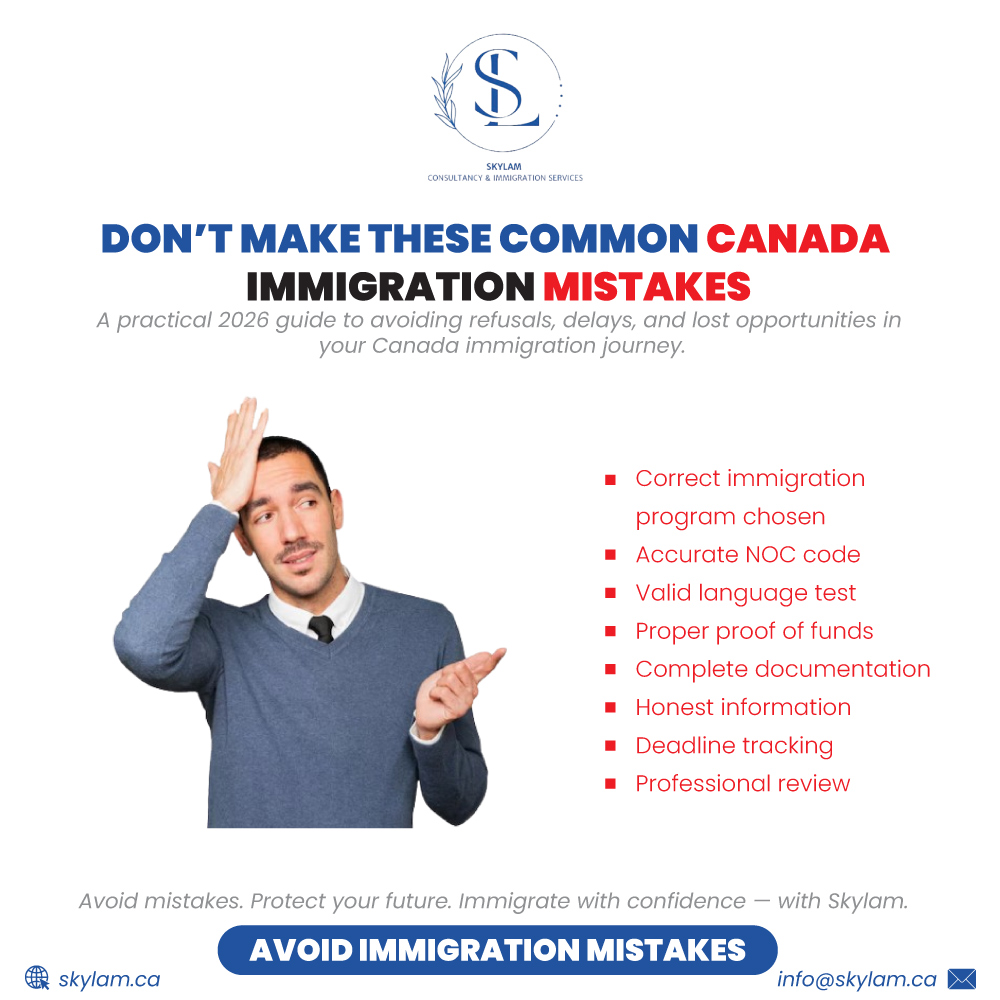
✔ Correct immigration program selected
✔ Proper NOC code chosen
✔ All documents complete & valid
✔ Proof of funds meets requirements
✔ Language test valid
✔ Medical & police certificates ready
✔ Forms filled correctly
✔ Deadlines tracked
✔ No false information provided
Conclusion
Canada immigration is a life-changing opportunity, but only when done correctly.
Most refusals happen not because applicants are unqualified — but because of avoidable mistakes.
With careful planning, accurate documents, honest information, and professional support, your chances of success increase dramatically.
Ready to Apply with Confidence?
Let Skylam Immigration Services guide you step by step — from profile evaluation to visa approval.
📩 Book your consultation today
🌍 Start your Canada journey the right way
From mistakes to success — Skylam is with you at every step.