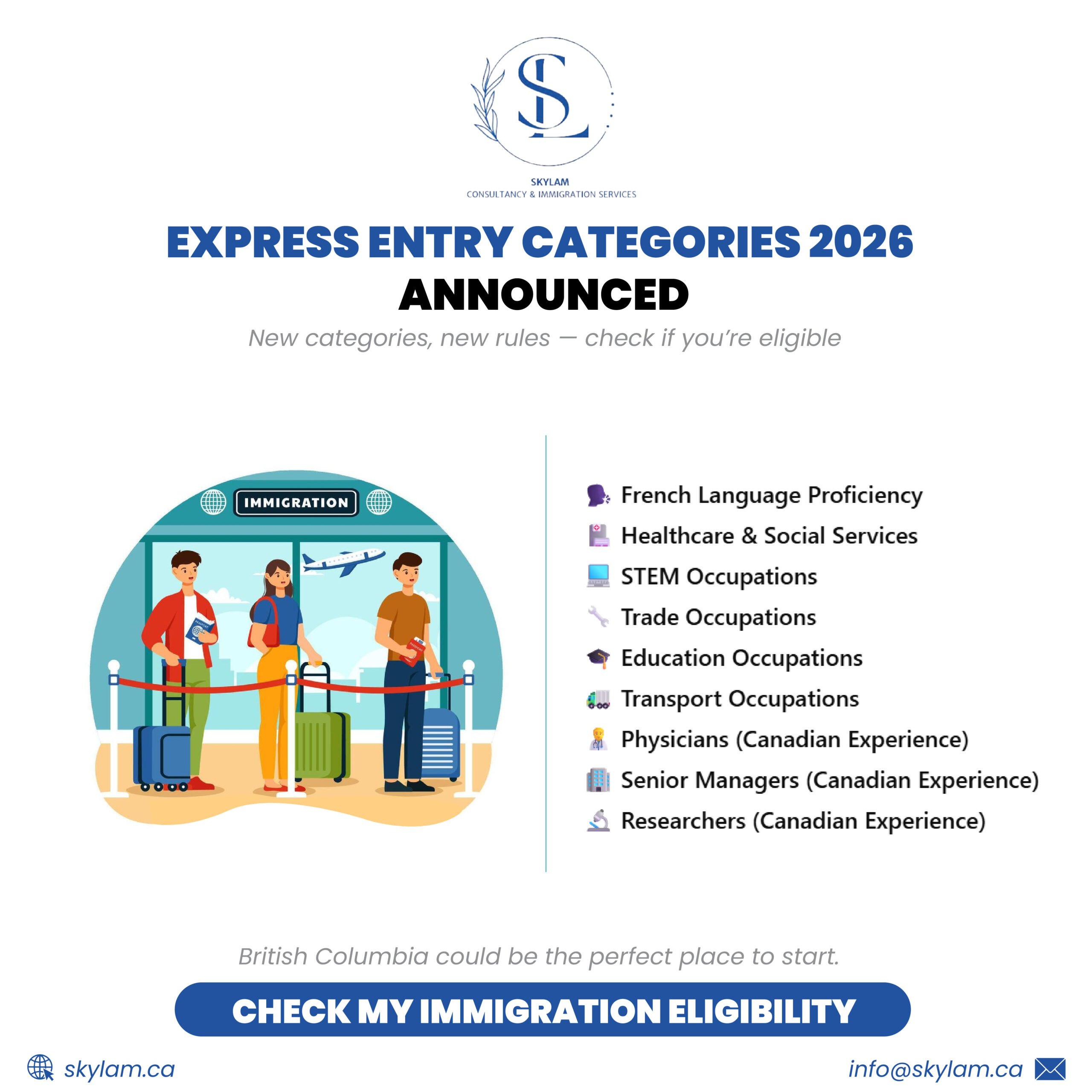
Canada has officially announced the Express Entry category-based selection system for 2026, marking one of the most strategic shifts in economic immigration in recent years. With global competition for skilled talent intensifying, Canada is refining its immigration system to better match labour market needs while maintaining sustainable immigration levels.
According to the latest announcement from Immigration, Refugees and Citizenship Canada, the 2026 Express Entry categories introduce new priority occupations, stricter eligibility requirements, and a stronger emphasis on Canadian work experience and French-language proficiency.
For skilled workers, international graduates, and professionals already working in Canada, these changes can significantly improve—or reduce—your chances of receiving an Invitation to Apply (ITA) for permanent residence, depending on how well your profile aligns with the new categories.
This in-depth blog explains everything you need to know about Express Entry 2026, including:
- The full list of 2026 categories
- Major changes from previous years
- The new 1-year work experience requirement
- Who benefits most from category-based draws
- How to improve your chances of selection
- What Skylam recommends you do next
What Is Express Entry Category-Based Selection?
Express Entry is Canada’s flagship immigration management system for economic permanent residence programs, including:
- Federal Skilled Worker Program (FSWP)
- Federal Skilled Trades Program (FSTP)
- Canadian Experience Class (CEC)
- Part of the Provincial Nominee Program (PNP)
Traditionally, Express Entry draws were CRS score–based, meaning candidates with the highest Comprehensive Ranking System (CRS) scores were invited regardless of occupation.
However, category-based selection allows IRCC to invite candidates with specific skills, work experience, or language abilities, even if their CRS score is not the highest in the pool.
This approach helps Canada:
- Address labour shortages in critical sectors
- Support economic growth
- Improve newcomer integration and job readiness
Express Entry Categories for 2026 (Official List)
For 2026, IRCC has announced nine targeted Express Entry categories, reflecting Canada’s most urgent workforce needs.
1. French-Language Proficiency
Candidates with strong French-language skills continue to receive top priority in Express Entry.
Why this matters:
- Supports Francophone communities outside Quebec
- Often requires lower CRS scores
- Ideal for bilingual candidates
French-speaking candidates may qualify even if they work outside traditionally high-demand occupations.
2. Healthcare and Social Services Occupations
Canada’s healthcare system continues to face shortages due to population growth and an aging workforce.
Included roles may include:
- Nurses
- Nurse practitioners
- Dentists
- Pharmacists
- Psychologists
- Chiropractors
- Social workers
Healthcare professionals remain one of the strongest groups for Express Entry success in 2026.
3. Science, Technology, Engineering and Math (STEPM) Occupations
STEM professionals remain critical to Canada’s innovation-driven economy.
Common STEPM roles include:
- Software engineers
- Data scientists
- IT specialists
- Engineers
- AI and machine learning professionals
This category benefits both foreign workers abroad and international graduates already working in Canada.
4. Trade Occupations
Skilled trades continue to be essential for Canada’s infrastructure, housing, and industrial development.
Examples include:
- Electricians
- Plumbers
- Carpenters
- Machinists
- Welders
Trade workers often benefit from lower CRS cut-offs in category-based draws compared to general draws.
5. Education Occupations (New Focus)
Education-related occupations are gaining priority due to teacher shortages and growing student populations.
This may include:
- Early childhood educators
- Teaching assistants
- Specialized education professionals
This category highlights Canada’s long-term focus on social development and workforce sustainability.
6. Transport Occupations
Canada relies heavily on skilled transport professionals to support trade, travel, and logistics.
Key roles include:
- Pilots
- Aircraft mechanics
- Transport inspectors
- Logistics and freight specialists
This category supports Canada’s aviation and supply chain sectors.
7. Physicians with Canadian Work Experience (New)
One of the most impactful additions for 2026 is the dedicated category for physicians with Canadian work experience.
Why this is significant:
- Addresses doctor shortages nationwide
- Offers faster PR pathways
- Prioritizes candidates already contributing to Canada
Physicians must have eligible Canadian work experience to qualify under this category.
8. Senior Managers with Canadian Work Experience (New)
Canada is prioritizing experienced leaders who can contribute to business growth and organizational stability.
Typical profiles include:
- Executives
- Operations managers
- Senior-level administrators
This category reflects Canada’s focus on attracting high-impact decision-makers, not just technical talent.
9. Researchers with Canadian Work Experience (New)
Researchers play a key role in innovation, public policy, healthcare, and education.
Eligible candidates may include:
- University researchers
- Research associates
- Postdoctoral fellows
This category strengthens Canada’s global position in research and development.
Major Change in 2026: Minimum 1 Year of Work Experience
One of the most important updates in Express Entry 2026 is the change to the work experience requirement.
What Changed?
- Previous requirement:
- Minimum 6 months of eligible work experience
- New requirement (2026):
- Minimum 1 year (12 months) of full-time work experience
- Must be in an eligible occupation
Why This Matters
This change means:
- Fewer short-term workers qualify
- More emphasis on stable, skilled employment
- Stronger alignment with labour market needs
Candidates who previously qualified may no longer be eligible if they do not meet the updated requirement.
Changes to Eligible Occupations
IRCC has also confirmed that some occupations within existing categories have changed.
This means:
- An occupation eligible in 2025 may not be eligible in 2026
- New occupations may be added
- Eligibility must be checked carefully
👉 Keeping your Express Entry profile up-to-date is now more important than ever.
Who Benefits Most from Express Entry 2026?
Based on the new categories, the strongest candidates in 2026 will be:
- Professionals with 1+ year of Canadian work experience
- Healthcare workers and physicians
- STEM and research professionals
- Skilled trade workers
- Transport and aviation professionals
- French-speaking candidates
- Senior managers and executives
Candidates already working in Canada will generally have a competitive advantage.
How Express Entry 2026 Affects CRS Scores
Category-based draws often:
- Have lower CRS cut-offs
- Focus less on total score, more on occupation and experience
- Create new opportunities for candidates with mid-range CRS scores
However, CRS still matters—especially in general draws and Provincial Nominee Program selections.
What Should You Do Now? (Skylam Recommendations)
To maximize your chances under Express Entry 2026, Skylam recommends:
✅ 1. Review Your Occupation Code
Ensure your NOC code matches the updated eligible occupation lists.
✅ 2. Confirm Work Experience Duration
You must have at least 12 months of eligible work experience.
✅ 3. Update Your Express Entry Profile
- Job title
- Duties
- Work dates
- Language scores
- Education details
✅ 4. Improve Language Scores
Both English and French proficiency can significantly boost your profile.
✅ 5. Explore Provincial Nominee Programs (PNPs)
Many PNPs align closely with Express Entry categories.
Why Professional Guidance Matters in 2026
With more targeted categories and stricter eligibility rules, Express Entry is now more complex than ever.
A small mistake—such as:
- Incorrect NOC selection
- Incomplete work history
- Outdated profile information
can mean missing an invitation entirely.
This is where professional immigration guidance becomes crucial.
How Skylam Immigration Services Can Help
Skylam Immigration Services provides personalized, up-to-date support to help you navigate Canada’s evolving immigration system.
We assist with:
- Express Entry profile assessment
- Category eligibility analysis
- CRS score improvement strategies
- PNP pathway planning
- End-to-end PR application support
Final Thoughts
The Express Entry Category-Based Selection 2026 system represents a clear shift toward quality, relevance, and real-world impact. Canada is no longer just inviting the highest CRS scores—it is inviting the right skills, experience, and talent.
If your profile aligns with these new priorities, 2026 could be your best opportunity yet to become a Canadian permanent resident.
📩 Contact Skylam today to evaluate your eligibility and prepare your Express Entry profile for success in 2026.