Immigration to Canada remains one of the most sought-after pathways for individuals and families seeking better opportunities worldwide. As we navigate through September 2025, our immigration consultants at Skylam continue to receive numerous questions about processing times, requirements, and recent policy changes. This comprehensive FAQ guide addresses the most common immigration processing questions we’ve encountered this month.
Understanding Current Immigration Processing Times
Q: How long does it take to process a Canadian immigration application in 2025?
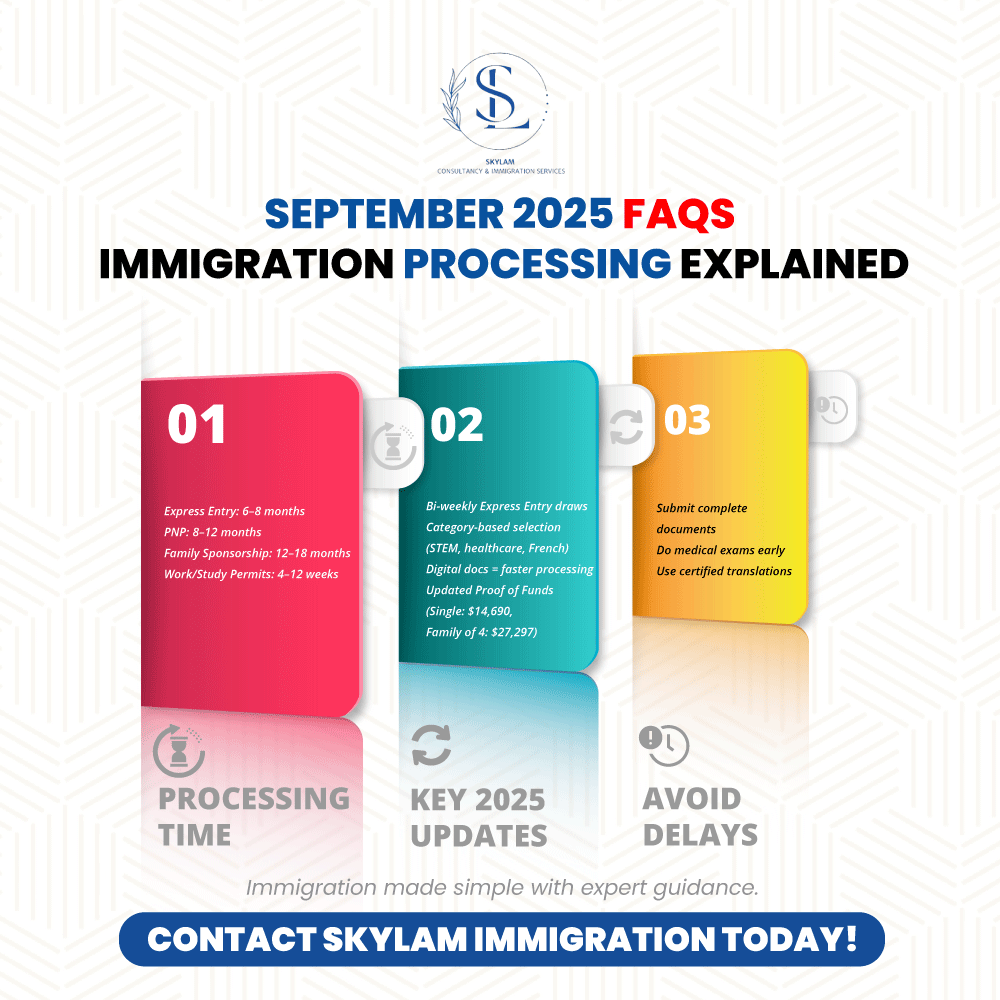
Processing times vary significantly depending on your immigration program and individual circumstances. As of September 2025, here are the current standard processing times:
- Express Entry (Federal Skilled Worker): 6-8 months from submission
- Provincial Nominee Program (PNP): 8-12 months total (including provincial nomination)
- Family Class Sponsorship: 12-18 months
- Work Permits: 4-12 weeks (depending on country of residence)
- Study Permits: 4-12 weeks
- Visitor Visas: 2-4 weeks
These timelines reflect recent improvements in IRCC’s processing capacity, though individual cases may experience variations based on completeness of documentation and complexity.
Express Entry System Updates
Q: What changes have been made to the Express Entry system in 2025?
The Express Entry system has undergone several enhancements this year:
- Category-Based Selection: IRCC continues to conduct draws targeting specific occupations and French-language proficiency
- Increased Draw Frequency: Draws now occur bi-weekly instead of monthly in most cases
- Enhanced Provincial Integration: Better coordination between federal and provincial programs
- Digital Documentation: Expanded acceptance of digital documents for faster processing
Q: What’s the minimum CRS score needed for Express Entry in September 2025?
CRS scores have remained competitive, typically ranging from 470-490 points for general draws. However, category-based draws often have lower thresholds:
- Healthcare occupations: 450-470 points
- French-language proficiency: 440-460 points
- STEM occupations: 460-480 points
Documentation and Requirements
Q: What documents are required for immigration applications in 2025?
Essential documentation remains consistent but has been streamlined:
Primary Documents:
- Valid passport and travel documents
- Language test results (IELTS, CELPIP, TEF, or TCF)
- Educational Credential Assessment (ECA)
- Work experience letters with detailed job descriptions
- Police clearance certificates from all countries of residence
- Medical examinations from IRCC-approved panel physicians
Financial Documentation:
- Proof of funds statements (updated requirements for 2025)
- Employment letters or job offers (if applicable)
- Tax documents from previous years
Q: Are there new requirements for proof of funds in 2025?
Yes, proof of funds requirements have been updated for 2025:
- Single applicant: CAD $14,690
- Family of two: CAD $18,288
- Family of three: CAD $22,483
- Family of four: CAD $27,297
- Each additional family member: CAD $3,076
Provincial Nominee Programs (PNP)
Q: Which provinces are most active in nominating candidates in September 2025?
Several provinces have increased their nomination allocations:
- Ontario: Continues to lead with tech and healthcare-focused streams
- British Columbia: Strong demand for skilled workers and entrepreneurs
- Alberta: Expanding programs for rural and northern communities
- Saskatchewan: Increased quotas for in-demand occupations
- Manitoba: Enhanced pathways for international graduates
Q: Can I apply to multiple PNP programs simultaneously?
Yes, you can apply to multiple provincial programs, but you must meet each province’s specific eligibility criteria. However, you can only accept one provincial nomination at a time.
Work and Study Permits
Q: What are the new regulations for work permits in 2025?
Key updates for work permits include:
- Open Work Permits: Expanded eligibility for spouses of skilled workers
- Post-Graduation Work Permits: Extended validity periods for certain programs
- Labour Market Impact Assessment (LMIA): Streamlined processing for high-demand occupations
- Digital Processing: Faster online applications with reduced paper requirements
Q: How do recent changes affect international students?
International students benefit from several new policies:
- Extended post-graduation work permit eligibility
- Improved pathways to permanent residence
- Enhanced support for French-language students
- Streamlined processes for program extensions
Family Class Immigration
Q: What are the current processing times for family sponsorship applications?
Family class processing has improved significantly:
- Spouse/Partner Sponsorship: 12-15 months
- Parent and Grandparent Program: 20-24 months
- Dependent Children: 8-12 months
- Other Eligible Relatives: 15-20 months
Q: Are there income requirements for family sponsorship in 2025?
Income requirements vary by family size and relationship:
- Spouse/partner sponsorship: No minimum income requirement (with exceptions)
- Parent and Grandparent Program: Must meet Low Income Cut-Off (LICO) plus 30%
- Other relatives: Specific income thresholds apply based on circumstances
Common Processing Concerns
Q: What causes delays in immigration processing?
The most common reasons for processing delays include:
- Incomplete Documentation: Missing or improperly formatted documents
- Medical Examinations: Delays in scheduling or completing required medical exams
- Security Clearances: Extended background checks for certain countries
- Additional Information Requests: IRCC requiring clarification or additional documents
- High Application Volumes: Seasonal fluctuations in processing capacity
Q: How can I check the status of my application?
You can monitor your application status through:
- IRCC Online Account: Real-time updates and document requests
- Application Tracking: Email notifications for status changes
- GCMS Notes: Detailed officer notes available through Access to Information requests
- Professional Consultation: Regular updates through your immigration consultant
Tips for Successful Applications
Q: What can I do to ensure faster processing of my application?
To optimize your application processing:
- Complete Documentation: Ensure all required documents are included and properly formatted
- Professional Translation: Use certified translators for non-English/French documents
- Regular Updates: Keep IRCC informed of any changes in circumstances
- Professional Guidance: Work with licensed immigration consultants
- Early Preparation: Begin gathering documents well in advance
Looking Ahead: What’s Next?
Q: What immigration changes should we expect in the coming months?
Anticipated developments include:
- Continued expansion of francophone immigration programs
- Enhanced digital processing capabilities
- New pathways for essential workers
- Increased provincial nomination allocations
- Improved integration between federal and provincial programs
Get Professional Assistance
Immigration processes can be complex and time-sensitive. At Skylam Immigration Services, our licensed consultants stay current with all policy changes and processing updates to ensure your application has the best chance of success.
Ready to start your Canadian immigration journey? Contact Skylam today for a comprehensive assessment of your eligibility and personalized guidance through every step of the process.
For the most current information on immigration processing times and requirements, always consult the official IRCC website or speak with a licensed immigration consultant. Skylam Immigration Services is authorized by the College of Immigration and Citizenship Consultants (CICC) to provide immigration advice and representation.
Contact Skylam Immigration:
- Website: www.skylam.ca
- Email: info@skylam.ca
- Phone: [Your phone number]
This blog post is for informational purposes only and does not constitute legal advice. Immigration laws and processing times are subject to change.