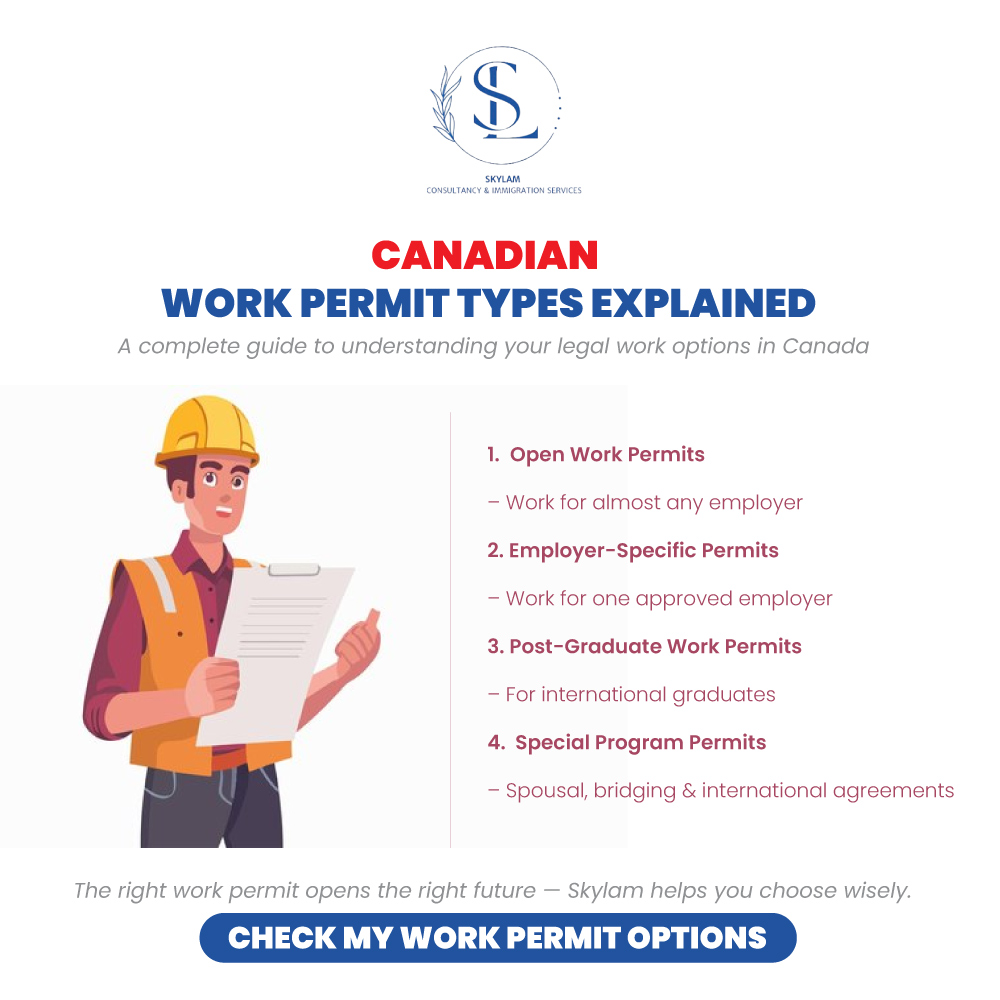
Working in Canada legally begins with one crucial step: obtaining the correct work permit. Many applicants mistakenly believe that all work permits are the same, but in reality, Canada operates several different types of permits, each designed for specific situations.
Choosing the wrong permit type can result in:
- Application refusal
- Delays of several months
- Lost job opportunities
- Immigration complications
This guide explains every major Canadian work permit type, who qualifies, and how to choose the right option in 2026.
Understanding the Canadian Work Permit System
A Canadian work permit is authorization granted by immigration authorities allowing foreign nationals to work in Canada for a specified period and under specific conditions.
Work permits are divided into two main categories:
- Open work permits
- Employer-specific (closed) work permits
Additional special permits exist under various immigration programs.
1. Open Work Permits
What Is an Open Work Permit?
An open work permit allows you to work for almost any employer in Canada, except those listed as ineligible.
It does not require:
- A job offer
- An LMIA (Labour Market Impact Assessment)
Who Can Apply for Open Work Permits?
Common eligible groups include:
- International graduates (Post-Graduate Work Permit holders)
- Spouses of skilled workers or international students
- Permanent residence applicants waiting for decisions
- Refugee claimants in some cases
- Participants of youth mobility programs
Advantages of Open Work Permits
- Flexibility to change employers
- Ability to work in different industries
- Easier entry to the Canadian labor market
- Valuable for gaining Canadian work experience
Limitations
- Usually time-limited
- Not available to all applicants
- Some jobs may still be restricted
2. Employer-Specific (Closed) Work Permits
What Is an Employer-Specific Work Permit?
This permit allows you to work:
- For one employer
- In one position
- At a specific location
LMIA Explained Simply
Most employer-specific permits require an LMIA, which proves:
- No Canadian worker is available for the role
- Hiring a foreign worker will not negatively impact the labor market
When LMIA Is Not Required
Certain cases are LMIA-exempt, such as:
- International agreements
- Intra-company transfers
- Certain professional categories
- Special trade or research programs
Advantages
- Direct job opportunity
- Often easier for applicants with employer support
- Strong foundation for future permanent residence
Disadvantages
- Limited flexibility
- Employer dependency
- Job loss affects legal status
3. Post-Graduate Work Permit (PGWP)
What Is the PGWP?
The Post-Graduate Work Permit allows international students who complete eligible Canadian programs to work in Canada after graduation.
Why PGWP Is One of the Most Powerful Permits
It allows:
- Full-time work
- Employment with any employer
- Accumulation of Canadian work experience
- Access to Express Entry and PNP programs
Key Eligibility Points
Applicants must:
- Graduate from an eligible institution
- Complete a qualifying program
- Apply within the required timeframe
- Maintain full-time study status
How PGWP Leads to PR
Canadian work experience gained through PGWP increases eligibility for:
- Canadian Experience Class
- Provincial nominee programs
- Employer-supported pathways
4. Spousal Open Work Permits
Spouses or partners of:
- International students
- Skilled foreign workers
- Permanent residence applicants
May qualify for open work permits.
This allows families to:
- Stay together
- Work legally
- Improve settlement success
5. Bridging Open Work Permit (BOWP)
This permit allows permanent residence applicants to:
- Continue working
- Maintain legal status
- Avoid interruption of employment
While waiting for PR application processing.
6. Special Program Work Permits
Canada also issues permits under:
- International Experience Canada (IEC)
- Free trade agreements
- Research and academic exchanges
- Religious or charitable work programs
These permits serve specific groups and objectives.
Choosing the Right Work Permit Type
The correct choice depends on:
- Your education
- Work experience
- Current status
- Employer availability
- Long-term immigration goals
Common Work Permit Application Mistakes
❌ Applying for the wrong permit type
❌ Missing LMIA requirements
❌ Submitting incomplete employer documents
❌ Incorrect job classifications
❌ Weak financial proof
❌ Lack of ties or intent explanation
How Work Permits Support Permanent Residence
Work permits are not just temporary solutions. They often serve as:
- Entry points to Canada
- Experience builders
- Immigration score boosters
- Provincial nomination enablers
A well-planned work permit strategy can shorten the path to permanent residence significantly.
Work Permit Processing in 2026
While timelines vary, success depends heavily on:
- Correct permit type
- Complete documentation
- Employer compliance
- Proper legal strategy
Why Professional Guidance Matters
Immigration officers review applications strictly. Even small errors can result in refusal.
Professional guidance helps:
- Identify correct permit categories
- Avoid documentation gaps
- Ensure compliance with regulations
- Improve approval probability
How Skylam Helps With Work Permits
Skylam Immigration Services supports clients with:
- Eligibility assessments
- Permit type selection
- Employer coordination
- LMIA guidance
- Full application preparation
- PR pathway planning
Our focus is not just approval — but long-term success in Canada.
Final Thoughts
Understanding Canadian work permit types is not optional — it is essential.
The right permit:
- Protects your legal status
- Opens career opportunities
- Supports your future immigration goals
Choosing incorrectly can cost time, money, and opportunity.