


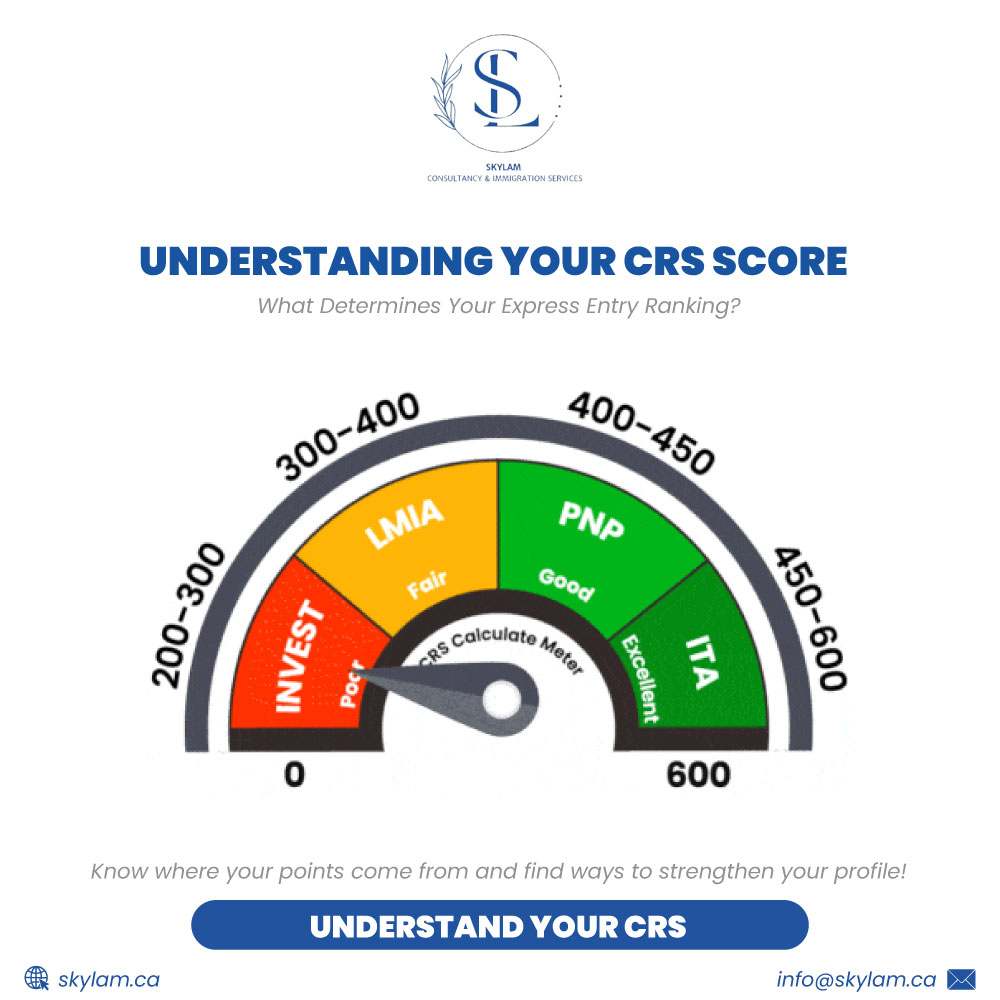
For many people planning to immigrate to Canada through Express Entry, one number can become especially important:
Your Comprehensive Ranking System (CRS) score.
The CRS is the points-based system Canada uses to assess and rank candidates in the Express Entry pool. Your score is based on factors such as age, education, language ability, Canadian work experience, and other eligible factors.
Understanding how the CRS works can help you make better decisions before creating an Express Entry profile.
It can also help you identify areas where your profile may be strengthened.
However, there is an important distinction:
Meeting the minimum eligibility requirements for an Express Entry program is not the same thing as having a competitive CRS score.
Canada currently manages three programs through Express Entry:
- Canadian Experience Class (CEC)
- Federal Skilled Worker Program (FSWP)
- Federal Skilled Trades Program (FSTP)
Candidates who are eligible can create an Express Entry profile and enter the pool. IRCC then invites candidates through rounds of invitations according to the applicable selection criteria.
This guide explains the CRS system, its major categories, how language and education can affect your score, the importance of French, provincial nomination, Canadian education, and common CRS mistakes applicants should avoid.
Important: CRS rules can change. This article is intended for general information and should not replace the current requirements published by IRCC.
What Is the CRS?
CRS stands for Comprehensive Ranking System.
It is the points-based system used by IRCC to rank eligible Express Entry candidates against one another.
The CRS can award up to 1,200 points in total.
The score is divided broadly into:
- Core/human capital factors
- Spouse or common-law partner factors, where applicable
- Skill-transferability factors
- Additional points
IRCC’s current CRS criteria confirm that job-offer points were removed from the CRS as of March 25, 2025.
This is an important update for anyone reading older Express Entry guides.
Older articles may still mention 50 or 200 CRS points for qualifying job offers. Those points are no longer part of the CRS.
However, a valid job offer can still matter for eligibility under certain programs or provincial streams.
CRS Score vs Express Entry Eligibility
These two concepts are often confused.
Express Entry Eligibility
First, you need to determine whether you qualify for one of the Express Entry programs.
For example, the Federal Skilled Worker Program has its own eligibility requirements and selection factors.
CRS Ranking
If you are eligible and enter the Express Entry pool, your profile receives a CRS score.
That score is then used to rank you against other candidates.
So the process is broadly:
Meet program requirements → Create Express Entry profile → Enter pool → Receive CRS score → Wait for applicable invitation rounds
IRCC confirms that Express Entry manages three federal programs and that eligible candidates enter a pool where candidates can be invited through rounds.
How Is the CRS Score Calculated?
The CRS considers several factors.
The main areas include:
- Age
- Education
- Official language ability
- Canadian work experience
- Spouse or common-law partner factors
- Skill transferability
- French-language ability
- Canadian education
- Sibling in Canada
- Provincial or territorial nomination
The maximum values for different categories are defined by IRCC’s current CRS criteria.
1. Age and CRS Points
Age is one of the core CRS factors.
Applicants between 20 and 29 years old receive the maximum age points:
- Up to 110 points without a spouse or common-law partner
- Up to 100 points with a spouse or common-law partner
After age 29, the available points gradually decrease.
At age 45 or older, the CRS age factor provides 0 points.
Why Does Age Matter?
Express Entry is designed around economic immigration, and age is one of the factors included in the CRS.
This means applicants do not control every part of their CRS score.
You cannot change your age.
Instead, you can focus on factors that are within your control, such as language preparation and documentation.
2. Education and CRS
Education is another major CRS factor.
Depending on your educational level, you may receive points for:
- Secondary school
- One-year post-secondary credential
- Two-year post-secondary credential
- Bachelor’s degree
- Multiple credentials
- Master’s degree
- Doctoral degree
For applicants without a spouse or common-law partner, the current CRS criteria provide up to 150 points for education.
For applicants with a spouse or common-law partner, education can provide up to 140 points under the principal applicant’s core factors.
Foreign Education and ECA
If you completed your education outside Canada, you may need an Educational Credential Assessment (ECA) for certain Express Entry purposes.
An ECA helps establish the Canadian equivalency of your foreign credential.
IRCC explains that candidates need an appropriate ECA for foreign education when required, and the ECA result is used when determining education-related points.
For example, if you completed a bachelor’s or master’s degree outside Canada, you should not simply assume that the credential automatically receives the corresponding Canadian CRS treatment.
You need to follow the applicable ECA requirements.
Multiple Educational Credentials
Having more than one credential can also affect CRS points.
Under the current CRS criteria, certain applicants can receive points for two or more certificates, diplomas, or degrees when at least one credential comes from a program of three or more years.
However, applicants need to provide the required educational documentation and ECA results where applicable.
This is why education history should be entered carefully in your Express Entry profile.
3. Language Ability and CRS
Language is one of the most important CRS factors.
For your first official language, each of the four abilities is assessed:
- Reading
- Writing
- Listening
- Speaking
Your results are converted into Canadian Language Benchmark (CLB) levels for English or the applicable NCLC level for French.
For the first official language, current CRS criteria provide up to:
160 points without a spouse or common-law partner
or
150 points with a spouse or common-law partner.
Why CLB 9 Can Be Important
CLB 9 is particularly significant in CRS planning.
At CLB 9 or higher in all four first-language abilities, an applicant may receive stronger language points.
CLB 9 can also interact with other factors through the skill-transferability section.
For example, education combined with strong official-language ability can generate additional points.
Foreign work experience combined with strong language ability can also generate additional points.
This means improving your language results can potentially have a broader effect than simply increasing the language section itself.
Language Test Results Must Be Accurate
Applicants should enter their actual language test results.
For example, if your IELTS results are:
- Listening: 8.0
- Reading: 7.0
- Writing: 7.0
- Speaking: 7.5
you should use the official conversion information to determine the corresponding CLB levels.
Do not estimate.
Do not round up.
Do not enter a score that you hope to achieve later.
Your Express Entry profile should reflect your actual valid results.
IRCC provides official language-test conversion tables for approved tests.
Which English Tests Can Be Used?
For eligible Express Entry applications, IRCC accepts approved English-language tests such as:
- IELTS General Training
- CELPIP-General
- PTE Core
For French, approved tests include:
- TEF Canada
- TCF Canada
The test version matters.
For example, applicants should not assume that every IELTS version is accepted for Express Entry.
Always verify the current IRCC list before booking a test.
4. Canadian Work Experience
Canadian work experience can also contribute to your CRS score.
Under the current CRS criteria, Canadian work experience can provide up to:
- 80 points without a spouse or common-law partner
- 70 points with a spouse or common-law partner
Five years or more of qualifying Canadian work experience can provide the maximum in this category.
Canadian work experience can also interact with education through the skill-transferability factors.
What Counts as Canadian Work Experience?
For CRS purposes, Canadian work experience refers to qualifying work for a Canadian employer while working in Canada.
IRCC notes that working remotely can count when the worker was physically in Canada.
However, not every type of work automatically qualifies.
Applicants need to review the specific program and work-experience requirements.
5. Spouse or Common-Law Partner Factors
If you apply with an accompanying spouse or common-law partner, their profile can contribute CRS points.
Spousal factors include:
- Education
- Official language ability
- Canadian work experience
The spouse or common-law partner section can contribute up to 40 points.
For example, a spouse’s:
- Education can contribute points
- Language results can contribute points
- Canadian work experience can contribute points
This is why both partners’ information should be reviewed carefully when calculating a CRS score.
Should You Include Your Spouse?
There is no universal answer.
Whether you should apply with or without an accompanying spouse can affect the CRS calculation, but immigration decisions should not be made based solely on a quick CRS comparison.
Your family circumstances and program requirements matter.
Applicants should use the official CRS calculator and ensure their family information is accurately reported.
6. Skill Transferability Factors
This is one of the most misunderstood parts of the CRS.
Skill-transferability points reward combinations of qualifications.
The system can consider combinations involving:
- Education
- Official language ability
- Foreign work experience
- Canadian work experience
- Certificate of qualification for certain trades
The skill-transferability section can provide up to 100 points.
Education + Language
Suppose an applicant has post-secondary education.
Strong language ability can increase the points available through the education-related skill-transferability factors.
For example, applicants with CLB 9 or higher across all four first-language abilities can potentially receive more points in this section than applicants with lower language results, depending on their education.
This is one reason why improving language scores can sometimes have a larger impact than applicants expect.
Foreign Work Experience + Language
Foreign work experience can also interact with language ability.
For example, applicants with:
- 1–2 years of foreign skilled work experience
or
- 3 or more years of foreign skilled work experience
can receive skill-transferability points when combined with qualifying language levels.
The maximum available in the applicable combinations can reach 50 points.
Foreign Work Experience + Canadian Work Experience
Foreign work experience can also interact with Canadian work experience.
This means your international professional background and Canadian experience may work together within the CRS framework.
Again, the exact points depend on the applicant’s circumstances.
7. French-Language Ability
French can be an important CRS factor.
Under the current CRS rules, French-language ability can provide additional points.
Applicants who achieve NCLC 7 or higher in all four French abilities may qualify for additional CRS points depending on their English results.
The current additional-point structure provides:
- Up to 25 points for qualifying French ability where the English threshold is lower
- Up to 50 points where the applicant also has qualifying English ability
This makes French a potentially valuable part of an Express Entry strategy.
Why French Is Worth Considering
An applicant who already speaks French may want to investigate whether obtaining an approved French-language test could strengthen their Express Entry profile.
French ability can potentially:
- Add CRS points
- Support French-language immigration opportunities
- Improve competitiveness in applicable selection rounds
However, applicants should review the current requirements rather than assuming that French automatically guarantees an invitation.
8. Canadian Education
Education completed in Canada can provide additional CRS points.
Current rules provide:
- Up to 15 additional points for qualifying one- or two-year Canadian post-secondary education
- Up to 30 additional points for qualifying Canadian education of three years or longer
These are additional points and are separate from the core education points.
9. Sibling in Canada
Some candidates may receive additional CRS points if they have a sibling in Canada who meets the applicable conditions.
The current CRS criteria provide up to 15 points for an eligible sibling who is:
- At least 18 years old
- A Canadian citizen or permanent resident
The applicant needs to meet the relevant family relationship and documentation requirements.
10. Provincial Nomination
A provincial or territorial nomination can make a very significant difference.
Under the current CRS system, a qualifying provincial or territorial nomination can provide:
600 additional CRS points.
This is why PNP pathways are an important consideration for some Express Entry candidates.
However, provincial nomination programs have their own requirements.
You should never assume that simply having an Express Entry profile means you qualify for every PNP.
Important Update: Job Offer CRS Points Were Removed
This deserves special attention.
Many older Express Entry articles still say:
“A valid job offer can give 50 or 200 CRS points.”
That information is outdated.
As of March 25, 2025, IRCC removed CRS points for job offers.
This includes the previous:
- 50-point category
- 200-point category
However, job offers can still matter for eligibility in certain immigration programs.
Therefore:
Job offer ≠ automatic CRS points
but
Job offer can still be relevant to eligibility.
Applicants should keep this distinction in mind when reading older immigration content.
CRS Score Is Not a Fixed “Passing Score”
One of the biggest misconceptions about Express Entry is that there is one permanent CRS passing score.
There isn’t.
The CRS score required to receive an invitation can vary according to the specific invitation round.
Factors can include:
- Number of candidates
- Type of round
- Number of invitations issued
- Selection criteria
- Candidate profiles in the pool
Therefore, someone asking:
“Is 470 CRS enough?”
cannot receive a reliable answer without considering the specific invitation context.
A score that receives an invitation in one type of round may not receive one in another.
General Rounds vs Category-Based Selection
Express Entry can involve different types of invitation rounds.
Depending on the round, IRCC may select:
- Candidates based on overall CRS ranking
- Candidates meeting category-based criteria
- Candidates under other applicable selection approaches
This means applicants should not look at CRS alone.
Category eligibility can matter too.
CRS and Category-Based Selection
Canada has introduced category-based selection within Express Entry.
Depending on current priorities, categories may target candidates with particular characteristics, such as:
- French-language proficiency
- Specific occupations
- Other eligible categories
The categories and criteria can change.
Therefore, applicants should review current IRCC announcements rather than relying on an old list.
How Can You Improve Your CRS Score?
Not every CRS factor can be changed.
You cannot change:
- Your age
- Your past education
- Your previous employment history
But some areas may be improved.
1. Improve Your Language Score
This can potentially increase:
- Language points
- Skill-transferability points
Language improvement can therefore be one of the most practical strategies for some applicants.
2. Consider French
If you have strong French skills, consider whether taking an approved French-language test could benefit your profile.
French can provide additional CRS points under current rules.
3. Complete an ECA When Required
If you have foreign education and an ECA is required, obtaining the appropriate assessment can help ensure that your education is correctly represented in your Express Entry profile.
4. Gain Qualifying Work Experience
Additional qualifying work experience can affect your CRS score depending on whether the experience is Canadian or foreign and how it interacts with other factors.
5. Explore Provincial Nomination
If your CRS score is not competitive, investigate whether a relevant provincial or territorial pathway exists for your profile.
A nomination can provide 600 additional CRS points under the current system.
6. Review Your Education
Education can be one of the largest components of the CRS.
If you have multiple credentials, make sure they are entered correctly and that you have the required ECA documentation where applicable.
What Should You Not Do to Increase Your CRS?
Applicants should never provide false information simply to increase their score.
Do not:
- Invent work experience
- Misrepresent job duties
- Use fake language results
- Misrepresent education
- Hide relevant immigration history
- Submit false documents
- Claim points you do not qualify for
Your Express Entry information must be accurate and supported by appropriate documentation.
IRCC notes that information entered into an Express Entry profile must be supported by documentation when the candidate submits the permanent residence application.
Example CRS Strategy
Consider a hypothetical applicant:
Applicant Profile
- Age: 28
- Bachelor’s degree
- Strong English
- Several years of foreign skilled work experience
- No Canadian work experience
- No Canadian education
- No provincial nomination
- No eligible sibling in Canada
This applicant may want to focus on:
Language → Education → Foreign work experience → French → PNP opportunities
The strategy is not simply:
“Get more points.”
It is:
Identify which factors are realistically available and determine which improvements could have the greatest impact.
Why CLB 9 Can Be a Strategic Target
For some applicants, reaching CLB 9 across all four language abilities can be particularly valuable.
Why?
Because language points themselves can increase, while skill-transferability combinations can also become more favorable.
This means an applicant who is currently around CLB 7 may benefit from targeted preparation aimed at reaching a higher level.
However, improvement is not guaranteed.
The applicant should choose a realistic target based on their current language ability.
CRS Score Calculation: Use the Official Tool
Because CRS calculations can involve multiple factors, manually calculating your score from an old blog post can lead to errors.
IRCC provides an official CRS calculator and current criteria.
Applicants should use official information whenever possible.
IRCC — CRS Calculator and Criteria
CRS Planning Checklist
Before creating an Express Entry profile, review:
- Age
- Marital status
- Education
- ECA, if required
- Language test
- CLB/NCLC levels
- Canadian work experience
- Foreign work experience
- Spouse’s education
- Spouse’s language ability
- Spouse’s Canadian work experience
- French-language ability
- Canadian education
- Eligible sibling in Canada
- Provincial nomination opportunities
- Proof of funds, if required
- Correct immigration program
Common CRS Mistakes
Mistake 1: Using an Old CRS Calculator
Immigration rules can change.
Use current IRCC information.
Mistake 2: Assuming a Job Offer Adds CRS Points
It does not under the current CRS system.
Job-offer CRS points were removed in March 2025.
Mistake 3: Confusing CLB With IELTS
IELTS scores are converted into CLB levels.
They are not interchangeable terms.
Mistake 4: Ignoring Individual Language Skills
Your four language abilities are assessed individually.
A strong overall impression does not replace the required results in each skill.
Mistake 5: Forgetting Skill Transferability
Some applicants calculate only age, education, language, and work experience.
They forget that combinations between these factors can generate additional points.
Mistake 6: Assuming CRS Guarantees an Invitation
A CRS score does not guarantee an invitation.
Invitation rounds and selection criteria matter.
Mistake 7: Entering Incorrect Information
Your profile should accurately reflect your actual qualifications and documents.
How Skylam Immigration Services Can Help
Understanding the CRS can be complicated because several factors interact with one another.
Skylam Immigration Services offers personalized support for applicants navigating Canada’s immigration system.
A consultation can help you understand:
- Your potential Express Entry pathway
- General CRS factors
- Language requirements
- Education and ECA considerations
- Work-experience requirements
- Potential provincial pathways
- Documentation requirements
- Areas that may need further preparation
Skylam can help you organize your immigration planning, but no consultant can guarantee a particular CRS score, invitation, nomination, or permanent residence approval.
Frequently Asked Questions
What is the CRS score?
CRS stands for Comprehensive Ranking System. It is the points-based system IRCC uses to rank eligible Express Entry candidates.
What is the maximum CRS score?
The CRS has a maximum of 1,200 points under the current system.
Does a job offer give CRS points?
No. CRS points for job offers were removed as of March 25, 2025.
Can French improve my CRS score?
Yes. Qualifying French-language ability can provide additional CRS points under the current system.
Can a provincial nomination improve my CRS?
Yes. A qualifying provincial or territorial nomination provides 600 additional CRS points under the current CRS criteria.
Is CLB 9 important?
It can be. CLB 9 or higher can improve language points and can also affect certain skill-transferability combinations.
Does education affect CRS?
Yes. Education is one of the core CRS factors.
Does age affect CRS?
Yes. Age is a core factor, with the highest age points generally available between ages 20 and 29.
Can my spouse’s profile affect my CRS?
Yes. If your spouse or common-law partner accompanies you, their education, language ability, and Canadian work experience can contribute points.
Is there one CRS score that guarantees an invitation?
No. Invitation requirements can vary depending on the type and circumstances of the invitation round.
Final Thoughts
The CRS is one of the most important parts of Express Entry, but it should not be viewed as just a single number.
Your score is the result of several factors working together:
Age + Education + Language + Work Experience + Skill Transferability + Additional Factors
Some factors cannot be changed.
Others can potentially be improved.
For many applicants, language preparation can be particularly valuable because stronger language results may affect both the language component and certain skill-transferability combinations.
French may also provide additional opportunities.
Canadian education, Canadian work experience, eligible family connections, and provincial nomination can also affect the overall profile.
Most importantly, keep your information accurate.
Do not rely on outdated CRS calculators or old immigration articles, especially regarding job-offer points. The current CRS rules removed those points in March 2025.
If you are considering Express Entry, start by understanding your actual profile, calculate your score using current IRCC information, identify potential weaknesses, and then build a realistic immigration plan.
A stronger Express Entry strategy starts with understanding your CRS profile. 🇨🇦