
Canada LMIA Prevailing Wage Update Takes Effect November 18, 2026: What Employers Need to Know
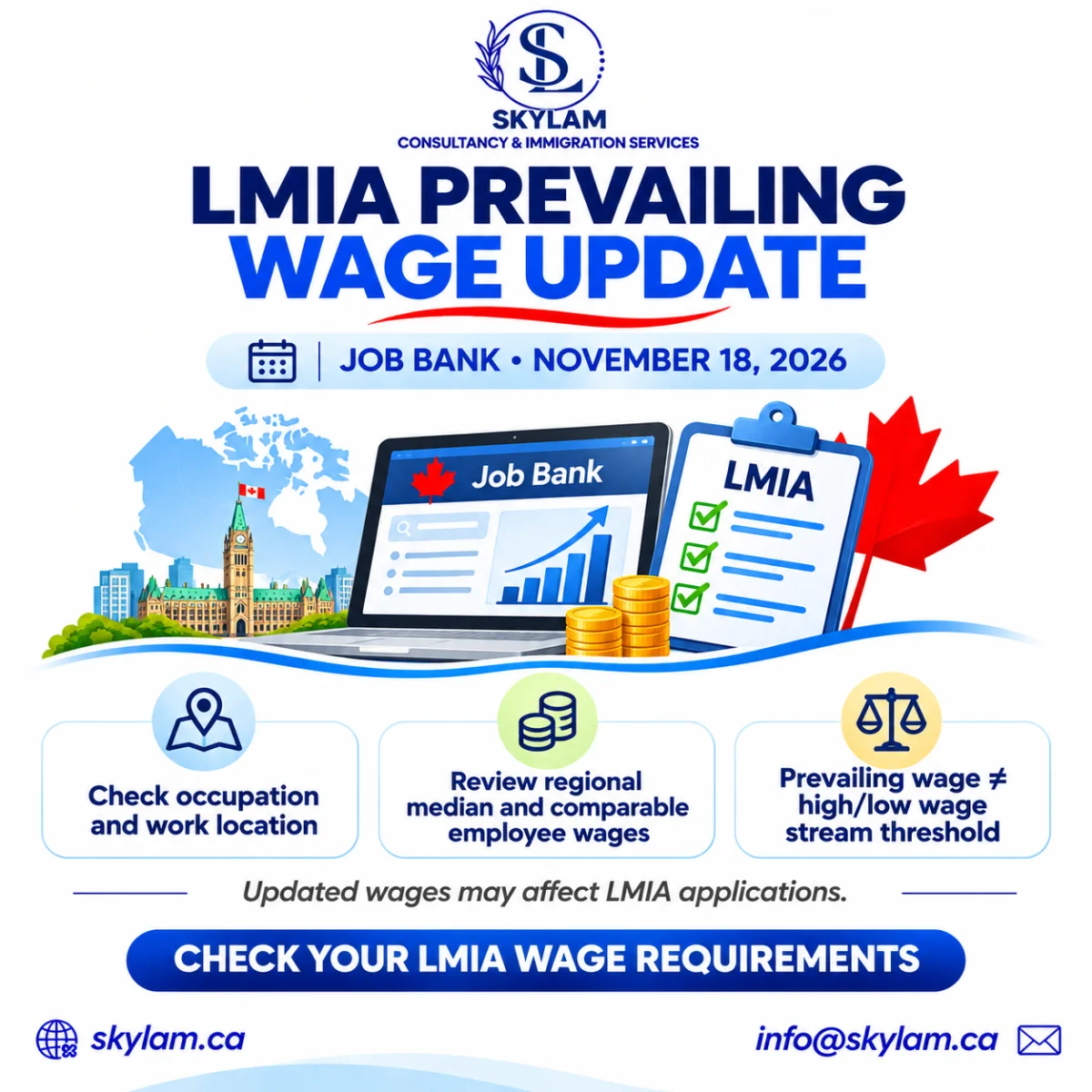
Canada's annual Job Bank fall wage update is scheduled for November 18, 2026, making it an important date for employers preparing Labour Market Impact Assessment (LMIA) applications.
Employment and Social Development Canada (ESDC) confirms that Job Bank wages are updated annually in the fall. These wage figures are used to determine the prevailing wage for occupations and employment locations under the Temporary Foreign Worker Program (TFWP).
Employers must ensure that wages offered to temporary foreign workers meet the applicable requirements.
The update may affect minimum wage offers required for certain LMIA applications and wage reviews for existing foreign workers.
However, employers should not confuse the occupation-specific prevailing wage with the separate provincial or territorial threshold used to classify positions under the High-Wage and Low-Wage Streams.
1. What Is Canada's LMIA Prevailing Wage?
A prevailing wage is the wage employers are generally required to offer when hiring a temporary foreign worker for a particular occupation and work location.
Under ESDC's rules, the prevailing wage is ordinarily determined using the regional median wage published on Job Bank.
Employers must also consider comparable wages paid to their existing employees working in the same occupation and location, with similar qualifications and experience.
Where the applicable comparable employee wage is higher, the employer must satisfy that higher requirement.
This helps ensure that the recruitment of temporary foreign workers does not undermine prevailing employment conditions.
2. What Changes on November 18, 2026?
ESDC confirms that the annual fall Job Bank wage update takes place on November 18, 2026.
The update concerns occupational wage information published through Canada's Job Bank.
Because prevailing wages vary by occupation and geographical area, the impact may differ between employers.
Some occupations or regions may see changed wage figures, while others may not experience significant differences.
Employers should check the current Job Bank information instead of relying on previously recorded wage figures.
Important: This article does not report revised occupation-specific wage amounts because those figures have not been independently verified.
3. How Should Employers Determine the Prevailing Wage?
Employers preparing LMIA applications should follow the relevant ESDC process.
Step 1: Identify the Occupation
Determine the correct National Occupational Classification (NOC) code associated with the position.
The NOC code helps identify the appropriate occupational wage information.
Step 2: Confirm the Employment Location
Prevailing wages may vary between regions.
Employers should use the location where the temporary foreign worker will actually perform the employment duties.
Step 3: Review Job Bank's Wage Information
Search Job Bank for the occupation and work location.
Identify the applicable median wage according to ESDC's guidance.
Where regional wage information is unavailable, employers should follow the applicable alternative wage-determination instructions.
Step 4: Compare Existing Employee Wages
Employers should review wages paid to current employees undertaking comparable work in the same location.
Relevant factors include the occupation, skills and experience.
Step 5: Apply the Relevant LMIA Requirements
The offered wage must satisfy the applicable prevailing-wage requirements and any additional conditions of the employment stream.
Some sectors and programs have separate wage rules that employers must also consider.
4. Prevailing Wage vs. High-Wage/Low-Wage Classification Threshold
These two wage concepts serve different purposes and must not be confused.
| Requirement | Purpose |
|---|---|
| Occupational prevailing wage | Determines the appropriate wage for a specific occupation and work location |
| High-wage/low-wage stream threshold | Helps determine which LMIA stream applies based on the offered wage and provincial or territorial threshold |
Occupational Prevailing Wage
The occupational prevailing wage is associated with the specific job and geographical area.
For example, the applicable prevailing wage for an occupation in Toronto may differ from the wage for the same occupation in another region.
High-Wage/Low-Wage Threshold
The high-wage/low-wage classification threshold is a separate provincial or territorial wage benchmark.
It is used to determine whether an employer must generally submit an LMIA application under the High-Wage Stream or Low-Wage Stream.
An employer must satisfy the applicable occupational prevailing-wage requirement regardless of the stream classification.
The November 18 Job Bank update should not automatically be described as a change to these separate provincial or territorial stream thresholds.
5. How Could Updated Wages Affect LMIA Applications?
Updated Job Bank wage information may influence an employer's recruitment planning and the assessment of an LMIA application.
Potential implications include:
-
Reviewing offered wage rates before submitting applications.
-
Adjusting recruitment advertisements where necessary.
-
Checking alignment with comparable employee wages.
-
Reassessing employment budgets.
-
Ensuring compliance with the relevant employment stream.
Under ESDC requirements, an employer offering less than the applicable prevailing wage risks receiving a negative LMIA.
Employers should therefore review the updated information before proceeding with recruitment.
6. What About Employers With Existing Temporary Foreign Workers?
The annual fall wage update may also be relevant to employers who already employ temporary foreign workers under the TFWP.
ESDC requires applicable employers to review prevailing wages annually and adjust wages where necessary.
For streams subject to the annual review requirement, employers generally have until January 1 of the following year to complete the review after the fall Job Bank update.
This makes January 1, 2027, a relevant review deadline for applicable employment arrangements following the November 18, 2026 update.
Employers must also ensure that a revised wage does not fall below the wage specified in the positive LMIA, even if the published prevailing wage decreases.
Some employment arrangements have additional requirements, so employers should consult the specific rules that apply to their workers.
7. Why Does This Matter for Canadian Employers?
The prevailing-wage requirement is an important part of Canada's Temporary Foreign Worker Program.
For employers, updated wage data can affect financial planning, recruitment decisions and compliance obligations.
Businesses seeking to hire internationally should consider wage requirements before making employment offers.
This is particularly relevant when recruitment involves occupations where regional wage conditions change.
Employers should retain accurate documentation supporting wage decisions and remain informed about subsequent ESDC updates.
8. What Does the Wage Update Mean for Foreign Workers?
Temporary foreign workers should understand that the prevailing-wage requirement is intended to support appropriate employment compensation.
The wage identified in an employment arrangement must satisfy applicable federal program rules.
However, the publication of updated Job Bank figures does not mean that every temporary foreign worker automatically receives a wage increase on November 18.
Whether a wage adjustment is required depends on the applicable employment arrangement, program requirements and the employer's wage review obligations.
Foreign workers with questions about their wages should review their employment documentation and the applicable government guidance.
9. Important Clarifications About the November 18 Update
Employers and applicants should distinguish the annual Job Bank wage update from other immigration policy changes.
First: The update concerns occupational wage information and prevailing-wage assessments.
Second: The occupational prevailing wage is different from the provincial or territorial high-wage/low-wage stream threshold.
Third: Wage requirements may vary according to occupation, region and employment stream.
Fourth: The update does not automatically guarantee LMIA approval or a work permit.
Fifth: Employers must use current official wage information rather than relying on unverified estimates or older wage tables.
10. Frequently Asked Questions
When is Canada's 2026 Job Bank fall wage update?
ESDC confirms that the update is scheduled for November 18, 2026.
Does the update affect LMIA applications?
It may. Updated wage figures can affect the applicable prevailing-wage requirement for particular occupations and work locations.
How is the prevailing wage determined?
The regional median wage published on Job Bank is generally used, alongside applicable comparisons with wages paid to existing employees and stream-specific requirements.
Is the prevailing wage the same as the provincial high-wage/low-wage threshold?
No. The prevailing wage relates to the occupation and work location. The stream threshold is used to determine which LMIA stream applies.
Do all foreign workers receive automatic wage increases?
No. Wage adjustments depend on applicable program requirements and employment circumstances.
When must employers review wages for existing workers?
For applicable TFWP arrangements, ESDC generally requires annual prevailing-wage reviews, with the review following the fall update completed by January 1 of the next year.
Does the update guarantee LMIA approval?
No. Employers must satisfy all relevant LMIA requirements, not only wage conditions.
Conclusion
Canada's annual Job Bank fall wage update on November 18, 2026, is an important development for employers preparing LMIA applications and maintaining compliance with Temporary Foreign Worker Program requirements.
Employers should review the prevailing wage for each occupation and work location, compare applicable existing employee wages and satisfy the requirements of the relevant LMIA stream.
It is equally important to distinguish occupation-specific prevailing wages from the separate high-wage/low-wage classification thresholds.
Using current official wage information can help employers make better-informed recruitment decisions and reduce avoidable compliance risks.
Stay Informed With Skylam Consultancy & Immigration Services
Canadian work permit and immigration requirements continue to evolve.
Skylam Consultancy & Immigration Services provides information and guidance on Canadian immigration pathways and applicable requirements.
Stay informed about LMIA wage updates and Canadian work permit developments.
Website: https://skylam.ca
Email: info@skylam.ca
Verify an immigration representative: https://register.college-ic.ca