
Proof of Funds for Canadian Immigration: Requirements, Documents and How to Prepare in 2026
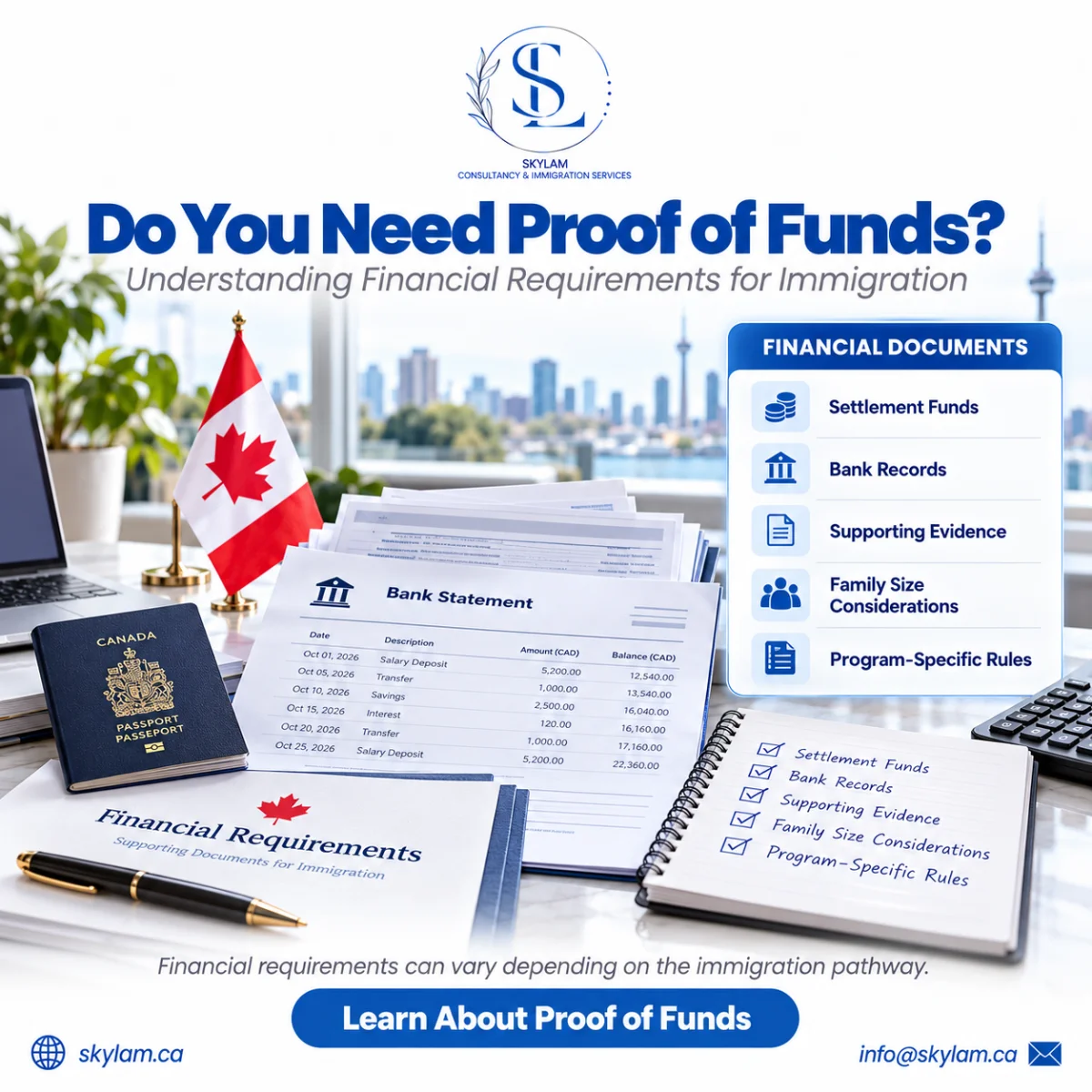
If you are planning to immigrate to Canada, one of the important financial questions you may face is whether you need to provide proof of funds.
Proof of funds is evidence that an applicant has enough money available to support themselves and, where applicable, their family members after arriving in Canada.
However, there is an important point to understand from the beginning:
Not every Canadian immigration applicant has the same proof-of-funds requirement.
The amount required, whether proof of funds is necessary, what documents may be accepted and when the funds must be available can depend on the immigration program and the applicant's circumstances.
For example, certain Express Entry applicants may need to demonstrate settlement funds, while applicants under the Canadian Experience Class generally do not need to show settlement funds. Some applicants with a valid job offer and authorization to work in Canada may also be exempt from the settlement-funds requirement under the applicable rules. (canada.ca)
Study permit applicants have separate financial requirements, which should not automatically be confused with Express Entry settlement funds.
This guide explains what proof of funds means, who may need it, how much money may be required, what documents can help demonstrate your financial situation and what mistakes applicants should avoid.
What Is Proof of Funds?
Proof of funds is documentation showing that you have sufficient money available to meet the financial requirements of an immigration program.
For certain economic immigration programs, these funds are intended to demonstrate that you can support yourself and your accompanying family members when settling in Canada.
The purpose is not necessarily to prove that you are wealthy.
Instead, the requirement is designed to demonstrate that you have access to the required amount of settlement funds.
The money must generally be:
-
Available to you
-
Legally obtained
-
Accessible
-
Properly documented
-
Not borrowed for the purpose of meeting the settlement-funds requirement
The exact rules depend on the program.
Why Does Canada Ask for Proof of Funds?
Moving to another country can involve significant initial expenses.
A newcomer may need money for:
-
Accommodation
-
Food
-
Transportation
-
Utilities
-
Communication
-
Clothing
-
Household items
-
Employment-related expenses
-
Other settlement costs
The Canadian immigration system therefore uses financial requirements in some immigration programs to assess whether applicants have the financial resources required under the applicable rules.
Proof of funds is one part of the overall immigration assessment.
Having enough money does not by itself make someone eligible for permanent residence.
Similarly, having the required amount does not guarantee an Invitation to Apply or permanent residence.
Who Needs Proof of Funds for Express Entry?
Proof of funds is particularly relevant to certain candidates applying through Express Entry.
IRCC currently states that applicants under the Federal Skilled Worker Program (FSWP) and Federal Skilled Trades Program (FSTP) generally need to show that they have enough money to settle in Canada, unless they are exempt under the applicable rules.
Candidates applying under the Canadian Experience Class (CEC) do not need to show proof of settlement funds.
Applicants may also be exempt in certain circumstances if they are authorized to work in Canada and have a valid job offer, subject to the applicable requirements. (canada.ca)
This distinction is important.
Express Entry does not have one universal proof-of-funds rule for everyone.
Your requirement depends partly on the program through which you qualify.
2026 Express Entry Proof-of-Funds Amounts
For Express Entry settlement funds, IRCC updates the minimum amounts periodically.
The amount depends on the number of family members included in your application.
For applications updated or submitted after the applicable annual update, applicants should always check the latest IRCC table before submitting.
For 2026, the current minimum settlement funds listed by IRCC are:
| Number of family members | Minimum funds required |
|---|---|
| 1 | CAD $15,263 |
| 2 | CAD $19,001 |
| 3 | CAD $23,360 |
| 4 | CAD $28,362 |
| 5 | CAD $32,168 |
| 6 | CAD $36,280 |
| 7 | CAD $40,392 |
| Each additional family member | CAD $4,112 |
These figures apply to the applicable Express Entry settlement-funds requirement and should be checked against the latest IRCC information before an application is submitted. (canada.ca)
Example
Suppose an applicant is immigrating with a spouse and one dependent child.
That means there are three family members.
Under the current table, the applicant would need to demonstrate at least the amount required for a family size of three.
The family-size calculation includes family members even if they are not accompanying you to Canada in certain circumstances.
This is why applicants should carefully review IRCC's definition of family members when calculating their required funds.
Who Counts as a Family Member?
For immigration purposes, family size is not always as simple as counting the people travelling with you.
Depending on the application, family members can include:
-
The principal applicant
-
Spouse or common-law partner
-
Dependent children
-
Dependent children of the spouse or common-law partner
Applicants must provide accurate family information and should not exclude a family member simply because that person is not travelling to Canada.
The applicable immigration program and IRCC instructions should be followed when determining family size.
When Do You Need to Show Proof of Funds?
Proof of funds can be relevant at different stages of the immigration process.
For Express Entry, you may enter your settlement-funds information in your profile and later be required to provide supporting evidence if you receive an Invitation to Apply.
When IRCC requests documentation, the applicant needs to provide evidence that meets the applicable requirements.
Applicants should not assume that the amount shown in their bank account on the day they create an Express Entry profile will automatically be enough.
Funds should remain available and properly documented throughout the relevant stages.
What Can Be Used as Proof of Funds?
IRCC provides specific guidance on acceptable proof of settlement funds.
For Express Entry, proof can generally include money held in:
-
Bank accounts
-
Savings accounts
-
Chequing accounts
-
Certain other eligible financial instruments
The evidence should clearly demonstrate that the funds are available to you.
IRCC indicates that applicants should provide official letters from financial institutions where required. (canada.ca)
What Should a Bank Letter Include?
A bank letter should contain the information required by IRCC.
Depending on the circumstances, the letter may need to include:
-
Financial institution's letterhead
-
Institution's contact information
-
Applicant's name
-
List of outstanding debts
-
Account numbers
-
Date each account was opened
-
Current balance
-
Average balance over the relevant period
The exact document requirements should always be checked against the current IRCC instructions before submission. (canada.ca)
A simple screenshot from an online banking application may therefore not be enough by itself when IRCC specifically requests formal financial documentation.
Why Bank History Can Matter
Applicants sometimes focus only on the current balance.
However, immigration authorities may also want evidence that the money is genuinely available and belongs to the applicant.
A sudden large deposit shortly before an application can create questions about the source of funds.
For this reason, applicants should maintain clear financial records.
If a large deposit is legitimate—for example, from the sale of an asset—the applicant should be prepared to provide appropriate evidence explaining the transaction where relevant.
The objective should be transparency.
Can Borrowed Money Be Used?
Applicants should be careful about relying on borrowed money to satisfy a settlement-funds requirement.
For Express Entry proof of funds, IRCC states that applicants cannot use borrowed money as proof of settlement funds. (canada.ca)
The purpose of the requirement is to demonstrate that you genuinely have access to the required settlement resources.
Therefore, an applicant should not take a temporary loan simply to make their bank balance appear higher.
Can You Use Joint Bank Accounts?
Joint accounts require careful consideration.
The applicant needs to demonstrate that the funds are genuinely available to them and satisfy the applicable requirements.
If funds are held jointly with a spouse or another person, the supporting documentation should clearly explain ownership and access to the money.
Because financial situations vary, applicants should verify how their specific account structure should be documented before submitting the application.
Can Property Be Used as Proof of Funds?
Owning property can demonstrate personal wealth, but property value is not automatically the same thing as settlement funds.
For example, owning:
-
A house
-
Land
-
An apartment
-
A commercial property
does not necessarily mean that the property itself satisfies the Express Entry settlement-funds requirement.
Settlement funds generally need to be available in an acceptable form.
If you sell an asset and place the proceeds into an eligible account, appropriate documentation may be important to explain the source of the funds.
Can a Credit Card Be Used?
A credit card limit is not the same as available settlement funds.
A credit card represents access to borrowed credit.
Because settlement funds generally need to be genuinely available to the applicant, applicants should not assume that a high credit-card limit can be counted toward their required settlement funds.
The same principle applies to other forms of credit.
What About Cash?
Holding physical cash can create difficulties when trying to demonstrate financial history and accessibility.
Applicants should follow IRCC's requirements for acceptable financial evidence rather than assuming that physical cash automatically satisfies the proof-of-funds requirement.
Financial institutions and official account records generally provide clearer documentation of available funds.
Proof of Funds vs Proof of Financial Support
These terms can sometimes be confused.
Proof of funds usually refers to evidence that the applicant has the required money available.
Proof of financial support can mean something different depending on the immigration program.
For example, a study permit applicant may have a parent or another person supporting their education and living expenses.
The applicant may need documents demonstrating the source and availability of that support.
The requirements for a study permit are different from Express Entry settlement funds.
Proof of Funds for Canadian Study Permit Applicants
Study permit applicants should not simply use the Express Entry settlement-funds table.
The financial requirements for studying in Canada are separate.
IRCC requires study permit applicants to demonstrate that they have enough money to:
-
Pay tuition
-
Support themselves during their stay
-
Pay transportation costs to and from Canada
The amount required depends on factors such as the applicant's location of study and family size.
For applications submitted on or after September 1, 2025, for applicants outside Quebec, the minimum amount for living expenses for one person is CAD $22,895, excluding tuition and transportation. IRCC updates these amounts annually. (canada.ca)
Because these figures are updated periodically, study permit applicants should check the latest official IRCC table when preparing their application.
The important lesson is:
Do not use an old proof-of-funds amount from a previous year.
Proof of Funds for Provincial Nominee Programs
Provincial Nominee Programs can have their own financial requirements.
Some PNP streams may require applicants to demonstrate settlement funds.
Others may use different eligibility criteria or have exemptions depending on the applicant's circumstances.
Therefore, applicants should never assume that the federal Express Entry settlement-funds table automatically applies to every PNP application.
Always check:
-
The specific province
-
The specific immigration stream
-
Whether the stream is Express Entry aligned
-
The province's current settlement-funds requirements
-
Any exemptions that may apply
Provincial requirements can change independently of federal requirements.
Proof of Funds for Family Sponsorship
Family sponsorship has different financial rules from economic immigration.
For example, sponsorship of a spouse, partner or dependent child generally does not use the same settlement-funds calculation as Express Entry.
However, sponsors can have financial obligations and income requirements in certain family sponsorship situations.
Parents and grandparents sponsorship has particularly important financial requirements when the program is open for intake.
Applicants should therefore avoid applying an Express Entry proof-of-funds rule to a family sponsorship case.
What If Your Funds Are in a Foreign Currency?
Applicants outside Canada may hold their money in their local currency.
The important point is to demonstrate the required value in Canadian dollars according to the applicable immigration requirements.
Bank documentation should clearly identify:
-
Account holder
-
Account balance
-
Currency
-
Account information
-
Relevant dates
Applicants should use the conversion approach required or accepted for their specific application.
Avoid making unsupported currency calculations yourself and assuming that the immigration officer will accept them without supporting evidence.
What If Your Balance Changes?
Financial balances naturally change.
However, if your funds fall below the required minimum at a critical stage of the application, this can create a problem.
Applicants should therefore monitor their settlement funds throughout the immigration process.
Do not assume that reaching the minimum once is enough.
Maintain an appropriate financial cushion whenever possible so ordinary account fluctuations do not unexpectedly place you below the applicable requirement.
What If You Have Multiple Bank Accounts?
You may have money spread across several accounts.
For example:
-
Savings account
-
Salary account
-
Fixed deposit
-
Joint account
-
Foreign currency account
Depending on the program and applicable rules, multiple accounts may be documented together.
The important thing is to present the information clearly and consistently.
A well-organized financial document package can make it easier for the officer to understand your financial position.
What If a Family Member Provides the Money?
Applicants should be careful when funds belong to another person.
For example, a parent may want to transfer money to an applicant before an immigration application.
The applicant should be able to explain the source and ownership of the funds where necessary.
Simply transferring a large amount shortly before an application without documentation can raise questions.
If money is legitimately gifted or transferred, supporting evidence may help establish the transaction and its source.
The exact documentation required depends on the circumstances.
Large Deposits: Why You Should Keep Records
A large deposit is not automatically a problem.
However, unexplained large transactions can make a financial history more difficult to understand.
Suppose you sell a vehicle, property or other legitimate asset and deposit the proceeds into your bank account.
Keep relevant documents such as:
-
Sale agreement
-
Transfer records
-
Bank transaction records
-
Ownership documents
-
Other evidence showing the source
This can help demonstrate where the money came from.
The principle is simple:
Do not only prove that you have the money. Be prepared to explain its legitimate source when necessary.
Common Proof-of-Funds Mistakes
1. Using the Wrong Program's Financial Requirement
Express Entry, study permits and family sponsorship do not all use the same financial rules.
Always check the specific program.
2. Using Outdated Amounts
Financial requirements can change.
Always check the current IRCC website before submitting an application.
3. Borrowing Money to Meet the Requirement
Borrowed funds should not be presented as settlement funds when the program prohibits borrowed money.
4. Providing Only a Screenshot
An online banking screenshot may not provide all the information required by IRCC.
Follow the official document instructions.
5. Ignoring Debts
Financial documentation may need to identify outstanding debts.
Do not assume that only your account balance matters.
6. Making Large Undocumented Deposits
A large deposit without a clear source can create questions.
Maintain supporting records.
7. Assuming Property Automatically Counts
Property ownership is not automatically equivalent to liquid settlement funds.
8. Forgetting Family Members
Family size can affect the amount required.
Make sure your family information is accurate.
How to Prepare Your Proof of Funds Step by Step
Step 1: Identify Your Immigration Program
Determine whether you are applying through:
-
Express Entry
-
PNP
-
Study permit
-
Family sponsorship
-
Another immigration pathway
Step 2: Check Whether Proof of Funds Is Required
Do not assume that every applicant needs it.
Check the specific program requirements.
Step 3: Determine Your Family Size
Calculate your family members according to IRCC's applicable definition.
Step 4: Check the Current Required Amount
Use the latest official government information.
Step 5: Review Your Bank Accounts
Identify the accounts that contain your available funds.
Step 6: Request Official Bank Documentation
Ask your financial institution for the required official documents.
Step 7: Review Your Financial History
Look for large transactions that may need explanation.
Step 8: Prepare Supporting Evidence
Keep documents that explain legitimate deposits or transfers.
Step 9: Check the Application Instructions
Make sure your documents meet the exact requirements for your program.
Step 10: Keep Funds Available
Do not assume that you can spend the money immediately after obtaining a bank letter.
Maintain the required funds during the relevant stages of your application.
A Simple Example
Imagine a family applying through an Express Entry program that requires settlement funds.
The family includes:
-
Principal applicant
-
Spouse
-
One dependent child
The family size is therefore three.
The applicant checks the latest IRCC settlement-funds table and identifies the minimum amount applicable to a three-person family.
The applicant then reviews their accounts.
Suppose the required money is distributed across:
-
Personal savings
-
Joint savings with spouse
-
Another eligible account
Instead of simply submitting random screenshots, the applicant organizes the required financial documentation so the source, ownership and availability of the funds can be clearly understood.
This is much more useful than simply saying:
“I have enough money.”
Immigration applications require evidence, not just statements.
How Skylam Immigration Services Can Support Your Immigration Planning
Preparing financial documents can be confusing, particularly when applicants are unsure which funds count, what documents are needed or which financial requirement applies to their immigration pathway.
Skylam Immigration Services provides personalized support for individuals exploring Canadian immigration options, including skilled worker programs, family sponsorship and study permits.
Depending on the service arrangement, applicants can seek support in understanding the financial documentation relevant to their immigration planning and organizing information for their application.
However, applicants should always verify the current requirements applicable to their specific program.
Financial requirements can change, and different immigration programs can have different rules.
Skylam cannot guarantee approval, an invitation to apply or a particular immigration outcome.
The strongest approach is to combine accurate personal information, properly documented funds and the current official immigration requirements.
Frequently Asked Questions About Proof of Funds
Do all Canadian immigration applicants need proof of funds?
No. The requirement depends on the immigration program and the applicant's circumstances. For example, Canadian Experience Class applicants generally do not need to show settlement funds, while certain Federal Skilled Worker Program and Federal Skilled Trades Program applicants do. (canada.ca)
How much money do I need for Express Entry?
The required settlement funds depend on family size. IRCC publishes the current minimum amounts and updates them periodically. Applicants should check the official table before submitting their application. (canada.ca)
Can I use borrowed money as proof of funds?
For Express Entry settlement funds, IRCC states that borrowed money cannot be used to meet the proof-of-funds requirement. (canada.ca)
Can I use money in my spouse's account?
The answer can depend on ownership and the specific circumstances. If funds are held jointly or belong to a spouse, documentation should clearly establish that the funds are available and meet the applicable requirements.
Can I use property as proof of settlement funds?
Owning property does not automatically mean that the property itself qualifies as settlement funds. Applicants should follow the specific IRCC requirements for acceptable financial evidence.
Can I use a credit card limit as proof of funds?
A credit limit is not the same as money that you own and have available. Applicants should not assume that unused credit can be counted as settlement funds.
What should a bank letter contain?
For Express Entry, IRCC specifies information that should be included in official financial institution letters, such as account information, opening dates, balances and other relevant details. Always check the current IRCC document instructions. (canada.ca)
Does proof of funds guarantee permanent residence?
No. Financial eligibility is only one part of an immigration application. Applicants must meet all applicable requirements and remain admissible.
Do study permit applicants use the same proof-of-funds rules?
No. Study permit applicants have separate financial requirements covering tuition, living expenses and transportation. (canada.ca)
Should I keep the required funds after receiving an Invitation to Apply?
Applicants should carefully follow IRCC requirements and maintain the funds as required during the application process. Changes in financial circumstances should not be ignored.
Final Takeaway
Proof of funds is an important part of some Canadian immigration applications, but there is no single financial requirement that applies to everyone.
The amount and documentation depend on the immigration pathway.
For Express Entry applicants, settlement funds are particularly important for certain Federal Skilled Worker Program and Federal Skilled Trades Program applicants. Canadian Experience Class applicants generally do not need to show settlement funds.
The most important steps are:
Identify your program → Check whether proof of funds is required → Calculate family size → Check the current amount → Prepare official financial documents → Explain legitimate large transactions → Maintain accurate and available funds.
Do not rely on old immigration articles or social media posts for financial requirements. Government requirements can change, and the correct amount today may not be the correct amount in the future.
If you are preparing for Canadian immigration, take the time to understand the financial requirements that apply specifically to your pathway.
Skylam Immigration Services can provide personalized support for applicants exploring skilled worker programs, family sponsorship and study permits, while applicants should always confirm the current requirements that apply to their individual case.
Good financial preparation is not just about having enough money—it is about being able to clearly and honestly demonstrate that your funds meet the applicable immigration requirements.