
What Factors Affect Your Express Entry CRS Score in Canada?
If you are planning to immigrate to Canada through Express Entry, one of the most important terms you will encounter is CRS score.
CRS stands for Comprehensive Ranking System. It is the points-based system used by Immigration, Refugees and Citizenship Canada (IRCC) to rank eligible candidates in the Express Entry pool.
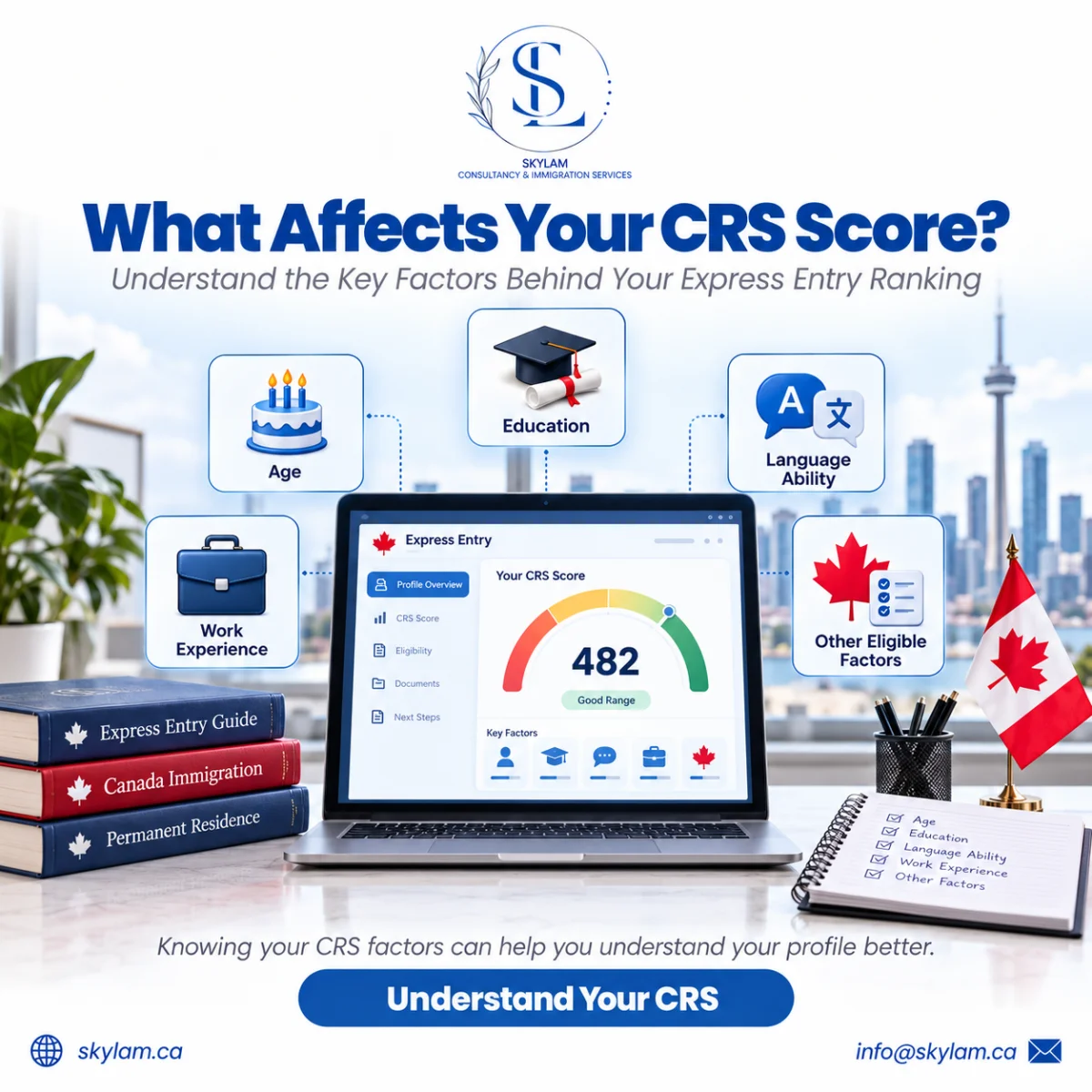
Your CRS score is not simply based on one factor. It considers several aspects of your profile, including your age, education, language ability, Canadian work experience, foreign work experience, spouse or common-law partner factors, and certain additional factors.
Understanding these factors can help you identify areas of your profile that may need attention before or after creating an Express Entry profile.
It is also important to understand that a CRS score does not guarantee an invitation to apply for permanent residence. IRCC conducts different types of invitation rounds, and the minimum score can change from one round to another.
This guide explains the major CRS factors, how the points system works, what has changed recently and what applicants should consider when planning their Express Entry journey.
What Is the Express Entry CRS?
The Comprehensive Ranking System is used to rank candidates who are already in the Express Entry pool.
To enter the pool, you must first be eligible for at least one of the immigration programs managed through Express Entry.
These include:
-
Federal Skilled Worker Program
-
Canadian Experience Class
-
Federal Skilled Trades Program
Once eligible candidates create an Express Entry profile, IRCC assigns them a CRS score based on the information in their profile.
Candidates are then ranked against other candidates in the pool.
When IRCC conducts an invitation round, candidates with qualifying profiles and sufficiently high rankings may receive an Invitation to Apply (ITA) for permanent residence.
How Many CRS Points Can You Get?
The CRS has a maximum of 1,200 points.
The system is broadly divided into:
Core/Human Capital Factors
Up to 500 points for candidates without an accompanying spouse or common-law partner, or up to 460 points for candidates with an accompanying spouse or common-law partner.
Spouse or Common-Law Partner Factors
Up to 40 points when applicable.
Skill Transferability Factors
Up to 100 points.
Additional Points
Up to 600 points.
Together, these components produce a maximum possible CRS score of 1,200.
The exact points available depend on your circumstances.
1. Age
Age is one of the core CRS factors.
For candidates without an accompanying spouse or common-law partner, applicants aged 20 to 29 can receive the maximum age points.
After age 29, the number of points gradually decreases.
For example, under the current CRS table:
| Age | With spouse/partner | Without spouse/partner |
|---|---|---|
| 20–29 | 100 | 110 |
| 30 | 95 | 105 |
| 31 | 90 | 99 |
| 32 | 85 | 94 |
| 33 | 80 | 88 |
| 34 | 75 | 83 |
| 35 | 70 | 77 |
| 36 | 65 | 72 |
| 37 | 60 | 66 |
| 38 | 55 | 61 |
| 39 | 50 | 55 |
| 40 | 45 | 50 |
| 41 | 35 | 39 |
| 42 | 25 | 28 |
| 43 | 15 | 17 |
| 44 | 5 | 6 |
| 45+ | 0 | 0 |
Applicants cannot control their age-related CRS points. However, understanding how age affects the score can help people plan their immigration timeline realistically.
2. Level of Education
Education is another major CRS factor.
Higher educational qualifications can result in more CRS points, provided the credential meets the applicable requirements.
For foreign education, an Educational Credential Assessment (ECA) may be required for Express Entry purposes.
An ECA is used to determine what a foreign educational credential is equivalent to in Canada.
Education points can vary depending on whether you have:
-
Secondary school education
-
One-year post-secondary credential
-
Two-year post-secondary credential
-
Bachelor's degree
-
Two or more post-secondary credentials
-
Master's degree
-
Professional degree
-
Doctoral degree
The exact CRS points depend on the credential and whether you have an accompanying spouse or common-law partner.
For example, under the current CRS criteria, a doctoral-level credential can receive up to 140 points with a spouse/common-law partner or 150 points without one under the core education factor.
What Is an ECA?
If you completed your education outside Canada, an ECA can be an important part of your Express Entry preparation.
The assessment organization evaluates your foreign credential and provides a Canadian equivalency.
The ECA report can then be used to determine the education level that should be entered into your Express Entry profile.
Applicants should use an ECA organization designated by IRCC when an ECA is required.
An ECA is not the same as receiving a Canadian degree.
It is an assessment of a foreign credential for immigration purposes.
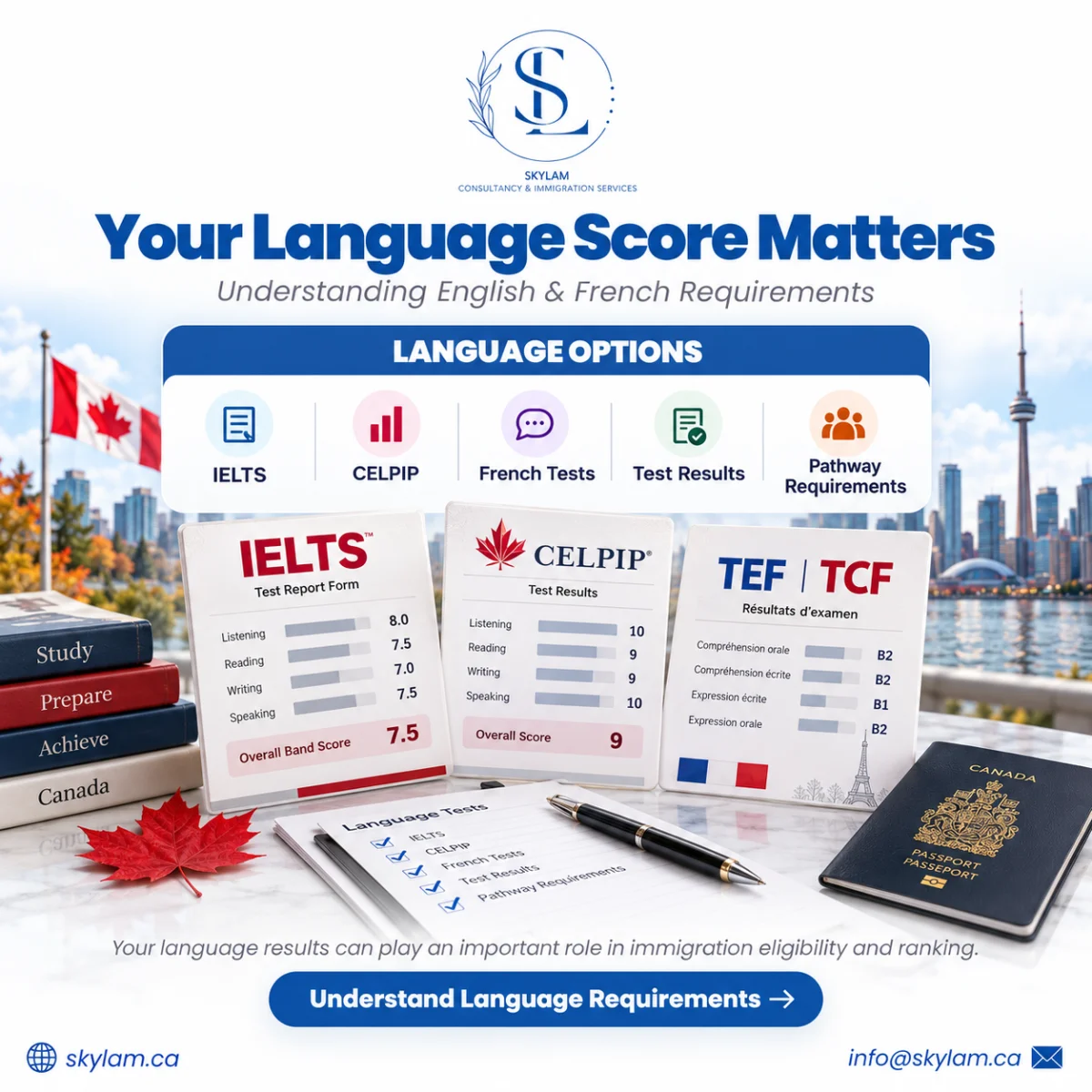
3. Official Language Ability
Language ability is one of the most important CRS factors.
For Express Entry, applicants may be able to claim points based on their English and/or French language test results.
IRCC recognizes specific approved language tests for Express Entry.
For English, these include:
-
IELTS General Training
-
CELPIP-General
-
PTE Core
For French, accepted tests include:
-
TEF Canada
-
TCF Canada
Language results are converted into Canadian Language Benchmark (CLB) or Niveaux de compétence linguistique canadiens (NCLC) levels for immigration purposes.
Your results are assessed across four abilities:
-
Reading
-
Writing
-
Listening
-
Speaking
Why Language Scores Matter So Much
Language can affect your CRS score in several different ways.
Your first official language contributes to core CRS points.
Language ability can also combine with education and work experience under the skill transferability factors.
French-language ability can also provide additional CRS points when the applicant meets the relevant requirements.
Under the current CRS criteria, strong French-language skills can provide up to 50 additional points, depending on the applicant's English results as well.
This means improving language ability can sometimes have a broader effect on an Express Entry profile than applicants initially expect.
4. Canadian Work Experience
Canadian work experience can contribute significantly to CRS.
Under the current CRS table, candidates without an accompanying spouse or common-law partner can receive:
-
1 year: up to 40 points
-
2 years: up to 53 points
-
3 years: up to 64 points
-
4 years: up to 72 points
-
5 years or more: up to 80 points
Candidates with an accompanying spouse or common-law partner can receive up to 70 points under this factor.
However, simply working in Canada does not automatically mean that all work experience will count.
The experience must meet the requirements applicable to the immigration program and CRS rules.
Applicants should carefully document their employment history.
5. Foreign Work Experience
Foreign work experience can also contribute to the CRS through skill transferability factors.
This is important because foreign work experience does not simply add a fixed number of points on its own in the same way as some core factors.
Instead, it can combine with:
-
Official language ability
-
Canadian work experience
For example, candidates with three or more years of foreign work experience and strong official language ability can receive up to 50 points through certain skill-transferability combinations.
This demonstrates an important feature of the CRS:
The combination of factors can matter as much as the individual factors themselves.
6. Skill Transferability
Skill transferability is designed to recognize combinations of education, language ability and work experience.
There are several combinations.
These include:
Education + Official Language Ability
A post-secondary credential combined with strong official language ability can produce additional CRS points.
Education + Canadian Work Experience
Canadian work experience combined with post-secondary education can provide additional points.
Foreign Work Experience + Official Language Ability
Foreign work experience combined with strong language results can produce additional points.
Foreign Work Experience + Canadian Work Experience
Applicants with both Canadian and foreign work experience may receive points through this combination.
Certificate of Qualification + Language Ability
This can apply to candidates in eligible trade occupations who have a certificate of qualification.
The total available under skill transferability factors is 100 points.
7. Spouse or Common-Law Partner Factors
If you have an accompanying spouse or common-law partner, their qualifications can affect your CRS score.
There are three major spouse/partner factors:
-
Education
-
Official language proficiency
-
Canadian work experience
A spouse or common-law partner can contribute up to:
-
10 points for education
-
20 points for language
-
10 points for Canadian work experience
That gives a maximum of 40 points.
For example, a spouse with strong official language results may contribute additional CRS points.
Similarly, Canadian work experience and education can contribute points under the applicable criteria.
8. Canadian Education
Canadian post-secondary education can provide additional CRS points.
Under the current CRS criteria:
-
A qualifying Canadian post-secondary credential of one or two years can provide up to 15 additional points.
-
A qualifying Canadian post-secondary credential of three years or longer can provide up to 30 additional points.
Additional conditions apply to Canadian education points, so applicants should verify that their credential meets the applicable requirements.
This is separate from the education points included under the core CRS factors.
9. French-Language Ability
French can play an important role in Canada's economic immigration system.
Strong French-language ability can provide additional CRS points.
Under the current CRS rules, applicants who have NCLC 7 or higher in all four French abilities can receive:
-
Up to 25 additional points when their English results are CLB 4 or lower or they have not taken an English test
-
Up to 50 additional points when they also have CLB 5 or higher in all four English abilities
French may therefore be particularly relevant for applicants who already have some French-language ability or are considering developing their French skills.
10. Sibling in Canada
Having a brother or sister living in Canada can provide additional CRS points if the applicable conditions are met.
The sibling generally must be:
-
18 years or older
-
A Canadian citizen or permanent resident
The relationship and the sibling's status must meet the relevant requirements.
The maximum additional points under this factor are 15.
Applicants should not claim these points simply because they have a relative somewhere in Canada.
The specific relationship and eligibility conditions matter.
11. Provincial or Territorial Nomination
A provincial or territorial nomination can have a very significant effect on CRS.
Under the current CRS criteria, a qualifying provincial or territorial nomination can provide 600 additional CRS points.
This is one of the largest sources of additional CRS points.
However, obtaining a provincial nomination is not automatic.
Each participating province or territory has its own immigration programs and requirements.
Applicants must qualify for the relevant provincial or territorial stream before receiving a nomination.
Important 2026 Change: Job Offers No Longer Give CRS Points
One of the most important CRS changes applicants need to understand is the removal of CRS points for job offers.
As of March 25, 2025, IRCC removed CRS points for job offers.
Previously, certain valid job offers could provide 50 or 200 CRS points depending on the position.
Those points are no longer awarded under the CRS.
However, this does not mean that job offers are irrelevant to Canadian immigration.
A valid job offer can still matter for eligibility under certain immigration programs, including the Federal Skilled Trades Program, Federal Skilled Worker Program and some Provincial Nominee Program streams.
This distinction is extremely important.
CRS points and program eligibility are not the same thing.
A job offer may no longer add CRS points while still being relevant to eligibility for a particular program.
Does a High CRS Score Guarantee an Invitation?
No.
This is one of the most common misconceptions about Express Entry.
IRCC conducts different types of invitation rounds, and the minimum CRS score can change.
The score required in one round may be different from the score required in another.
IRCC explains that candidates need to have a score above the minimum score for the particular round in order to receive an invitation.
Therefore, applicants should avoid statements such as:
“If your CRS is X, you will definitely receive an ITA.”
There is no universal CRS number that guarantees an invitation in every future round.
CRS and Category-Based Selection
Express Entry is not limited to general invitation rounds.
IRCC can also conduct category-based selection rounds.
These rounds identify candidates who meet specific category requirements.
Current categories include areas such as:
-
French-language proficiency
-
Healthcare and social services
-
STEM occupations
-
Trade occupations
-
Education
-
Transport
-
Physicians with Canadian work experience
-
Senior managers with Canadian work experience
-
Researchers with Canadian work experience
-
Skilled military recruits
Candidates still receive CRS scores, but in a category-based round they must also meet the requirements of the relevant category.
This means applicants should look at more than just their CRS score.
They should also understand whether their occupation, language ability or other circumstances may align with a current category.
How Can You Improve Your CRS Score?
Not every CRS factor can be changed.
You cannot change your age or rewrite your past education.
However, some areas may be improved through legitimate planning.
Improve Your Language Results
Language testing is one of the areas where applicants may be able to improve their profile.
A higher language level can potentially improve:
-
Core language points
-
Skill transferability points
-
Eligibility for certain programs
-
Additional French-language points
Applicants should always use approved tests and enter accurate results.
Complete Additional Education
Additional education may affect your CRS score depending on your existing credentials and the applicable rules.
However, education should not be pursued solely because someone promises that it will guarantee an ITA.
The cost, time and relevance of the education should be considered carefully.
Gain Qualifying Work Experience
Additional qualifying Canadian work experience may increase CRS points.
Foreign work experience may also become more valuable when combined with strong language results or Canadian experience.
Applicants should maintain accurate employment records throughout their careers.
Explore Provincial Nomination Opportunities
For eligible candidates, a provincial or territorial nomination can significantly increase CRS because of the 600 additional points.
However, applicants should not apply randomly to provinces.
Each province has different programs, eligibility requirements and priorities.
The appropriate approach is to research programs that genuinely match your profile.
Consider French
Applicants who have an interest or ability in French may want to explore whether improving French could benefit their Express Entry profile.
Strong French results can provide additional CRS points when the applicable requirements are met.
What Should You Check Before Calculating Your CRS?
Before calculating your score, make sure you have accurate information about:
Personal Information
-
Age
-
Marital status
-
Accompanying spouse or partner
Education
-
Highest credential
-
Other credentials
-
Canadian education
-
ECA result if applicable
Language
-
English results
-
French results
-
Test date
-
CLB/NCLC levels
Work Experience
-
Canadian work experience
-
Foreign work experience
-
Occupation
-
Duration
-
Qualifying employment
Additional Factors
-
Provincial nomination
-
Canadian education
-
Eligible sibling in Canada
-
French-language ability
Accurate information is essential because your CRS score is calculated from the information in your profile.
Common CRS Mistakes to Avoid
Mistake 1: Assuming a Job Offer Gives 50 CRS Points
It does not under the current rules.
Job-offer CRS points were removed in March 2025.
Mistake 2: Confusing Eligibility With CRS
Being eligible for Express Entry does not automatically mean your CRS score will be competitive enough for an ITA.
Mistake 3: Using an Incorrect Education Equivalency
Foreign education should be entered according to the applicable ECA results when an ECA is required.
Mistake 4: Entering Expired Language Results
Applicants must ensure their language test results meet the validity requirements when required.
Mistake 5: Assuming Previous Cut-Offs Will Stay the Same
Invitation cut-offs can vary from round to round.
Mistake 6: Ignoring French
For eligible candidates, French can be an important source of additional CRS points.
Mistake 7: Assuming a Consultant Can Increase Your CRS
A representative cannot simply add points to your profile.
CRS points must be supported by genuine qualifications, test results, education, work experience or other eligible factors.
CRS Improvement Checklist
If you are planning your Express Entry profile, consider reviewing:
☐ Age and application timeline
☐ Highest education credential
☐ ECA requirements
☐ English language results
☐ French language results
☐ Canadian work experience
☐ Foreign work experience
☐ Spouse/partner factors
☐ Canadian education
☐ Eligible sibling in Canada
☐ Provincial nomination options
☐ Current Express Entry categories
☐ Validity of language test results
☐ Accuracy of employment information
This checklist does not guarantee an ITA, but it can help you identify areas that deserve attention.
How Skylam Immigration Services Can Help With Express Entry Planning
Understanding CRS can be confusing, especially when several factors interact.
Skylam Immigration Services provides personalized support for individuals exploring Canadian immigration options, including skilled worker programs.
For an Express Entry applicant, professional support may help with understanding the information relevant to the applicant's circumstances, organizing documents and reviewing possible immigration pathways.
The exact services available should be confirmed directly with Skylam before proceeding.
Applicants should always provide complete and truthful information.
There should never be an expectation that a representative can guarantee an ITA, increase a score artificially or guarantee permanent residence.
The purpose of immigration support should be to help applicants understand the process and prepare according to the applicable requirements.
Frequently Asked Questions About CRS
What is the maximum CRS score?
The maximum CRS score is 1,200 points. It combines core/human capital factors, spouse or partner factors where applicable, skill transferability and additional points.
What factors affect CRS score?
Major factors include age, education, official language ability, Canadian work experience, spouse or partner factors, skill transferability, Canadian education, French ability, eligible siblings in Canada and provincial or territorial nominations.
Do job offers still give CRS points?
No. As of March 25, 2025, job-offer CRS points were removed. However, job offers can still be relevant to eligibility for certain immigration programs.
How many CRS points does a provincial nomination give?
A provincial or territorial nomination can provide 600 additional CRS points under the current CRS criteria.
Does French give extra CRS points?
Yes. Strong French-language results can provide additional CRS points when the applicable requirements are met. Up to 50 additional points can be available under the current criteria.
Does Canadian education give CRS points?
Yes. Eligible Canadian post-secondary education can provide additional CRS points, with the current criteria allowing up to 15 points for qualifying one- or two-year credentials and up to 30 points for qualifying credentials of three years or longer.
Does foreign work experience increase CRS?
Foreign work experience can contribute through skill transferability factors, particularly when combined with strong language ability or Canadian work experience.
Is a high CRS score enough to guarantee an ITA?
No. Invitation rounds have their own requirements and minimum scores, and cut-offs can vary. Category-based rounds can also have additional eligibility requirements.
Can I improve my CRS score?
Potentially, depending on your circumstances. Areas that may change include language results, qualifying work experience, education, French-language ability and provincial nomination opportunities.
Should I create an Express Entry profile just to see my CRS score?
You should first make sure you are eligible for at least one Express Entry program. IRCC also provides a CRS calculator that can help eligible candidates estimate their score.
Final Takeaway
Your Express Entry CRS score is based on a combination of factors—not one single qualification.
The major areas include:
Age + Education + Language + Work Experience + Spouse/Partner Factors + Skill Transferability + Additional Points
Some factors, such as age, cannot be changed. Others, such as language results, qualifying work experience, education or French-language ability, may provide opportunities for legitimate profile improvement.
One of the most important lessons for Express Entry applicants in 2026 is that CRS rules can change. The removal of job-offer CRS points in March 2025 is a good example of why applicants should not rely on older immigration information.
Before making an immigration decision, check the latest information from IRCC and make sure your profile accurately reflects your real circumstances.
If you are exploring skilled worker immigration to Canada, Skylam Immigration Services can provide personalized support based on the services available to you.
A strong Express Entry strategy starts with accurate information, realistic expectations and careful planning.