
Canada Express Entry Researchers Update 2026: Stipend-Funded Work Experience Now Recognized
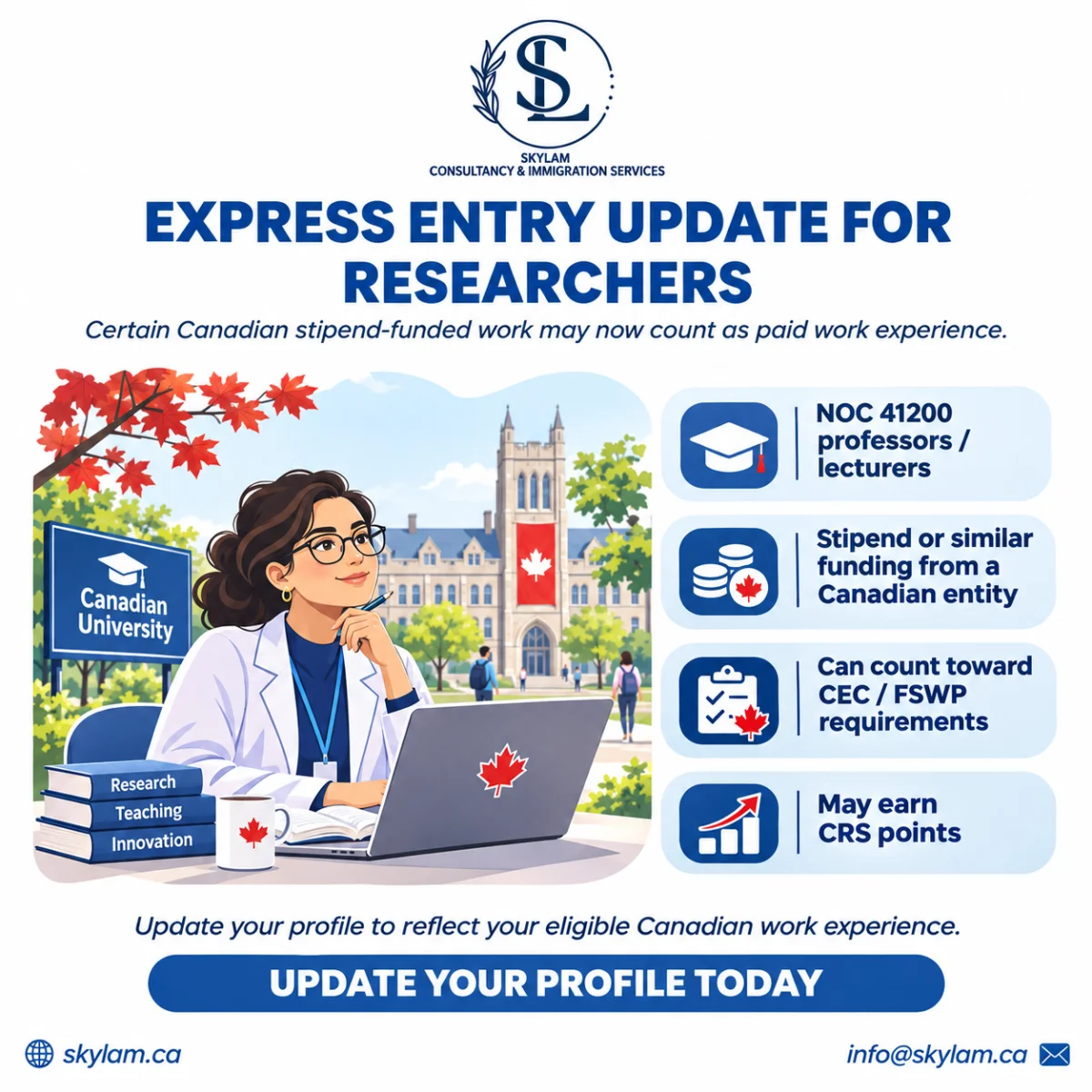
Canada has introduced an important Express Entry policy update affecting university professors, lecturers and eligible researchers with Canadian work experience.
On November 18, 2026, Immigration, Refugees and Citizenship Canada (IRCC) announced changes to the eligibility criteria for the Researchers with Canadian Work Experience category.
Effective November 17, 2026, qualifying Canadian work experience under National Occupational Classification (NOC) 41200 may now include employment compensated through stipends, grants, bursaries, scholarships and similar financial arrangements provided by Canadian entities.
This update recognizes that many researchers and academics receive compensation through funding arrangements rather than traditional employment wages.
Eligible candidates may now be able to count qualifying experience toward the Canadian Experience Class (CEC), Federal Skilled Worker Program (FSWP), and applicable Comprehensive Ranking System (CRS) points.
However, eligibility remains subject to program-specific requirements.
1. What Has Changed Under Express Entry?
Previously, certain researchers receiving stipends or similar non-wage funding could face difficulties having their work experience recognized under the standard paid-employment requirements.
IRCC has now clarified that eligible Canadian experience in NOC 41200 can qualify even when compensation is provided through specified non-wage arrangements.
Key changes effective November 17, 2026:
-
Eligible Canadian work experience under NOC 41200 can include stipends and similar monetary funding from Canadian entities.
-
Qualifying work may count toward CEC and FSWP experience requirements.
-
Eligible experience can contribute to CRS points.
-
Qualifying job offers may also be recognized under applicable Express Entry rules.
-
NOC 41201 is no longer included in the Researchers with Canadian Work Experience category.
The changes aim to recognize academic employment arrangements more accurately.
2. Which Occupations Are Affected?
The update primarily concerns:
NOC 41200 — University Professors and Lecturers
This occupational category includes eligible academic professionals undertaking university-level teaching and research activities.
Examples may include university professors, lecturers and eligible researchers whose duties and employment circumstances meet the relevant NOC requirements.
It is important to distinguish the actual employment duties from an applicant's job title.
IRCC assesses qualifying experience according to applicable occupational and immigration program requirements.
3. What Types of Compensation Can Now Qualify?
IRCC recognizes several forms of non-wage monetary compensation for qualifying NOC 41200 Canadian work experience.
These include:
-
Stipends
-
Research grants
-
Bursaries
-
Scholarships
-
Other qualifying monetary funding arrangements
The compensation must be provided by a Canadian entity and relate to eligible employment activities.
Receiving a scholarship or grant does not automatically mean that all associated activities qualify as work experience.
Applicants must demonstrate that the experience satisfies the requirements of the relevant immigration program.
4. How Does This Affect the Canadian Experience Class?
The Canadian Experience Class is a federal immigration program administered through Express Entry.
Applicants generally need at least one year, or 1,560 hours, of qualifying Canadian skilled work experience gained within the three years preceding their application.
The November 2026 update means that eligible NOC 41200 experience paid through qualifying non-wage monetary arrangements can now be considered when assessing the relevant work experience requirements.
Applicants must continue meeting other CEC conditions, including requirements related to work authorization, occupational duties and language ability.
The update does not remove the standard requirement to establish qualifying Canadian work experience.
5. How Does This Affect the Federal Skilled Worker Program?
The Federal Skilled Worker Program is another Express Entry-managed economic immigration pathway.
IRCC has confirmed that eligible Canadian work experience under NOC 41200 compensated through qualifying stipends or similar funding can now count toward applicable FSWP work experience requirements.
Candidates must still satisfy the program's other requirements.
These may include:
-
Qualifying skilled work experience
-
Language proficiency
-
Education requirements
-
Selection criteria
-
Relevant admissibility requirements
The recognition of stipend-funded experience does not guarantee that an applicant will meet every FSWP eligibility condition.
6. Can Researchers Receive Additional CRS Points?
The Comprehensive Ranking System evaluates eligible Express Entry candidates and ranks them within the selection pool.
IRCC has indicated that qualifying Canadian work experience under NOC 41200 can contribute to CRS points.
Recognition of qualifying job offers may also affect points under the applicable updated CRS rules.
The actual number of points depends on the applicant's circumstances and current scoring requirements.
Applicants should avoid assuming that everyone receiving a stipend automatically qualifies for additional points.
IRCC's current CRS criteria should be reviewed before estimating any potential score increase.
7. Important Change for NOC 41201
Alongside the expanded recognition of eligible NOC 41200 experience, IRCC has announced a separate occupational eligibility change.
NOC 41201 — Post-secondary Teaching and Research Assistants is no longer eligible for the Researchers with Canadian Work Experience category.
This distinction is particularly important for individuals working in Canadian universities and research institutions.
Applicants should confirm their correct NOC classification rather than assuming that every research-related position qualifies under the category.
The exclusion concerns the specific researcher selection category; it should not automatically be interpreted as making all NOC 41201 experience ineligible for every other immigration program.
8. Eligibility for the Researchers With Canadian Work Experience Category
The Researchers with Canadian Work Experience category is intended to help Canada attract and retain eligible academic and research talent.
Under the published category requirements, applicants generally need qualifying Canadian work experience in the eligible occupation.
The category requires at least 12 months of qualifying full-time Canadian work experience, or an equivalent amount of part-time experience, within the previous three years.
The experience does not need to be continuous.
Candidates must also satisfy the minimum requirements of an Express Entry-managed immigration program and meet the relevant category-based selection rules.
Meeting a category's occupational requirements does not guarantee an invitation to apply.
9. What Should Existing Express Entry Candidates Do?
IRCC advises individuals with qualifying Canadian research experience to update their Express Entry profiles.
Candidates should review whether their previously declared experience now qualifies under the revised rules.
Recommended steps:
-
Confirm that your employment duties correspond to NOC 41200.
-
Identify the period during which the qualifying work was performed in Canada.
-
Review your compensation arrangements and Canadian funding source.
-
Collect supporting employment and financial documentation.
-
Check eligibility under CEC, FSWP or the relevant researcher category.
-
Update your Express Entry profile with accurate information.
IRCC's CEC guidance also instructs candidates reporting qualifying NOC 41200 experience not to select the self-employed work checkbox when entering that eligible Canadian experience.
Applicants should follow the applicable official instructions and provide accurate supporting information.
10. Why Is Canada Introducing This Change?
The federal government has identified research and innovation as important components of Canada's economic development strategy.
Universities and research institutions employ professionals whose compensation arrangements may differ from those found in conventional employment.
Stipends, grants and scholarships are common within academic and research environments.
The revised rules recognize qualifying forms of compensation while maintaining occupational and immigration eligibility requirements.
IRCC states that the changes are intended to help attract and retain research talent contributing to Canada's innovation ecosystem.
11. Frequently Asked Questions
When did the new Express Entry researcher rules take effect?
The changes took effect on November 17, 2026, with IRCC publishing its announcement on November 18, 2026.
Can stipend-funded work now count as Canadian work experience?
Yes, qualifying NOC 41200 Canadian experience paid by a Canadian entity through stipends or other eligible monetary funding can be recognized.
Are grants and scholarships included?
Yes. IRCC identifies grants, bursaries and scholarships among the forms of monetary compensation that may qualify.
Does the change apply to all researchers?
No. Applicants must meet the relevant occupation and immigration program requirements.
Can eligible experience count toward CEC?
Yes, if the experience satisfies the applicable Canadian Experience Class conditions.
Can eligible experience count toward FSWP?
Yes, qualifying experience may count toward the Federal Skilled Worker Program's work experience requirements.
Will my CRS score automatically increase?
Not necessarily. CRS points depend on the applicant's qualifying experience, other circumstances and applicable scoring rules.
Is NOC 41201 still eligible for the researcher category?
No. IRCC has removed NOC 41201 from the Researchers with Canadian Work Experience category.
Should candidates update their Express Entry profiles?
Yes. IRCC encourages candidates with qualifying Canadian experience to update their profiles to accurately reflect that experience.
Conclusion
Canada's November 2026 Express Entry update introduces important changes for eligible university professors, lecturers and researchers with Canadian work experience.
Recognizing qualifying stipend-funded and grant-funded work under NOC 41200 may help eligible candidates meet CEC and FSWP requirements and receive applicable CRS points.
At the same time, the exclusion of NOC 41201 from the researcher category makes correct occupational classification especially important.
Candidates should review their employment history, funding arrangements and eligibility requirements before updating their Express Entry profiles.
Explore Your Canadian Immigration Options With Skylam
Have you gained teaching or research experience in Canada?
Skylam Consultancy & Immigration Services provides information and guidance on Express Entry, Canadian permanent residence pathways and immigration eligibility requirements.
Stay informed about the latest Canadian immigration changes and review how they may relate to your circumstances.
Website: https://skylam.ca
Email: info@skylam.ca
Representative verification: Verify an immigration consultant's registration status through the College of Immigration and Citizenship Consultants public register:
https://register.college-ic.ca