
Canada Immigration in November 2026: What Applicants Should Know
Canada remains an important destination for people exploring skilled employment, higher education, family reunification and permanent residence. However, Canadian immigration programs have different eligibility requirements, application procedures and financial considerations. Understanding the latest information is essential before choosing a pathway.
November 2026 begins with an important development in the Express Entry system. Immigration, Refugees and Citizenship Canada (IRCC) introduced changes to the Comprehensive Ranking System (CRS) on November 3, 2026, placing new emphasis on Canadian work experience in eligible high-wage occupations and qualifying job offers.
These changes may affect candidates who are already in the Express Entry pool, as well as people preparing to create a profile.
But Express Entry is only one part of Canada's immigration system. Study permits, work permits, Provincial Nominee Programs, family sponsorship and regional immigration pathways also remain important areas for applicants to understand.
This guide provides an overview of important Canadian immigration topics for November 2026, explains the latest verified Express Entry changes and highlights what prospective applicants should consider before starting an application.
1. Important Express Entry Changes Effective November 3, 2026
One of the most significant immigration developments at the beginning of November concerns the Express Entry Comprehensive Ranking System.
On October 16, 2026, IRCC announced changes to the CRS and job-offer assessment process. These changes took effect on November 3, 2026. <Cite refs={["turn970073search1","turn970073news5"]}/>
The updated system introduces a new CRS component called the Labour Market Integration factor.
This factor recognizes either:
-
Eligible Canadian work experience, with additional points for qualifying experience in high-wage occupations; or
-
A qualifying job offer in an eligible high-wage occupation.
Candidates can receive points through Canadian work experience or a qualifying job offer under this new factor, but they cannot receive points for both through the same component.
How the new Labour Market Integration factor works
Under the new rules, the maximum available points depend on whether the candidate has an accompanying spouse or common-law partner.
| Factor | With accompanying spouse/partner | Without accompanying spouse/partner |
|---|---|---|
| Maximum Labour Market Integration points | 140 | 150 |
| Qualifying job offer option | Up to 100 | Up to 100 |
For Canadian work experience, the points combine qualifying work duration with additional points for eligible high-wage occupation experience.
The work-duration component can provide up to 70 points with an accompanying spouse or partner, or 80 points without one. Eligible high-wage experience can provide up to another 70 points. <Cite refs={["turn970073search3","turn970073news5"]}/>
What counts as a high-wage occupation?
IRCC uses occupation-level wage information to identify eligible high-wage occupations.
An occupation is considered high-wage for this purpose when its median wage is at least 1.3 times the overall Canadian workforce's median wage, according to the methodology published by IRCC.
The assessment is based on the occupation's wage data, not simply on the salary an individual applicant happens to receive.
IRCC groups eligible occupations into three levels:
-
At least twice the overall workforce median wage
-
At least 1.5 times but less than twice the median wage
-
At least 1.3 times but less than 1.5 times the median wage
The applicable occupation list and methodology should be checked through IRCC's official website. <Cite refs={["turn970073news13","turn970073search1"]}/>
What does this mean for job offers?
The updated CRS rules reintroduce points for qualifying job offers in eligible high-wage occupations.
| Qualifying job-offer category | CRS points |
|---|---|
| At least twice the overall median wage | 100 |
| At least 1.5 times but less than twice the median wage | 70 |
| At least 1.3 times but less than 1.5 times the median wage | 50 |
| Not in an eligible high-wage occupation | 0 |
A job offer must meet the relevant Express Entry requirements and be considered genuine by the immigration officer. <Cite refs={["turn970073search3"]}/>
Does a job offer still need an LMIA?
As of November 3, 2026, IRCC no longer requires a Labour Market Impact Assessment (LMIA) for a qualifying job offer to receive the new Express Entry points or meet the relevant job-offer requirements under the Federal Skilled Worker Program and Federal Skilled Trades Program.
However, removing the LMIA requirement does not mean that every job offer automatically qualifies.
IRCC will still assess whether the job offer is genuine and meets the applicable requirements. <Cite refs={["turn970073search2","turn970073search1"]}/>
Important: Applicants should not assume that an ordinary employment letter or informal promise of work automatically qualifies for CRS points.
2. Temporary Pause in Express Entry Invitation Rounds
Another important part of the November update is the temporary pause in Express Entry invitation rounds.
IRCC has stated that existing profiles will be recalculated under the new CRS rules. The recalculation process may take up to two weeks.
During this period, invitation rounds will be paused and are expected to resume after the process is complete. <Cite refs={["turn970073news5","turn970073search3"]}/>
What should existing Express Entry candidates do?
If you already have a profile in the Express Entry pool, consider the following:
-
Review the new CRS rules.
-
Check whether your Canadian work experience may qualify for additional points.
-
Review whether you have a qualifying job offer.
-
Check whether your occupation appears on IRCC's eligible high-wage occupation list.
-
Make sure your profile information is accurate.
-
Follow official IRCC instructions for updating your profile.
Candidates should avoid making assumptions about their new score before the recalculation is completed.
If you have a job offer that is not included in your profile, IRCC advises candidates to update their profile with the relevant information.
The online system may temporarily display instructions that have not yet been fully updated to reflect the new rules. Applicants should follow IRCC's published transition guidance rather than guessing how to enter information. <Cite refs={["turn970073search2","turn970073search3"]}/>
3. Understanding Express Entry Categories
Express Entry remains one of Canada's major economic immigration systems.
It manages applications for:
-
Federal Skilled Worker Program
-
Canadian Experience Class
-
Federal Skilled Trades Program
-
A portion of Provincial Nominee Program applications
Candidates must first qualify for an eligible program before entering the Express Entry pool.
After entering the pool, candidates receive a CRS score and are ranked against other candidates.
IRCC can invite candidates through different types of invitation rounds, including general rounds, program-specific rounds and category-based selection rounds.
What is category-based selection?
Category-based selection allows IRCC to invite candidates who meet specific category requirements.
The categories announced for 2026 include areas such as:
-
French-language proficiency
-
Healthcare and social services
-
Science, technology, engineering and mathematics
-
Trade occupations
-
Education
-
Transport
-
Physicians with Canadian work experience
-
Senior managers with Canadian work experience
-
Researchers with Canadian work experience
-
Skilled military recruits
Category-based selection does not remove the need to qualify for an Express Entry program.
Candidates must meet the relevant program and category requirements to be considered. <Cite refs={["turn970073search1","turn970073news8"]}/>
Applicants should therefore consider both their CRS score and whether their professional background may fit an eligible category.
4. Study Permit Preparation for International Students
Canada continues to attract international students interested in post-secondary education and professional development.
However, a study permit application involves more than receiving admission from a Canadian educational institution.
Applicants should understand the requirements before making financial or educational commitments.
Important study permit considerations
Before applying, prospective students should review:
-
Admission from a Designated Learning Institution (DLI)
-
Letter of Acceptance
-
Provincial or Territorial Attestation Letter, where required
-
Financial documentation
-
Educational history
-
Study plans
-
Identity documents
-
Biometrics, where required
-
Medical examination, where applicable
Some applicants may also need additional provincial documents, depending on where they intend to study.
Financial preparation
Study permit applicants generally need to demonstrate that they can pay their tuition, support themselves and pay transportation costs.
Financial requirements vary depending on the number of accompanying family members and the location of study.
For Quebec, separate financial requirements apply.
Applicants should check the current IRCC proof-of-funds guidance before submitting their application. They should not rely on financial figures from older articles or previous application cycles.
Does studying in Canada guarantee permanent residence?
No.
A Canadian study permit is temporary authorization to study. Completing a Canadian educational program does not automatically provide permanent residence.
Some graduates may qualify for a Post-Graduation Work Permit (PGWP), depending on the applicable program and eligibility rules.
However, PGWP eligibility is not automatic for every course or institution.
Students should check the current requirements before choosing a program. <Cite refs={["turn970073news14"]}/>
5. Work Permit Planning in Canada
For people interested in working in Canada, understanding work permit categories is an important first step.
Canadian work permits generally fall into two broad categories:
Employer-specific work permits
These permits authorize a person to work under specified conditions, which may include the employer, location and occupation.
Open work permits
These allow eligible individuals to work for most employers, subject to any restrictions attached to the permit.
Open work permits are available only to people who meet specific eligibility requirements. They are not available to every applicant simply because they want to work in Canada.
What should work permit applicants prepare?
Depending on the application, documents may include:
-
Passport
-
Employment offer
-
Employer-related documents
-
LMIA or exemption-related information, where applicable
-
Educational documents
-
Work experience evidence
-
Application forms
-
Financial documents, where required
-
Medical or police documents, where applicable
The exact requirements depend on the type of work permit and the applicant's circumstances.
Applicants should not pay for an employment offer without verifying the employer and the legitimacy of the opportunity.
6. Provincial Nominee Programs: Exploring Opportunities Across Canada
The Provincial Nominee Program (PNP) allows participating provinces and territories to nominate eligible individuals who meet their immigration priorities.
Different provinces have different immigration streams.
Some streams focus on skilled workers, while others may target international graduates, entrepreneurs or people with employment connections in the province.
Why do PNP requirements differ?
Each province has its own labour market needs and selection criteria.
Depending on the stream, applicants may need:
-
Relevant work experience
-
Education
-
Language test results
-
A qualifying job offer
-
A connection to the province
-
Financial resources
-
Other program-specific qualifications
Some provincial streams are aligned with Express Entry, while others operate outside the Express Entry system.
What should applicants remember?
A person who qualifies for one provincial stream may not qualify for another.
Applicants should research the exact province and stream rather than assuming that a general PNP eligibility checklist applies everywhere.
They should also check whether a stream is open, accepting expressions of interest or operating under an intake limit before preparing an application.
7. Family Sponsorship and Reuniting With Family
Family sponsorship is another important Canadian immigration pathway.
It allows eligible Canadian citizens and permanent residents to sponsor certain family members under the relevant program rules.
Depending on the category, sponsorship may involve:
-
Spouse
-
Common-law partner
-
Conjugal partner
-
Dependent child
-
Parent or grandparent, subject to the applicable program and intake arrangements
What should applicants understand?
Family sponsorship applications require accurate information about the relationship between the sponsor and the person being sponsored.
Supporting evidence may include:
-
Marriage documentation
-
Proof of cohabitation, where relevant
-
Birth certificates
-
Identity documents
-
Family information
-
Sponsor eligibility documents
-
Financial information, where applicable
The documents required vary by sponsorship category.
Applicants should also understand that the Parents and Grandparents Program has separate intake arrangements and should not assume that applications are open simply because they are interested in sponsoring a parent or grandparent.
Always check the latest IRCC announcements for intake information.
8. Language Tests Remain Important for Many Applicants
Language ability can influence eligibility and competitiveness across several immigration programs.
For Express Entry, IRCC accepts specific English and French language tests.
Approved English tests include:
-
IELTS General Training
-
CELPIP-General
-
PTE Core
Approved French tests include:
-
TEF Canada
-
TCF Canada
The test requirements depend on the immigration program.
For Express Entry, language results are converted into Canadian Language Benchmark (CLB) or Niveaux de compétence linguistique canadiens (NCLC) levels.
Applicants should remember that:
-
The test must be accepted for the relevant program.
-
Results must meet the required validity period.
-
Each language ability is assessed separately.
-
A result in one skill does not automatically establish the required level in every other skill.
Language preparation should begin early enough to allow applicants to understand their current level and plan for any required improvement.
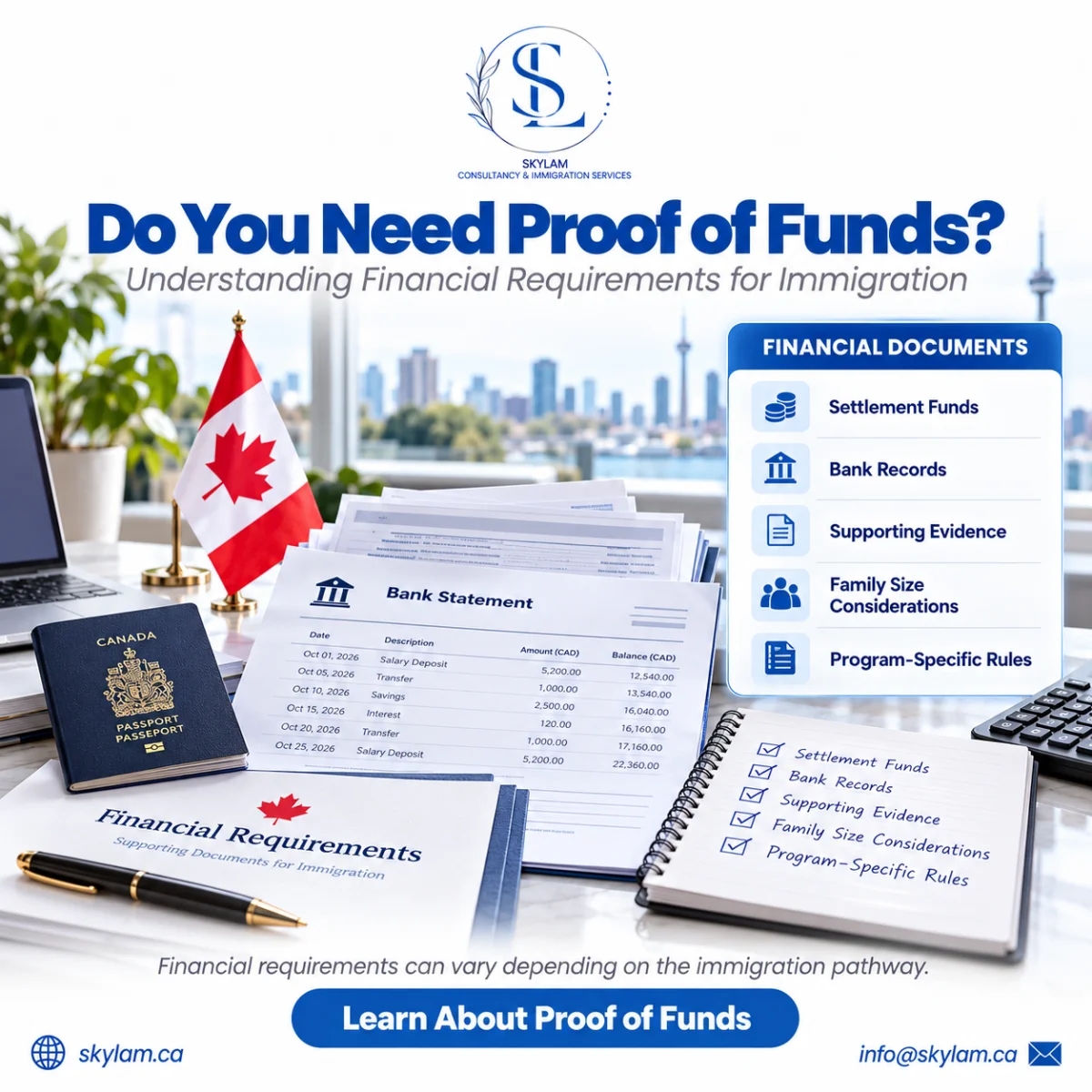
9. Proof of Funds and Financial Preparation
Financial preparation is important for several Canadian immigration pathways, but the requirements are not identical.
Some Express Entry applicants must demonstrate settlement funds.
Other applicants, such as eligible Canadian Experience Class candidates, generally do not need to provide settlement funds for that program.
Study permit applicants have separate financial requirements involving tuition, living expenses and transportation.
Some family sponsorship categories have their own financial rules.
What documents may be relevant?
Depending on the program, applicants may need to prepare:
-
Official bank letters
-
Bank statements
-
Account information
-
Evidence of financial support
-
Scholarship documentation
-
Education loan documentation
-
Evidence explaining significant deposits
Applicants should never assume that the same bank balance or document package will satisfy every immigration pathway.
Check the current official requirements for your specific application.
10. Immigration Document Preparation
Document preparation is an important part of the application process.
Incomplete, inconsistent or unclear documents can create delays or lead to requests for additional information.
Before submitting an application, review the document checklist for the relevant program.
Depending on the pathway, documents may include:
-
Passport and identity documents
-
Educational certificates
-
Transcripts
-
Employment reference letters
-
Language test results
-
ECA reports
-
Financial documents
-
Family relationship evidence
-
Police certificates
-
Medical examination information
-
Translations of documents not issued in an accepted language
Applicants should make sure that names, dates and other details are consistent across documents.
If a document needs translation, follow the applicable IRCC translation and certification requirements.
11. Avoid Immigration Scams and False Promises
Immigration applicants should be careful when dealing with people or organizations offering assistance.
Be cautious of anyone who promises:
-
Guaranteed permanent residence
-
Guaranteed visa approval
-
Guaranteed Express Entry invitations
-
Special access to immigration officers
-
Guaranteed jobs in Canada
-
CRS points without genuine qualifications
As of October 28, 2026, IRCC has also published a news release announcing new penalties relating to fraudulent and unauthorized immigration and citizenship representatives. Applicants should consult the official announcement for the details and applicable legal provisions. <Cite refs={["turn970073search0"]}/>
If you hire someone for paid immigration advice or representation, check whether the person is authorized under Canadian rules.
The Government of Canada provides guidance on choosing an authorized representative.
Remember that hiring a representative is optional. Applicants can also use official government instructions and submit applications themselves.
12. How to Prepare for Your Canadian Immigration Journey in November
Instead of rushing into an application, take time to review your circumstances.
The following practical checklist can help you organize your planning.
Personal profile
-
Confirm your identity information.
-
Review your marital and family circumstances.
-
Check your passport validity.
-
Prepare a timeline of important personal events.
Education
-
Collect certificates and transcripts.
-
Check whether an ECA is required.
-
Review the educational requirements of your intended program.
Employment
-
Prepare accurate employment dates.
-
Review your job duties.
-
Identify the correct occupation classification where relevant.
-
Collect supporting employment documents.
-
Check whether your Canadian work experience or job offer may be affected by the November 3 Express Entry changes.
Language
-
Review accepted language tests.
-
Check your test results and expiry dates.
-
Identify any language requirements that you have not yet met.
Financial preparation
-
Identify whether your immigration pathway requires proof of funds.
-
Check the latest financial amounts.
-
Organize official bank documentation.
-
Keep evidence explaining significant transactions.
Immigration history
-
Review previous applications.
-
Disclose relevant refusals.
-
Check your current immigration status, if applicable.
-
Make sure your application history is accurate.
13. How Skylam Immigration Services Can Support Your Planning
Choosing an immigration pathway can be difficult when you are unfamiliar with the different requirements and application procedures.
Skylam Immigration Services provides personalized support for individuals exploring Canadian immigration options, including:
-
Skilled worker programs
-
Family sponsorship
-
Study permits
The appropriate support depends on the applicant's circumstances and the services agreed with Skylam.
For someone exploring skilled worker immigration, it may be useful to understand the relevant program requirements, education, work experience and language information.
For family sponsorship applicants, the relationship category and supporting documents are important areas to understand.
For students, educational plans, admission documents and financial preparation can be important parts of the process.
Applicants should provide accurate information and confirm the exact services available before proceeding.
No immigration service can guarantee an application outcome. Final decisions are made by the relevant Canadian authorities under the applicable rules.
Frequently Asked Questions
1. What is the most important Canadian immigration update in November 2026?
One of the most important updates took effect on November 3, 2026. IRCC introduced a new Labour Market Integration factor in the Express Entry CRS, changing how points are awarded for Canadian work experience and qualifying job offers. <Cite refs={["turn970073news5","turn970073search3"]}/>
2. Are Express Entry invitation rounds currently paused?
IRCC announced a temporary pause while existing profiles are recalculated under the new CRS rules. The process may take up to two weeks. Applicants should check the official Express Entry page for the latest status. <Cite refs={["turn970073news5"]}/>
3. Do job offers still provide CRS points?
Yes, qualifying job offers in eligible high-wage occupations can now provide points under the new Labour Market Integration factor. The available points depend on the occupation's wage category and the job offer's eligibility.
4. Is an LMIA still required for qualifying Express Entry job offers?
As of November 3, 2026, an LMIA is no longer required for a qualifying job offer to receive the new Express Entry points or meet the relevant job-offer requirements under the Federal Skilled Worker Program and Federal Skilled Trades Program. The offer must still meet the applicable requirements and be genuine. <Cite refs={["turn970073search2"]}/>
5. Can I apply for permanent residence through a Provincial Nominee Program?
Potentially, if you meet the requirements of an available provincial or territorial stream. Eligibility differs between provinces and programs.
6. Does studying in Canada guarantee permanent residence?
No. A study permit is temporary authorization to study. Permanent residence requires a separate application and eligibility under an applicable immigration pathway.
7. Do all immigration applicants need proof of funds?
No. Financial requirements depend on the immigration program and individual circumstances.
8. Can I apply without an immigration consultant?
Yes. Hiring a representative is optional. Applicants can use official Canadian government instructions and submit their applications themselves.
9. Where can I check official Canadian immigration updates?
The Government of Canada's immigration website and IRCC newsroom provide official announcements, program requirements and application instructions.
10. Should I update my Express Entry profile after the November changes?
Review your profile against the new rules. If relevant information, including a qualifying job offer, is missing, follow IRCC's current instructions for updating it.
Final Takeaway
November 2026 is an important month for Canadian immigration planning, particularly because of the Express Entry changes that took effect on November 3.
The introduction of the Labour Market Integration factor changes how Canadian work experience and qualifying high-wage job offers contribute to CRS points. The temporary pause in invitation rounds also means that existing candidates should monitor their profiles and follow official IRCC guidance.
Beyond Express Entry, applicants should continue to pay attention to study permit requirements, work permit eligibility, provincial immigration programs, family sponsorship, language testing and financial preparation.
The most important step is to understand which immigration pathway matches your actual circumstances.
Before applying:
-
Identify your immigration objective.
-
Review the current program requirements.
-
Prepare accurate personal and employment information.
-
Check the latest financial and language requirements.
-
Follow official IRCC announcements.
-
Avoid false promises and unauthorized representatives.
Canadian immigration planning should begin with verified information, realistic expectations and careful preparation.
Skylam Immigration Services offers personalized support for individuals exploring skilled worker programs, family sponsorship and study permits.
Your Canadian immigration journey starts with understanding your options and preparing the right way.