
How to Choose the Right Canadian Immigration Pathway: A Practical Guide for 2026
Moving to Canada is a major decision that requires careful planning. Canada offers several immigration pathways for skilled workers, international graduates, family members and people with specific professional backgrounds. However, not every pathway is suitable for every applicant.
Some programs focus on education and skilled work experience. Others require a qualifying job offer, a provincial nomination or an eligible family relationship. There are also temporary options, such as study permits and work permits, which may support a person's plans to gain experience in Canada but do not automatically lead to permanent residence.
Choosing the right pathway begins with understanding the available options and comparing their requirements with your actual circumstances.
This guide explains the main Canadian immigration pathways, the factors applicants should consider and how to prepare before choosing a program.
This article reflects Government of Canada information reviewed on November 4, 2026. Immigration programs and eligibility requirements can change. Always check the latest official instructions before applying.
1. Why Choosing the Right Immigration Pathway Matters
Canada's immigration system includes several programs with different eligibility conditions. A pathway that is suitable for one person may not be appropriate for another.
For example, a skilled worker with several years of overseas professional experience may consider the Federal Skilled Worker Program. Someone who has already gained qualifying skilled work experience in Canada may be better positioned to assess the Canadian Experience Class.
A person with a qualifying Canadian employer and a suitable provincial or regional opportunity may consider a Provincial Nominee Program, the Atlantic Immigration Program or a community-based immigration pilot.
Similarly, someone whose spouse is a Canadian citizen or permanent resident may have a family sponsorship option, depending on the relationship and sponsorship requirements.
Choosing an unsuitable pathway can lead to wasted time, unnecessary expenses and incomplete applications.
A proper assessment should consider:
-
Age and personal circumstances
-
Education and academic qualifications
-
Work experience and occupational background
-
English or French language ability
-
Available settlement funds
-
Canadian job offers, if applicable
-
Family relationships in Canada
-
Preferred province or community
-
Long-term plans and professional goals
The most appropriate option is the one whose actual requirements match the applicant's qualifications and circumstances—not simply the program that appears most popular.
2. Understand the Difference Between Temporary and Permanent Immigration
Before comparing individual programs, applicants should understand the difference between temporary residence and permanent residence.
Permanent Residence
Permanent residence allows an eligible person to live in Canada permanently, subject to the responsibilities and conditions attached to permanent resident status.
Permanent residence pathways include:
-
Express Entry
-
Provincial Nominee Programs
-
Atlantic Immigration Program
-
Rural Community Immigration Pilot
-
Francophone Community Immigration Pilot
-
Family sponsorship
-
Other eligible economic and regional programs
Each program has its own requirements and application process.
Temporary Residence
Temporary residence generally allows someone to enter or stay in Canada for a specific purpose and period, subject to the conditions of their authorization.
Examples include:
-
Study permits
-
Work permits
-
Visitor status
Temporary residence and permanent residence are not the same.
For example, receiving a study permit does not guarantee permanent residence after graduation. Similarly, holding a work permit does not automatically make someone eligible for a permanent residence program.
Some temporary residents may later qualify for permanent residence through an available program, but they must meet its requirements independently.
Applicants should therefore identify whether their immediate goal is to study, work temporarily, reunite with family or apply for permanent residence.
3. Express Entry: A Major Option for Skilled Workers
Express Entry is an online system used by Immigration, Refugees and Citizenship Canada (IRCC) to manage applications from skilled workers.
It manages three federal economic immigration programs:
-
Canadian Experience Class
-
Federal Skilled Worker Program
-
Federal Skilled Trades Program
The general process involves creating an eligible profile, entering the candidate pool, receiving an invitation if selected and submitting a permanent residence application.
Candidates are ranked using the Comprehensive Ranking System (CRS). The CRS considers factors such as age, education, language ability, work experience and other eligible factors.
An Express Entry profile does not guarantee an invitation. Candidates must meet program requirements and receive an invitation before applying for permanent residence through this process.
Canadian Experience Class
The Canadian Experience Class (CEC) is designed for skilled workers who have qualifying Canadian work experience.
It may be worth assessing if an applicant:
-
Has worked legally in Canada.
-
Has qualifying skilled work experience.
-
Meets the language requirements.
-
Plans to live outside Quebec.
-
Meets the remaining program conditions.
The minimum work experience requirement is generally one year of eligible skilled Canadian work experience within the three years before applying.
The work experience must be in an eligible TEER 0, 1, 2 or 3 occupation. The language requirement depends on the occupation's TEER category.
For TEER 0 or 1 occupations, the minimum is generally CLB 7 or equivalent. For TEER 2 or 3 occupations, it is generally CLB 5 or equivalent.
There is no formal education requirement for the CEC, although education can help improve a candidate's CRS score.
This program may be relevant to eligible temporary foreign workers and international graduates who have gained qualifying Canadian work experience after completing their studies.
However, not every type of Canadian employment counts. Applicants should review the program's specific rules before calculating their experience.
Federal Skilled Worker Program
The Federal Skilled Worker Program (FSWP) is designed for skilled workers with eligible work experience, including qualifying experience gained outside Canada.
It may be relevant to applicants who have:
-
Skilled professional work experience.
-
Eligible educational qualifications.
-
The required English or French language ability.
-
Sufficient settlement funds, unless exempt.
-
The required points under the program's selection-factor system.
The program generally requires at least one year of continuous paid skilled work experience within the previous ten years in an eligible TEER 0, 1 or 2?
Correction for applicants: The eligible occupations are TEER 0, 1, 2 or 3. Applicants should use the official IRCC program page to verify the detailed work experience conditions.
Candidates must also meet the minimum language requirement, generally CLB 7 or equivalent, and satisfy the education requirements.
Foreign education may require an Educational Credential Assessment (ECA) when it is being used to meet program requirements or claim relevant points.
The FSWP has a separate selection-factor assessment. Meeting the minimum selection score does not guarantee a high CRS score or an invitation.
For applicants living outside Canada, this program can be an important option to investigate if their education, language ability and work history meet the requirements.
Federal Skilled Trades Program
The Federal Skilled Trades Program (FSTP) is intended for eligible workers with experience in skilled trades.
It may be relevant to people working in selected occupations in areas such as construction, manufacturing, natural resources and other eligible trade sectors.
Applicants generally need:
-
At least two years of eligible skilled trade work experience within the five years before applying.
-
The required language ability.
-
A qualifying full-time job offer for at least one year or a certificate of qualification in the relevant skilled trade issued by a Canadian provincial, territorial or federal authority.
-
The remaining program requirements.
The language requirements are generally CLB 5 for speaking and listening and CLB 4 for reading and writing.
There is no formal education requirement under this program, although education may help improve a candidate's CRS score.
Trade workers should also consider whether their intended occupation requires licensing or certification in the province where they want to work.
How to choose between the three programs: Compare your actual work history, education, language results and professional background against the official requirements of each program. Do not select a program simply because its name appears to match your occupation.
4. Provincial Nominee Programs: When a Province Is the Right Fit
The Provincial Nominee Program (PNP) allows participating Canadian provinces and territories to nominate eligible candidates who meet their regional immigration priorities.
Provinces and territories operate different streams. Some focus on skilled workers, while others may target international graduates, workers with local employment or candidates with specific occupational backgrounds.
A provincial nomination may be relevant if an applicant:
-
Has experience in an occupation targeted by a province.
-
Has a qualifying job offer from an employer in that province.
-
Has studied or worked in the province.
-
Meets the requirements of a particular provincial stream.
-
Has a genuine intention to live and work in the nominating province or territory.
There are two broad application routes:
Express Entry-Linked PNP
Some provincial streams are connected to Express Entry.
To qualify, applicants must meet both the provincial stream's requirements and the requirements of an eligible federal Express Entry program.
A nomination through an Express Entry-linked stream can add 600 CRS points, which significantly improves a candidate's ranking in the pool.
However, receiving a provincial nomination is not automatic. Applicants must meet the relevant provincial selection requirements and follow the province's process.
Non-Express Entry PNP
Some provincial streams operate outside Express Entry.
Candidates who qualify may apply through the non-Express Entry process, following the instructions of the province or territory and IRCC.
This can be relevant to applicants who meet a provincial stream's requirements but do not qualify for a federal Express Entry program.
Why Province Selection Matters
Applicants should research more than the name of a province.
Consider:
-
Whether the province has a stream relevant to your occupation.
-
Whether a job offer is required.
-
Whether the stream is currently accepting applications.
-
Whether there are language or education conditions.
-
Whether the province has specific work experience requirements.
-
Whether you genuinely intend to settle there.
A provincial nomination is not a general invitation to move anywhere in Canada. Applicants should understand the conditions of the stream and their responsibilities.
5. Atlantic Immigration Program
The Atlantic Immigration Program (AIP) is a permanent residence pathway for eligible skilled workers and international graduates who want to live and work in one of Canada's four Atlantic provinces:
-
New Brunswick
-
Nova Scotia
-
Prince Edward Island
-
Newfoundland and Labrador
The program is based on employment opportunities with designated employers in Atlantic Canada.
Applicants generally need:
-
A qualifying job offer from a designated employer.
-
Eligible work experience, unless an applicable graduate exemption applies.
-
The required education.
-
Approved language test results.
-
Sufficient settlement funds, unless exempt.
-
A settlement plan from a service provider organisation.
The job offer must meet the program's conditions, including requirements related to working hours, employment type and the position.
International graduates from eligible recognised post-secondary institutions in Atlantic Canada may qualify for an exemption from the work experience requirement if they meet the applicable conditions.
The Atlantic Immigration Program may be worth investigating for skilled workers who are open to living outside Canada's largest metropolitan areas and can secure a qualifying offer from a designated employer.
A job offer from just any employer in Atlantic Canada is not sufficient. The employer must be designated under the program and the offer must satisfy the official requirements.
6. Rural and Francophone Community Immigration Pilots
Canada also operates community-focused immigration pilots intended to help participating communities attract skilled workers.
Two examples are:
-
Rural Community Immigration Pilot (RCIP)
-
Francophone Community Immigration Pilot (FCIP)
These pathways are designed for eligible candidates who want to work and settle in participating communities.
Rural Community Immigration Pilot
The RCIP provides a permanent residence pathway for eligible skilled workers who want to live and work in participating rural communities.
Applicants generally need:
-
A valid job offer from a designated employer in a participating community.
-
At least one year of related work experience in the previous three years, unless an applicable exemption applies.
-
The required language ability.
-
Eligible education.
-
Sufficient settlement funds, where required.
-
A community recommendation.
A key feature is that candidates need a job offer from a designated employer. The community also assesses whether the position and candidate meet the pilot's conditions.
This pathway may suit applicants who are willing to consider smaller communities rather than focusing only on major Canadian cities.
Francophone Community Immigration Pilot
The FCIP is intended to support French-speaking newcomers who want to settle in selected Francophone minority communities outside Quebec.
Applicants must meet the relevant program conditions, including requirements related to a qualifying job offer, language ability, education and work experience.
The community recommendation process is also important.
French-language ability can therefore be relevant to applicants considering this pathway. However, candidates must still meet the complete eligibility requirements.
Applicants should check the participating communities, designated employers and current occupation priorities before making plans.
7. Family Sponsorship: When You Have an Eligible Family Relationship
Family sponsorship may be an appropriate pathway for people who have an eligible family member in Canada.
Under Canada's family sponsorship programs, eligible Canadian citizens and permanent residents may sponsor certain family members to become permanent residents.
Depending on the program, eligible family members can include:
-
A spouse
-
A common-law partner
-
A conjugal partner
-
A dependent child
-
Certain other eligible relatives under specific conditions
Spousal and Partner Sponsorship
A Canadian citizen or permanent resident may be able to sponsor an eligible spouse or partner if the sponsor and applicant meet the relevant requirements.
The relationship must be genuine and meet IRCC's definition.
For example, a common-law partner generally needs to have lived with the sponsor in a conjugal relationship for at least 12 consecutive months.
The sponsor must also meet the applicable eligibility requirements and agree to the financial undertaking associated with sponsorship.
Dependent Child Sponsorship
Eligible dependent children may also be sponsored.
IRCC generally defines a dependent child as someone under 22 who does not have a spouse or common-law partner. Certain older children may qualify if they meet specific dependency conditions.
Applicants should check the official rules and supporting-document requirements.
Parents and Grandparents Sponsorship
Canada also has a Parents and Grandparents Program, subject to its invitation and intake arrangements.
This program is not continuously open to all interested sponsors. Applicants should check the latest official announcements and eligibility requirements before making plans.
Family sponsorship is not a general pathway for sponsoring any relative. Eligibility depends on the exact relationship and the program's conditions.
8. Study Permit: An Education Route, Not a Guaranteed PR Pathway
Studying in Canada can be an important educational opportunity for international students.
However, applicants should understand that a study permit is a temporary residence authorization, not permanent residence.
A study permit may allow an eligible student to attend an approved Canadian educational institution, subject to the conditions of the permit.
Before applying, students should consider:
-
Whether the institution and program meet the applicable requirements.
-
Tuition fees and living expenses.
-
The relevance of the chosen program to their education and career goals.
-
Study permit eligibility.
-
Financial documentation.
-
Language requirements, where applicable.
-
Whether the program may be eligible for a Post-Graduation Work Permit (PGWP).
Some graduates may later qualify for a permanent residence pathway, such as the Canadian Experience Class or a Provincial Nominee Program.
However, graduating from a Canadian institution does not automatically qualify someone for permanent residence.
For example, an eligible graduate may need to obtain a suitable work permit, gain qualifying skilled work experience and meet the requirements of the relevant permanent residence program.
Students should also confirm the current PGWP eligibility conditions before choosing a course or institution. Not every program or institution automatically provides PGWP eligibility.
The best study plan should make sense academically and financially even if the student does not later qualify for permanent residence.
9. Work Permits: A Temporary Route That May Support Future Plans
A Canadian work permit allows an eligible foreign national to work in Canada under the conditions of their authorization.
There are different types of work permits, including employer-specific and open work permits.
Employer-Specific Work Permit
An employer-specific work permit generally limits the worker to the employer and employment conditions listed on the permit.
Depending on the situation, the employer may need to complete additional requirements before the worker can apply.
Open Work Permit
An open work permit allows eligible holders to work for most employers in Canada, subject to the conditions and restrictions of the permit.
Not everyone is eligible for an open work permit. Eligibility depends on the relevant immigration category or policy.
Can a Work Permit Lead to Permanent Residence?
Some workers may later qualify for permanent residence through programs such as the Canadian Experience Class or a Provincial Nominee Program.
However, holding a work permit alone does not guarantee eligibility.
The work experience must meet the requirements of the particular permanent residence program. The applicant must also satisfy language, education and other relevant conditions.
Before accepting a job or making a relocation decision, applicants should understand the type of work permit available and whether their intended employment aligns with their longer-term plans.
10. Quebec Immigration: A Different Selection Process
Applicants who want to settle in Quebec should understand that the province has its own immigration selection system for many economic immigration pathways.
Quebec is not part of the Provincial Nominee Program.
Its skilled worker immigration routes and selection conditions are administered through Quebec's own immigration authorities, while the federal government remains responsible for relevant federal admissibility and permanent residence processing.
Applicants interested in Quebec should therefore research Quebec's current programs rather than assuming that a federal or provincial pathway elsewhere in Canada will apply.
French-language ability may be important for many Quebec immigration options, depending on the specific program.
The intended destination matters when choosing a pathway. Applicants should decide whether they genuinely want to settle in Quebec or another province before comparing programs.
11. Important Factors to Compare Before Choosing a Pathway
After understanding the main options, applicants should compare their circumstances against each program.
Education
Review your highest completed qualification and whether it is recognised or assessed for Canadian immigration purposes.
If your education was completed outside Canada, check whether an Educational Credential Assessment is required.
Work Experience
Prepare a clear record of your work history, including:
-
Job titles
-
Employer names
-
Employment dates
-
Main duties
-
Working hours
-
Salary information
-
Supporting documents
The National Occupational Classification (NOC) system is important for many economic immigration programs.
Your NOC should reflect your actual job duties, not just a similar job title.
Language Ability
English and French language ability can affect both eligibility and ranking.
Applicants should identify the accepted tests and minimum scores for the program they are considering.
Improving language results may strengthen an application, but the required score depends on the program.
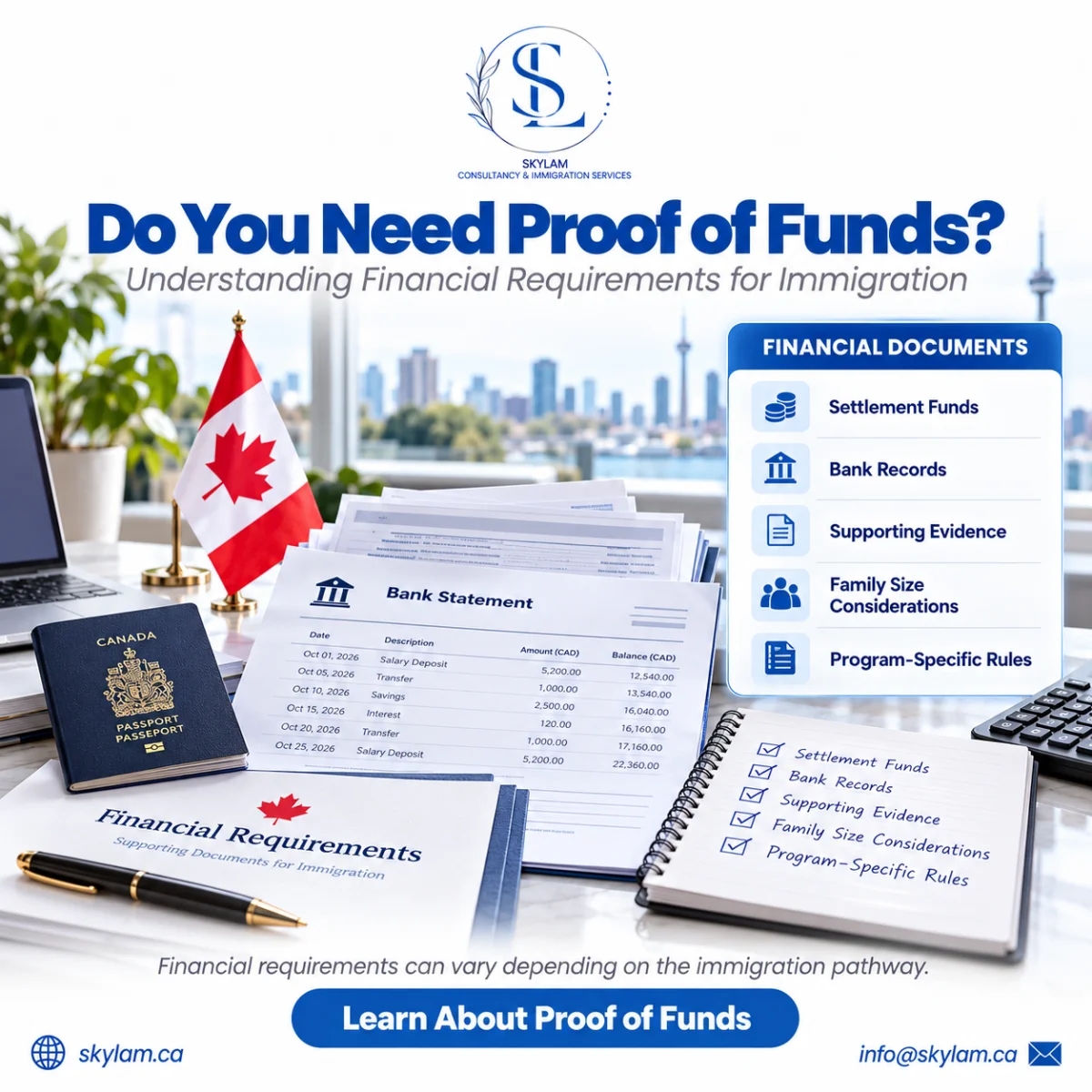
Financial Preparation
Some programs require proof that applicants have sufficient funds to support themselves and their accompanying family members.
The required amount and exemptions depend on the pathway and circumstances.
Applicants should check current financial requirements rather than relying on old figures.
Job Offers
Some immigration pathways require a qualifying job offer, while others do not.
A job offer should be genuine and meet the program's conditions.
Applicants should be careful about anyone promising a guaranteed job offer, nomination or permanent residence approval in exchange for money.
Family Situation
The applicant's spouse, partner and dependent children may affect the application, required documents and financial planning.
Family members may need to be declared even if they are not accompanying the principal applicant.
Applicants should follow the program's instructions carefully.
Intended Province or Community
A candidate's preferred destination may influence the available pathways.
Some programs are designed for specific provinces, Atlantic Canada or participating rural and Francophone communities.
Applicants should consider employment opportunities, living costs, community preferences and settlement plans.
12. A Practical Step-by-Step Approach to Selecting a Pathway
Choosing an immigration pathway becomes easier when the process is divided into manageable steps.
Step 1: Define your goal
Decide whether you want to study, work temporarily, reunite with family or apply directly for permanent residence.
Step 2: Review your qualifications
Make a list of your education, professional experience, language ability and other relevant qualifications.
Step 3: Identify your occupational classification
Find the NOC code that best matches your actual work responsibilities.
Step 4: Compare federal economic programs
If you are a skilled worker, check the Canadian Experience Class, Federal Skilled Worker Program and Federal Skilled Trades Program.
Step 5: Explore provincial and regional options
Review the Provincial Nominee Program, Atlantic Immigration Program and community immigration pilots if their conditions may match your circumstances.
Step 6: Check family sponsorship possibilities
If you have an eligible family relationship with a Canadian citizen or permanent resident, review the applicable sponsorship requirements.
Step 7: Review language and education requirements
Check accepted tests, minimum scores and whether an ECA is required.
Step 8: Assess your finances
Calculate the costs of the application, travel, education or relocation and any required settlement funds.
Step 9: Verify the current program status
Some immigration streams have limited intake periods, changing occupation priorities or invitation-based selection.
Check official information before proceeding.
Step 10: Prepare accurate documents
Make sure your employment, education, identity and financial information is complete and consistent.
13. Common Mistakes to Avoid When Choosing an Immigration Pathway
Choosing a Program Only Because It Is Popular
A program may be widely discussed online but still be unsuitable for your circumstances.
Always compare the official eligibility requirements with your own qualifications.
Assuming a Job Offer Guarantees Permanent Residence
A job offer may be required or helpful under some pathways, but it does not automatically guarantee a nomination or permanent residence.
Confusing a Study Permit With Permanent Residence
A study permit is temporary. Future permanent residence eligibility depends on the requirements of a separate immigration program.
Ignoring Language Requirements
Language results can affect both program eligibility and CRS ranking.
Applicants should plan their test preparation carefully.
Using the Wrong NOC Code
The wrong occupational classification can create problems when assessing work experience.
Compare actual job duties with the official NOC description.
Relying on Outdated Information
Immigration requirements, application intake periods and program priorities can change.
Always check the latest official government instructions.
Believing in Guaranteed Approval Promises
No one can guarantee an immigration invitation or permanent residence approval. Final decisions are made by the relevant Canadian immigration authorities.
14. How Skylam Immigration Services Can Support Your Planning
Choosing an immigration pathway can involve several decisions about education, work experience, family circumstances, language ability and financial preparation.
Skylam Immigration Services offers personalised support for skilled worker programs, family sponsorship and study permits.
A well-organised preparation process begins with understanding the applicant's circumstances and reviewing the requirements of the relevant pathway.
Applicants should ensure that their information is accurate, their documents are consistent and their chosen program matches their actual eligibility.
Skylam encourages people planning to move to Canada to research their options carefully and use official government information when making important decisions.
The right pathway depends on the individual applicant. There is no single immigration program that is suitable for everyone, and no assessment or consultation can guarantee an immigration outcome.
Frequently Asked Questions
1. What is the best immigration pathway to Canada in 2026?
There is no single best pathway for everyone. The appropriate option depends on the applicant's education, work experience, language ability, family situation, finances and intended destination.
2. Can I apply for Canadian permanent residence from outside Canada?
Yes. Several permanent residence pathways can accept eligible applicants who are living outside Canada, including the Federal Skilled Worker Program and certain regional immigration programs.
The applicant must meet the specific program requirements.
3. Is Express Entry the only way to immigrate to Canada?
No. Canada has several other permanent residence pathways, including Provincial Nominee Programs, family sponsorship, the Atlantic Immigration Program and community immigration pilots.
4. Do I need a job offer to apply for Express Entry?
A job offer is not required for every Express Entry program. For example, it is not a basic requirement for the Canadian Experience Class or Federal Skilled Worker Program. The Federal Skilled Trades Program has a job offer or certificate of qualification requirement.
Applicants should check the latest program rules.
5. Can a student become a permanent resident in Canada?
Some international graduates may later qualify for permanent residence through programs such as the Canadian Experience Class or a Provincial Nominee Program.
However, graduating from a Canadian institution or holding a study permit does not guarantee permanent residence.
6. What is the difference between Express Entry and a Provincial Nominee Program?
Express Entry manages applications under three federal economic immigration programs. A Provincial Nominee Program allows participating provinces and territories to nominate eligible candidates according to their regional immigration priorities.
Some PNP streams are connected to Express Entry, while others use a separate application process.
7. Can I apply for more than one immigration pathway?
Depending on your circumstances, you may be eligible to explore more than one program. However, each application must meet the relevant eligibility and application requirements.
Applicants should understand the rules before submitting multiple applications.
8. How important is English or French language ability?
Language ability is important for many Canadian immigration pathways. It can affect eligibility, CRS ranking and category-based selection.
The required level depends on the program.
9. What is an Educational Credential Assessment?
An Educational Credential Assessment evaluates a foreign educational qualification against Canadian educational standards for immigration purposes.
It may be required when an applicant uses foreign education to meet specific program requirements or claim points.
10. Where can I check which Canadian immigration program I may qualify for?
The Government of Canada's Come to Canada tool can help users assess whether they may qualify for certain immigration programs. It is an initial assessment tool, not a final immigration decision.
Applicants should also review the official eligibility instructions for the program they are considering.
Final Thoughts: Make an Informed Immigration Decision
Choosing the right Canadian immigration pathway requires more than looking at program names or following popular immigration discussions.
Applicants should begin by reviewing their actual qualifications, work experience, language ability, education and long-term goals.
Skilled workers may explore Express Entry or provincial and regional programs. Eligible family members may consider sponsorship. International students should understand the difference between temporary study authorization and permanent residence opportunities.
The most important step is to verify eligibility before committing time and money to an application.
A well-planned immigration journey starts with accurate information and the right pathway. Explore your options carefully, prepare your documents and make decisions based on the latest official Canadian immigration requirements.
Skylam Immigration Services supports individuals exploring skilled worker programs, family sponsorship and study permit options.