
Canada Expands Practice-Ready Pathways for Internationally Educated Physicians in Ontario and Manitoba
Introduction
Canada is taking additional steps to help internationally educated physicians enter its healthcare workforce through expanded practice-ready assessment opportunities in Ontario and Manitoba. These initiatives aim to make better use of the skills and experience of qualified doctors who completed their medical education and training outside Canada.
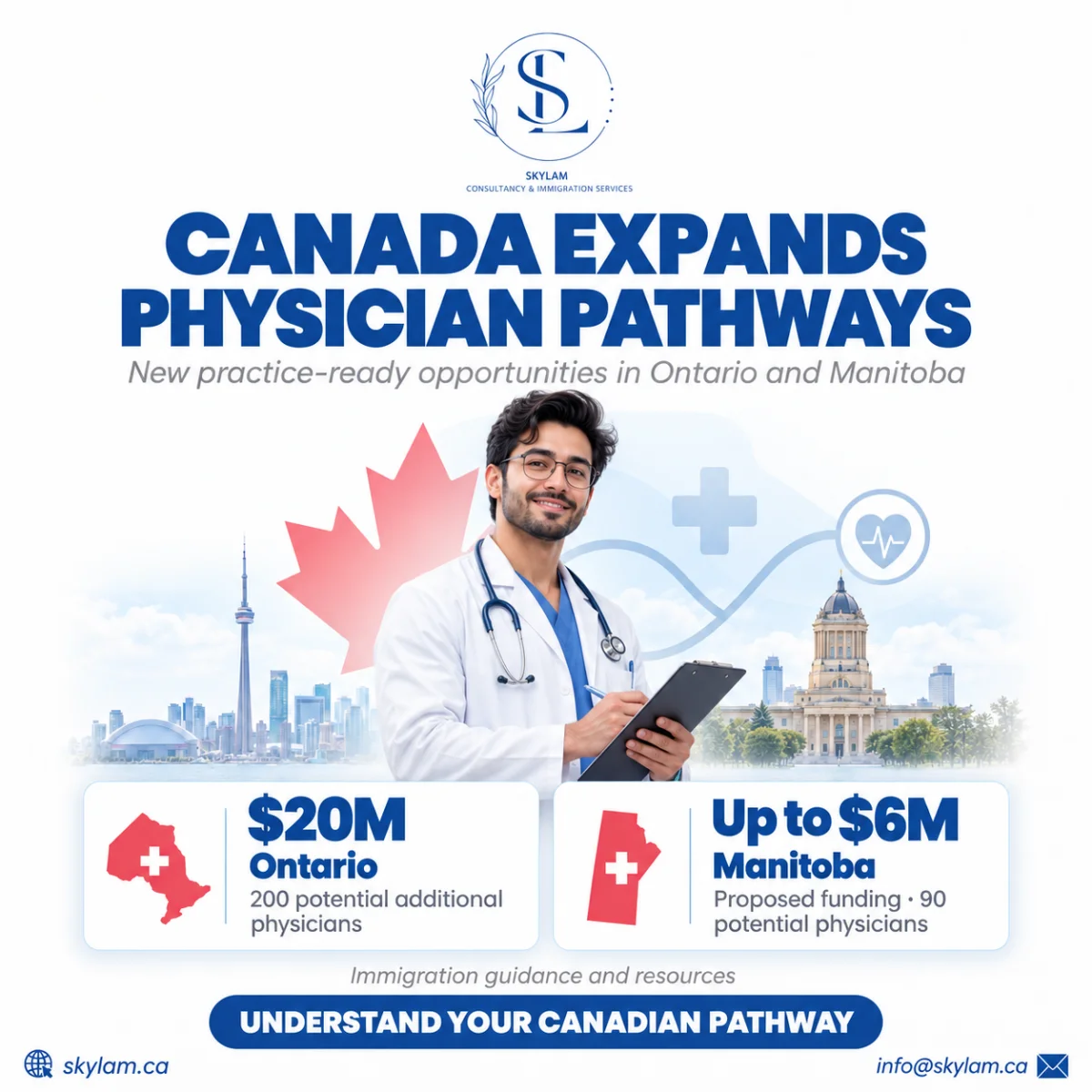
On October 7, 2026, Health Canada announced more than $31 million in federal funding for six projects designed to help internationally educated health professionals navigate professional recognition and licensing requirements. The announcement included $20 million to support additional positions in Ontario’s Practice Ready Ontario (PRO) program.
One week later, on October 14, 2026, the federal government announced its intention to provide up to $6 million over three years to expand Manitoba’s Practice-Ready Assessment opportunities for internationally trained family physicians.
Together, these announcements could help up to 290 additional family physicians become ready to work in the two provinces by 2028–2029. Ontario’s expansion is expected to support up to 200 additional physicians, while Manitoba’s proposed expansion could support up to 90.
These initiatives are particularly relevant to healthcare workforce needs in rural, northern, remote and other underserved communities.
For internationally educated physicians considering Canada, however, understanding the difference between professional licensing and immigration eligibility remains essential. Additional assessment positions do not automatically guarantee medical registration, employment, permanent residence or a work permit.
This guide explains the latest announcements, the purpose of practice-ready assessments, the potential opportunities for international medical graduates, and the important steps to consider before pursuing a Canadian career.
1. Ontario Announces $20 Million for Practice Ready Ontario
On October 7, 2026, Health Canada announced $20 million in federal funding to support the expansion of Ontario’s Practice Ready Ontario program.
The investment is expected to create 50 additional positions annually over four years for internationally educated family physicians. By 2028–2029, the expansion could help up to 200 additional family physicians become ready to work in Ontario.
The initiative forms part of a broader federal investment exceeding $31 million across six projects intended to help internationally educated health professionals enter the Canadian workforce.
What is Practice Ready Ontario?
Practice Ready Ontario is designed to assess eligible internationally educated physicians who have previous medical training and practice experience. Instead of assuming that every internationally trained doctor must follow the same training route, practice-ready assessment programs evaluate whether qualified candidates can demonstrate the competencies required for practice in a Canadian setting.
The process is intended to help eligible physicians move toward professional registration while maintaining the standards required for patient safety and quality healthcare.
Participation is not automatic. Candidates must satisfy the program's eligibility criteria, complete the required assessments and meet applicable medical regulatory requirements.
Where will Ontario focus its expansion?
Ontario's initiative places particular emphasis on improving primary care access in communities experiencing physician shortages.
Key areas of focus include:
-
Northern Ontario: Communities where access to family physicians may be limited.
-
Rural Ontario: Areas that face challenges recruiting and retaining healthcare professionals.
-
Francophone communities: Communities that need access to healthcare services in French.
The federal announcement also identifies a specific stream for French-speaking internationally educated family physicians.
For qualified doctors, this expansion may create additional opportunities to pursue professional assessment. Nevertheless, the number of available positions should not be interpreted as a guarantee that every interested applicant will qualify.
Official source: Health Canada — More health professionals, better care for Canadians.
2. Manitoba Plans to Expand Practice-Ready Assessment Opportunities
On October 14, 2026, Health Canada and Manitoba announced a proposed investment to expand opportunities for internationally trained family physicians.
The federal government announced its intention to provide up to $6 million over three years to support Manitoba's Practice-Ready Assessment process.
The proposed expansion could help up to 90 additional family physicians become ready to work in Manitoba by 2028–2029.
Important: The proposed federal funding remains subject to the finalization of an agreement between the Government of Canada and the Government of Manitoba. It should therefore not be described as fully finalized funding.
What is the Manitoba Practice-Ready Assessment program?
Manitoba's Practice-Ready Assessment pathway is designed for eligible internationally trained physicians who have completed appropriate medical training and have the experience needed to be considered for assessment.
The family medicine assessment process evaluates whether a physician's clinical knowledge and practical abilities meet the standards required for practice.
Successful candidates must still satisfy the relevant registration requirements and any applicable conditions associated with their assessment and employment arrangements.
The program is not a general entry route for anyone holding a medical degree. Applicants must meet specific education, postgraduate training, work experience, language and other eligibility requirements.
Which communities could benefit?
The proposed expansion prioritizes healthcare needs in rural and northern Manitoba.
The initiative is expected to strengthen family medicine services in clinics and emergency departments, helping communities access care closer to home.
For physicians, this may mean that employment opportunities and regional healthcare needs could play an important role in determining whether a particular pathway is suitable.
Candidates should investigate the actual eligibility conditions, approved assessment opportunities, sponsorship arrangements and employment commitments before making decisions.
Official source: Health Canada — More doctors to strengthen healthcare in rural and Northern Manitoba communities.
3. Ontario vs. Manitoba: What Are the Main Differences?
Both provinces are expanding opportunities for internationally educated family physicians, but their announcements differ in funding status and program details.
| Feature | Ontario | Manitoba |
|---|---|---|
| Announcement date | October 7, 2026 | October 14, 2026 |
| Federal investment | $20 million announced | Up to $6 million proposed |
| Funding period | Four years of additional positions | Three years of proposed funding |
| Additional positions | 50 annually | Expansion of assessment opportunities |
| Expected impact | Up to 200 additional family physicians | Up to 90 additional family physicians |
| Target timeline | By 2028–2029 | By 2028–2029 |
| Main geographic focus | Northern, rural and Francophone communities | Rural, northern and remote communities |
| Funding status | Announced | Subject to a finalized federal-provincial agreement |
These figures describe the announced expansions, not the total number of physicians each province will recruit or the number of applications that will be approved.
Applicants should also remember that a province's healthcare recruitment priorities do not automatically determine whether an individual qualifies for assessment, licensing or immigration.
4. Why Are Practice-Ready Pathways Important for International Medical Graduates?
International medical graduates, often referred to as IMGs, are physicians who obtained their medical education outside Canada. Many have substantial clinical experience, postgraduate qualifications and professional knowledge acquired in their home countries.
However, entering medical practice in Canada can involve multiple stages of credential verification, examinations, clinical assessment, registration and other requirements.
These processes help ensure that physicians practising in Canada meet the appropriate standards for patient care.
At the same time, navigating the system can be complicated for internationally trained professionals who are unfamiliar with Canadian regulatory procedures.
Practice-ready assessment initiatives seek to address part of this challenge by assessing eligible, experienced physicians through structured processes.
Potential benefits for qualified physicians
A clearer professional pathway
A defined assessment route can help candidates understand the professional standards they need to meet and the steps involved in pursuing registration.
Recognition of previous experience
Eligible physicians may have an opportunity to demonstrate their existing clinical competencies rather than assuming that all international training and experience must be repeated through an identical educational route.
Additional assessment capacity
More positions could allow programs to assess additional candidates, although eligibility and selection remain important.
Opportunities outside major cities
The focus on underserved communities may create opportunities for qualified physicians willing and able to work in locations where healthcare providers are needed.
Better professional navigation
Additional resources and support initiatives can help internationally educated health professionals understand credential recognition and provincial licensing requirements.
These benefits depend on the specific program and the candidate's circumstances. A practice-ready assessment does not remove the need to meet the relevant professional standards.
5. Who May Be Eligible for Practice-Ready Assessment?
Eligibility differs by province and program. The Ontario and Manitoba expansions should not be treated as identical application routes.
Nevertheless, internationally trained family physicians considering these opportunities should be prepared to review several common areas.
Medical education and credentials
Applicants generally need an acceptable medical degree from a recognized institution. They may need to provide primary-source verification of their medical credentials and supporting documentation.
Documents can include medical diplomas, transcripts, internship records and other evidence requested by the relevant authorities.
Postgraduate training
Family medicine assessment programs may require specific postgraduate training or an accepted combination of training and recent clinical experience.
A medical degree alone is not necessarily sufficient.
Clinical experience
Programs may assess the nature, duration and recency of a candidate's medical practice. Requirements can differ depending on the pathway and the candidate's background.
Physicians should carefully check whether their previous practice experience meets the current criteria.
Language proficiency
Candidates may need to demonstrate English-language proficiency or meet other language requirements set by the program or regulator.
French-language opportunities may be particularly relevant to eligible candidates interested in serving Francophone communities in Ontario.
Assessment and registration
Applicants may need to complete clinical assessments, examinations, supervised practice or other requirements specified by the program and medical regulator.
Meeting the initial eligibility criteria does not necessarily guarantee successful assessment or registration.
Employment and sponsorship
Some practice-ready pathways require an approved sponsoring organization, an eligible employment opportunity or a commitment to serve a particular community for a specified period.
Candidates should understand any return-of-service obligations before accepting a position.
Practical advice: Always use the current official program requirements to assess your eligibility. Do not rely solely on a social media post, third-party summary or general description of a licensing pathway.
6. Understanding the Canadian Medical Licensing Process
Canada does not have a single medical licence that automatically authorizes a physician to practise independently in every province.
Medical regulation is primarily handled at the provincial and territorial level. Consequently, the requirements applicable to a physician in Ontario may differ from those in Manitoba.
A typical pathway may involve the following stages.
Step 1: Review your professional background
Identify your medical degree, postgraduate training, work experience, current registration status and any relevant examinations or certifications.
Compare these details with the requirements of the specific program you are considering.
Step 2: Verify your credentials
Follow the relevant instructions for credential verification. Ensure that your educational and professional documents are accurate, complete and consistent.
Missing or inconsistent documentation may create delays.
Step 3: Identify a suitable licensing route
Research whether a practice-ready assessment, residency, examination-based route or another recognized pathway may be appropriate for your qualifications.
Not every internationally trained physician will qualify for the same route.
Step 4: Apply to the relevant program
Follow the program's official application procedure and submit the required documents within the applicable deadlines.
Confirm whether the program is accepting applications and whether positions are available to candidates with your background.
Step 5: Complete required assessments
If selected, complete the assessments, examinations, supervised clinical requirements or other steps specified by the program.
The purpose is to determine whether you meet the required standards for practice.
Step 6: Meet provincial registration requirements
Successful participation in an assessment program does not necessarily mean that every registration condition has been satisfied.
The relevant medical regulator determines whether a candidate meets the requirements for the applicable class of registration.
Step 7: Confirm employment and immigration arrangements
Before relocating or accepting an opportunity, confirm your employment arrangements and your legal authorization to work in Canada.
Professional registration, employment and immigration status are related but separate matters.
7. How Do These Announcements Relate to Canadian Immigration?
The Ontario and Manitoba announcements concern healthcare workforce development and professional assessment. They may complement broader immigration measures, but they do not establish automatic immigration eligibility for participating physicians.
On December 8, 2025, the federal government announced targeted measures intended to help recruit internationally trained physicians to Canada.
Health Canada's October 2026 announcements refer to measures that included:
-
A physician-focused Express Entry category.
-
An additional 5,000 federal admission spaces allocated through the Provincial Nominee Program for provinces and territories to nominate eligible licensed physicians with job offers.
-
Expedited, 14-day work permit processing for eligible applicants under the announced measures.
These measures are subject to their respective eligibility requirements and operational rules. Applicants should verify the current details with Immigration, Refugees and Citizenship Canada (IRCC) before relying on them.
Express Entry for physicians
Express Entry is Canada's application management system for certain economic immigration programs.
A physician-focused category may provide a relevant option for eligible candidates who meet the applicable category criteria. However, being a doctor does not automatically qualify someone for an invitation or permanent residence.
Candidates must review the applicable work experience, occupational, language, education and other requirements.
Provincial Nominee Program
The Provincial Nominee Program allows participating provinces and territories to nominate eligible candidates according to their immigration priorities and program criteria.
For physicians, a provincial nomination opportunity may be relevant when the candidate meets the requirements of the specific stream and any applicable professional or employment conditions.
A nomination is not automatic simply because a province needs more doctors.
Work permits
Some eligible candidates may pursue a work permit based on their employment and immigration circumstances.
Expedited processing applies only where the relevant policy and eligibility conditions are met. It should not be interpreted as a guarantee of approval or as an exemption from professional licensing requirements.
Permanent residence and licensing are separate
A physician may be eligible for an immigration program but still need to complete provincial licensing requirements before practising medicine.
Similarly, qualifying for a professional assessment does not automatically establish eligibility for permanent residence.
A well-prepared plan should consider both processes without confusing their requirements.
8. Ontario or Manitoba: Which Province Should Physicians Consider?
There is no single province that is suitable for every internationally educated physician. The right choice depends on professional qualifications, assessment eligibility, career goals, employment opportunities, family circumstances and immigration plans.
Consider Ontario if:
-
You meet the requirements of Practice Ready Ontario.
-
You are interested in family medicine opportunities in northern or rural communities.
-
You may qualify for the program's French-language stream.
-
Your professional and personal circumstances align with the available assessment and employment arrangements.
Consider Manitoba if:
-
You meet the requirements for the relevant Manitoba assessment pathway.
-
You are interested in opportunities in rural, northern or remote communities.
-
You can satisfy any applicable sponsorship and employment conditions.
-
You understand the current status of the proposed expansion and the availability of assessment positions.
Do not choose a province based solely on the number of announced positions or funding amount. The most useful comparison is whether you qualify for a specific route and whether its requirements align with your professional background and long-term plans.
9. Documents Internationally Educated Physicians Should Prepare
The exact document checklist depends on the program, regulator and immigration route. However, preparing a clear professional record can help candidates respond efficiently when documents are requested.
Potentially relevant documents include:
-
Medical degree and academic transcripts.
-
Internship and postgraduate training certificates.
-
Evidence of clinical work experience.
-
Current or previous medical registration details.
-
Certificates of good standing, where required.
-
Proof of language proficiency, if applicable.
-
Identity and travel documents.
-
Curriculum vitae detailing medical education and employment.
-
References or employment verification letters, where requested.
-
Documents required for credential verification.
-
Immigration documents relevant to the candidate's circumstances.
Not every document will be required in every case. Some authorities may require documents to be sent directly by the issuing institution or verified through a designated service.
Keep your information accurate and avoid submitting misleading, altered or unverified documents. Before paying application or assessment fees, confirm the official requirements and payment procedures.
10. Common Mistakes to Avoid
Internationally educated physicians should approach licensing and immigration planning carefully.
Assuming that every international doctor qualifies
Practice-ready pathways are intended for eligible candidates. A medical degree from outside Canada does not automatically establish eligibility.
Confusing an announced expansion with an open application period
Additional funding or assessment positions do not necessarily mean that applications are currently open. Confirm the latest program information before preparing an application.
Treating professional recognition as immigration approval
Licensing and immigration have different legal requirements. Both may need to be addressed.
Ignoring regional employment conditions
Some pathways may involve specific employment locations, sponsorship arrangements or return-of-service commitments. Understand these conditions before accepting an opportunity.
Relying on outdated information
Program requirements and immigration rules can change. Information published before the October 2026 announcements may not reflect the latest arrangements.
Making financial commitments too early
Avoid making major relocation, employment or education decisions based only on anticipated eligibility or proposed funding. Verify your assessment status, registration requirements and immigration arrangements first.
11. What Should Internationally Educated Physicians Do Next?
The October 2026 announcements provide a reason for eligible physicians to review their Canadian career options. However, the most effective next step is to establish which professional and immigration pathways genuinely fit their circumstances.
Consider the following approach:
-
Review your qualifications: Organize your medical education, postgraduate training and clinical experience records.
-
Check the official program criteria: Compare your background with the requirements of Practice Ready Ontario or Manitoba's Practice-Ready Assessment program.
-
Verify current availability: Confirm application status, assessment positions, deadlines and any program-specific conditions.
-
Understand the licensing process: Identify the medical regulator responsible for registration in your intended province.
-
Review immigration eligibility: Check the current requirements of relevant Express Entry, Provincial Nominee Program or work permit options.
-
Plan your timeline realistically: Allow for credential verification, assessments, registration and immigration processing.
-
Seek appropriate professional guidance: Consult official regulatory bodies and, where necessary, qualified Canadian immigration professionals.
A structured approach can help candidates avoid unnecessary expenses, incomplete applications and misunderstandings about their eligibility.
Frequently Asked Questions
1. How many additional family physicians could benefit from the 2026 announcements?
Ontario's expansion is expected to support up to 200 additional family physicians by 2028–2029. Manitoba's proposed expansion could support up to 90 additional family physicians over a similar period.
These are expected outcomes, not guaranteed individual placements.
2. What is Practice Ready Ontario?
Practice Ready Ontario is a program designed to assess eligible internationally educated physicians with previous medical training and experience who seek to practise family medicine in Ontario.
Candidates must meet the program's eligibility and assessment requirements and satisfy applicable registration conditions.
3. Is Manitoba's $6 million investment finalized?
As of the October 14, 2026 announcement, the federal government had announced its intention to provide up to $6 million over three years. The proposed investment remains subject to a finalized agreement between the federal and Manitoba governments.
4. Can an internationally trained physician apply directly for permanent residence?
Some physicians may qualify for Canadian economic immigration pathways, including applicable Express Entry categories or provincial nomination streams. Eligibility depends on the specific program requirements and the individual's circumstances.
Professional licensing and permanent residence are separate processes.
5. Does a practice-ready assessment guarantee a medical licence?
No. Candidates must complete the applicable assessment and satisfy the relevant provincial medical regulator's registration requirements.
6. Are these pathways only for physicians from particular countries?
Eligibility depends on the relevant program's education, training, experience, language and other criteria. Candidates should consult the official program requirements rather than assume eligibility or ineligibility based solely on nationality.
7. Should physicians choose Ontario or Manitoba based on the announced funding?
Not necessarily. Candidates should compare program eligibility, assessment availability, employment conditions, licensing requirements, location preferences and immigration options before deciding which province to pursue.
8. Where can applicants verify the latest information?
Start with Health Canada's announcements and the official provincial program and medical regulatory websites. For immigration matters, consult Immigration, Refugees and Citizenship Canada.
Conclusion: Plan Your Canadian Healthcare Career with the Right Information
Canada's October 2026 announcements represent additional investment in pathways intended to help internationally educated physicians contribute to the healthcare system.
Ontario's $20 million expansion could support up to 200 additional family physicians, while Manitoba's proposed investment of up to $6 million could help prepare up to 90 more by 2028–2029.
Both initiatives place particular emphasis on communities where access to family physicians can be challenging. For eligible internationally trained doctors, these developments may create additional opportunities to explore professional assessment and Canadian employment.
However, funding announcements alone do not determine individual eligibility. Physicians must understand the requirements for credential recognition, clinical assessment, provincial registration, employment and immigration.
Skylam Immigration Services can help individuals understand relevant Canadian immigration options and identify the official requirements they should review before taking their next steps.
If you are an internationally educated physician considering Canada, begin by assessing your qualifications, reviewing the relevant licensing pathway and checking the latest immigration rules.
Contact Skylam Immigration Services to discuss your Canadian immigration options and plan your next steps with confidence.
Disclaimer: This article is for general informational purposes only and does not constitute legal, immigration or medical licensing advice. Program eligibility, funding arrangements, assessment availability and immigration requirements may change. Always verify current information with official Canadian government authorities, provincial medical regulators and the relevant assessment programs before making decisions.