
Proof of Canadian Citizenship Processing Time Reaches 34 Months as Application Queue Shrinks
SEO Title: Canadian Citizenship Certificate Processing Time Reaches 34 Months in 2026
Meta Description: Canada's proof of citizenship processing time reached 34 months in October 2026, even as the reported queue declined. Learn what this means for applicants, urgent processing options, and how to prepare.
Suggested URL Slug: canadian-citizenship-certificate-processing-time-34-months
Primary Keyword: Proof of Canadian citizenship processing time
Secondary Keywords: Canadian citizenship certificate, citizenship certificate processing time 2026, IRCC processing times, proof of citizenship Canada, urgent citizenship certificate processing, Canadian citizenship application.
Introduction
People applying for proof of Canadian citizenship are facing a lengthy wait, with the published processing-time estimate reaching approximately 34 months in October 2026. The increase comes despite a reported decline in the number of applications waiting for a decision.
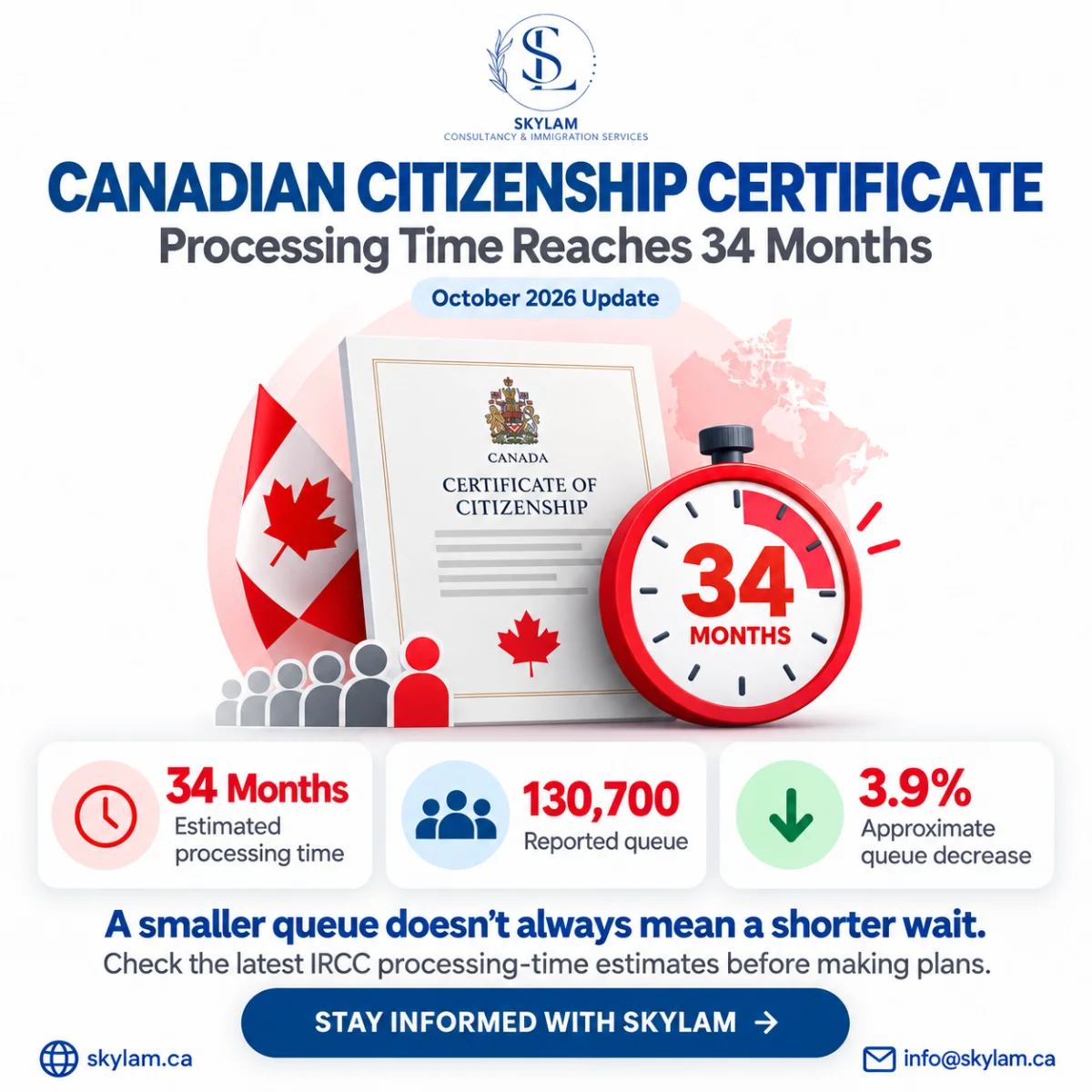
According to figures reported on October 14, 2026, and updated the following day, Immigration, Refugees and Citizenship Canada (IRCC) increased the estimated processing time for citizenship certificates to approximately 34 months on October 9. The estimate had been approximately 33 months in September.
At the same time, the reported application queue fell from around 136,000 to approximately 130,700. This represents a reduction of roughly 5,300 applications, or 3.9%.
Although a smaller queue might appear to be positive news, it does not necessarily mean that applicants will receive their decisions sooner. Processing times also depend on how many applications IRCC expects to receive, how quickly existing files can be processed, staffing and operational capacity, and the complexity of individual cases.
For applicants who need official documentation confirming their Canadian citizenship, the distinction between the number of pending applications and the estimated waiting period is particularly important.
This article explains the October 2026 update, what a citizenship certificate is, why processing times can increase even when a queue shrinks, how urgent processing works, and what applicants can do while waiting for a decision.
1. Canadian Citizenship Certificate Processing Time Reaches 34 Months
IRCC publishes processing-time estimates to help applicants understand how long different immigration and citizenship applications may take.
According to the October 2026 report, the estimated processing time for a Canadian citizenship certificate reached approximately 34 months on October 9, 2026.
The previous estimate, published in September, was approximately 33 months.
The change represents an increase of about one month. However, the longer-term trend is also relevant because the reported estimate had been rising since the spring of 2026.
What do the latest reported figures show?
The October update highlighted two important developments.
| Indicator | September 2026 | October 2026 |
|---|---|---|
| Estimated processing time | Approximately 33 months | Approximately 34 months |
| Reported application queue | Approximately 136,000 | Approximately 130,700 |
| Change in queue | — | Decrease of approximately 5,300 |
| Percentage decrease in queue | — | Approximately 3.9% |
These figures describe the reported estimates and queue size for the period covered by the October update. They should not be interpreted as a guarantee about the time any individual application will take.
Applicants should check the official IRCC processing-times tool for the latest available estimate before making decisions.
IRCC explains that its published processing times are estimates rather than maximum waiting periods or guaranteed deadlines. Actual processing may take longer or shorter depending on the application and other circumstances. <Cite refs={["turn216536search0","turn216536search9"]}/>
2. Why Is the Application Queue Shrinking While Processing Times Increase?
One of the most notable aspects of the October update is that the reported number of pending applications decreased while the estimated processing time increased.
At first glance, these figures may seem contradictory. If fewer applications are waiting, applicants might reasonably expect the waiting period to become shorter.
However, the queue size and processing-time estimate measure different things.
The queue indicates how many applications are awaiting a decision at a particular point in time. The processing-time estimate reflects IRCC's assessment of how long it may take to process applications under current and anticipated conditions.
Processing capacity matters
The number of applications waiting is only one part of the overall picture.
If IRCC receives new applications, processes existing files and makes decisions at different rates, the estimated waiting period can change even when the total queue becomes smaller.
For example, a reduction in pending files does not necessarily mean that the department is processing every remaining application faster. The mix of applications, anticipated new submissions and available processing capacity can also affect the estimate.
New applications can influence future waiting periods
Processing-time estimates are forward-looking. They are intended to give applicants an indication of how long a newly submitted application may take, rather than simply describing the experience of people whose applications are already in the queue.
If IRCC expects to receive a different volume of applications in the coming months, its estimated processing time may change.
Individual applications may require different levels of review
Some applications may be straightforward, while others require additional documentation or verification.
Differences in the information provided, the need to verify records and the complexity of individual cases can affect processing.
Consequently, a smaller queue should not automatically be interpreted as evidence that all applicants will receive decisions sooner.
The key takeaway: The reported decline in pending applications is one indicator of progress, but it does not guarantee a shorter processing time.
3. What Is Proof of Canadian Citizenship?
A Canadian citizenship certificate is an official document that confirms a person's Canadian citizenship.
It is commonly relevant to people who may already be Canadian citizens by birth or descent but need official documentation to establish their status.
For example, someone born outside Canada to a Canadian parent may need to apply for proof of citizenship, depending on their circumstances and the applicable citizenship laws.
The certificate is different from a permanent resident card, a citizenship grant certificate and a Canadian passport.
Who might apply for a citizenship certificate?
Potential applicants may include:
-
People born outside Canada who believe they acquired Canadian citizenship through a parent.
-
Individuals who need official documentation confirming their existing Canadian citizenship.
-
People seeking a replacement or updated citizenship certificate.
-
Eligible individuals who need to establish their citizenship status for administrative or personal purposes.
Eligibility depends on the person's circumstances and the applicable legislation. Having a Canadian parent does not automatically settle every citizenship-by-descent question, so applicants should review the current rules.
The Government of Canada provides information about eligibility and applications through its official proof of Canadian citizenship page. <Cite refs={["turn216536search12"]}/>
4. Citizenship Certificates and Citizenship Grants Are Different
A common source of confusion is the difference between applying for proof of citizenship and applying to become a Canadian citizen.
Although both processes involve Canadian citizenship, they serve different purposes.
Citizenship certificate: Proof of existing citizenship
An application for a citizenship certificate generally concerns a person who is already a Canadian citizen but needs official documentation confirming that status.
The application assesses whether the person is a citizen under the applicable rules and whether the required evidence supports the request.
Citizenship grant: Applying to become a citizen
A citizenship grant application is generally used by eligible permanent residents seeking to acquire Canadian citizenship.
Applicants must meet the relevant requirements, which may include physical presence, language ability, knowledge requirements and other conditions, depending on their circumstances.
A person applying for a citizenship grant is therefore following a different process from someone requesting a certificate to prove citizenship they already possess.
Why does this distinction matter?
The processing time for a citizenship certificate should not be treated as the processing time for a citizenship grant.
The two application categories have separate eligibility criteria, procedures and processing estimates.
Anyone researching Canadian citizenship should make sure they select the correct application type when checking processing times.
IRCC lists citizenship grants and citizenship certificates as separate categories in its processing-times tool. <Cite refs={["turn216536search0"]}/>
5. How Long Could Applicants Outside Canada Wait?
Applicants living outside Canada and the United States should pay particular attention to the submission method and any additional mailing requirements that apply to their circumstances.
The published processing-time estimate is not necessarily the entire period between preparing an application and receiving the required documentation.
For certain paper applications submitted through a Canadian embassy, high commission or consulate, IRCC advises applicants to account for an additional three to four months for mailing time.
Different arrangements can apply depending on where the applicant lives, how the application is submitted and whether the applicant is applying for a minor.
IRCC also identifies an additional six to eight months for certain applications made for minors under 18 who live outside Canada and the United States and whose applications are sent directly to the Case Processing Centre in Sydney, Nova Scotia. These additional periods apply to the circumstances described by IRCC and should not be added indiscriminately to every application. <Cite refs={["turn216536search9"]}/>
What should overseas applicants consider?
Before submitting an application, applicants should:
-
Confirm whether they are eligible to apply online or must use a paper application.
-
Review the instructions for their specific circumstances.
-
Check whether mailing or document-delivery time applies.
-
Allow sufficient time if they need the certificate for travel, education, employment or another important purpose.
-
Review the available urgent-processing options if their situation meets the applicable criteria.
Applicants should not assume that living outside Canada automatically qualifies them for faster processing. Urgent requests are assessed according to IRCC's requirements.
6. Can You Request Urgent Processing of a Citizenship Certificate?
In some circumstances, IRCC may process a citizenship certificate application faster than the normal processing time.
However, urgent processing is not automatic. Applicants must explain why their situation qualifies and provide appropriate supporting evidence.
IRCC identifies several situations that may justify a request for urgent processing, depending on the circumstances.
Examples include:
-
Needing a citizenship certificate to apply for a job or avoid losing an existing job.
-
Needing to attend a school, college or university.
-
Needing to access certain benefits, such as healthcare or a pension.
-
Needing to travel because of a death or serious illness in the family when a passport in another nationality cannot be obtained.
-
Certain situations involving a minor child with a Canadian parent who needs to move to Canada.
-
Certain cases involving statelessness or the need to avoid harm or hardship.
These are examples rather than an exhaustive guarantee of eligibility. IRCC reviews each request and determines whether it qualifies for urgent processing. <Cite refs={["turn216536search3"]}/>
What evidence may be required?
Depending on the reason for the request, supporting evidence may include:
-
A letter explaining why urgent processing is necessary.
-
A paid plane ticket or travel itinerary.
-
A letter from an employer.
-
A letter from a school or educational institution.
-
A doctor's note.
-
A death certificate or other relevant supporting documentation.
The evidence should directly support the circumstances described in the request.
For example, an applicant who needs proof of citizenship for a job may need a letter explaining the employment requirement and the relevant deadline.
A person facing a family emergency may need documents demonstrating the urgency of the situation.
How can you request urgent processing?
Applicants who have not yet submitted their application can review the online application process and indicate that they need urgent processing if the option is available and they qualify.
Applicants using the paper process should follow the instructions in the applicable application guide.
If an application has already been submitted and circumstances have become urgent, IRCC provides instructions for contacting the department and submitting supporting evidence.
Official instructions are available through IRCC's urgent processing guidance for citizenship certificates. <Cite refs={["turn216536search3","turn216536search8"]}/>
Important: Requesting urgent processing does not guarantee that IRCC will approve the request or issue the certificate by a particular date.
7. What Should Applicants Do While Waiting?
A long processing-time estimate can create uncertainty, particularly for people who need citizenship documentation for important personal, educational or professional reasons.
Although applicants cannot control IRCC's overall processing capacity, they can take practical steps to manage their applications.
Check your application status
Use your online account or the appropriate IRCC process to review the status of your application.
If you applied on paper, follow the relevant instructions for confirming receipt and tracking your file.
Keep your contact information current
If your address changes, inform IRCC through the appropriate channel.
Keeping contact information current helps ensure that important correspondence and requests for additional documents can reach you.
Respond to requests promptly
If IRCC requests further information or documents, review the instructions carefully and respond within the specified timeframe.
Delays in providing requested information can affect the progress of an application.
Keep your supporting documents organized
Maintain copies of your application, submission confirmation, supporting evidence and any correspondence from IRCC.
Organized records can make it easier to respond to requests or explain your situation if you need to contact the department.
Avoid duplicate applications without checking the rules
Submitting another application is not necessarily a solution to a long waiting period.
IRCC specifically advises applicants not to submit an online citizenship certificate application if they have already applied on paper and that application is still being processed. The duplicate online application will not be processed. <Cite refs={["turn216536search8"]}/>
Before taking action on an existing application, review the official instructions for your application type.
Plan around uncertainty
If you need your certificate for a specific event or deadline, do not assume that the published processing time is a guaranteed delivery date.
Where possible, allow additional time and investigate whether an eligible urgent-processing request is appropriate.
8. How to Prepare a Citizenship Certificate Application Correctly
Although a complete application cannot guarantee faster processing, careful preparation can help reduce avoidable problems.
Applicants should begin by reviewing the current official application guide and identifying the documents required for their individual circumstances.
Verify your eligibility
Determine whether you may already be a Canadian citizen and whether a citizenship certificate is the correct document to request.
Citizenship-by-descent rules can depend on factors such as birth dates, parental citizenship and applicable legal provisions.
Use the correct application process
IRCC offers online and paper application routes, but not everyone is eligible to use both.
Check the current instructions before beginning. If you have already submitted a paper application, do not submit a duplicate online application while it remains in process.
Check your identity and supporting records
Make sure the information in your application is consistent with your identity documents and supporting evidence.
If documents are not in English or French, follow the applicable translation and affidavit requirements.
Review every section before submitting
Check that the required fields are complete and that all requested documents are included.
Missing information, unclear copies or incomplete documentation can lead to delays or a returned application.
Keep proof of submission
Save confirmation messages, payment records where applicable, tracking information and copies of the application.
These records can help you follow the appropriate process if you need to check whether your application was received.
Applicants should always use the latest instructions published by the Government of Canada rather than relying on an old checklist or an unofficial document list.
9. Will Citizenship Certificate Processing Times Improve?
The October 2026 update does not establish whether processing times will improve in the coming months.
The reported queue reduction is a change in the number of pending applications, but the increase in the estimated processing time indicates that the waiting-period outlook has not improved in the same way.
Future estimates may change as IRCC receives applications, processes existing files and updates its operational projections.
Applicants should therefore avoid assuming that the queue will continue to decline or that processing times will automatically return to earlier levels.
The most reliable approach is to monitor official IRCC updates and make decisions based on the current estimate and the circumstances of the individual application.
A future decline in processing time would be welcome news, but it should be confirmed through an official update rather than predicted from a single month's queue figures.
10. Frequently Asked Questions
What is the reported Canadian citizenship certificate processing time in October 2026?
According to the October 2026 report, the estimate reached approximately 34 months on October 9, up from approximately 33 months in September. Applicants should check the official IRCC processing-times tool for the latest figure.
How many citizenship certificate applications were waiting in October 2026?
The report cited approximately 130,700 pending applications, compared with around 136,000 in the previous update. These are reported queue figures, not a prediction of when any individual application will be completed.
Why did the processing time increase when the queue decreased?
The queue size and processing-time estimate measure different things. IRCC's estimate also reflects anticipated application volumes, processing capacity and other operational factors. A smaller queue does not automatically mean that new applications will be processed faster.
Is a citizenship certificate the same as a Canadian passport?
No. A citizenship certificate is evidence of Canadian citizenship. A Canadian passport is a separate travel document subject to its own application requirements.
Is a citizenship certificate the same as a citizenship grant?
No. A certificate generally documents citizenship that a person already possesses, while a citizenship grant is the process through which an eligible applicant seeks to become a Canadian citizen.
Can I request urgent processing?
You may be able to request urgent processing if your circumstances meet IRCC's criteria and you provide supporting evidence. Approval is not guaranteed.
Will applying online make my application faster?
Applicants should follow the application method that applies to their circumstances. Online submission does not guarantee faster processing, and some people must apply on paper.
Can I submit another application if my current application is taking too long?
Do not submit a duplicate application without reviewing the official instructions. IRCC advises people whose paper citizenship certificate applications are still being processed not to submit another online application.
Where can I check the latest processing time?
Use the official IRCC processing-times tool and select the citizenship certificate or proof-of-citizenship category.
Conclusion: Stay Informed About Canada's Citizenship Certificate Delays
The October 2026 report highlights a significant issue for people waiting for proof of Canadian citizenship. The estimated processing time reached approximately 34 months even as the reported application queue declined by around 3.9%.
This development demonstrates why queue size alone is not a reliable indicator of how long an applicant will wait.
For people who need proof of citizenship, the most useful steps are to understand the correct application category, prepare complete documentation, monitor application status and review urgent-processing options when circumstances justify a request.
Applicants living outside Canada should also consider any additional mailing time that applies to their submission method.
Above all, remember that IRCC's published processing times are estimates, not guaranteed deadlines. Regularly checking official information can help you make better-informed decisions and avoid relying on outdated figures.
Need help understanding your Canadian immigration options?
Skylam Immigration Services can help you understand relevant Canadian immigration processes, identify official requirements and prepare for your next steps.
Contact Skylam Immigration Services to explore your options and move forward with the right information.
Disclaimer: This article is for general informational purposes only and does not constitute legal or immigration advice. Processing times and application requirements can change. The October 2026 figures discussed above are based on the report described in this article and should be checked against current IRCC information before publication or use. Always consult official Canadian government sources for decisions concerning your application.