
Saskatchewan SINP 2026 Update: Nomination Allocation Increased to 5,261
Saskatchewan has released updated third-quarter statistics for the Saskatchewan Immigrant Nominee Program (SINP), providing an important snapshot of the province's nomination activity for 2026.
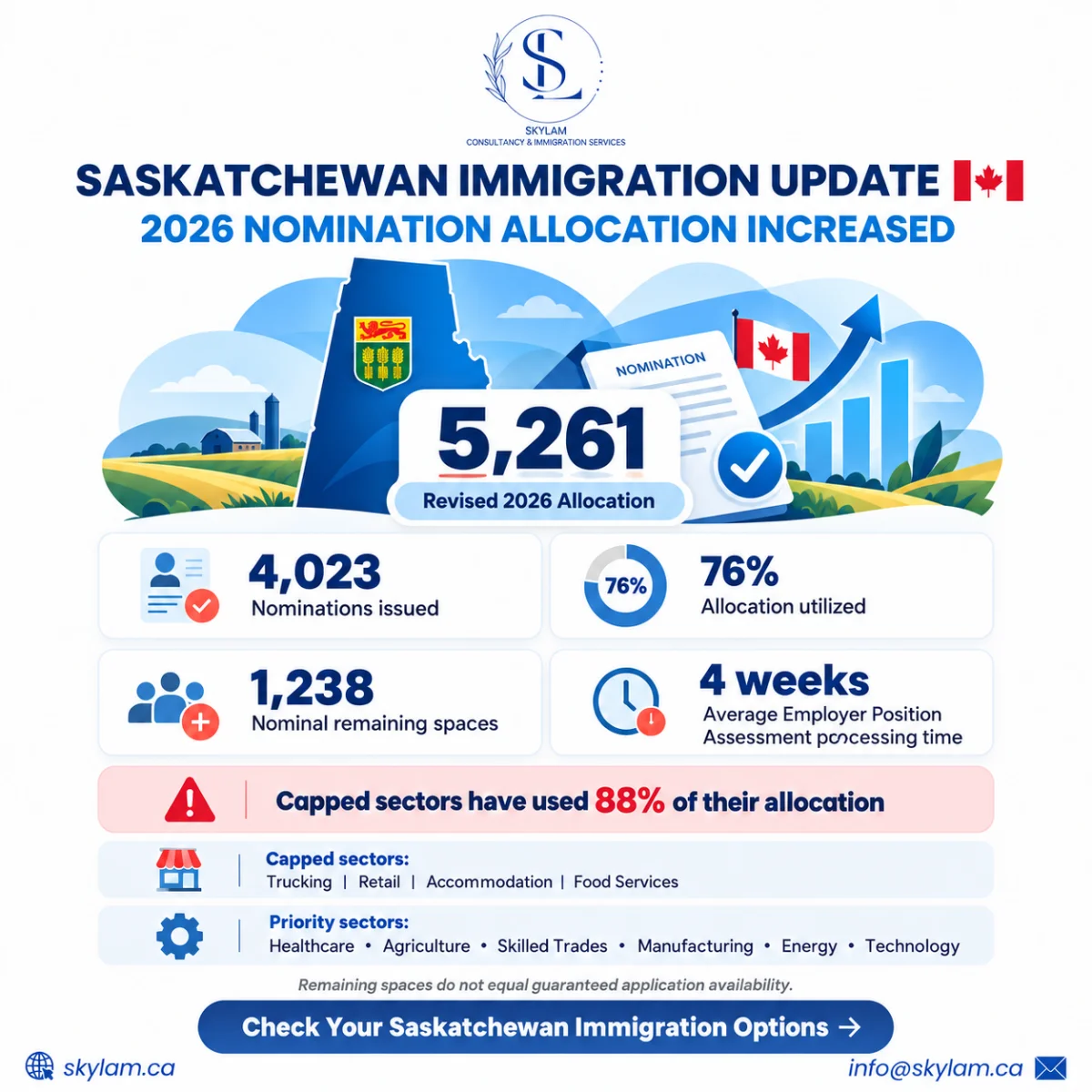
The latest figures confirm that Saskatchewan's 2026 nomination allocation has increased from 4,761 to 5,261.
As of the latest update, the province has issued 4,023 nominations, representing approximately 76% of the revised allocation.
On the surface, this leaves a nominal 1,238 nomination spaces remaining.
However, prospective applicants should not assume that all 1,238 spaces are immediately available for new applications. Saskatchewan has clarified that applications already in processing are not included in the nomination totals.
The update also shows that opportunities are becoming increasingly uneven across different sectors. Capped sectors such as trucking, retail, accommodation and food services have already used 88% of their allocation.
At the same time, Saskatchewan continues to give priority consideration to sectors including healthcare, agriculture, skilled trades, manufacturing, energy and technology.
Saskatchewan's 2026 Nomination Allocation
The biggest headline from the latest SINP update is the increase in Saskatchewan's nomination allocation.
| SINP statistic | Updated figure |
|---|---|
| Original 2026 allocation | 4,761 |
| Revised 2026 allocation | 5,261 |
| Nominations issued | 4,023 |
| Allocation utilized | 76% |
| Nominal remaining spaces | 1,238 |
The increase from 4,761 to 5,261 provides Saskatchewan with additional nomination capacity for 2026.
However, the province's remaining capacity should be viewed in context.
A nominal remaining figure does not necessarily mean that the same number of new applications can be submitted immediately.
What Does 76% Utilized Mean?
Saskatchewan has issued 4,023 nominations from its revised allocation of 5,261.
This represents approximately 76% utilization of the allocation.
That leaves a mathematical difference of 1,238 between the revised allocation and nominations issued.
However, applicants should be careful when interpreting this figure.
The remaining allocation is not the same thing as the number of guaranteed application spots.
Applications that are already in processing may not yet be reflected in the nomination totals. Therefore, the actual availability for future applicants can be more limited than the headline number suggests.
Capped Sectors Have Used 88% of Their Allocation
Another important part of Saskatchewan's latest update concerns capped sectors.
The province reports that trucking, retail, accommodation and food services have already utilized 88% of their allocation.
These sectors therefore have significantly less remaining capacity compared with the overall provincial figure.
For workers in these industries, this means that simply seeing Saskatchewan's overall remaining allocation may give an incomplete picture of their potential opportunities.
Sector-specific capacity can be more important than the province-wide total.
Capped sectors include:
-
Trucking
-
Retail
-
Accommodation
-
Food services
Applicants working in these areas should pay particular attention to current SINP intake conditions and sector-specific restrictions.
Priority Sectors Continue to Receive Attention
While some sectors are approaching their caps, Saskatchewan continues to prioritize several other areas.
The latest update identifies priority consideration for:
-
Healthcare
-
Agriculture
-
Skilled trades
-
Manufacturing
-
Energy
-
Technology
This reflects the importance of matching immigration selection with Saskatchewan's workforce and economic needs.
For candidates working in these areas, understanding the current provincial priorities may be useful when evaluating Saskatchewan as a potential immigration destination.
However, priority consideration does not mean automatic nomination.
Candidates still need to satisfy the applicable SINP requirements and any conditions associated with their particular pathway.
Employer Position Assessments Are Being Processed Faster Than the Target
The third-quarter statistics also provide information about Employer Position Assessments (EPAs).
During the third quarter, Employer Position Assessments averaged approximately four weeks to process.
This was faster than Saskatchewan's stated six-week processing target.
Processing times can provide useful context for employers and workers planning an immigration application.
However, processing times can change depending on application volume, completeness and other factors.
Candidates and employers should therefore avoid treating the four-week average as a guaranteed processing time for every application.
Why Employer Position Assessments Matter
An Employer Position Assessment is an important part of Saskatchewan's immigration process for employers and positions subject to the relevant requirements.
Employers need to understand the provincial process before supporting a foreign worker through an applicable SINP pathway.
For candidates, the employer's ability and willingness to support the immigration process can therefore be an important part of the overall pathway.
A strong candidate profile alone may not be sufficient if the employment position or employer does not meet the applicable provincial requirements.
What Does the Allocation Increase Mean for Applicants?
The increase in Saskatchewan's allocation is generally positive because it gives the province additional nomination capacity.
The revised allocation of 5,261 is higher than the original 4,761 allocation.
However, applicants should not interpret this increase as an announcement that all streams are open or that every occupation has equal access to the remaining capacity.
The latest statistics show exactly why.
While the province has nominal capacity remaining overall, capped sectors have already used 88% of their allocation.
This means opportunities can differ significantly depending on an applicant's occupation and sector.
Why Sector Matters in Saskatchewan Immigration
Provincial immigration programs are designed to help provinces address specific economic and labour market needs.
As a result, immigration opportunities can vary according to occupation, sector and employer.
A candidate working in healthcare may face a different set of opportunities from someone working in retail or food services.
Similarly, a skilled trades professional may have a different pathway from a worker in a capped sector.
This is why applicants should evaluate their profile against the current SINP requirements and priorities, rather than relying only on the province-wide nomination number.
Healthcare Workers May Want to Monitor SINP Opportunities
Healthcare continues to be identified among Saskatchewan's priority areas.
For qualified healthcare professionals, this may make Saskatchewan worth considering as part of a broader Canadian immigration strategy.
However, healthcare occupations can have specific requirements, including potential licensing or professional regulatory requirements.
Candidates should therefore review both immigration eligibility and any professional requirements that apply to their occupation.
Agriculture Remains a Priority Area
Agriculture is another sector receiving priority consideration.
Saskatchewan has a significant agricultural economy, making workers with relevant experience potentially important to the province's labour market.
Candidates with agricultural backgrounds should review the specific SINP pathways and requirements applicable to their occupation and employment situation.
Skilled Trades and Manufacturing
Skilled trades and manufacturing are also among the sectors receiving priority consideration.
Workers with experience in these areas may want to monitor Saskatchewan's provincial immigration opportunities.
As with every SINP pathway, eligibility depends on the applicable program requirements and the candidate's individual circumstances.
Energy and Technology
Saskatchewan's current priorities also include energy and technology.
These sectors can include a wide range of occupations, so candidates should not assume that every job within a broad industry category automatically receives the same treatment.
The specific occupation, NOC classification, employment circumstances and applicable SINP pathway should be reviewed.
What Does This Mean for Trucking, Retail, Accommodation and Food Services?
Workers in capped sectors should pay particular attention to the latest statistics.
Since these sectors have already utilized 88% of their allocation, remaining capacity may be considerably more limited.
This does not necessarily mean that every worker in these industries is immediately ineligible.
Instead, it highlights the importance of checking the current intake rules, available pathways and sector-specific conditions before making plans.
Is the 1,238 Remaining Spaces Number Guaranteed?
No.
This is one of the most important points in the latest update.
The 1,238 figure is the nominal difference between Saskatchewan's revised allocation and the nominations already issued.
It should not be interpreted as a guarantee that 1,238 new applications can be submitted or that 1,238 candidates will necessarily receive nominations.
Applications already in processing are excluded from the nomination totals.
Therefore, the actual availability for new applicants can differ from the headline remaining figure.
What Should Saskatchewan Applicants Do Now?
If you are considering the SINP, several steps can help you understand your potential options.
1. Identify Your Occupation
Determine your correct occupation and NOC classification.
This is particularly important because Saskatchewan's priorities and restrictions can vary by sector and occupation.
2. Check Whether Your Sector Is Capped
If you work in:
-
Trucking
-
Retail
-
Accommodation
-
Food services
you should pay particular attention to the latest sector-specific information because these areas have already used 88% of their allocation.
3. Review Priority Sectors
Candidates working in healthcare, agriculture, skilled trades, manufacturing, energy or technology may want to examine current Saskatchewan opportunities.
4. Review Employer Requirements
Some Saskatchewan pathways depend heavily on the employer and job position.
Make sure your employer understands the applicable requirements before proceeding.
5. Monitor SINP Updates
Provincial nomination availability can change quickly.
A pathway that is available today may have different conditions later depending on nomination capacity and application volume.
6. Do Not Rely Only on the Overall Allocation
The province-wide figure is useful, but it does not tell the entire story.
Sector-specific capacity and applications already in processing can affect actual availability.
Frequently Asked Questions
How many nominations can Saskatchewan issue in 2026?
The revised 2026 allocation is 5,261 nominations, increased from the original allocation of 4,761.
How many Saskatchewan nominations have been issued?
According to the updated third-quarter figures, Saskatchewan has issued 4,023 nominations.
How much of the allocation has been used?
Approximately 76% of the revised allocation has been utilized.
How many nomination spaces are reportedly remaining?
The nominal remaining figure is 1,238 spaces.
However, this should not be considered guaranteed availability for new applications because applications already in processing are excluded from the nomination totals.
Which sectors have used 88% of their allocation?
The capped sectors are:
-
Trucking
-
Retail
-
Accommodation
-
Food services
Which sectors continue to receive priority consideration?
Saskatchewan continues to prioritize areas including healthcare, agriculture, skilled trades, manufacturing, energy and technology.
How long did Employer Position Assessments take in Q3?
Employer Position Assessments averaged approximately four weeks during the third quarter, compared with the province's six-week processing target.
Does the allocation increase guarantee more SINP invitations?
No. The increase provides additional provincial nomination capacity, but actual opportunities depend on the applicable stream, sector, allocation and current provincial priorities.
Final Thoughts
Saskatchewan's latest SINP statistics provide an important picture of the province's immigration landscape in 2026.
The province's nomination allocation has increased from 4,761 to 5,261, while 4,023 nominations have already been issued.
Although the figures show a nominal 1,238 spaces remaining, applicants should not assume that all of those spaces are available for new applications.
The situation is particularly important for workers in capped sectors such as trucking, retail, accommodation and food services, which have already used 88% of their allocation.
At the same time, Saskatchewan continues to give priority consideration to healthcare, agriculture, skilled trades, manufacturing, energy and technology.
For prospective immigrants, the key lesson is simple: Saskatchewan's overall nomination allocation is only one part of the picture.
Your occupation, sector, employer, eligibility and the province's current priorities can all affect your potential pathway.
If you are considering Saskatchewan for Canadian permanent residence, reviewing your profile against the latest SINP requirements before making a decision can help you better understand your options.
Need help assessing your Saskatchewan immigration options?
Skylam Immigration Services can help you understand the pathways that may be relevant to your profile and circumstances.
Your Canadian immigration journey starts with the right information and preparation.
This article is for general information only and does not constitute legal or immigration advice. Provincial nomination allocations, processing times, eligibility requirements and selection priorities can change. Applicants should verify the latest information through official Saskatchewan and Government of Canada sources before applying.