
Canada’s 100,000-Worker Permanent Residence Plan: Provinces Will Decide How Additional Spaces Are Used
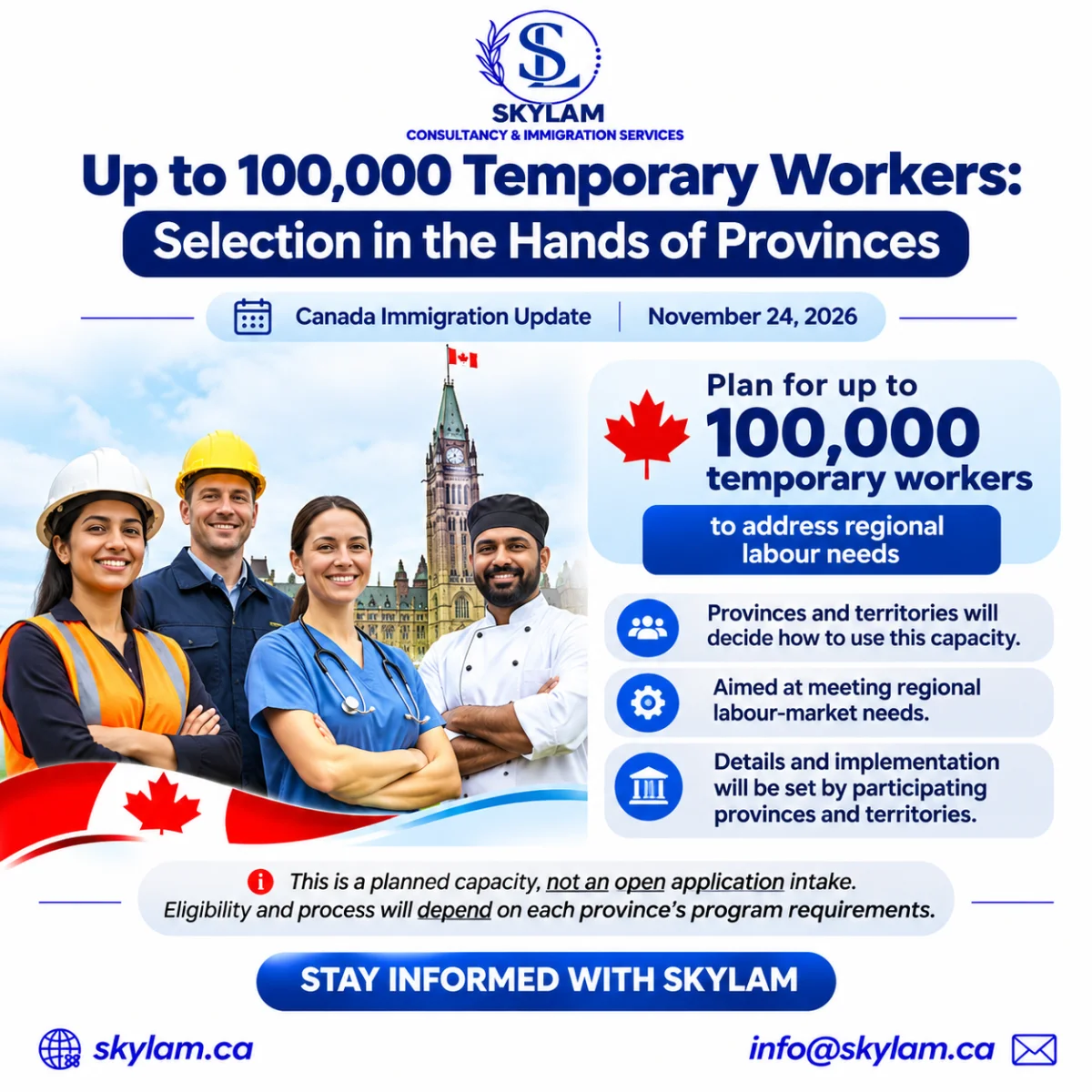
Canada's plan to help up to 100,000 eligible workers and accompanying family members transition to permanent residence in 2027 will depend significantly on decisions made by provincial and territorial governments.
On November 24, 2026, Canadian Immigration Minister Lena Metlege Diab clarified that the federal government's time-limited worker-retention initiative provides additional immigration spaces that provinces and territories may choose to use according to their regional labour-market needs.
The minister also indicated that spaces will remain unfilled if provinces and territories decide not to use them.
This is an important clarification for temporary foreign workers and other prospective applicants already living in Canada.
Although the federal government has announced additional permanent residence capacity, it has not created a general open application pathway for every temporary resident.
1. What Is Canada's 100,000-Worker PR Initiative?
The initiative is part of Canada's time-limited permanent residence measures introduced alongside Budget 2026 and the 2027–2029 Immigration Levels Plan.
The federal government intends to support the transition of up to 100,000 eligible workers and accompanying family members already living in Canada to permanent residence in 2027.
Its objective is to help retain established workers whose skills and experience support Canadian communities and regional economies.
The initiative involves cooperation between Immigration, Refugees and Citizenship Canada (IRCC) and provincial and territorial governments.
Key details:
| Policy detail | Information |
|---|---|
| Planned capacity | Up to 100,000 workers and eligible family members |
| Intended year | 2027 |
| Primary beneficiaries | Qualifying workers already in Canada |
| Provincial participation | Optional |
| Selection approach | Regional labour-market priorities and applicable pathways |
| General public application intake | Not announced |
The 100,000 figure represents the maximum planned capacity, not a guarantee that every space will be used.
2. What Did the Immigration Minister Clarify?
According to reporting published on November 24, 2026, Immigration Minister Lena Metlege Diab explained that provinces and territories would determine how to use the optional additional spaces.
If a provincial or territorial government does not require the additional capacity, those spaces will not automatically be filled elsewhere.
This means the actual number of permanent residence transitions supported through the provincial component may depend on the participation and selection decisions of individual jurisdictions.
The federal government's role includes providing additional admission space and coordinating with participating provinces and territories.
However, individual provinces and territories remain responsible for identifying workers who meet their regional priorities.
3. Why Are Provinces and Territories Involved?
Canada's labour-market conditions vary between provinces, territories and communities.
Some regions face ongoing shortages of skilled workers in particular sectors, while others have different employment needs.
The Provincial Nominee Program (PNP) allows participating provincial and territorial governments to nominate foreign nationals whose qualifications align with their economic priorities.
The additional 2027 worker-transition measure is intended to complement this approach.
Provincial governments can use the available capacity to help retain eligible workers already contributing to local economies.
This may be particularly relevant to employers seeking to retain experienced staff members.
However, provincial selection criteria and nomination procedures remain applicable.
4. How Will Additional Provincial Nomination Capacity Work?
IRCC confirmed on November 12, 2026, that the federal government is offering optional additional space to participating provinces and territories.
The additional capacity is intended to support workers who meet regional economic requirements.
Rather than creating one universal national application system, the government will collaborate with provinces and territories through identified immigration pathways.
The additional capacity includes increases to Provincial Nominee Program allocations.
Provinces and territories may use this space to nominate eligible workers already living in Canada.
They may also identify qualifying workers who have submitted permanent residence applications under selected existing federal immigration programs.
Specific implementation arrangements and individual applicant eligibility will depend on applicable program rules.
5. Does Every Temporary Worker in Canada Qualify?
No.
The announcement does not establish automatic permanent residence eligibility for everyone holding a Canadian work permit.
Applicants must satisfy the requirements of the relevant immigration program.
Depending on the pathway, eligibility may involve factors such as:
-
Current immigration status.
-
Qualifying work experience.
-
Occupation and employment location.
-
Provincial or territorial nomination criteria.
-
Education and language proficiency.
-
Existing permanent residence application status.
-
Other federal immigration requirements.
Being employed in Canada does not automatically mean a worker will receive permanent residence under the initiative.
6. What Happens if a Province Does Not Participate?
The November 24 clarification makes provincial participation especially important.
If a province or territory chooses not to use the optional additional spaces, those places will remain unfilled.
This indicates that the 100,000-person capacity is a maximum planning figure rather than a guaranteed number of admissions.
Applicants should avoid assuming that unused provincial spaces will automatically become available through another program or jurisdiction.
The availability of opportunities will depend on the decisions of participating provinces and territories and applicable federal processing arrangements.
7. Is This a New Temporary-to-Permanent Residence Pathway?
No.
IRCC describes the initiative as a time-limited measure that provides additional permanent residence admission capacity in 2027.
It is intended to operate through selected existing provincial and federal immigration pathways.
The government has not announced a new general application process allowing all temporary residents to apply solely because they are already living in Canada.
This is different from an open immigration program with a universal application form and published eligibility criteria.
Applicants should be cautious of advertisements promising guaranteed permanent residence through the 100,000-worker initiative.
8. How Does This Relate to the Broader 200,000-Person PR Measure?
Canada's time-limited initiative includes two principal cohorts.
| Cohort | Planned maximum capacity |
|---|---|
| Workers and eligible family members | 100,000 |
| Specified humanitarian and family-related applicants | 100,000 |
| Total | 200,000 |
The November 24 ministerial clarification primarily concerns the provincial role in the worker component.
The humanitarian component involves selected applicants already living in Canada, including people with longstanding applications and existing humanitarian or family-related commitments.
These are separate applicant groups with different implementation arrangements.
The broader 200,000-person measure does not establish universal eligibility for all temporary residents.
9. How Is the 100,000-Worker Plan Different From Regular PNP Targets?
Canada's 2027–2029 Immigration Levels Plan sets an annual Provincial Nominee Program target of 95,000 permanent resident admissions.
The new time-limited measure provides additional capacity for identified worker transitions in 2027.
The two figures should not be confused.
The 95,000 PNP figure is the regular planned annual admissions target.
The additional worker-retention initiative is a separate, time-limited measure designed to support selected in-Canada workers and accompanying family members.
Neither figure represents an immediately available number of nomination certificates for the general public.
10. Why Does This Matter for Employers?
Canadian employers may have temporary foreign workers who have developed valuable skills and established strong connections with their workplaces.
The worker-retention measure is intended to help participating provinces and territories retain qualifying workers whose contributions are important to regional economies.
Employers should monitor provincial immigration announcements to understand whether their workers may qualify under relevant nomination streams.
However, the initiative does not exempt employers or workers from applicable immigration or employment requirements.
11. What Should Temporary Workers Do Now?
Workers already living in Canada should focus on confirming their eligibility under currently available immigration pathways.
Step 1: Review your current immigration status
Ensure that your work permit and other immigration documents remain valid.
Step 2: Research provincial nomination programs
Identify provincial streams that may align with your occupation, employment experience and location.
Step 3: Check eligibility requirements
Review applicable education, work experience, language and job offer requirements.
Step 4: Follow provincial announcements
Watch for official details about how additional 2027 nomination capacity will be administered.
Step 5: Monitor IRCC instructions
Use official government sources to verify any changes affecting application eligibility or processing.
Step 6: Avoid guaranteed-PR claims
Do not assume the new measure provides automatic eligibility or a new open intake.
12. Frequently Asked Questions
Is Canada granting permanent residence to 100,000 temporary workers?
Canada has announced additional capacity intended to support up to 100,000 eligible workers and accompanying family members already living in Canada in 2027. It is not a guarantee that all spaces will be used or that every applicant will be approved.
Who decides how the additional spaces are used?
Participating provinces and territories will play a significant role in identifying qualifying workers according to regional labour-market requirements.
What happens if provinces do not use their additional spaces?
According to the immigration minister's November 24 clarification, unused spaces will remain unfilled.
Is the initiative open for applications?
No general public application intake has been announced solely for this measure.
Can international students automatically qualify?
No. Holding temporary resident status or studying in Canada does not automatically establish eligibility.
Does a provincial nomination guarantee permanent residence?
No. IRCC is responsible for the final federal permanent residence decision, including admissibility and applicable program requirements.
When is the initiative intended to operate?
The additional worker-transition capacity is intended for 2027.
Conclusion
Canada's plan to transition up to 100,000 eligible workers and accompanying family members to permanent residence in 2027 depends on cooperation between federal, provincial and territorial governments.
The November 24 clarification emphasizes that provincial participation is optional and unused spaces will not automatically be filled.
The initiative may create opportunities for certain established workers whose qualifications align with regional employment needs.
However, it does not establish a general open permanent residence pathway or guarantee approval for all temporary workers.
Prospective applicants should continue monitoring official IRCC and provincial immigration announcements and assess their eligibility under the applicable programs.
Stay Informed with Skylam Consultancy & Immigration Services
Interested in understanding Canada's provincial immigration and permanent residence pathways?
Skylam Consultancy & Immigration Services provides information and guidance on immigration eligibility and application requirements.
Stay informed about policy developments and explore the pathways that may be appropriate for your circumstances.
Website: https://skylam.ca
Email: info@skylam.ca
Verify your immigration representative: https://register.college-ic.ca