
IRCC Removes 90-Day Limit for Pending LMIA Work Permits
IRCC Removes 90-Day Limit for Pending LMIA Work Permits: What Foreign Workers in Canada Need to Know
Canada has introduced an important update to its immigration processing procedures that could make a significant difference for eligible temporary foreign workers waiting for their employers' Labour Market Impact Assessment (LMIA) decisions.
On October 28, 2026, Immigration, Refugees and Citizenship Canada (IRCC) updated its operational instructions for officers handling work permit applications under the Temporary Foreign Worker Program (TFWP). The update removes the previous 90-day limit on holding certain eligible in-Canada work permit applications while an employer's LMIA application is still being processed.
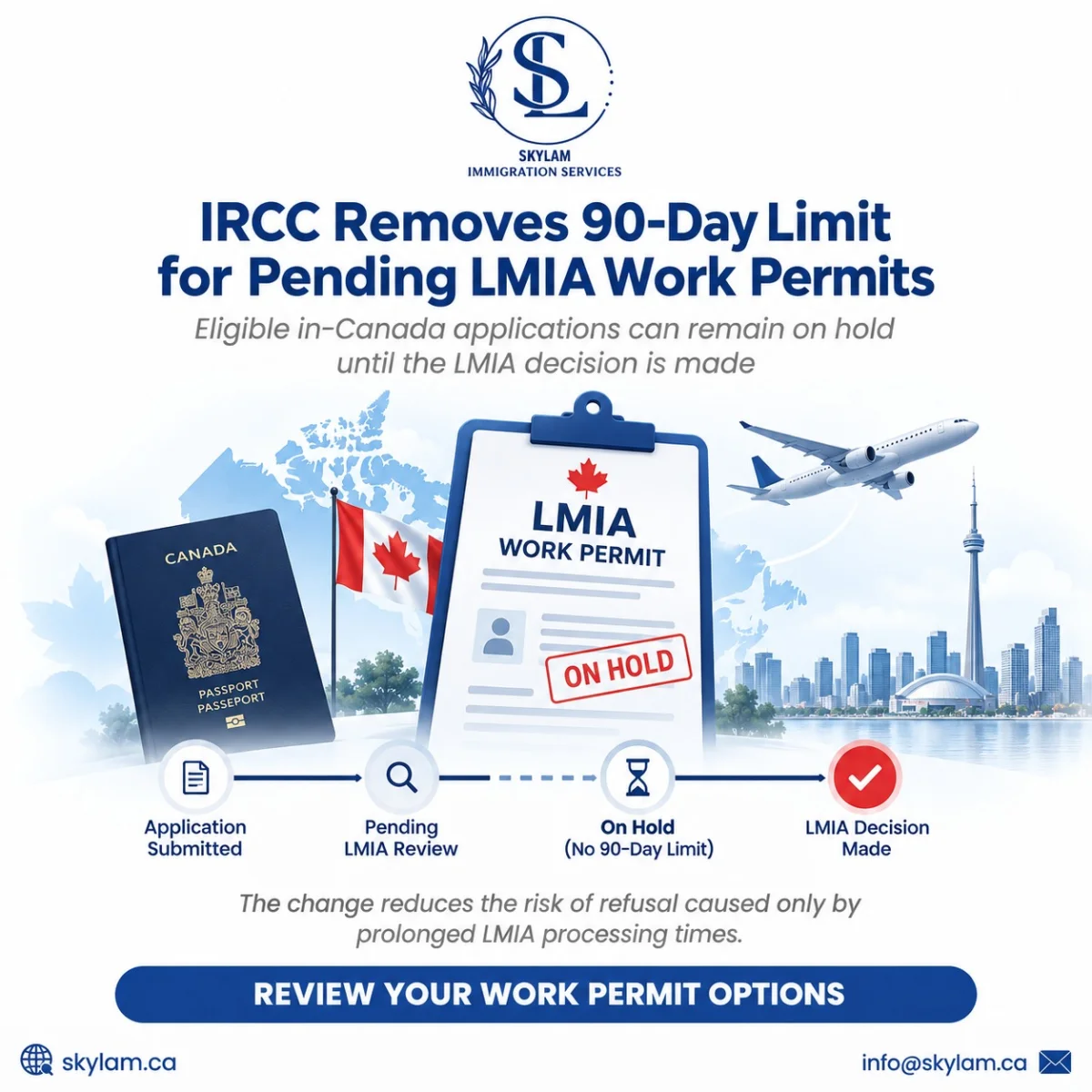
Under the revised instructions, IRCC will hold eligible work permit applications until a decision is made on the employer's pending LMIA. Where required, the department will also wait for the relevant Quebec Acceptance Certificate (CAQ) before making a final determination.
This is welcome news for foreign workers who have been concerned about their work permit applications being refused simply because their employers' LMIA processing takes longer than expected.
Previously, eligible applicants could benefit from concurrent processing, but immigration officers were generally instructed to hold their applications for a maximum of 90 days. If the LMIA decision was not available within that period, the work permit application could still face a final decision.
The latest update removes that fixed waiting period for qualifying applications.
However, it is important to understand that this change does not eliminate the LMIA requirement, automatically extend every work permit, or guarantee approval. Applicants must still satisfy the eligibility requirements and follow the correct application procedures.
In this article, we explain what has changed, who can benefit, how the new procedure works, and what temporary foreign workers should consider before submitting their work permit applications.
1. What Has Changed in Canada's LMIA Work Permit Processing?
The most significant change is the removal of the 90-day deadline previously applied to certain work permit applications submitted through concurrent processing.
To understand the importance of this development, it is helpful to look at how the previous procedure worked.
Under the concurrent processing procedure, certain foreign workers already living in Canada could submit their work permit applications while their employers' LMIA applications were still pending.
This was particularly useful when a worker's existing work permit was approaching its expiry date and waiting for the final LMIA decision could create immigration difficulties.
However, the previous instructions established a maximum 90-day holding period.
If the employer's LMIA application remained undecided after those 90 days, IRCC could proceed with a final decision on the work permit application.
This created uncertainty because LMIA processing times can vary considerably depending on the application stream, employer circumstances, and the volume of applications being handled by Employment and Social Development Canada (ESDC).
The October 28, 2026 update changes this approach.
Under the revised instructions:
-
The previous 90-day holding limit has been removed.
-
Eligible applications can remain on hold while the LMIA is being processed.
-
IRCC will wait for the LMIA decision before making a final determination.
-
A Quebec Acceptance Certificate (CAQ) will also be awaited where required.
-
The work permit application will still be assessed under the applicable immigration requirements.
In simple terms, eligible applicants no longer face the same fixed 90-day processing deadline while waiting for their employer's LMIA decision.
2. Understanding Concurrent Processing for LMIA Work Permits
Concurrent processing is an important procedure that allows certain foreign nationals already in Canada to submit their work permit applications before their employers receive the final LMIA decision.
Normally, an employer must obtain a positive or neutral LMIA before a foreign worker can receive an employer-specific work permit under the Temporary Foreign Worker Program.
However, the LMIA assessment and work permit application do not always need to be completed at the same time.
Under the concurrent processing procedure, eligible workers may submit their applications while their employers' LMIA applications are still being assessed.
This gives applicants an opportunity to apply for an extension before their current work permits expire.
The purpose of this arrangement is to reduce the risk of immigration complications caused by delays outside the worker's control.
For example, imagine a foreign worker employed by a Canadian company whose work permit is about to expire.
The employer has already submitted a complete LMIA application, but ESDC has not yet issued a decision.
Without the concurrent processing procedure, the worker might have to wait for the LMIA decision before submitting the intended work permit application.
The procedure provides another option for qualifying applicants.
They may submit the work permit application while the LMIA remains pending, and IRCC can hold the application until the employer receives the required decision.
The October 2026 update makes this process more flexible by removing the previous 90-day holding limit.
3. Who Is Eligible for the New IRCC Processing Procedure?
One of the most important things applicants should understand is that this update does not apply automatically to every foreign worker in Canada.
The concurrent processing procedure has specific eligibility conditions.
Generally, an applicant must meet the following requirements.
A. The Applicant Must Be Applying From Inside Canada
The procedure concerns qualifying in-Canada work permit applications under the applicable provisions, including section R199 of the Immigration and Refugee Protection Regulations.
It is not a general policy for every overseas work permit applicant.
Applicants must review the applicable instructions to determine whether their application falls within the scope of concurrent processing.
B. The Existing Work Permit Must Expire Within Two Weeks or Less
The applicant's current work permit must be approaching its expiry date.
Specifically, the procedure applies when the existing permit is due to expire within two weeks or less.
This requirement is important because concurrent processing is designed to address situations where a worker is approaching the end of their existing work authorization while an LMIA decision remains pending.
C. The Employer Must Have Submitted a Complete LMIA Application
The employer must already have submitted a complete LMIA application to ESDC.
Simply discussing an LMIA application with an employer, preparing documents, or planning to submit an application is not sufficient.
The worker should obtain supporting evidence showing that the employer has actually submitted the application.
D. The LMIA Must Have Been Submitted With Sufficient Lead Time
This is another critical eligibility requirement.
The employer must have submitted the LMIA sufficiently early that, based on the published processing times, ESDC could reasonably have been expected to process it before the worker's existing work permit expired.
Applications submitted at the last minute do not automatically qualify for concurrent processing.
IRCC indicates that such late submissions may be considered only on an exceptional basis.
E. The LMIA Decision Must Still Be Pending
The employer's LMIA application must not already have received a final decision.
If the LMIA has been approved or refused, the applicant's situation must be assessed according to the applicable rules and the decision received.
Meeting these conditions is essential for applicants seeking to benefit from the revised processing instructions.
4. What Does Removing the 90-Day Limit Actually Mean?
The removal of the 90-day limit is particularly important because LMIA processing does not always follow a predictable timeline.
Under the previous arrangement, an eligible applicant could submit a work permit application and have it held for up to 90 days while waiting for the LMIA decision.
If the LMIA was still pending after the 90-day period, IRCC could proceed with a final decision.
This created a difficult situation for workers whose employers were still waiting for ESDC to complete the assessment.
The October 28 update removes this fixed deadline.
Now, where the application qualifies for concurrent processing, IRCC's instructions direct officers not to make a final decision on the work permit application until the LMIA decision is available.
For applicants who require a CAQ, the relevant certificate must also be available before the final determination.
This means the application can remain on hold for longer than 90 days if the LMIA process requires additional time.
The main benefit is that eligible applicants are no longer exposed to the same fixed 90-day deadline simply because the LMIA decision has not arrived.
However, this does not mean that IRCC has promised to approve every pending application.
The department will still assess the application after the necessary supporting decision becomes available.
5. How Does the New Update Affect Maintained Status?
Maintained status is another important concept for foreign workers submitting work permit extension applications from inside Canada.
When an eligible temporary resident applies to extend their status before their existing permit expires, they may be allowed to remain in Canada under maintained status while IRCC processes the application.
For eligible workers who have submitted a work permit extension application before their current permit expires, maintained status can also allow them to continue working under the conditions of their previous work permit.
For example, a worker holding an employer-specific work permit may generally continue working:
-
For the same employer.
-
In the same occupation.
-
Under the same authorized employment conditions.
The new 90-day policy update is relevant because it can allow an eligible work permit application to remain pending until the LMIA decision is available, even when processing takes longer than 90 days.
If the applicant has valid maintained status and continues meeting the applicable conditions, the longer processing period may provide greater continuity.
Nevertheless, applicants must understand that maintained status is not a new work permit.
It does not automatically authorize a worker to change employers, occupations, or employment conditions.
Applicants should also carefully review the rules concerning international travel because leaving Canada during maintained status can affect their ability to work when they return.
6. What Happens After the Employer Receives the LMIA Decision?
Removing the 90-day limit does not eliminate the requirement for a valid LMIA decision.
The employer must still obtain the required positive or neutral LMIA for the foreign worker to receive a work permit under the Temporary Foreign Worker Program.
Once ESDC issues its decision, the applicant should follow the applicable IRCC instructions for providing the result and any required supporting information.
IRCC can then continue assessing the work permit application.
The final decision will depend on whether the applicant meets the relevant immigration requirements.
A positive LMIA supports the work permit application, but it does not guarantee approval.
IRCC may still review:
-
The validity of the employment offer.
-
The employer's eligibility.
-
The applicant's qualifications.
-
The applicant's immigration history.
-
The completeness and accuracy of the submitted documents.
-
Compliance with the applicable work permit conditions.
Therefore, workers should continue monitoring their IRCC accounts and respond to any requests from immigration officers.
7. What If the Employer's LMIA Application Is Refused?
The new policy is helpful when an LMIA decision is delayed, but it does not protect applicants from a negative LMIA decision.
If ESDC refuses the employer's LMIA application, the applicant may no longer qualify for the intended LMIA-based work permit.
The removal of the 90-day limit only changes how long IRCC can hold an eligible work permit application while waiting for the LMIA decision.
It does not change the requirement for a positive or neutral LMIA.
In this situation, applicants should carefully review the reasons for the refusal and seek professional guidance.
Depending on their individual circumstances, possible next steps may include:
-
Reviewing the reasons for the LMIA refusal with the employer.
-
Determining whether the employer has another available option under the relevant program.
-
Exploring another eligible work permit category.
-
Assessing alternative immigration pathways.
-
Reviewing whether the applicant needs to take action to maintain or restore temporary resident status.
Workers should not assume that a pending application will automatically be approved if the employer's LMIA is refused.
Timely professional advice can be particularly important in these situations.
8. What Documents Should Applicants Prepare?
Proper documentation is essential when applying for a work permit through concurrent processing.
Applicants should carefully review the current IRCC instructions and personalized document checklist.
Depending on the circumstances, the following documents may be relevant:
-
A copy of the current work permit.
-
A valid passport.
-
Employment offer or supporting employment documents.
-
Employer information and business details.
-
Evidence that the employer submitted a complete LMIA application.
-
The LMIA application submission confirmation or receipt.
-
The LMIA application reference number, where available.
-
The date of LMIA submission.
-
Relevant supporting correspondence from the employer.
-
A letter of explanation describing the pending LMIA situation.
-
Additional documents requested by IRCC.
Applicants should ensure that the information provided by the employer matches the details included in the work permit application.
Any inconsistencies should be addressed before submission.
9. Important Application Instructions: The CPTS2026 Code
Applicants seeking concurrent processing should also pay attention to IRCC's application instructions.
The updated procedure includes a specific tracking instruction for eligible applications.
Applicants are directed to enter the code CPTS2026 in the intended occupation field of the IMM 5710 application form, following the applicable IRCC instructions.
This code is used for internal application tracking.
It is not an LMIA approval, a work permit approval, or a separate immigration category.
Applicants should ensure that they follow the correct instructions for the specific application they are submitting rather than inserting the code into unrelated applications.
The purpose of the tracking process is to help IRCC identify applications that require concurrent processing.
10. What Should Employers Do Under the Updated Procedure?
Canadian employers also have an important responsibility when supporting foreign workers through the LMIA and work permit process.
The removal of the 90-day limit does not mean that employers should delay submitting their LMIA applications.
In fact, the lead-time requirement makes early preparation particularly important.
Employers should:
-
Assess upcoming work permit expiry dates.
-
Submit complete LMIA applications sufficiently early.
-
Follow the applicable recruitment requirements.
-
Ensure that employment conditions meet program standards.
-
Provide workers with LMIA submission confirmation.
-
Communicate regularly with employees about application progress.
-
Respond promptly to requests from ESDC.
-
Ensure that the employment arrangement remains compliant with Canadian immigration rules.
Employers should also understand that submitting an LMIA does not guarantee approval.
The application must still satisfy the requirements of the Temporary Foreign Worker Program.
11. Does the New Policy Guarantee Work Permit Approval?
No. This is perhaps the most important point for foreign workers to understand.
The October 28, 2026 update removes the previous 90-day holding limit for eligible concurrent processing applications.
It does not remove the LMIA requirement.
It does not automatically extend every worker's existing work permit.
It does not guarantee a positive LMIA decision.
And it does not guarantee that IRCC will approve the final work permit application.
The update simply changes the way IRCC handles qualifying applications while the employer's LMIA remains pending.
Once the LMIA decision is available, IRCC will continue the assessment and make a final determination.
Applicants must still satisfy all relevant immigration requirements.
12. Why This Update Is Important for Foreign Workers in Canada
For many temporary foreign workers, an expiring work permit can create considerable uncertainty.
They may have a stable job, an employer willing to continue their employment, and a complete LMIA application already submitted.
However, delays in government processing can create problems that neither the worker nor the employer can directly control.
The removal of the 90-day limit provides a more flexible approach for eligible applicants.
Some of the main benefits include:
Greater protection against timing-related refusals: Eligible applications can remain on hold until the LMIA decision is available.
Reduced uncertainty: Workers no longer face the same fixed 90-day deadline for receiving an LMIA decision.
Improved employment planning: Employers and employees can plan their next steps with a clearer understanding of the processing procedure.
Better continuity: Eligible applicants who properly maintain their status may benefit from continued authorization to work under their previous permit conditions while waiting for a decision.
More flexibility for delayed LMIA applications: The updated instructions recognize that government processing times can extend beyond the previous 90-day holding period.
Although the update does not eliminate all immigration risks, it represents an important administrative change for eligible foreign workers.
13. Frequently Asked Questions About the New IRCC 90-Day Limit Update
Q1. Has IRCC officially removed the 90-day limit for pending LMIA work permits?
Yes. IRCC updated its operational instructions on October 28, 2026, removing the previous 90-day holding limit for eligible concurrent processing applications.
Q2. Will IRCC now wait until the LMIA decision is issued?
For applications that qualify under the concurrent processing procedure, IRCC will hold the work permit application until the LMIA decision is available. A CAQ must also be available where required.
Q3. Does this update apply to every foreign worker in Canada?
No. The procedure has specific eligibility requirements, including the two-weeks-or-less work permit expiry condition and the requirement for a complete LMIA application submitted with sufficient lead time.
Q4. Can I apply if my work permit expires in one month?
The specific concurrent processing procedure discussed here generally requires the existing work permit to expire within two weeks or less. Applicants should review their circumstances and the official instructions.
Q5. Does the new update remove the requirement for a positive LMIA?
No. A positive or neutral LMIA is still required for the relevant work permit under the Temporary Foreign Worker Program.
Q6. Can I continue working while my application is pending?
Eligible applicants who submit their work permit extension applications before their existing permits expire may benefit from maintained status and continue working under the conditions of their previous permits, subject to the applicable rules.
Q7. What happens if the LMIA is refused?
The updated procedure does not guarantee approval. If the LMIA is refused, the applicant's work permit application may not meet the requirements of the intended LMIA-based category.
Q8. Is the CPTS2026 code an approval code?
No. It is an application tracking code used according to IRCC's instructions. It does not guarantee a work permit or LMIA approval.
14. Final Thoughts: A Significant Update for Eligible LMIA Work Permit Applicants
The removal of the 90-day limit is an important development for eligible foreign workers already living and working in Canada.
By directing officers to hold qualifying work permit applications until the employer's LMIA decision becomes available, IRCC has addressed an important concern associated with lengthy LMIA processing times.
For workers whose existing permits are approaching expiry, this change can provide greater flexibility and reduce the risk of a refusal caused solely by the time required to process an LMIA.
However, eligibility remains limited.
The worker must be applying from inside Canada, their current permit must expire within two weeks or less, and their employer must have submitted a complete LMIA application with sufficient lead time. The LMIA must also remain undecided.
Applicants must follow the correct application procedures, submit accurate supporting documents, and ensure that their work permit extension application is submitted before their existing permit expires if they intend to benefit from maintained status.
Most importantly, the LMIA requirement remains in place, and final work permit approval is still subject to IRCC's assessment.
If you are currently working in Canada and your work permit is approaching expiry while your employer's LMIA application is pending, understanding this update may help you identify the appropriate next steps.
Need Help Reviewing Your Canadian Work Permit Options?
Immigration procedures can be complicated, particularly when work permit expiry dates and pending LMIA applications overlap.
At Skylam Immigration Services, we understand the importance of staying informed about Canadian immigration policy changes and preparing applications carefully.
Whether you are an employer supporting a foreign worker or an employee looking to understand your work permit extension options, getting the right information is an important first step.
Do not wait until your work permit expires to review your options.
Visit www.skylam.ca or contact info@skylam.ca to learn more about Canadian work permits, LMIA processing, and immigration options.
Disclaimer: This article is provided for general informational and educational purposes only. It does not constitute legal or immigration advice. Immigration policies and operational instructions may change. Eligibility and outcomes depend on individual circumstances. Always consult the official Government of Canada immigration instructions or an authorized Canadian immigration professional before making immigration decisions.