
IRCC Updates LMIA Work Permit Processing
IRCC Updates LMIA Work Permit Processing: Eligible In-Canada Applicants Can Now Wait for an LMIA Decision
Canada continues to attract skilled workers and international talent from around the world. For many temporary foreign workers, obtaining or extending a work permit is an important step toward maintaining employment, financial stability, and long-term career opportunities in the country. However, one of the biggest challenges applicants face is the time required to process a Labour Market Impact Assessment (LMIA).
In some situations, employers submit LMIA applications to Employment and Social Development Canada (ESDC), but the decision takes longer than expected. Meanwhile, the foreign worker's existing work permit may be approaching its expiry date. This creates uncertainty for both employers and employees, particularly when a work permit extension depends on receiving a positive LMIA.
To address this situation, Immigration, Refugees and Citizenship Canada (IRCC) provides a specific process that allows certain eligible workers already in Canada to submit their work permit extension applications while their employer's LMIA application is still being processed.
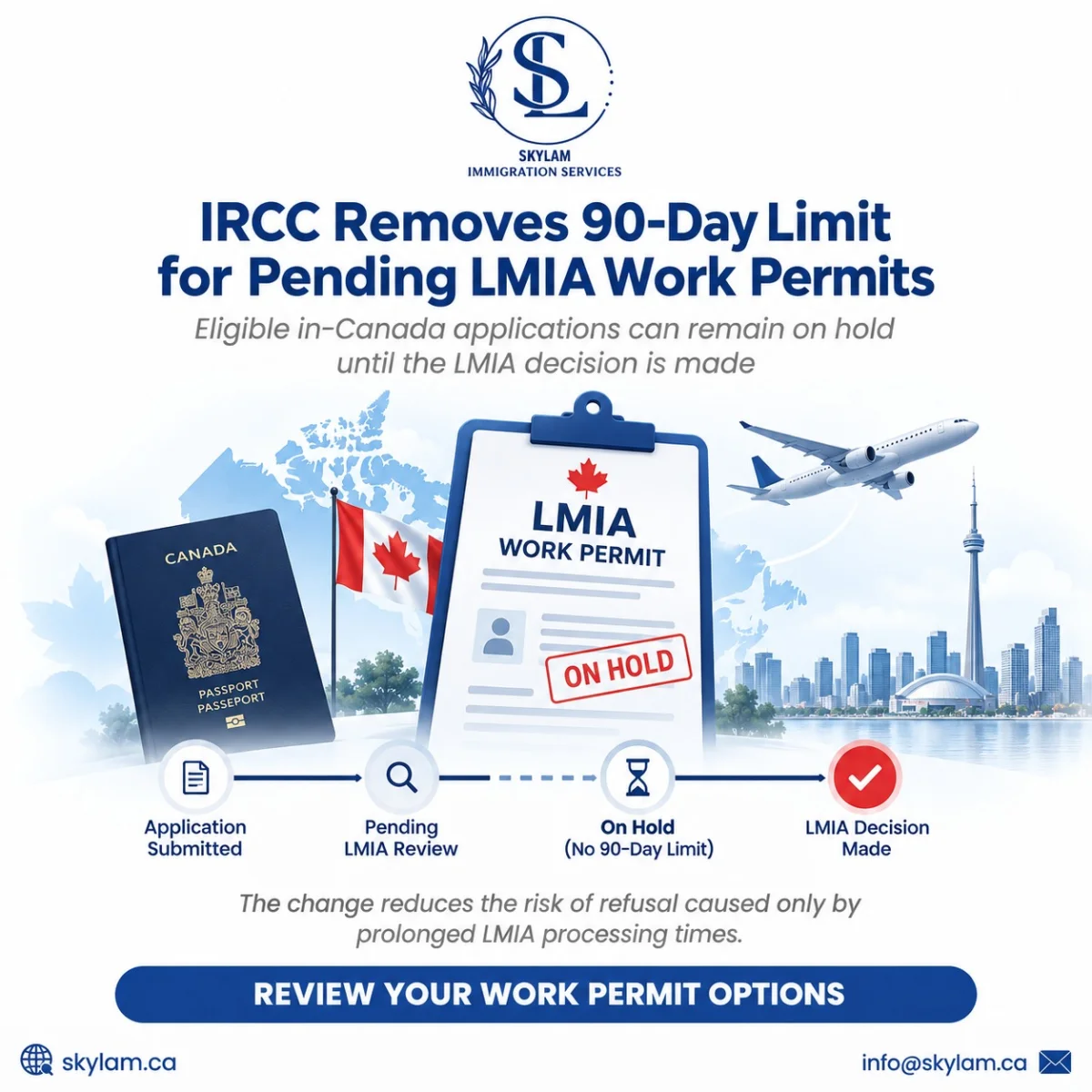
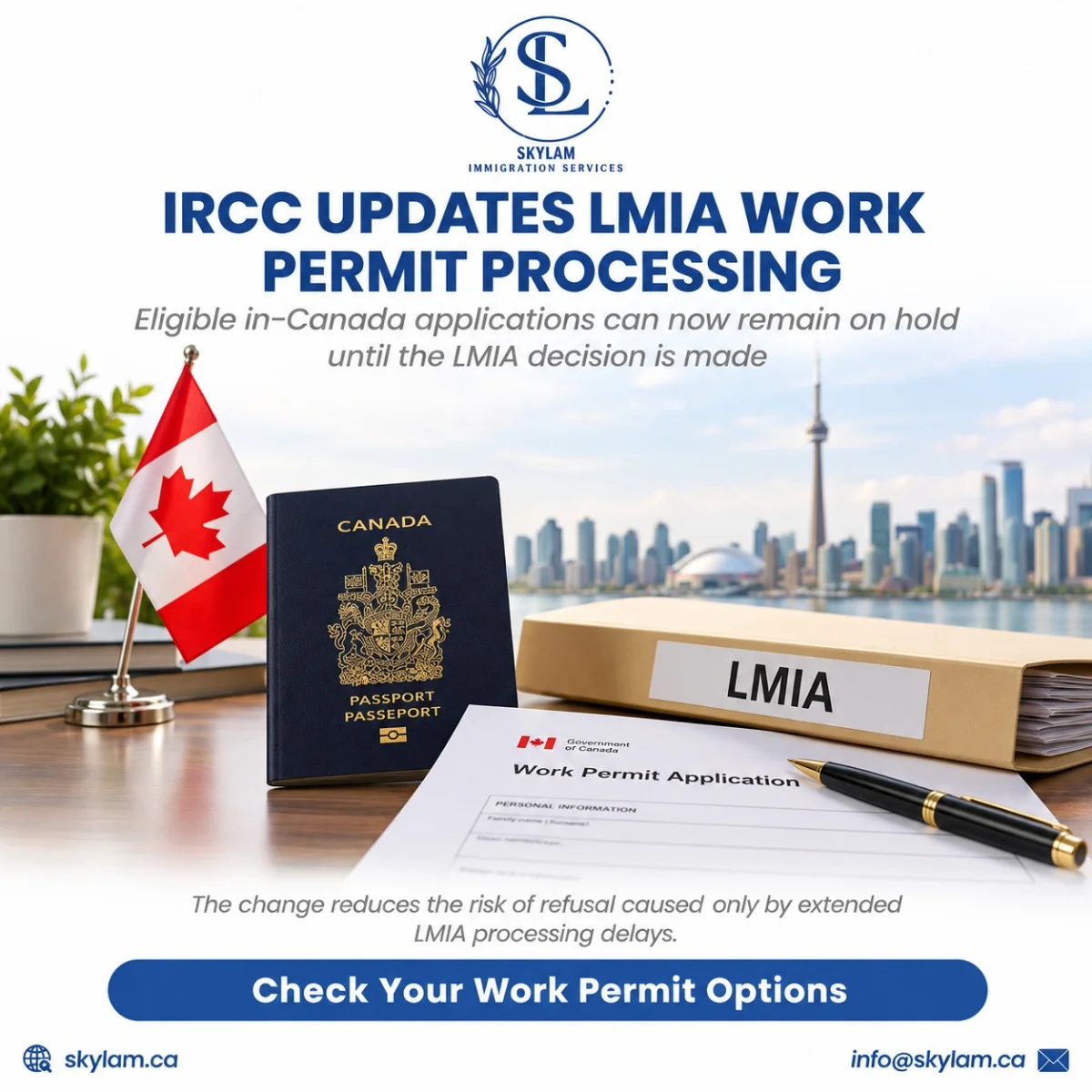
Under this process, IRCC can hold the work permit application without making a final decision until the required LMIA decision is received. This can help eligible workers avoid having their applications refused simply because the LMIA decision has not yet arrived.
For foreign workers currently living and working in Canada, understanding this process is essential. It can help them plan their work permit extensions more effectively, understand their immigration status, and avoid unnecessary complications during the application process.
1. Understanding the Latest IRCC LMIA Work Permit Processing Update
A Labour Market Impact Assessment is an important document used in Canada's Temporary Foreign Worker Program (TFWP). It is issued by Employment and Social Development Canada after assessing an employer's request to hire a foreign worker.
In most cases, an employer must obtain a positive LMIA before the foreign worker can apply for an employer-specific work permit.
The LMIA process helps the Canadian government assess whether hiring a foreign national is likely to have a positive or neutral impact on the Canadian labour market. It also helps determine whether sufficient efforts have been made to recruit Canadian citizens or permanent residents for the position.
However, LMIA processing can take time. Different application streams have different processing periods, and employers may experience delays depending on the volume of applications and the documents submitted.
The IRCC procedure provides a solution for certain workers whose current work permits are about to expire.
Eligible applicants may submit their work permit extension applications before receiving the final LMIA decision, provided that their current work permit expires within two weeks or less and their employer has already submitted a complete LMIA application.
IRCC will not make a final decision on the work permit application until the required LMIA decision is received.
This is particularly important because applicants do not necessarily have to wait until the last moment to understand their options or risk missing an opportunity to submit an extension application.
2. What Is an LMIA and Why Is It Important?
LMIA stands for Labour Market Impact Assessment. It is an assessment conducted by ESDC to determine whether a Canadian employer can hire a foreign worker for a particular position.
When a Canadian business cannot find a suitable Canadian citizen or permanent resident to fill a job vacancy, it may be eligible to apply for an LMIA.
The employer generally needs to demonstrate that:
-
There is a genuine job vacancy within the business.
-
The position meets the applicable program requirements.
-
Recruitment requirements have been fulfilled.
-
The offered wages and working conditions meet the applicable standards.
-
Hiring a foreign worker is justified under the relevant LMIA stream.
If the application is approved, the employer receives a positive LMIA decision letter. The foreign worker can then use the required LMIA information and supporting employment documents when applying for an employer-specific work permit.
Without the required approval, an applicant may not qualify for the work permit category they intend to use.
However, the special in-Canada extension procedure provides an opportunity for certain workers to submit their applications before the final LMIA decision becomes available.
3. Who Can Benefit from This IRCC Procedure?
Not every foreign worker is automatically eligible to submit a work permit extension application while waiting for an LMIA decision.
IRCC has established specific eligibility conditions for this process.
Generally, applicants must meet the following two important requirements:
First: The current work permit must expire within two weeks or less.
The applicant must be approaching the expiry date of their existing work permit. This procedure is designed for workers who are close to losing their current work authorization and need to submit an extension application.
Second: The employer must have submitted a complete LMIA application.
The employer must already have submitted a complete LMIA application to the appropriate authority. Simply planning to apply for an LMIA or preparing the required documents is not sufficient.
The applicant should have supporting evidence showing that the employer has submitted the application.
If these conditions are met, the worker may be able to submit an in-Canada work permit extension application before the LMIA decision is issued.
It is important to remember that meeting these conditions does not guarantee approval of the work permit. IRCC must still assess the application and determine whether the applicant meets all applicable immigration requirements.
4. IRCC Can Hold Eligible Work Permit Applications Until the LMIA Decision
One of the most important aspects of this procedure is how IRCC handles an application submitted without the final LMIA decision.
Normally, applicants are advised to wait until their employer receives a positive LMIA before applying for a work permit extension.
However, when an applicant qualifies under the specific in-Canada procedure, the application may be submitted while the LMIA is still being processed.
IRCC will wait for the LMIA or the applicable Quebec Acceptance Certificate (CAQ) before making a final decision on the work permit application.
This means that the work permit application does not have to be finalized before the supporting LMIA decision becomes available.
For eligible applicants, this can reduce the risk of a refusal caused only by the fact that the LMIA decision is still pending.
It also gives employers and workers additional flexibility when managing employment and immigration timelines.
Nevertheless, applicants should understand that an application being held does not mean it has been approved. IRCC may still examine the applicant's eligibility, supporting documents, employment details, and other relevant factors before reaching a final decision.
5. Understanding Maintained Status in Canada
Another important concept associated with work permit extensions is maintained status.
Maintained status allows certain temporary residents to remain legally in Canada while IRCC processes an application to extend or change their temporary resident status.
For foreign workers, this can be especially important when their existing work permits expire before IRCC makes a decision on their extension applications.
If an eligible worker submits a work permit extension application before their current permit expires, they may benefit from maintained status.
In general, if the worker remains in Canada and has applied to extend or change their work permit before expiry, they may continue working under the conditions of their original work permit while waiting for a decision.
For employer-specific work permit holders, this generally means continuing with:
-
The same employer.
-
The same occupation or job.
-
The same authorized work location.
Open work permit holders have different employment flexibility and may generally continue changing employers and jobs under the conditions of their original authorization.
However, maintained status is not the same as receiving a new work permit. It is a temporary legal arrangement that allows eligible applicants to remain in Canada while their application is being processed.
Applicants should also understand that leaving Canada during this period can affect their ability to continue working when they return.
For this reason, anyone considering international travel while on maintained status should review the applicable IRCC rules before making travel arrangements.
6. Why This Change Matters for Foreign Workers
LMIA delays can create considerable stress for foreign workers who depend on employer-specific work permits.
Imagine a worker who has been employed by a Canadian company for several years. Their employer wants to continue the employment relationship and has already submitted an LMIA application.
However, the worker's current work permit is approaching its expiry date, and the LMIA decision has not yet arrived.
Previously, the worker might have faced considerable uncertainty about whether they could submit an extension application without the positive LMIA.
The current IRCC procedure offers an option for applicants who meet the specific eligibility conditions.
Rather than automatically waiting until the LMIA decision is issued, eligible applicants may submit their extension applications within the permitted timeframe.
This provides several potential benefits:
Reduced risk of timing-related refusal: The application can remain pending until the required LMIA decision becomes available, instead of being finalized without it.
Better employment planning: Employers and workers can plan their next steps with a clearer understanding of the available immigration procedure.
Improved application flexibility: Eligible workers may be able to submit their extension applications even when the LMIA process has not been completed.
Greater peace of mind: Understanding maintained status and the LMIA-related extension procedure can help workers make more informed decisions about their immigration situations.
Although this procedure cannot eliminate every immigration risk, it can provide meaningful support to workers facing LMIA processing delays.
7. What Documents Should Applicants Prepare?
Preparing the correct supporting documents is essential when submitting a work permit extension application.
If the applicant does not yet have a positive LMIA decision, additional documentation must be provided to explain the pending LMIA application.
Depending on the applicant's circumstances and the IRCC document checklist, relevant documents may include:
-
A copy of the current work permit.
-
A valid passport and relevant identity documents.
-
A valid employment offer or supporting employment documentation.
-
Proof that the employer submitted a complete LMIA application.
-
The LMIA online receipt confirmation number, where applicable.
-
A copy of the LMIA application submitted to Service Canada, where applicable.
-
The date the LMIA application was submitted.
-
The name of the employer and the office to which the application was submitted.
-
A confirmation or reference number, if available.
-
A letter of explanation outlining why the applicant is submitting the work permit extension application before receiving the LMIA decision.
Applicants should carefully review the personalized IRCC document checklist and follow the current instructions for applications submitted without an LMIA decision.
Submitting incomplete or inconsistent information can cause unnecessary complications and may negatively affect the application.
8. How to Apply for a Work Permit Extension While Waiting for an LMIA
Eligible workers should approach the application process carefully.
Here is a general overview of the steps involved.
Step 1: Check the Current Work Permit Expiry Date
First, review the expiry date of the existing work permit.
The special procedure discussed in this article requires the permit to expire within two weeks or less.
Applicants should not assume that they qualify simply because their permit expires soon.
Step 2: Confirm That the Employer Has Submitted a Complete LMIA Application
The employer must have submitted a complete LMIA application.
Ask the employer for the submission confirmation, receipt number, and any other supporting evidence.
Step 3: Review the IRCC Eligibility Requirements
Before applying, confirm that the application falls under the applicable in-Canada work permit extension procedure.
Check whether any additional requirements apply to the applicant's employment situation.
Step 4: Prepare the Required Documents
Gather the current work permit, passport, employment documents, LMIA submission evidence, and any additional supporting documents required by IRCC.
Step 5: Complete the Online Application
Most applicants must apply online through their IRCC secure account.
Follow the application instructions carefully and provide accurate information.
IRCC's current instructions also specify the code CPTS2026 in the Job Title field of the IMM 5710 form for eligible applications submitted under the applicable procedure without an LMIA or CAQ.
Applicants should verify that this instruction applies to their specific application before submitting.
Step 6: Submit the Application Before the Current Permit Expires
Timing is extremely important.
To benefit from maintained status, IRCC must receive the extension application before the existing work permit expires.
For online applications, the deadline is based on Coordinated Universal Time (UTC), not necessarily the applicant's local time.
Step 7: Monitor the Application and Wait for the LMIA Decision
After submission, monitor the IRCC account regularly.
Once the employer receives the LMIA decision, the applicant should follow the applicable instructions for providing the decision to IRCC.
IRCC can then continue assessing the work permit extension application.
9. What Happens If the LMIA Application Is Refused?
Although this procedure can help eligible workers manage processing delays, it does not guarantee a positive LMIA decision.
An employer's LMIA application may be refused for several reasons, including failure to meet recruitment requirements, insufficient supporting evidence, employer ineligibility, or other program-related concerns.
If the LMIA is refused, the work permit application may no longer meet the requirements of the intended LMIA-based work permit category.
The applicant should carefully review the situation and obtain appropriate immigration advice before deciding what to do next.
Depending on the circumstances, possible options may include:
-
Reviewing the reasons for the LMIA refusal with the employer.
-
Determining whether the employer can address the identified concerns.
-
Exploring another eligible work permit category.
-
Assessing whether another immigration pathway may be available.
-
Seeking professional guidance regarding temporary resident status and future applications.
Applicants should never assume that a pending work permit application will automatically be approved if an LMIA is refused.
10. How Long Does LMIA Processing Take?
LMIA processing times vary depending on the application stream and the volume of applications received by ESDC.
Different LMIA categories have different processing requirements.
For example, the Global Talent Stream generally has a different processing timeline from the high-wage and low-wage streams.
Processing times can also change from month to month.
Employers should therefore submit LMIA applications as early as possible and ensure that all required documents are included.
Foreign workers should also avoid relying on estimated processing times when planning their work permit extensions.
The official Government of Canada website publishes updated average LMIA processing times.
Checking these figures can help employers and employees understand potential delays and prepare for upcoming permit expiry dates.
11. Common Mistakes Applicants Should Avoid
Even when applicants qualify for the LMIA-related extension procedure, mistakes during the application process can create unnecessary problems.
Here are some important mistakes to avoid.
Waiting Too Long to Apply
One of the biggest mistakes is waiting until the last day to submit a work permit extension application.
Applicants should prepare their documents early and understand the applicable submission deadline.
Assuming That an LMIA Submission Guarantees Approval
A submitted LMIA application does not mean that the employer will receive a positive decision.
The LMIA must still be assessed by the responsible authority.
Submitting Incomplete Documents
Applicants must provide the required evidence showing that their employer has submitted a complete LMIA application.
Missing documents may delay the assessment or lead to a refusal.
Misunderstanding Maintained Status
Maintained status does not automatically give applicants permission to work for any employer.
Employer-specific work permit holders must generally continue working under the conditions of their original permits.
Ignoring Official IRCC Instructions
Immigration policies and application procedures can change.
Applicants should always review the latest instructions published by IRCC before submitting their applications.
12. What Should Employers Do to Support Their Foreign Workers?
Canadian employers also play an important role in helping foreign workers maintain their employment authorization.
If an employee's work permit is approaching expiry, employers should review the LMIA process and work permit timeline as early as possible.
They should ensure that:
-
The LMIA application is submitted with all required information.
-
Recruitment and advertising requirements are properly fulfilled.
-
The employer maintains accurate employment records.
-
The foreign worker receives the necessary LMIA submission confirmation.
-
The employee is informed about the work permit expiry date.
-
Any required supporting documents are provided promptly.
Good communication between employers and employees can help prevent avoidable delays and misunderstandings.
Employers should also remember that an employee's immigration status and authorization to work must be respected throughout the process.
13. Is This Procedure a Guarantee of Work Permit Approval?
No. This is an important point that every applicant should understand.
The ability to submit an application while waiting for an LMIA decision does not mean that IRCC has approved the work permit.
It simply means that certain eligible in-Canada applicants may submit their extension applications before receiving the positive LMIA decision, and IRCC will wait for that decision before finalizing the application.
Applicants must still satisfy the relevant immigration requirements.
IRCC may assess several factors, including the validity of the job offer, the employer's eligibility, the applicant's qualifications, the completeness of the application, and compliance with previous immigration conditions.
A positive LMIA is an important supporting document, but it does not automatically guarantee work permit approval.
Understanding this distinction can help applicants make realistic decisions and avoid relying on misleading immigration information.
14. Final Thoughts: Plan Your Canadian Work Permit Extension Carefully
Canada's LMIA-related work permit extension procedure provides an important option for certain foreign workers who are already in Canada and approaching the expiry of their current work permits.
By allowing eligible applicants to submit an extension application while their employer's LMIA application is still being processed, IRCC provides greater flexibility in situations where processing delays could otherwise create significant uncertainty.
The most important requirements are straightforward: the existing work permit must expire within two weeks or less, and the employer must have submitted a complete LMIA application.
Applicants who meet these requirements may be able to submit their extension applications and have IRCC hold the decision until the LMIA decision is received.
However, proper documentation, accurate information, timely submission, and a clear understanding of maintained status remain essential.
Whether you are a foreign worker planning to extend your work permit or a Canadian employer supporting an employee through the LMIA process, staying informed about the latest immigration requirements is extremely important.
Need Help With Your Canadian Work Permit Options?
Navigating Canada's immigration system can be complicated, especially when LMIA processing delays and work permit expiry dates overlap.
Skylam Immigration Services can help you understand the relevant immigration requirements, review your available options, and prepare for the next steps in your Canadian immigration journey.
Do not wait until your work permit expires to explore your options. Get informed, prepare your documents, and make your next immigration decision with confidence.
Visit www.skylam.ca or contact info@skylam.ca to learn more about Canadian immigration and work permit options.
Disclaimer: This article is intended for general informational purposes only and does not constitute legal or immigration advice. Eligibility depends on individual circumstances and current Canadian immigration regulations. Applicants should consult official IRCC instructions or an authorized Canadian immigration professional before making decisions about their status or work authorization.