
IRCC Issues 5,942 Express Entry Invitations in Three Consecutive Draws
Immigration, Refugees and Citizenship Canada conducted three consecutive Express Entry invitation rounds from October 26 to October 28, 2026, issuing a combined 5,942 Invitations to Apply for Canadian permanent residence.
The three rounds targeted three different groups of Express Entry candidates.
On October 26, IRCC conducted a Provincial Nominee Program round and issued 792 Invitations to Apply at a Comprehensive Ranking System cut-off of 761.
On October 27, IRCC conducted a French-language proficiency category-based round and issued 5,000 Invitations to Apply at a CRS cut-off of 407.
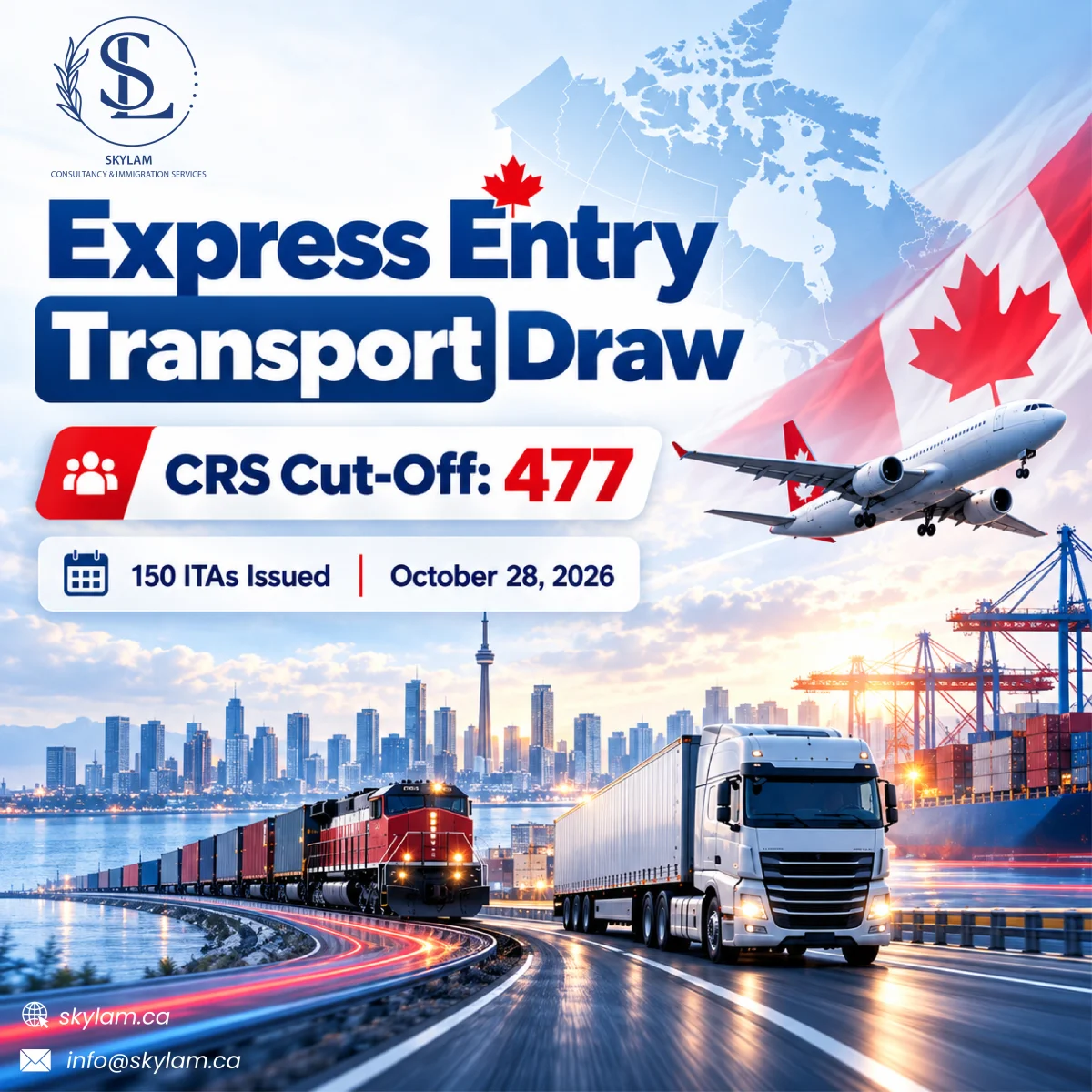
On October 28, IRCC conducted a Transport Occupations category-based round and issued 150 Invitations to Apply at a CRS cut-off of 477.
Together, the three rounds demonstrate an important reality of Canada’s current Express Entry system.
A candidate’s CRS score is extremely important, but it is no longer the only number that should be considered when assessing potential invitation opportunities.
The type of invitation round matters.
Program eligibility matters.
Category-based eligibility matters.
French-language proficiency can matter.
Occupation can matter.
A provincial nomination can significantly alter a candidate’s ranking.
The October 26–28 results therefore provide a useful example of how different Express Entry selection streams can produce very different CRS cut-offs within only a few days.
Three Express Entry Draws in Three Consecutive Days
The official IRCC results were:
October 26, 2026
Round type: Provincial Nominee Program
Invitations issued: 792
CRS score of lowest-ranked candidate invited: 761
October 27, 2026
Round type: French-Language proficiency 2026-Version 2
Invitations issued: 5,000
CRS score of lowest-ranked candidate invited: 407
October 28, 2026
Round type: Transport Occupations, 2026-Version 2
Invitations issued: 150
CRS score of lowest-ranked candidate invited: 477
Combined invitations: 5,942
At first glance, the range between CRS 407 and CRS 761 may appear unusual.
However, these scores apply to different groups of eligible Express Entry candidates.
They should not be interpreted as interchangeable general Express Entry cut-offs.
Understanding the difference between round types is therefore essential.
What Is Express Entry?
Express Entry is Canada’s application management system for several major federal economic immigration programs.
Candidates who meet the eligibility requirements of an Express Entry-managed program can create an online profile and enter the Express Entry pool.
Once in the pool, candidates are ranked using the Comprehensive Ranking System.
The CRS awards points based on various characteristics that can include:
Age
Education
English-language ability
French-language ability
Canadian work experience
Foreign work experience
Spouse or common-law partner factors where applicable
Provincial or territorial nomination
Other factors recognized by the Express Entry system
Candidates are ranked against other eligible candidates.
IRCC then conducts rounds of invitations throughout the year.
During each round, the department identifies the group of candidates it wants to consider, determines how many invitations will be issued and invites the highest-ranking eligible candidates.
What Is an Invitation to Apply?
An Invitation to Apply, commonly called an ITA, allows an eligible Express Entry candidate to submit a full application for Canadian permanent residence.
Receiving an ITA is an important step, but it is not the same as permanent residence approval.
Candidates must still submit the required application and supporting documents.
IRCC then assesses the application against the applicable immigration requirements.
This means all information entered into an Express Entry profile should be accurate and supportable.
October 26: Provincial Nominee Program Draw
The first of the three consecutive rounds took place on October 26.
IRCC issued 792 Invitations to Apply to Provincial Nominee Program candidates.
The CRS cut-off was 761.
At first glance, 761 may look extremely high compared with the French-language cut-off of 407 or the Transport cut-off of 477.
However, PNP candidates are ranked differently because a qualifying provincial nomination provides a major CRS advantage.
Express Entry candidates who accept a qualifying provincial or territorial nomination receive 600 additional CRS points.
This explains why PNP-specific invitation rounds regularly have much higher CRS thresholds than other draw types.
A CRS cut-off of 761 should therefore not be interpreted as meaning every Express Entry candidate needed 761 points.
The round was specifically limited to eligible Provincial Nominee Program candidates.
Why Provincial Nomination Can Be So Important
Provincial and territorial immigration programs allow participating jurisdictions to nominate foreign nationals who may help address their economic, demographic or labour-market needs.
Some provincial nomination pathways are connected to Express Entry.
If an eligible candidate receives a nomination through an Express Entry-aligned provincial stream and accepts that nomination, the additional CRS points can significantly improve the candidate’s federal ranking.
However, provincial nomination is not automatic.
Different provinces operate different programs.
Requirements can involve factors such as:
Occupation
Work experience
Job offers
Language ability
Education
Current employment
Provincial study history
Family or other connections
Settlement intentions
Candidates should therefore assess provincial programs individually.
October 27: French-Language Proficiency Draw
The largest of the three invitation rounds took place on October 27.
IRCC issued 5,000 Invitations to Apply under the French-language proficiency category.
The CRS cut-off was 407.
This round was particularly notable for two reasons.
First, 5,000 invitations represented the large majority of the 5,942 invitations issued across the three consecutive rounds.
Second, the CRS cut-off dropped significantly compared with the previous French-language round.
On October 16, IRCC had also issued 5,000 French-language proficiency invitations, but the CRS cut-off was 435.
The October 27 threshold of 407 was therefore 28 points lower.
This created a significant opportunity for eligible French-speaking Express Entry candidates.
However, the 407 cut-off needs to be interpreted correctly.
CRS 407 Was Not the General Express Entry Cut-Off
The October 27 round was a category-based invitation round.
Only candidates who satisfied the requirements of the French-language proficiency category were considered.
A candidate with CRS 407 who did not meet those French-language requirements would not have been eligible merely because their score matched the draw cut-off.
This is one of the most important concepts for Express Entry candidates to understand.
When IRCC conducts a category-based draw, the CRS threshold applies to candidates eligible for that category.
It does not automatically apply to everyone in the Express Entry pool.
French-Language Category Requirements
For the October 27 French-language proficiency round, IRCC’s Ministerial Instructions state that candidates needed an approved French-language test with results that were less than two years old.
Candidates also needed a score of at least level 7 under the Niveaux de compétence linguistique canadiens, or NCLC, in each tested language skill.
The four abilities are:
Reading
Writing
Listening
Speaking
A candidate therefore needed NCLC 7 or higher in all four abilities.
Strong performance in three language abilities would not compensate for falling below the category requirement in the fourth.
French-language candidates must also otherwise qualify through the Express Entry system.
Why French Has Become Important in Express Entry
French-language proficiency can create important opportunities for Express Entry candidates.
Language ability can influence a candidate’s CRS score.
Strong French can also make someone eligible for French-language category-based selection when the category requirements are met.
The October 27 round illustrates the potential importance of this pathway.
5,000 candidates were invited at CRS 407.
For comparison, the Canadian Experience Class round on October 15 had a CRS cut-off of 519.
These numbers should not be directly compared as universal requirements because the eligible groups were different.
However, they clearly demonstrate that the type of round can significantly affect the CRS threshold required for an invitation.
October 16 Versus October 27
The two most recent French-language draws before the November 3 reforms were:
October 16
5,000 invitations
CRS 435
October 27
5,000 invitations
CRS 407
The number of invitations stayed the same.
The CRS cut-off decreased by 28 points.
This shows how quickly category-specific ranking can change.
Changes can be influenced by:
The number of eligible candidates
Candidate CRS scores
Profiles entering or leaving the pool
Language-test updates
Other changes to candidate profiles
Invitation timing
IRCC’s selection decisions
Candidates should therefore avoid assuming that a future French-language round will have the same CRS cut-off.
October 28: Transport Occupations Draw
The third consecutive round occurred on October 28.
IRCC issued 150 Invitations to Apply through Transport Occupations, 2026-Version 2.
The CRS cut-off was 477.
This was a much smaller draw than the French-language round.
It was also a category-based selection.
Only candidates who met IRCC’s eligibility requirements for the Transport Occupations category could be considered.
The result can be compared with the previous Transport Occupations draw on August 7.
That round issued 300 invitations at CRS 470.
The October 28 round therefore issued half as many invitations and had a CRS cut-off that was seven points higher.
August 7 Transport Draw
The August 7 Transport Occupations round had:
300 invitations
CRS cut-off: 470
The October 28 round had:
150 invitations
CRS cut-off: 477
The difference in invitations may help explain why IRCC did not need to move as far down the eligible ranking in October.
However, CRS cut-offs cannot be attributed to one factor alone.
The composition of the eligible candidate group also changes over time.
What Does a Transport Category Draw Mean?
A Transport Occupations category-based draw focuses on candidates whose qualifying work experience falls within occupations IRCC has designated for that category.
Candidates must meet the applicable occupational and work-experience requirements.
Working somewhere in the broader transportation industry does not automatically mean a candidate qualifies.
The candidate’s actual work experience and National Occupational Classification need to align with IRCC’s current eligibility rules.
Correct NOC Classification Matters
The National Occupational Classification system is used throughout Canadian immigration to identify occupations.
Candidates should choose the NOC code that accurately corresponds with their actual employment duties.
A job title by itself may not be enough to determine the correct NOC.
IRCC can examine duties and responsibilities when assessing work experience.
Candidates should therefore avoid selecting an occupation merely because it appears on a targeted Express Entry category list.
Incorrectly claiming occupational experience can create serious problems at the permanent residence application stage.
Why Category-Based Selection Matters
The October 26–28 rounds highlight how much Express Entry has evolved beyond a single general CRS threshold.
Consider the three results:
PNP: CRS 761
French-language proficiency: CRS 407
Transport Occupations: CRS 477
These scores look dramatically different because the eligible populations were dramatically different.
The PNP round only considered qualifying provincial nominees.
The French-language round considered candidates who met the French-language category requirements.
The Transport round considered candidates eligible under the targeted occupation category.
A candidate’s Express Entry strategy should therefore involve more than asking:
“What is my CRS score?”
Candidates should also ask:
Which Express Entry programs do I qualify for?
Am I eligible for any category-based rounds?
Does my French-language ability meet IRCC’s requirements?
Does my occupation fall within a current targeted category?
Could provincial nomination be a realistic option?
How competitive is my CRS score within the selection pathways available to me?
CRS Still Matters
Category-based selection does not remove the importance of the CRS.
CRS is still used to rank eligible candidates.
The difference is that candidates may first need to belong to the group selected for a particular invitation round.
Within that group, the highest-ranking candidates receive invitations until IRCC reaches the specified invitation number.
This means there are effectively two questions:
Are you eligible for the round?
Is your CRS score high enough within that eligible group?
A candidate can qualify for a category but still have a score below the cut-off.
A candidate can also have a high CRS score but not qualify for the selected category.
Both factors matter.
How Express Entry Invitation Rounds Work
IRCC explains that Express Entry candidates are ranked using the Comprehensive Ranking System.
Invitation rounds then select top candidates from the relevant eligible population.
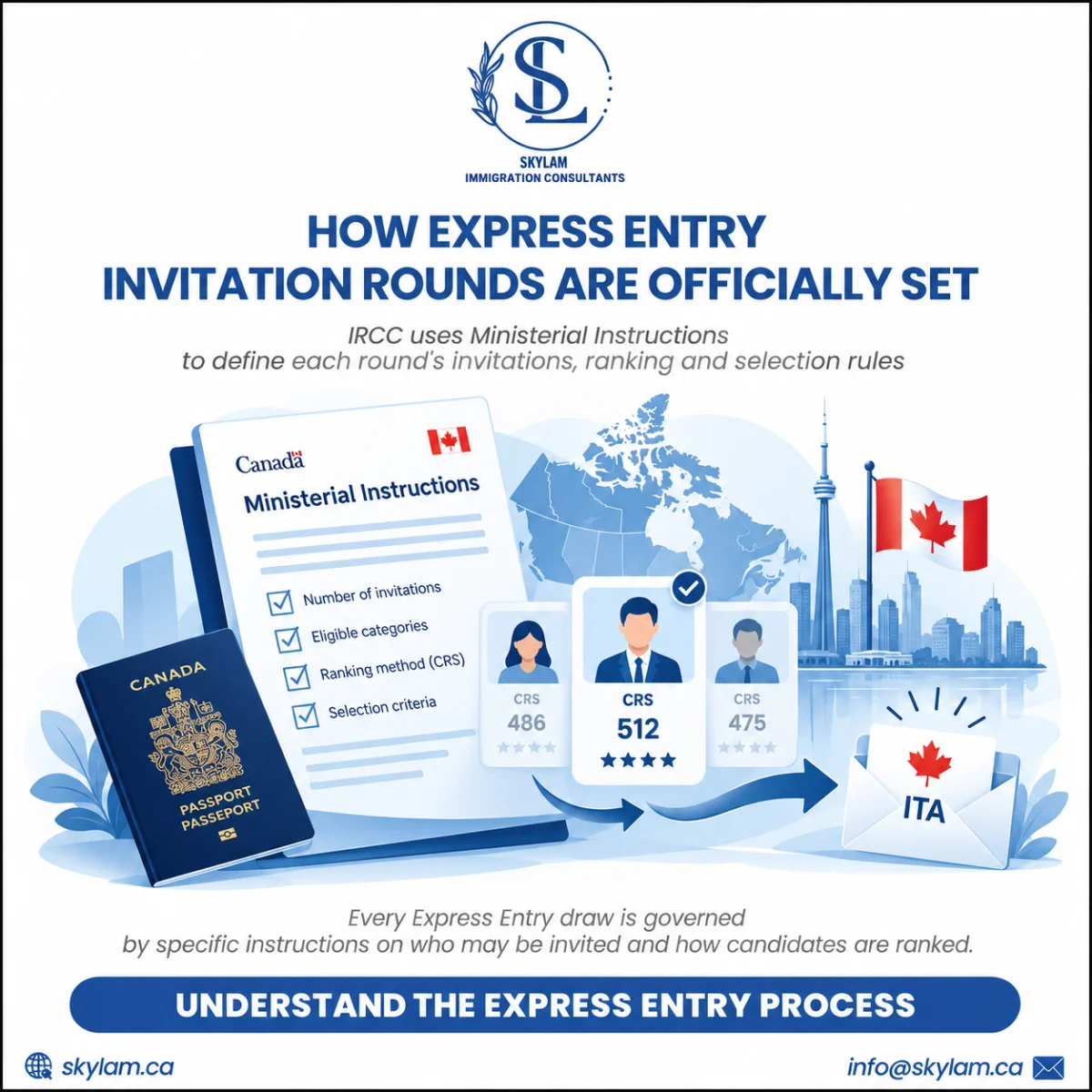
Ministerial Instructions set the rules for individual invitation rounds.
Each round can specify:
Round type
Number of invitations
Rank required
CRS score of the lowest-ranked candidate invited
Date and time
Tie-breaking rule
The round type is therefore just as important as the CRS number when candidates interpret an Express Entry result.
Why the Tie-Breaking Rule Matters
When several candidates have the same CRS score as the lowest-ranked candidate invited, IRCC uses a tie-breaking rule.
The rule is based on the date and time candidates submitted their Express Entry profiles.
Candidates with earlier profiles can rank ahead of otherwise equal candidates when the score is exactly at the cut-off.
This means a candidate exactly at the draw’s CRS threshold should also check the applicable tie-breaking timestamp.
Express Entry Is Not One Single Competition
A common misunderstanding is to view all Express Entry candidates as competing against each other in exactly the same way during every round.
Category-based selection shows why that is not always correct.
Candidates in one category may be ranked only among those eligible for the selected category.
Program-specific rounds similarly focus on candidates eligible for a particular program.
This structure explains why different rounds can produce significantly different CRS thresholds.
The Importance of Looking Beyond Headlines
Immigration headlines often emphasize a number such as:
“CRS drops to 407.”
Without context, this can be misleading.
The more accurate statement is:
“The French-language proficiency category invited 5,000 eligible candidates at a CRS cut-off of 407.”
That distinction matters.
Most Express Entry candidates cannot automatically benefit from a category-specific cut-off.
The candidate must first satisfy the category requirements.
Likewise, CRS 477 in the October Transport round applied to eligible Transport Occupations candidates.
It was not a universal Express Entry cut-off.
What Could Candidates Potentially Improve?
Depending on individual circumstances, candidates may be able to improve different parts of their Express Entry profiles.
Potential areas can include:
English-language scores
French-language scores
Education
Additional qualifying work experience
Canadian work experience
Provincial nomination opportunities
Accurate occupational classification
Other CRS factors
However, no improvement strategy guarantees an invitation.
Candidates should assess which factors realistically apply to their personal situation.
French-Language Candidates
Candidates interested in the French-language category should review:
Approved French-language tests
NCLC equivalency
Test validity
Results in all four abilities
Express Entry program eligibility
Current CRS score
Profile accuracy
The October 27 draw shows that French-language selection can provide significant opportunities.
However, achieving NCLC 7 across all four abilities requires genuine French proficiency.
Transport Occupation Candidates
Candidates who believe they may qualify under the Transport Occupations category should review:
Their current NOC
Job duties
Qualifying work experience
Current IRCC occupation list
Express Entry eligibility
CRS score
Language test validity
Education information
Candidates should rely on current IRCC category requirements because targeted occupation lists can change.
Provincial Nominee Candidates
Candidates considering provincial immigration should review individual provincial or territorial programs.
Requirements differ substantially.
A program may prioritize:
Specific occupations
Job offers
Canadian work experience
Provincial employment
Language proficiency
Education
Connections to the province
Other economic or settlement factors
A provincial nomination can be extremely valuable for an Express Entry candidate, but only if the person meets the applicable provincial requirements.
Why the Timing of These Three Draws Is Important
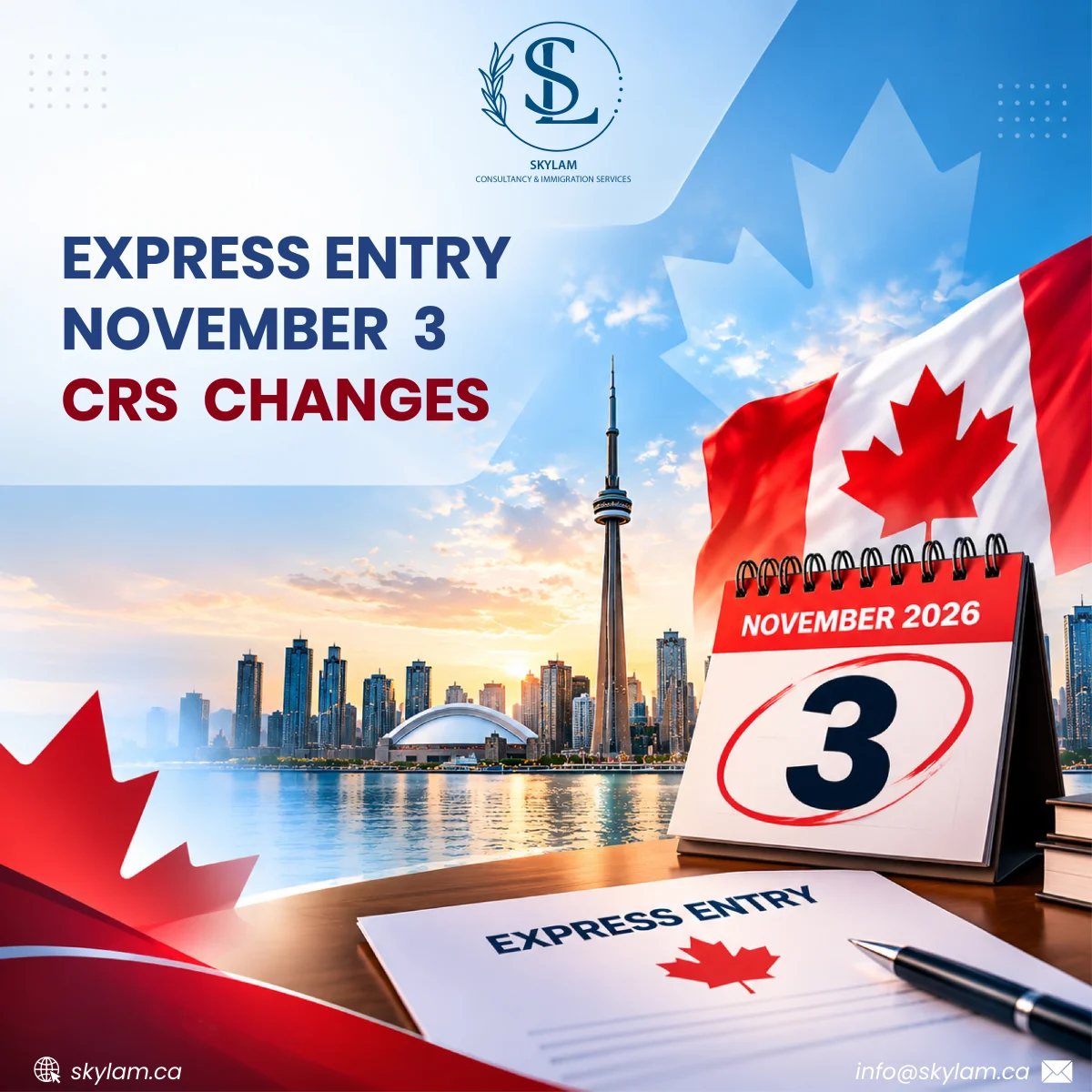
The October 26–28 invitation rounds occurred immediately before the planned November 3, 2026 Express Entry scoring reforms.
The revised CRS framework introduces a Labour Market Integration factor affecting qualifying Canadian work experience and eligible high-wage job offers.
Existing Express Entry profiles are expected to be recalculated under the new scoring system.
As a result, some candidate CRS scores could change.
That means the ranking of candidates after implementation may differ from the ranking that produced the October 26–28 invitation results.
Candidates should therefore be cautious about using these pre-reform CRS cut-offs as direct predictors of future draws.
Could Future CRS Cut-Offs Change?
Yes.
CRS cut-offs routinely change between invitation rounds.
The French-language results themselves illustrate this.
August 6: CRS 391
August 19: CRS 382
October 16: CRS 435
October 27: CRS 407
The invitation number in several of these rounds was 5,000, yet the cut-off still changed considerably.
This demonstrates that invitation volume is only one factor.
Candidate pool composition also matters.
Can Previous Draws Predict the Next Draw?
Previous results can provide context, but they cannot reliably predict a future CRS cut-off.
IRCC controls:
The type of round
The number of invitations
The category
The timing of selection
Candidates in the pool also change continuously.
New profiles enter.
Other profiles expire.
Candidates improve language scores.
Some receive provincial nominations.
Others gain additional work experience.
As a result, future ranking conditions can change quickly.
Frequently Asked Questions
How many Express Entry invitations were issued from October 26 to October 28, 2026?
IRCC issued 5,942 Invitations to Apply across the three rounds.
What happened on October 26?
IRCC issued 792 Provincial Nominee Program invitations at CRS 761.
What happened on October 27?
IRCC issued 5,000 invitations through the French-language proficiency category at CRS 407.
What happened on October 28?
IRCC issued 150 Transport Occupations invitations at CRS 477.
Was CRS 407 the general Express Entry cut-off?
No.
It applied to eligible candidates in the French-language proficiency category.
What French-language level was required?
IRCC required at least NCLC 7 in each of the four tested language abilities.
What was the previous French-language CRS cut-off?
The October 16 round had a CRS cut-off of 435.
How much did the French CRS threshold decrease?
It decreased by 28 points, from 435 to 407.
What was the previous Transport Occupations cut-off?
The August 7 round had a CRS cut-off of 470.
How much did the Transport cut-off increase?
It increased by seven points, from 470 to 477.
How many invitations were issued in the August Transport round?
300 invitations.
Does having CRS 407 guarantee a French-language ITA?
No.
Candidates need to meet the French-language category requirements and rank high enough in the selected group.
Does CRS 477 guarantee a Transport invitation?
No.
Candidates also need to meet the Transport Occupations category requirements.
Can a candidate qualify for more than one type of Express Entry draw?
Potentially, yes.
A candidate may satisfy more than one category or program requirement, depending on their profile.
Does an ITA guarantee permanent residence?
No.
An ITA gives the candidate the opportunity to submit a permanent residence application. IRCC must still assess and approve that application.
Final Takeaway
IRCC issued a combined 5,942 Invitations to Apply across three consecutive Express Entry rounds from October 26 to October 28, 2026.
The results were:
October 26
Provincial Nominee Program
792 ITAs
CRS 761
October 27
French-language proficiency
5,000 ITAs
CRS 407
October 28
Transport Occupations
150 ITAs
CRS 477
The French-language round was particularly significant because the CRS cut-off fell by 28 points compared with the October 16 round.
However, CRS 407 should never be presented as a universal Express Entry threshold.
Candidates needed to meet the French-language category requirements, including at least NCLC 7 across all four abilities.
The October Transport round had a CRS cut-off seven points higher than the previous Transport round in August.
That round was also smaller, issuing 150 invitations compared with 300 in August.
Together, the three draws reinforce an important principle:
Your CRS score matters, but the invitation categories you qualify for can matter just as much.
Candidates should assess:
Express Entry program eligibility
CRS score
French-language ability
Occupation
Category eligibility
Provincial nomination options
Current IRCC selection requirements
The timing of these rounds is also important because they occurred immediately before the November 3 Express Entry scoring reforms.
Once existing profiles are recalculated under the revised system, candidate rankings may change.
Planning Your Express Entry Pathway?
Skylam Consultancy & Immigration Services can help you understand your Express Entry profile, CRS score, French-language opportunities, occupation-based categories and potential provincial nomination pathways.
Express Entry categories, scoring rules and invitation results can change. Candidates should always review the latest official IRCC information before making an immigration decision.