
IRCC Issues 5,942 Express Entry Invitations in Three Consecutive Draws
Canada conducted three consecutive Express Entry invitation rounds between October 26 and October 28, 2026, issuing a combined 5,942 Invitations to Apply for permanent residence.
The rounds targeted three very different groups:
Provincial Nominee Program candidates
French-language proficiency candidates
Transport occupation candidates
The results highlight one of the most important realities of the modern Express Entry system: there is no single CRS score that applies equally to every candidate.
The type of invitation round matters.
Program eligibility matters.
Category eligibility matters.
Occupation matters.
Language ability can matter.
A provincial nomination can dramatically change a candidate’s CRS score.
Across the three rounds, CRS cut-offs ranged from 407 in the French-language round to 761 in the Provincial Nominee Program round.
At first glance, these numbers may appear difficult to reconcile.
Why would one round require CRS 761 while another invite candidates at CRS 407?
The answer lies in the structure of Express Entry selection.
Each round considers a different eligible group.
This article examines the October 26–28 Express Entry rounds, why the French-language draw was significant, what the transport result means and why candidates should avoid treating a category-based CRS cut-off as a general Express Entry threshold.
Three Consecutive Express Entry Draws
According to the selection results provided, IRCC conducted three rounds over three consecutive days.
October 26 — Provincial Nominee Program
Invitations: 792
CRS cut-off: 761
October 27 — French-language proficiency
Invitations: 5,000
CRS cut-off: 407
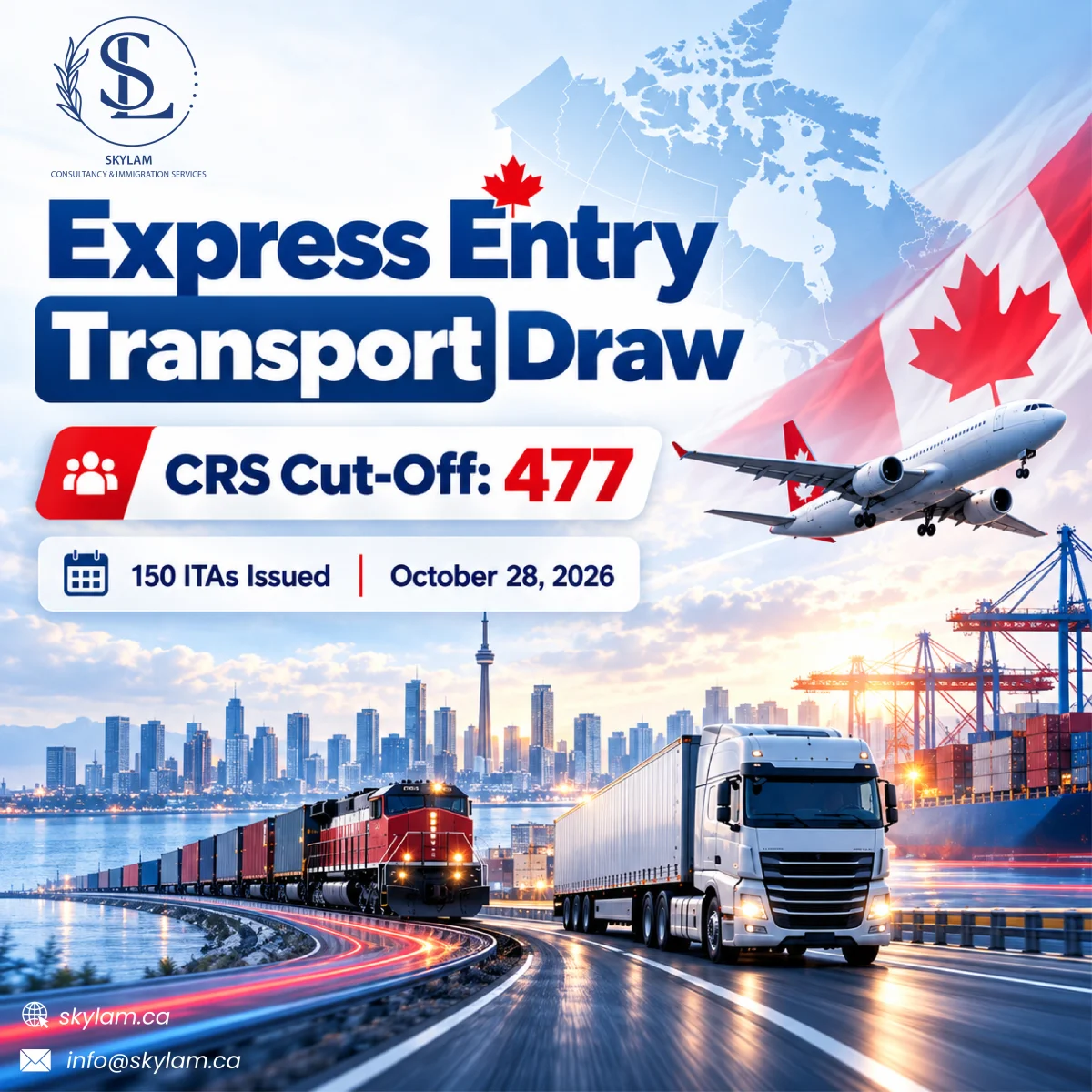
October 28 — Transport occupations
Invitations: 150
CRS cut-off: 477
Combined invitations: 5,942
The scale and scoring of these rounds varied considerably.
The French-language draw accounted for the majority of invitations.
Transport was highly targeted, with only 150 invitations.
PNP candidates faced the highest CRS threshold.
Understanding why requires looking at the different types of Express Entry selection.
What Is Express Entry?
Express Entry is Canada’s federal application management system for major economic immigration programs.
Eligible candidates create an online profile and enter the Express Entry pool.
They receive a Comprehensive Ranking System score.
The CRS ranks candidates according to factors connected with their ability to establish economically in Canada.
These factors can include:
Age
Education
English or French language ability
Canadian work experience
Foreign work experience
Spouse or partner factors where applicable
Provincial nomination
Other applicable CRS factors
However, being in the Express Entry pool does not guarantee an invitation.
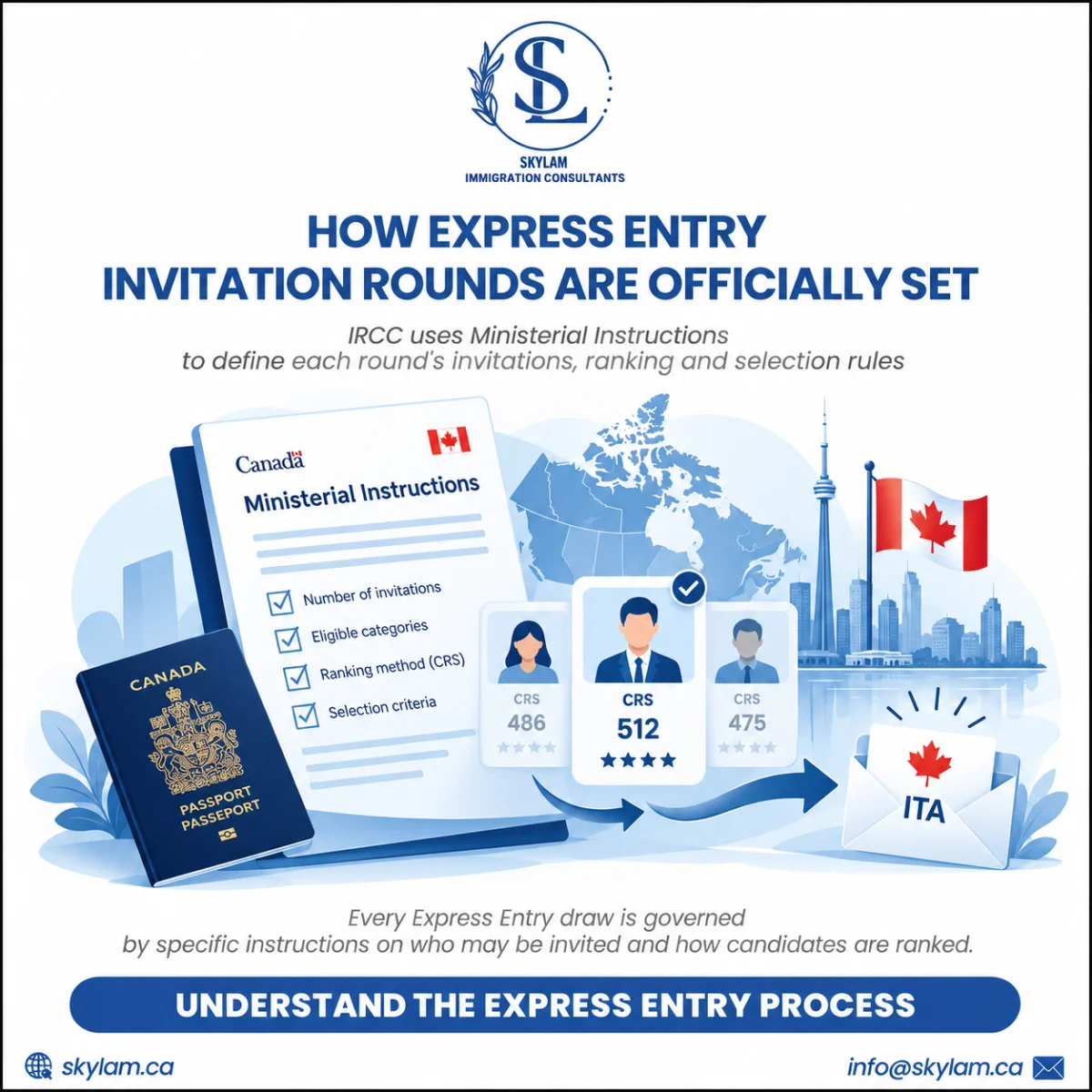
IRCC conducts invitation rounds and selects eligible candidates according to the rules of each round.
Different Types of Express Entry Rounds
Express Entry can include different types of rounds.
General rounds may consider candidates from multiple Express Entry programs.
Program-specific rounds consider candidates eligible for a particular program.
Provincial Nominee Program-specific rounds focus on candidates with provincial or territorial nominations.
Category-based rounds target candidates with particular attributes that match categories established by IRCC.
French-language proficiency and Transport occupations are examples of category-based selection.
Because each round has a different eligible population, CRS cut-offs cannot be compared without context.
October 26: Provincial Nominee Program Round
The first of the three rounds took place on October 26.
It targeted Provincial Nominee Program candidates.
IRCC issued 792 invitations.
The CRS cut-off was 761.
This is much higher than the CRS cut-offs seen in the French-language and Transport rounds.
However, PNP CRS scores need to be understood differently.
Express Entry candidates who receive a qualifying provincial or territorial nomination receive a major CRS advantage.
The nomination substantially increases their overall ranking.
As a result, PNP-specific invitation rounds commonly have CRS cut-offs that appear much higher than other categories.
This does not mean an ordinary Express Entry candidate without a provincial nomination needed 761 points in a general sense.
The draw was specifically for PNP candidates.
Why Provincial Nomination Matters
Provincial nomination can be one of the most significant developments in an Express Entry profile.
Canadian provinces and territories operate immigration streams designed to meet their particular economic and labour-market needs.
Some are connected with Express Entry.
A province may identify or nominate candidates who meet its program requirements.
Once an eligible Express Entry-linked nomination is accepted, the candidate can receive a substantial CRS increase.
This can dramatically change the candidate’s position in the federal pool.
However, candidates should not view provincial nomination as an automatic option.
Every provincial program has its own criteria.
These can involve occupation, work experience, job offers, provincial connections, language ability or other requirements.
October 27: French-Language Proficiency Round
The largest round of the three took place on October 27.
IRCC issued 5,000 invitations to eligible candidates in the French-language proficiency category.
The CRS cut-off was 407.
The round is particularly significant because of both its size and its relatively low CRS threshold compared with many other types of Express Entry rounds.
The previous French-language round on October 16 had a CRS cut-off of 435.
The October 27 round therefore represented a reduction of 28 CRS points.
However, candidates need to interpret this correctly.
CRS 407 was not a general Express Entry cut-off.
It applied to eligible candidates in the French-language category.
Why the 407 CRS Cut-Off Matters
A candidate might see a score of 407 and assume that anyone with CRS 407 can now expect an Invitation to Apply.
That would be incorrect.
Category-based rounds only consider candidates who meet the category requirements.
For French-language proficiency selection, candidates must satisfy IRCC’s French-language criteria.
The source information identifies a requirement of at least NCLC 7 across all four language abilities.
Candidates also need to qualify under an eligible Express Entry program.
Therefore, two candidates with CRS 407 could have very different outcomes.
If one meets the French-language category requirements and the other does not, only the eligible French-language candidate would have been considered in the October 27 round.
Why French Can Be Important for Express Entry
Strong French-language ability can create several potential advantages within Canada’s economic immigration system.
French can contribute to CRS scoring.
It can also make a candidate eligible for French-language category-based invitation rounds if all requirements are met.
The October 27 result demonstrates the significance of this pathway.
5,000 invitations represented a substantial selection round.
For candidates who already have French ability, obtaining valid approved language test results and understanding NCLC equivalencies can therefore be important.
For candidates considering learning French solely for immigration purposes, the process requires realistic planning.
Achieving NCLC 7 across all four abilities involves meaningful language proficiency.
Applicants should avoid treating French as a quick CRS shortcut.
What Does NCLC 7 Mean?
NCLC refers to Niveaux de compétence linguistique canadiens, the Canadian framework used to measure French-language ability for immigration purposes.
French-language category candidates need to meet the applicable minimum requirement across:
Reading
Writing
Listening
Speaking
The category requirement is therefore not based on one strong skill alone.
A candidate needs the required level in each of the four abilities.
Candidates should also use an IRCC-approved French test and ensure that the results remain valid.
Previous French Round Had CRS 435
The October 16 French-language round invited 5,000 candidates at CRS 435.
On October 27, another 5,000 eligible candidates were invited at CRS 407.
The difference was 28 points.
That is a substantial movement between two rounds of the same category.
It illustrates why CRS cut-offs can change even within the same selection type.
Factors that may affect draw results include:
Number of invitations
Number of eligible candidates
CRS distribution among eligible candidates
Changes in the pool
IRCC’s invitation strategy
Candidates should therefore avoid assuming that the next French-language round will remain at 407.
Future rounds may have different cut-offs.
October 28: Transport Occupations Round
The third consecutive draw targeted Transport occupations.
It took place on October 28.
IRCC issued 150 invitations.
The CRS cut-off was 477.
This was a much smaller round than the French-language selection.
It was also more targeted.
Only eligible candidates who satisfied the requirements of IRCC’s designated Transport category could be considered.
The source information states that the 477 cut-off was seven points higher than the previous transport round in August.
This means competition within the eligible transport candidate group was different from the prior round.
What Is a Transport Occupations Category-Based Draw?
A Transport category-based draw selects eligible Express Entry candidates whose work experience falls within occupations identified by IRCC for that category.
Not every person who works in transportation automatically qualifies.
Candidates need to confirm that their work experience matches an eligible occupation and satisfies the category requirements.
Correct NOC classification is particularly important.
Candidates should select a National Occupational Classification code based on actual job duties, not simply based on a job title or a desire to become eligible for a category.
Why Was the Transport Cut-Off 477?
The CRS cut-off reflects the ranking of candidates eligible for that particular round.
The transport round issued only 150 invitations.
Because the number of invitations was limited, IRCC only needed to reach the 150 highest-ranking eligible candidates.
The final candidate invited had CRS 477.
A larger transport round could potentially produce a different cut-off.
Likewise, changes in the eligible pool could cause a future score to move higher or lower.
No future CRS threshold can be guaranteed.
Why Category-Based Selection Is So Important
The three October rounds demonstrate how category-based and program-specific selection can create very different outcomes within the same Express Entry system.
Consider the CRS cut-offs:
PNP — 761
French-language — 407
Transport — 477
These are not three versions of a universal Express Entry passing score.
Each belongs to a separate eligible population.
A candidate with CRS 450 might have received an invitation in the French-language round if eligible for the category.
The same person would not have received an invitation in the transport round at CRS 477.
A candidate with CRS 500 might appear well above the French-language threshold but would not have been considered in that round without the required French-language eligibility.
This is why CRS should never be analyzed without considering draw type.
5,942 Invitations in Three Days
The combined total of 5,942 invitations is notable.
Most of the invitations came from the French-language category.
French-language proficiency: 5,000
Provincial Nominee Program: 792
Transport occupations: 150
This distribution shows that invitation volume can differ significantly between categories.
Candidates should therefore monitor both CRS cut-offs and the number of invitations issued.
A category with a relatively low CRS threshold but strict eligibility requirements may be inaccessible to most of the pool.
Conversely, a category with fewer invitations may remain highly competitive among those who qualify.
Why a Low Category Cut-Off Is Not a General Cut-Off
This is one of the most important lessons for Express Entry candidates.
When IRCC announces CRS 407 in a French-language category draw, it does not mean the overall Express Entry cut-off has fallen to 407.
Only candidates who met the category criteria were considered.
The same principle applies to Transport occupations, healthcare, trades or other category-based rounds.
A CRS score must always be considered together with:
Express Entry program eligibility
Category eligibility
Round type
Invitation count
Tie-breaking rules where relevant
How Candidates Should Read Express Entry Results
When reviewing a new draw, candidates should ask five questions.
What type of round was held?
How many invitations were issued?
What was the CRS cut-off?
Was the candidate eligible for that program or category?
What was the tie-breaking rule if the candidate was exactly at the cut-off?
This prevents misunderstanding.
A headline stating “CRS drops to 407” without explaining that it was a French-language category round can be misleading.
Why the October Draws Matter Before November 3
These three invitation rounds occurred immediately before the November 3 Express Entry scoring reform.
Beginning November 3, IRCC is introducing the new Labour Market Integration factor.
Eligible Canadian work experience in designated high-wage occupations and qualifying high-wage job offers will affect CRS scoring under the new structure.
Existing Express Entry profiles will be recalculated.
This means the Express Entry pool after implementation could look different from the pool that produced the October 26–28 draw results.
Candidates should therefore be careful when using these draws to estimate their future competitiveness.
The scoring rules themselves are about to change.
Could CRS Cut-Offs Change After November 3?
Yes, they could.
But the direction or size of any change cannot be predicted with certainty.
If some candidates receive substantial new Labour Market Integration points, their positions in the pool could improve.
The CRS distribution could shift.
However, future invitation results will still depend on:
Draw type
Category
Invitation volume
Candidate eligibility
Updated pool distribution
IRCC selection priorities
Candidates should therefore avoid treating pre-November 3 CRS cut-offs as guaranteed benchmarks for the post-reform system.
What Should French-Speaking Candidates Do?
Candidates with French-language ability should make sure they understand the official category requirements.
They should confirm:
Their approved French test results
NCLC equivalency
Validity of results
Express Entry program eligibility
Overall CRS score
Profile accuracy
French category selection can provide valuable opportunities, but only candidates who satisfy the required criteria will be considered.
What Should Transport Candidates Do?
Transport candidates should review:
Their NOC code
Actual job duties
Qualifying work experience
Current Transport category eligibility
CRS score
Language results
Education
Express Entry program eligibility
They should not change an NOC merely to try to fit a category.
The NOC needs to accurately reflect the person’s employment experience.
What Should PNP Candidates Do?
Candidates interested in provincial nomination should identify provincial streams aligned with their profile.
Relevant considerations may include:
Occupation
Work experience
Language proficiency
Job offers
Education
Provincial employment
Study history
Family or other provincial connections
Provincial programs can open, close or change criteria.
Candidates should follow official provincial information.
Can One Candidate Qualify for More Than One Type of Draw?
Potentially, yes.
A candidate may meet the requirements of more than one invitation category.
For example, a person could potentially have strong French-language ability and work in a qualifying category occupation.
Another candidate might receive a provincial nomination while also having category-based eligibility.
However, invitations depend on the specific round IRCC conducts and the candidate’s ranking within the eligible population.
How Important Is CRS Still?
CRS remains central to Express Entry.
Category eligibility does not replace ranking.
Once IRCC identifies the candidates eligible for a round, CRS is used to rank them.
The highest-ranking eligible candidates are invited until IRCC reaches the number of invitations specified for that round.
This means candidates benefit from both:
Eligibility for relevant selection pathways
A competitive CRS score
Improving either side of that equation may increase opportunities, depending on the individual profile.
Frequently Asked Questions
How many Express Entry invitations were issued from October 26 to 28?
According to the three round results provided, IRCC issued a combined 5,942 invitations.
How many PNP candidates were invited?
792 candidates were invited in the October 26 PNP round.
What was the PNP CRS cut-off?
How many candidates were invited in the October 27 French-language round?
5,000.
What was the French-language CRS cut-off?
What was the previous French-language cut-off?
The October 16 round had a CRS cut-off of 435.
How large was the change?
The cut-off decreased by 28 points.
What French level is required for the category?
Candidates need to meet the applicable French-language requirements, including at least NCLC 7 in all four language abilities.
How many candidates were invited in the Transport occupations round?
What was the transport CRS cut-off?
Does CRS 407 mean any Express Entry candidate with 407 could receive an ITA?
No. The 407 threshold applied to candidates eligible for the French-language proficiency category.
Why was the PNP score so high?
Provincially nominated Express Entry candidates receive a significant CRS benefit from their nomination, so PNP-specific draw scores typically sit much higher than other categories.
Were these draws held before the November 3 CRS reform?
Yes. All three rounds occurred before the new Labour Market Integration scoring system takes effect.
Final Takeaway
IRCC issued 5,942 Invitations to Apply across three consecutive Express Entry rounds from October 26 to October 28, 2026.
The invitation results were:
October 26 — PNP: 792 ITAs at CRS 761
October 27 — French-language proficiency: 5,000 ITAs at CRS 407
October 28 — Transport occupations: 150 ITAs at CRS 477
The French-language round was particularly significant because its CRS threshold fell from 435 on October 16 to 407 on October 27.
However, that 407 score cannot be interpreted as a general Express Entry cut-off.
Candidates had to meet the French-language category requirements and qualify under an eligible Express Entry program.
Likewise, Transport candidates needed to satisfy the requirements of the designated occupational category.
The three rounds reinforce an increasingly important principle in Express Entry:
Your CRS score matters, but so does the type of round for which you are eligible.
Candidates should assess their language ability, occupation, provincial nomination opportunities, Express Entry program eligibility and overall CRS position together.
These October draws also represent the final phase of Express Entry before the November 3 scoring reform.
Once IRCC recalculates profiles under the new Labour Market Integration system, the distribution of CRS scores could change.
Planning Your Express Entry Pathway?
Skylam Consultancy & Immigration Services can help you understand your CRS score, category-based eligibility, provincial nomination options and the impact of upcoming Express Entry changes.
Always review the latest official IRCC requirements and draw results when making Canadian immigration decisions.