
IRCC Extends Temporary Measures for Sudanese and Haitian Nationals Until December 2027
Immigration, Refugees and Citizenship Canada has announced an important update for certain Sudanese and Haitian nationals who are currently in Canada.
On October 27, 2026, IRCC confirmed that selected temporary immigration measures for people affected by the ongoing situations in Sudan and Haiti will continue beyond their previous expiry date.
The previous measures were scheduled to expire on October 27, 2026.
Instead of continuing all of the previous special provisions in the same form, IRCC has introduced a more targeted extension focused primarily on eligible individuals who already hold valid work permits issued under the earlier special measures.
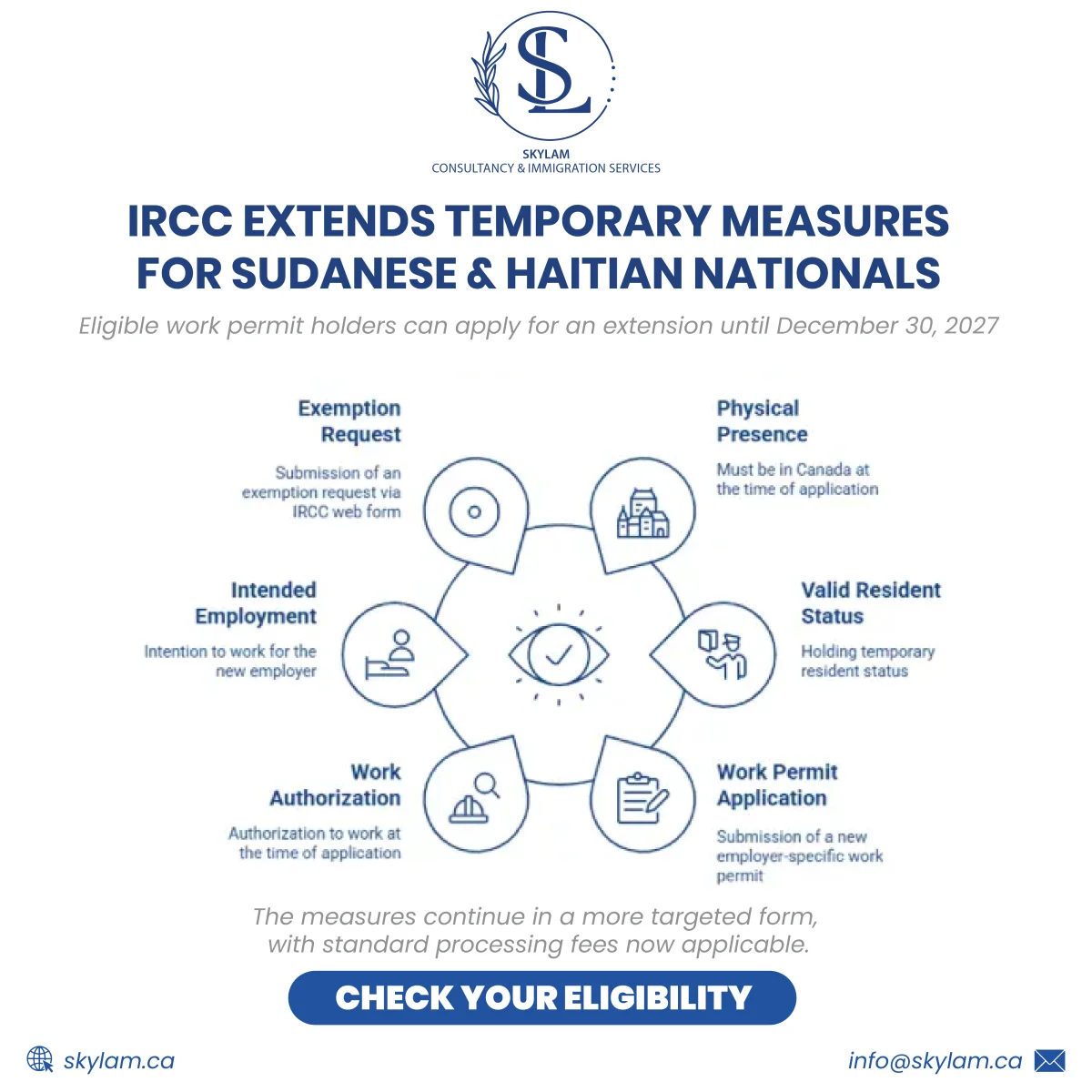
Under the updated approach, eligible work permit holders may be able to apply for an extension of their work authorization.
The targeted measures are available until December 30, 2027.
There is also an important change regarding fees.
Applicants using the extended work permit measure are now required to pay standard processing fees.
Meanwhile, individuals who want to extend visitor status or study permits must use IRCC’s regular application processes.
For Sudanese and Haitian nationals in Canada who previously benefited from the special temporary measures, understanding these distinctions is important before submitting a new application.
What Did IRCC Announce on October 27, 2026?
IRCC announced that it was updating the temporary measures for certain Sudanese and Haitian nationals in Canada who are affected by the continuing instability in their home countries.
The existing measures were due to expire on October 27, 2026.
Rather than ending all support immediately, Canada has continued selected measures in a more limited and targeted form.
The key focus of the extension is eligible people who already hold valid work permits that were issued through the previous temporary public policies.
These individuals may be able to apply to renew their work permits.
The updated measures remain available until December 30, 2027.
IRCC described the approach as targeted support for individuals who may be unable to return home and who need to continue supporting themselves while in Canada.
However, the new framework is not identical to the earlier special measures.
Applicants need to carefully distinguish between the previous temporary policies and the new extension.
Who May Benefit From the Updated Measures?
The most important group covered by the extension is eligible Sudanese and Haitian nationals, as well as certain eligible foreign national family members covered by the relevant previous public policies, who currently hold valid work permits issued under those earlier special measures.
IRCC’s current country-specific guidance indicates that eligible workers must hold a valid work permit issued under one of the previous applicable temporary public policies.
They must also continue to satisfy the conditions established by IRCC for the new work permit renewal measure.
This means the extension should not be understood as a general new open work permit program available to every Sudanese or Haitian national in Canada.
Eligibility depends on the applicant’s current immigration status, the type of work permit they hold, how that permit was issued and whether they meet the conditions of the updated measure.
People considering an application should therefore review their existing permit and the public policy under which it was issued before assuming that the extension applies.
How Long Are the Measures Available?
The targeted extension is available until December 30, 2027.
Eligible individuals who want to use the measure must submit the applicable application within the period established by IRCC.
The December 30, 2027 date is therefore particularly important for people who currently hold qualifying work permits.
However, applicants should avoid waiting until the deadline to begin reviewing their situation.
Immigration status, permit validity and eligibility conditions can affect when and how an extension application should be submitted.
Planning ahead may help applicants avoid unnecessary complications with temporary status or work authorization.
What Is the Biggest Change From the Previous Measures?
One of the most significant changes is that the special measures have become more limited.
Previously, the Sudan and Haiti temporary policies provided broader forms of temporary immigration relief to certain eligible people in Canada.
Depending on the specific policy, eligible people could potentially apply to extend or change temporary resident status under special conditions.
Some applications were also exempt from certain processing fees.
Under the new approach, IRCC is continuing targeted support specifically for qualifying work permit holders.
Other types of temporary resident applications are moving back to the normal immigration process.
This makes it particularly important for individuals to identify which application they need.
Work permit renewal, visitor status extension and study permit extension are no longer being treated the same way under the updated measures.
Standard Processing Fees Now Apply
Another major change is the introduction of standard application processing fees.
Under previous special measures, qualifying applicants could benefit from fee exemptions for certain applications.
Those exemptions were designed to provide additional support to people affected by the crises in Sudan and Haiti.
Under the October 2026 targeted extension, eligible applicants seeking to renew qualifying work permits are expected to pay the standard applicable processing fees.
This means applicants should not assume that an earlier fee exemption continues automatically.
Before submitting an application, candidates should review the current IRCC fee requirements for the application they are making.
Submitting an application without the required payment could create processing issues if a fee exemption no longer applies.
What Happens to Work Permit Holders?
Eligible individuals who hold a valid work permit issued under a qualifying previous temporary policy may apply to renew their work permit under the new targeted measure.
This is the central feature of the October 2026 update.
IRCC’s current guidance for both Sudan and Haiti states that a qualifying applicant must be in Canada with valid temporary resident status when applying and when IRCC makes a decision on the application.
The applicant must also meet the general eligibility and admissibility requirements applicable to a work permit.
Applicants should therefore understand that holding a previous special-measures work permit does not remove all normal immigration requirements.
The new measure creates a particular pathway to request renewal, but applicants must still satisfy the conditions established by IRCC.
Can Someone Apply for More Than One Renewal Under the New Measure?
IRCC’s current country-specific guidance states that an eligible person must not already have been issued a work permit renewal under the October 28, 2026 special measure.
This indicates that the targeted extension is structured as a limited renewal opportunity rather than an unlimited series of special-measure extensions.
Applicants should therefore carefully check whether they have already received a permit under the updated measure before considering another application.
This is another reason why it is important to distinguish a permit issued under the earlier special policies from one issued under the new targeted extension.
What About Sudanese and Haitian Visitors?
Visitors are treated differently under the updated measures.
People who want to extend their visitor status are no longer covered by the broader previous special measures in the same way.
Instead, they can apply through IRCC’s regular visitor-status extension process.
This means a visitor should not assume that the targeted work permit extension allows them to obtain a work permit.
The October 2026 update is specifically focused on qualifying individuals who already hold eligible work permits from the previous special measures.
A person currently in Canada as a visitor should review the regular temporary resident rules that apply to their circumstances.
If they want to remain in Canada longer, they may need to submit an application to extend their stay as a visitor before their status expires.
What About International Students?
Study permit holders also need to use the regular IRCC process if they want to extend their study authorization.
The updated targeted measure does not continue the earlier special treatment for study permit extensions.
Students should therefore review the ordinary requirements for extending a study permit.
This can include maintaining valid temporary resident status, continuing to satisfy study permit requirements and submitting the correct application and supporting documentation.
Students should also consider their permit expiry date carefully.
Failing to submit the appropriate application within the required timeframe may affect immigration status and the ability to continue studying in Canada.
Why Did IRCC Change the Measures?
IRCC’s announcement states that the revised approach is intended to provide focused support to people who cannot currently return home and who need the ability to support themselves.
At the same time, the government described the approach as consistent with maintaining a sustainable immigration system.
The result is a narrower policy than the previous special measures.
Rather than continuing every temporary benefit, the government is maintaining a specific work permit renewal option for qualifying individuals.
This allows certain people already established as temporary workers in Canada to potentially continue working while reducing the scope of the broader emergency measures.
What Were the Previous Sudan Measures?
Canada introduced a series of temporary measures in response to the conflict in Sudan.
Those measures allowed certain Sudanese nationals and eligible family members who were already in Canada to access temporary immigration relief.
Over time, the measures were extended through different temporary public policies.
Depending on the policy and applicant, the measures included options connected with work permits, study permits, visitor status and temporary resident permits.
Previous policies also included fee exemptions for eligible applicants.
The earlier Sudan measures were extended multiple times, with the latest previous framework scheduled to expire on October 27, 2026.
The October 2026 update replaces that broader approach with a more targeted work permit renewal measure for qualifying people.
What Were the Previous Haiti Measures?
Canada also introduced temporary immigration measures for Haitian nationals and certain eligible family members due to the continuing instability and violence in Haiti.
These measures allowed eligible people already in Canada to access temporary immigration options under special public policies.
Like the Sudan measures, the Haiti policies included provisions related to temporary resident status and work or study authorization.
They were also extended over time.
The October 27, 2026 announcement represents another stage in this policy response.
Instead of continuing all previous special provisions, IRCC is maintaining a narrower work permit extension option for qualifying permit holders until December 30, 2027.
Why Current Status Matters
Temporary resident status remains an important consideration for applicants.
IRCC’s updated country-specific instructions indicate that eligible work permit renewal applicants must be in Canada with valid temporary resident status both when they apply and when a decision is made on the application.
Applicants should therefore review their current permit and status carefully.
The expiry date shown on a permit can have significant consequences for work authorization and temporary resident status.
People approaching an expiry date should understand the rules governing extensions and maintained status before making employment or travel decisions.
What Is Maintained Status?
Maintained status can allow a temporary resident who applies to extend their authorized stay before the current status expires to remain in Canada while IRCC processes the application, provided the applicable legal conditions are met.
For workers, maintained status may also affect whether they can continue working and under what conditions while waiting for a decision.
However, the exact consequences depend on the type of application, the applicant’s existing authorization and whether all requirements were satisfied.
Applicants should not assume that every submitted application automatically allows them to continue working.
The timing and type of application are important.
Does the Extension Automatically Renew a Work Permit?
No.
The government announcement does not mean existing work permits are automatically extended until December 30, 2027.
December 30, 2027 is the deadline associated with the special measure.
Eligible individuals must still submit an application for renewal and receive a decision from IRCC.
Their new permit validity period will depend on the permit issued by IRCC and the circumstances of the application.
Applicants should therefore not interpret the policy expiry date as the expiry date of their personal work permit.
These are different dates.
Does Every Sudanese or Haitian National in Canada Qualify?
No.
The extension is targeted.
The official announcement specifically refers to eligible individuals holding valid work permits issued under the previous temporary measures.
Nationality alone does not establish eligibility.
An applicant may need to demonstrate that their current work permit was issued through the applicable previous public policy and that they satisfy the new measure’s conditions.
Other factors such as current temporary resident status, admissibility and general work permit requirements may also apply.
What If Someone Has a Regular Work Permit?
People with work permits issued outside the relevant previous Sudan or Haiti special measures should not assume the new targeted policy applies to them.
They may need to use the regular work permit extension process or another immigration program depending on their circumstances.
The first step is therefore identifying the basis on which the current permit was issued.
Applicants can review their immigration records and previous IRCC correspondence to understand which program or public policy applied to their permit.
Can Visitors Switch to Workers Under This New Measure?
The current update should not be interpreted as a broad visitor-to-worker pathway.
The targeted measure focuses on eligible people who already hold valid work permits issued under the earlier special measures.
Visitors wishing to remain in Canada can use the regular process to extend visitor status.
If a visitor wants to obtain authorization to work, they need to determine whether they qualify under another applicable Canadian immigration or work permit category.
Can Students Obtain Work Permits Through This Extension?
The announcement does not create a general work permit pathway for study permit holders.
Students who need to extend their study permits must use the regular IRCC process.
If they later want to obtain a work permit, they would need to meet the requirements of an applicable work permit program.
The special extension should therefore not be viewed as automatically converting student status into worker status.
What Documents Might Applicants Need?
The exact document list depends on the application and IRCC instructions.
However, applicants should generally be prepared to provide documents showing their identity, current temporary resident status and existing work authorization.
Someone applying under the targeted Sudan or Haiti measure may also need to show that their current permit was issued under a qualifying previous temporary public policy.
Other supporting documentation may be required based on the applicant’s personal circumstances.
Applicants should always follow the current online IRCC document checklist rather than relying exclusively on documents used for an earlier application.
What Should Eligible Work Permit Holders Do Now?
Eligible people should first review their current work permit.
Check the expiry date.
Confirm whether the permit was issued under one of the previous Sudan or Haiti temporary public policies.
Review current temporary resident status.
Check whether the targeted October 2026 extension applies.
Review standard processing fees.
Prepare the required supporting documentation.
Submit the application using the correct IRCC process before the applicable deadline.
Applicants should also retain copies of all application forms, payment receipts, submitted documents and IRCC correspondence.
Why the December 30, 2027 Deadline Matters
The new targeted measures have a clear end date.
December 30, 2027 is therefore an important deadline for potentially eligible individuals.
However, it should not be interpreted as permission to wait until that date regardless of an applicant’s current permit expiry.
A person whose existing work permit expires earlier should consider the applicable extension requirements in relation to that earlier expiry date.
Individual immigration status should always guide the timing of an application.
What Does This Update Mean for Employers?
Employers with Sudanese or Haitian employees who received work permits under the previous temporary measures may also want to understand the new rules.
Employees should ensure that they continue to hold valid authorization to work in Canada.
An employer should not assume that the government announcement automatically extends an employee’s existing permit.
The worker may need to submit an application and rely on applicable maintained-status rules while it is processed.
Employers and employees should therefore keep accurate immigration documentation and pay attention to permit expiry dates.
What Does the Update Mean for Families?
Different family members may have different types of temporary resident status.
For example, one family member may hold a work permit while another holds a study permit or visitor status.
Under the new targeted system, those family members may need to follow different application processes.
The worker may potentially qualify for the special renewal measure.
The student may need to use the regular study permit extension process.
The visitor may need to use the regular visitor extension process.
Families should therefore avoid assuming that one person’s eligibility automatically applies to every family member.
Each person’s immigration status should be reviewed separately.
Does a Work Permit Extension Lead to Permanent Residence?
A temporary work permit extension and permanent residence are different immigration processes.
Receiving or renewing temporary work authorization does not automatically provide permanent resident status.
However, depending on an individual’s circumstances, Canadian work experience, occupation, language ability, education and other factors may be relevant to separate permanent residence programs.
Potential pathways can differ significantly from person to person.
Applicants interested in remaining in Canada permanently should assess their permanent residence options separately from the temporary work permit extension.
Possible immigration pathways may have their own eligibility criteria, invitation systems, provincial requirements or employer-related conditions.
Important Difference Between a Public Policy and a Permanent Immigration Program
Temporary public policies are generally introduced to respond to particular circumstances.
They may provide exemptions or temporary flexibility that would not otherwise apply.
They can also be amended, extended, replaced or ended.
The Sudan and Haiti measures are examples of temporary immigration responses connected to ongoing crises.
Because these policies can change, applicants should not assume that a benefit available in a previous year will continue indefinitely.
The October 2026 announcement demonstrates this clearly.
Support has been extended, but the scope of the support has changed.
Fee exemptions have also changed.
Applicants therefore need to rely on the current policy rather than an earlier version.
Frequently Asked Questions
When did IRCC announce the extension?
IRCC issued the federal notice on October 27, 2026.
When did the previous measures expire?
The previous temporary measures were scheduled to expire on October 27, 2026.
How long does the new extension remain available?
The targeted temporary measures remain available until December 30, 2027.
Who is the new extension mainly for?
It is focused on eligible individuals who hold valid work permits issued under previous Sudan or Haiti temporary measures.
Are applications still free?
No. Standard processing fees now apply to applications made under the targeted extension.
Can visitors use the special work permit extension?
The updated policy is not a general visitor-to-worker measure. People who want to extend visitor status must use the regular IRCC process.
Can students extend their permits under the special measure?
Study permit extensions must now be made through the regular IRCC application process.
Does December 30, 2027 automatically become the expiry date of an existing work permit?
No. It is the deadline associated with the targeted public policy. Individual permit validity depends on the permit issued by IRCC.
Does nationality alone make someone eligible?
No. Applicants need to satisfy the eligibility conditions of the measure, including requirements related to their current qualifying work permit and temporary resident status.
Can someone receive more than one special renewal?
Current IRCC instructions indicate that a person must not already have been issued a work permit renewal under the October 2026 measure to qualify for another renewal under it. Applicants should check the current instructions that apply to their case.
Does this measure provide permanent residence?
No. It relates to temporary work authorization. Permanent residence requires qualification under a separate immigration pathway.
Final Takeaway
IRCC’s October 27, 2026 announcement provides continued but more targeted temporary support for certain Sudanese and Haitian nationals in Canada.
The main development is the extension of a work permit renewal option for eligible people who already hold valid work permits issued under previous temporary measures.
The special measure remains available until December 30, 2027.
However, the policy has changed in several important ways.
Standard processing fees now apply.
Visitor extensions must use the regular IRCC process.
Study permit extensions must also use the regular IRCC process.
The new measure should therefore not be viewed as a continuation of every benefit available under the earlier policies.
It is a narrower extension designed primarily for qualifying work permit holders.
People potentially affected by the update should review their current immigration status, permit expiry date, the basis on which their existing work permit was issued and the latest IRCC eligibility requirements before submitting an application.
Planning Your Next Step in Canada?
If you are a Sudanese or Haitian national currently in Canada and were previously covered by special temporary measures, understanding the new rules can help you determine which application process applies to you.
Skylam Consultancy & Immigration Services can help you understand your Canadian immigration options, review the requirements relevant to your situation and plan the next steps for maintaining your legal status in Canada.
Always review the latest official IRCC instructions before submitting an application, as temporary public policies and immigration requirements can change.