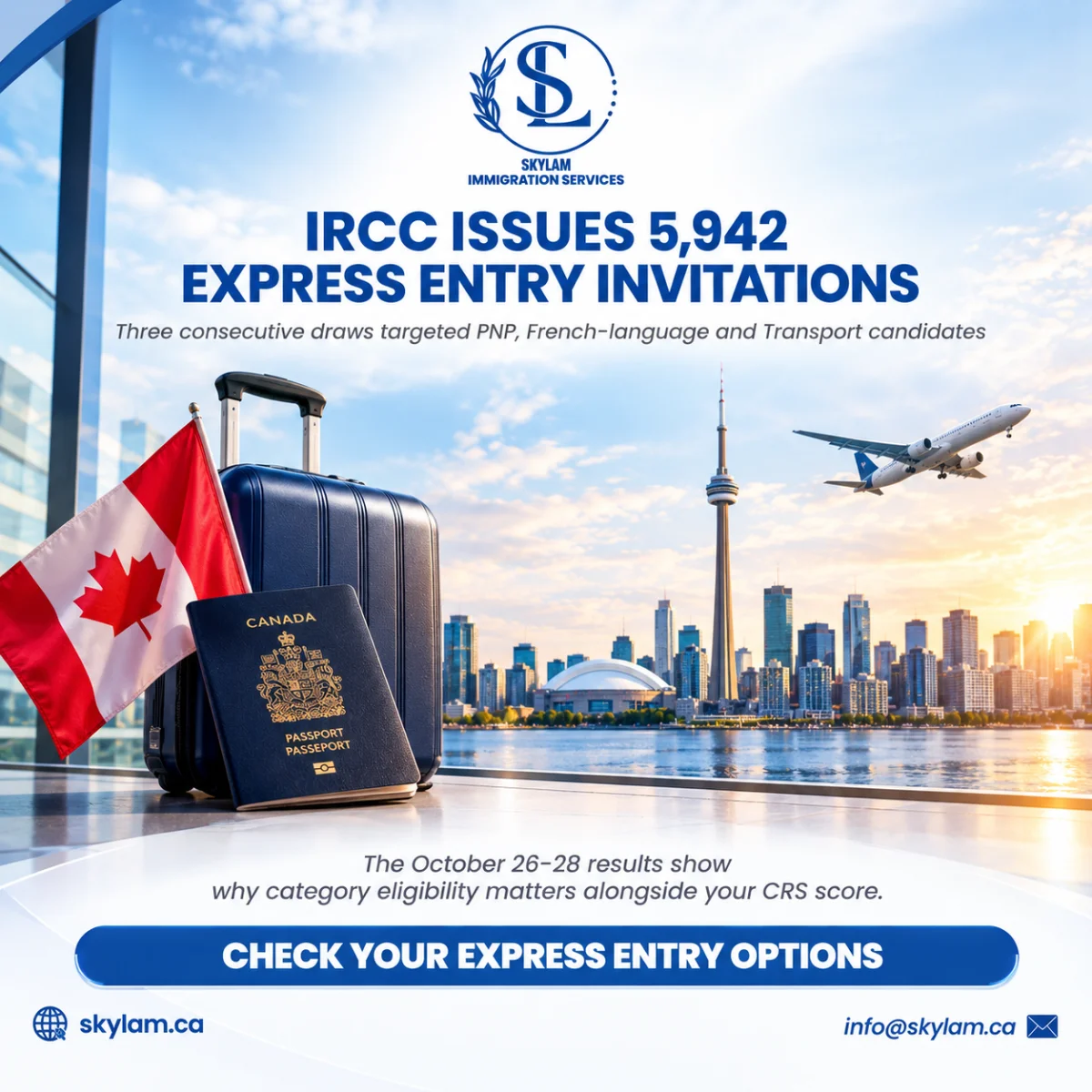

IRCC Issues 5,942 Express Entry Invitations in Three Consecutive Draws
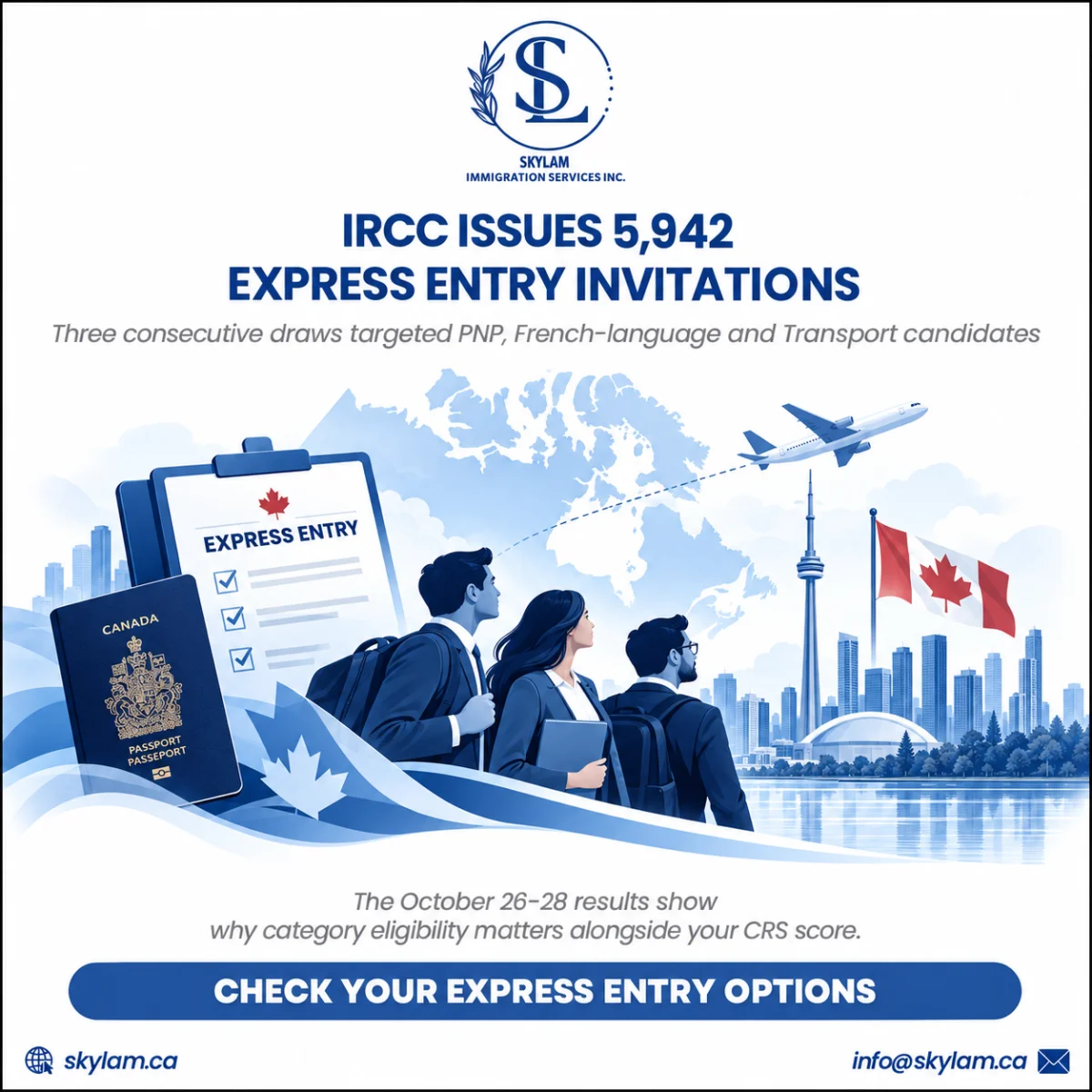
Immigration, Refugees and Citizenship Canada conducted three consecutive Express Entry invitation rounds from October 26 to October 28, 2026, issuing a combined 5,942 Invitations to Apply for Canadian permanent residence.
The three rounds targeted very different groups of Express Entry candidates.
On October 26, IRCC held a Provincial Nominee Program round and issued 792 invitations at a CRS cut-off of 761.
On October 27, IRCC conducted a French-language proficiency category-based round and issued 5,000 invitations at a CRS cut-off of 407.
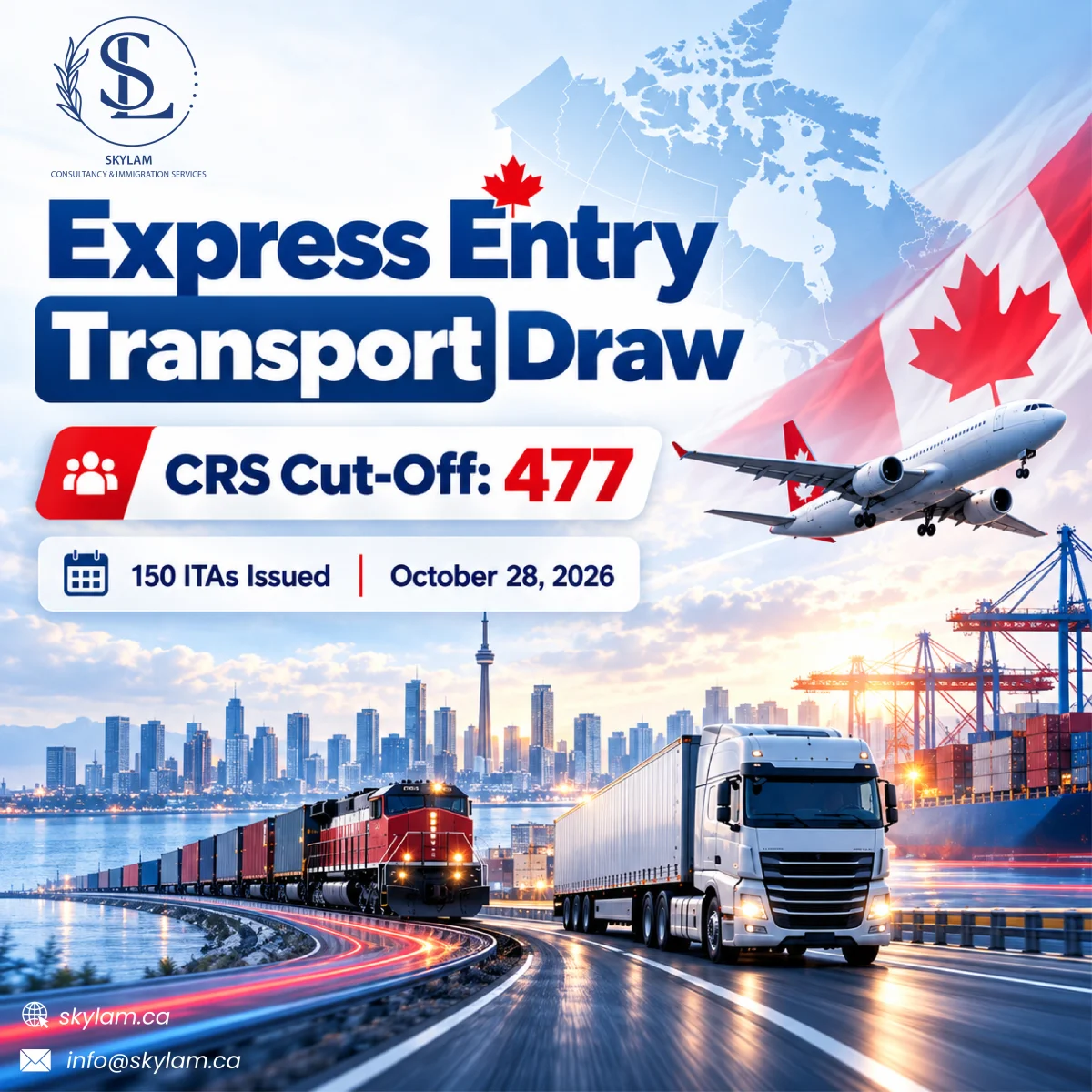
On October 28, IRCC followed with a Transport Occupations category-based round, issuing 150 invitations at a CRS cut-off of 477.
Together, these three rounds demonstrate an increasingly important feature of Canada’s Express Entry system.
There is no single CRS score that determines whether every candidate will receive an Invitation to Apply.
The type of invitation round matters.
Program eligibility matters.
Category eligibility matters.
Language ability can matter.
Occupation can matter.
A provincial nomination can significantly change a candidate’s overall CRS position.
The October 26–28 results are therefore important not only because 5,942 candidates received invitations, but also because they show how different selection pathways can produce very different CRS thresholds.
October 26–28 Express Entry Results
The three rounds were:
October 26, 2026
Selection category: Provincial Nominee Program
Invitations issued: 792
CRS cut-off: 761
October 27, 2026
Selection category: French-language proficiency
Invitations issued: 5,000
CRS cut-off: 407
October 28, 2026
Selection category: Transport occupations
Invitations issued: 150
CRS cut-off: 477
Total invitations issued: 5,942
These numbers should not be read as three competing general Express Entry cut-offs.
Each round applied to a different group of eligible candidates.
Understanding that distinction is essential when evaluating Express Entry results.
What Is Express Entry?
Express Entry is Canada’s application management system for several federal economic immigration programs.
Eligible candidates create an online profile and enter the Express Entry pool.
Once in the pool, candidates receive a Comprehensive Ranking System score, commonly known as a CRS score.
The CRS ranks candidates according to various factors connected with their potential economic establishment in Canada.
These factors may include:
Age
Education
Official language ability
Canadian work experience
Foreign work experience
Spouse or common-law partner factors where applicable
Provincial nomination
Other applicable CRS factors
However, entering the Express Entry pool does not guarantee an Invitation to Apply.
IRCC conducts rounds of invitations throughout the year.
During each round, the department decides which group of candidates will be considered and how many invitations will be issued.
What Is an Invitation to Apply?
An Invitation to Apply, or ITA, gives an eligible Express Entry candidate the opportunity to submit a complete application for permanent residence.
Receiving an ITA is therefore an important stage in the immigration process.
However, an ITA is not the same as permanent residence approval.
After receiving an invitation, a candidate still needs to submit the required application and supporting documentation.
IRCC then assesses whether the candidate continues to meet the applicable immigration requirements.
The information in an Express Entry profile should therefore be accurate and capable of being supported during the permanent residence application stage.
Why Did the Three Draws Have Such Different CRS Scores?
The CRS thresholds ranged from 407 to 761.
At first glance, this may appear inconsistent.
However, the difference comes from the fact that each round selected candidates from a different eligible group.
The October 26 round considered Provincial Nominee Program candidates.
The October 27 round considered candidates eligible under the French-language proficiency category.
The October 28 round considered candidates eligible under the Transport Occupations category.
The CRS cut-off therefore reflects the ranking of candidates within the group eligible for that particular round.
This means CRS 407 in the French-language round does not mean the overall Express Entry system suddenly had a general cut-off of 407.
Only candidates who met the requirements of the French-language category could be considered in that round.
October 26 Provincial Nominee Program Draw
The first of the three rounds took place on October 26.
IRCC issued 792 invitations to Provincial Nominee Program candidates.
The CRS cut-off was 761.
This was the highest CRS threshold of the three consecutive rounds.
However, PNP CRS scores need to be understood in context.
Candidates who receive a qualifying provincial or territorial nomination through an Express Entry-aligned stream receive a substantial increase to their CRS score.
A provincial nomination can add 600 CRS points to an Express Entry profile.
This is why PNP-specific rounds commonly have CRS thresholds that appear significantly higher than other Express Entry categories.
A cut-off of 761 does not mean a candidate without a provincial nomination generally needed CRS 761.
The round specifically targeted nominees.
Why Provincial Nomination Can Be Important
Canada’s provinces and territories operate immigration programs designed around their own economic and labour-market priorities.
Some provincial programs are linked with Express Entry.
If an eligible Express Entry candidate receives and accepts a provincial nomination, the nomination can substantially increase the candidate’s federal ranking.
This can create a strong pathway toward an Invitation to Apply.
However, provincial nomination should not be viewed as automatic.
Every provincial or territorial stream has its own requirements.
Depending on the stream, these can involve factors such as:
Occupation
Work experience
Language ability
Education
Job offers
Provincial employment
Study history
Connections to a province
Settlement intentions
Candidates should therefore review provincial programs individually rather than assuming every province offers the same pathway.
October 27 French-Language Proficiency Round
The largest of the three rounds took place on October 27.
IRCC issued 5,000 Invitations to Apply through the French-language proficiency category.
The CRS score of the lowest-ranked candidate invited was 407.
This was a significant round because of both the number of invitations and the CRS threshold.
The previous French-language round on October 16 also issued 5,000 invitations, but the CRS cut-off was 435.
This means the October 27 threshold was 28 points lower.
For French-speaking candidates who met the applicable category requirements, this represented a substantial invitation opportunity.
However, the 407 score must be interpreted correctly.
It was a category-based CRS cut-off.
It was not a general Express Entry cut-off.
French-Language Category Requirements
IRCC’s current French-language category requires candidates to demonstrate French-language test results of at least NCLC 7 in all four language abilities.
These are:
Reading
Writing
Listening
Speaking
Candidates must also meet all the other requirements specified for that round.
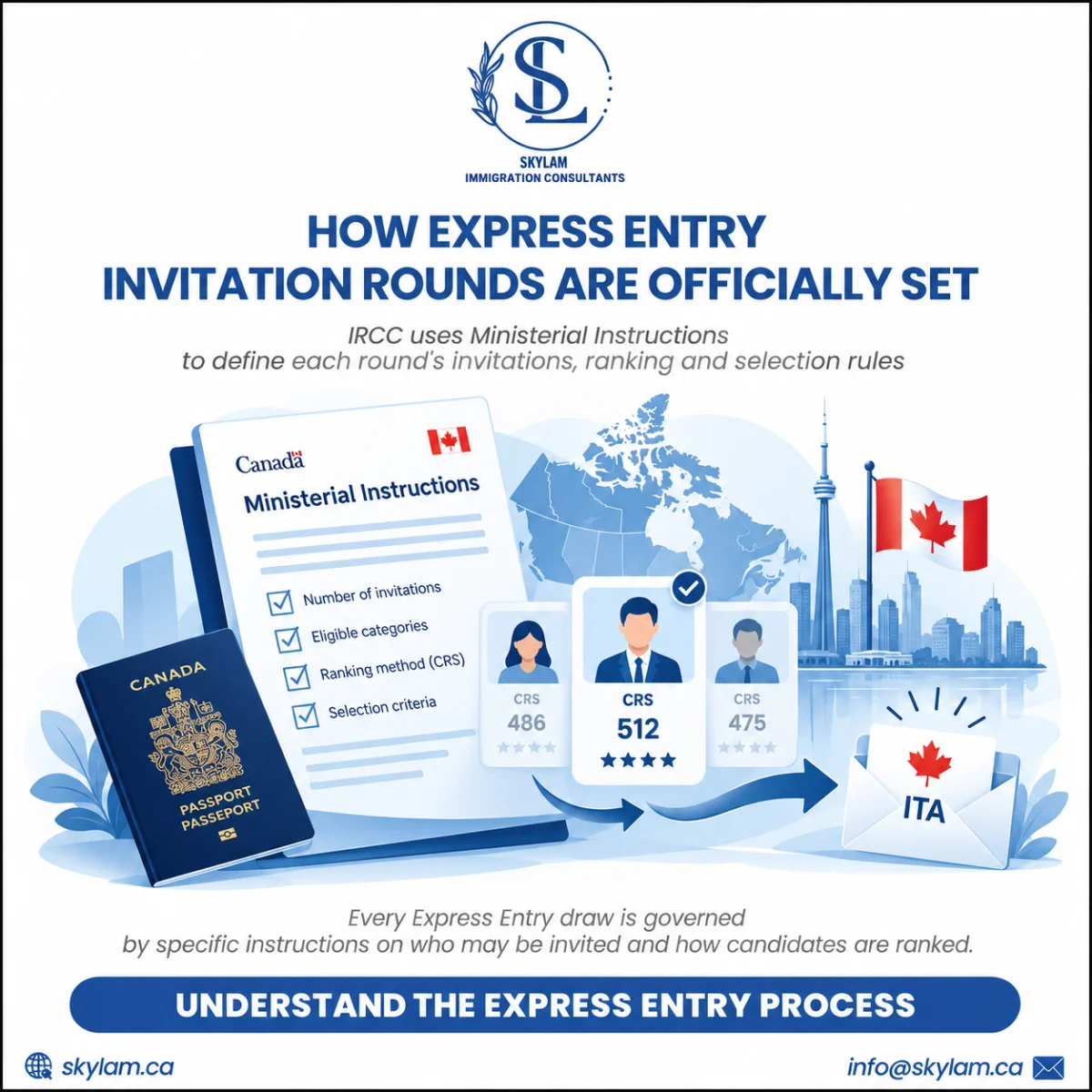
IRCC’s Ministerial Instructions for the October 27 round confirm that candidates needed valid French-language test results that were less than two years old and showed level 7 or higher in each language skill area.
This means French ability has to be demonstrated across all four abilities.
A candidate cannot rely on one particularly strong language skill while falling below the requirement in another.
Why CRS 407 Is Not the General Express Entry Cut-Off
This is one of the most important points candidates should understand.
When IRCC conducts a French-language category round, only eligible French-language category candidates are ranked for that particular selection.
Imagine two candidates both have CRS 407.
Candidate A meets the French-language category requirements.
Candidate B does not.
Candidate A could potentially have been considered in the October 27 round.
Candidate B would not have been considered simply because their CRS score was also 407.
This is why headlines suggesting that “Express Entry dropped to CRS 407” without explaining the category can be misleading.
The correct interpretation is that eligible candidates in the French-language proficiency category were invited down to CRS 407.
French-Language Draw Compared With October 16
The previous French-language proficiency round occurred on October 16, 2026.
IRCC invited 5,000 candidates with a CRS cut-off of 435.
The October 27 round again invited 5,000 candidates.
However, the CRS cut-off decreased to 407.
That is a difference of 28 points.
A 28-point movement within the same category demonstrates how much invitation thresholds can change between rounds.
Candidates should therefore avoid assuming that the next French-language draw will remain at CRS 407.
Future thresholds depend on factors such as:
The number of invitations
The number of eligible candidates
The CRS distribution within the category
New candidates entering the pool
Profiles expiring
Changes to candidate scores
IRCC’s selection strategy
Previous draws provide useful context, but they cannot guarantee the result of the next round.
Why French Language Ability Matters
French-language ability has become an important feature of Canada’s category-based Express Entry system.
Candidates who meet the language requirements may become eligible for French-language proficiency invitation rounds.
French can also affect other parts of a candidate’s Express Entry profile.
This makes language planning particularly relevant for candidates who already have some French ability.
However, reaching NCLC 7 in all four abilities requires meaningful proficiency.
Candidates should not treat French simply as a quick immigration shortcut.
Language preparation requires time, consistent study and an approved language test result.
October 28 Transport Occupations Round
The third consecutive Express Entry draw occurred on October 28.
IRCC issued 150 invitations under the Transport Occupations category.
The CRS cut-off was 477.
This round was much smaller than the French-language round.
It was also highly targeted.
Only candidates who met the eligibility requirements for the designated Transport Occupations category could be considered.
The 477 CRS cut-off was seven points higher than the previous Transport Occupations round held on August 7, 2026.
That earlier round issued 300 invitations with a CRS cut-off of 470.
This means the October transport round had both fewer invitations and a higher CRS threshold.
What Is the Transport Occupations Category?
Transport Occupations is one of IRCC’s category-based Express Entry selection groups.
To qualify under the current Transport category, candidates must have qualifying work experience in an occupation listed by IRCC.
Current IRCC instructions state that candidates need at least 12 months of full-time work experience, or an equivalent amount of part-time experience, within the previous three years in a single eligible occupation.
The experience can be gained in Canada or abroad.
Candidates must also meet all other requirements for the invitation round.
Examples of eligible occupations currently listed by IRCC include certain aviation and automotive occupations.
Candidates should always check the current official occupation list because category requirements can change.
Why Correct NOC Classification Matters
Express Entry occupation categories are linked to the National Occupational Classification system.
Candidates should select the NOC that accurately reflects their actual work experience.
The job title alone is not enough.
The applicant’s duties and responsibilities need to align with the occupation being claimed.
Candidates should never choose an NOC simply because it appears in a category-based list.
Incorrect occupational classification can create serious problems later if IRCC reviews the permanent residence application.
Why Did the Transport CRS Rise From 470 to 477?
The October 28 Transport draw had a CRS cut-off of 477.
The August 7 round had a cut-off of 470.
The seven-point increase does not necessarily indicate a permanent trend.
Several factors can affect a category-based CRS threshold.
One important factor is the number of invitations issued.
The August transport round issued 300 invitations.
The October round issued only 150.
When fewer invitations are available, IRCC may only need to reach a smaller group of the highest-ranking eligible candidates.
Changes in the eligible pool can also affect the final CRS score.
For this reason, candidates should not assume that the next Transport Occupations cut-off will necessarily be above or below 477.
Why Category-Based Selection Matters
The October 26–28 results provide a strong example of how category-based selection works within Express Entry.
Consider the three CRS cut-offs:
PNP — 761
French-language proficiency — 407
Transport occupations — 477
These numbers are dramatically different.
But they are not directly comparable as general Express Entry cut-offs.
Each round considered a different eligible population.
The French-language round selected candidates who met the French-language proficiency requirements.
The Transport round selected candidates who met the occupational requirements.
The PNP round selected candidates with provincial nominations.
This means a candidate’s Express Entry strategy should not focus only on the CRS number.
Candidates should also ask:
Which Express Entry programs do I qualify for?
Do I meet any category-based requirements?
Could French-language proficiency create another selection opportunity?
Does my occupation fall within a targeted category?
Am I eligible for a provincial nomination?
How competitive is my CRS score within the rounds for which I qualify?
CRS Score Still Matters
Category eligibility does not eliminate the importance of CRS.
CRS remains the ranking mechanism used within eligible groups.
IRCC identifies candidates who qualify for a particular round and then selects the highest-ranking candidates according to CRS.
This creates two important components:
Eligibility for the round
Competitive ranking within that eligible group
A candidate may qualify for the French-language category but still have a CRS score that is below the cut-off.
Similarly, a candidate may work in a transport occupation but still need a sufficiently competitive CRS score.
Candidates therefore benefit from both strong category eligibility and a competitive CRS profile.
What Factors Can Affect a CRS Score?
A candidate’s CRS score can depend on several factors.
These can include:
Age
Education
English-language ability
French-language ability
Canadian work experience
Foreign work experience
Spouse or partner characteristics
Provincial nomination
Other applicable scoring factors
Improving one or more of these areas can sometimes increase a candidate’s ranking.
However, every profile is different.
A strategy that helps one candidate may have little impact on another.
Language Scores Can Be Particularly Important
Language proficiency often plays a significant role in Express Entry.
Higher English or French test results can potentially increase CRS points.
Language results can also interact with education and work experience through certain CRS transferability factors.
French-language proficiency can create additional category-based opportunities when the candidate meets IRCC’s requirements.
For someone who is close to a higher Canadian Language Benchmark or NCLC level, retaking a language test may sometimes be worth considering.
However, candidates should assess the potential CRS impact before deciding whether another test is worthwhile.
Provincial Nomination Opportunities
Candidates with lower CRS scores may also consider provincial nomination options where appropriate.
Express Entry-linked PNP streams can provide a major ranking advantage.
However, provincial programs differ significantly.
Some target specific occupations.
Others may require a job offer.
Some select candidates already working in the province.
Others may identify candidates directly from the Express Entry pool.
Candidates should therefore review provincial requirements carefully.
There is no single PNP strategy that applies to every Express Entry candidate.
Why These Draws Matter Before November 3
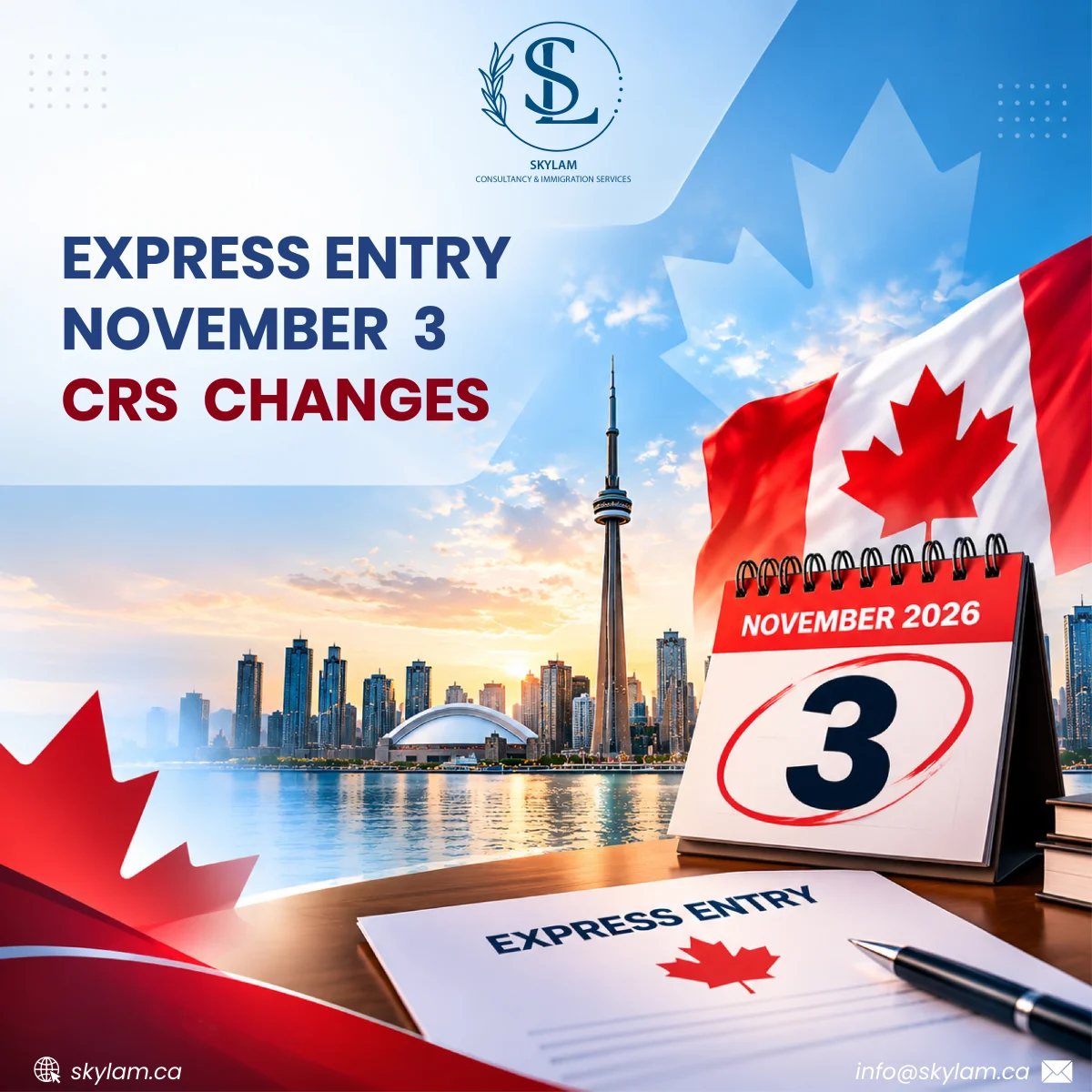
The October 26–28 invitation rounds took place immediately before a significant Express Entry scoring reform scheduled for November 3, 2026.
IRCC is introducing changes to CRS scoring through its Labour Market Integration factor.
Eligible Canadian work experience in designated high-wage occupations and qualifying job offers will receive new scoring treatment.
Existing profiles are expected to be recalculated.
This means the post-November 3 Express Entry pool may not look exactly like the pool that produced the October 26–28 results.
Some candidates could gain additional points under the revised scoring system.
As scores change, candidate rankings can also shift.
Candidates should therefore be careful about using October CRS thresholds as guaranteed indicators of what will happen after the scoring reform.
Can Future CRS Scores Be Predicted?
No future CRS cut-off can be guaranteed.
Several factors affect each round.
These include:
Round type
Category
Number of invitations
Number of eligible candidates
CRS distribution
Changes in candidate profiles
IRCC selection priorities
The November 3 CRS changes may create additional movement in the pool.
For this reason, candidates should use past rounds as reference points rather than predictions.
What Does the October 27 French Draw Mean for Candidates Below CRS 407?
Candidates below CRS 407 were not invited in the October 27 French-language round.
However, this does not mean they can never receive an invitation.
Future CRS thresholds may change.
Candidates can continue improving their profiles where possible.
Depending on individual circumstances, potential strategies could include:
Improving language results
Adding eligible work experience
Completing additional education
Exploring provincial nomination
Updating Canadian experience
Reviewing the impact of the November 3 CRS reform
Maintaining an accurate Express Entry profile
There is no guarantee that any one strategy will result in an invitation.
What Does the Transport Draw Mean for Candidates Below CRS 477?
A candidate below CRS 477 was not selected in the October 28 Transport round.
However, future Transport rounds may have different invitation numbers and thresholds.
The August round, for example, had a CRS cut-off of 470.
That shows that the threshold can change between invitation rounds.
Transport candidates should focus on maintaining eligibility and improving their CRS profile where realistic.
Does a High CRS Score Guarantee a Category Invitation?
No.
A candidate can have a CRS score above a category cut-off and still not receive an invitation from that category if they do not meet its eligibility requirements.
For example, a candidate with CRS 500 who does not meet the French-language category requirements would not have been selected in the October 27 French-language round simply because their score was above 407.
Similarly, someone with CRS 500 who does not meet the Transport category requirements would not automatically receive an invitation in the October 28 transport round.
This is why category eligibility and CRS must always be assessed together.
Can One Candidate Qualify for Multiple Types of Rounds?
Potentially, yes.
An Express Entry candidate may qualify for more than one selection pathway.
For example, a candidate could have strong French-language proficiency and also work in an occupation included in a category-based list.
Another person may receive a provincial nomination while also meeting another category requirement.
Eligibility for multiple types of rounds may create additional opportunities, but it does not guarantee an ITA.
The candidate still needs to satisfy the requirements and ranking threshold of the round IRCC conducts.
How Should Candidates Read Express Entry Draw Headlines?
Candidates should avoid focusing only on the number shown in a headline.
When a new Express Entry draw is announced, review:
The round date
The round type
The number of invitations
The CRS cut-off
The category or program requirements
The tie-breaking rule where applicable
This creates a much more accurate picture than reading only “CRS 407” or “CRS 477.”
A lower score in a targeted category may not apply to most candidates in the Express Entry pool.
What Should French-Speaking Candidates Review?
Candidates interested in French-language category selection should confirm:
They qualify for an Express Entry-managed program
They have an approved French-language test
Their results are still valid
They have at least NCLC 7 in reading
They have at least NCLC 7 in writing
They have at least NCLC 7 in listening
They have at least NCLC 7 in speaking
Their Express Entry profile accurately reflects their language results
They should also monitor future French-language invitation rounds.
What Should Transport Candidates Review?
Transport candidates should review:
Their NOC code
Their actual employment duties
Whether the occupation appears on the current Transport category list
Whether they have the required qualifying work experience
Their overall Express Entry eligibility
Their CRS score
The validity of language results
Education and ECA information where applicable
All information should be accurate and supported by documentation.
What Should PNP Candidates Review?
Candidates exploring PNP options should review the immigration programs of the province or territory where they may realistically qualify.
Consider:
Occupation
Work experience
Current employment
Job offer requirements
Language results
Education
Provincial ties
Study history
Settlement intentions
Express Entry eligibility
A provincial nomination can be extremely valuable in Express Entry, but candidates must first satisfy the province’s requirements.
Frequently Asked Questions
How many Express Entry invitations were issued between October 26 and October 28, 2026?
A total of 5,942 invitations were issued across the three rounds described.
What happened on October 26?
IRCC conducted a Provincial Nominee Program round and issued 792 invitations at CRS 761.
What happened on October 27?
IRCC conducted a French-language proficiency category round and issued 5,000 invitations at CRS 407.
What happened on October 28?
IRCC conducted a Transport Occupations round and issued 150 invitations at CRS 477.
Was CRS 407 the general Express Entry cut-off?
No.
It was the cut-off for eligible candidates in the French-language proficiency category.
What French level was required?
IRCC requires a minimum of NCLC 7 in each of the four French-language abilities for the category.
What was the previous French-language CRS score?
The October 16, 2026 French-language round had a CRS cut-off of 435.
How much did the score decrease?
It decreased by 28 points, from 435 to 407.
What was the previous Transport Occupations CRS cut-off?
The August 7, 2026 Transport round had a cut-off of 470.
How much did the October Transport score increase?
It increased by seven points to 477.
Does working in transport automatically qualify someone for the Transport category?
No.
Candidates need to meet the specific occupational and work-experience requirements established by IRCC.
Does an eligible category guarantee an invitation?
No.
Candidates must also rank high enough under the CRS for the invitation round.
Does receiving an ITA mean permanent residence is approved?
No.
An ITA allows a candidate to submit a permanent residence application. IRCC must still assess and approve that application.
Did these draws happen before the November 3 CRS reform?
Yes.
All three invitation rounds occurred before the new Express Entry scoring changes scheduled for November 3, 2026.
Final Takeaway
IRCC issued 5,942 Invitations to Apply across three consecutive Express Entry rounds between October 26 and October 28, 2026.
The rounds included:
792 PNP invitations at CRS 761
5,000 French-language invitations at CRS 407
150 Transport Occupations invitations at CRS 477
The October 27 French-language round was especially significant because its cut-off fell from 435 in the previous October 16 French round to 407.
However, this result should not be interpreted as a general Express Entry CRS threshold.
Candidates had to meet the specific French-language proficiency requirements, including at least NCLC 7 in all four language abilities.
The October 28 Transport Occupations round had a CRS cut-off of 477, seven points higher than the previous Transport round in August.
Again, candidates needed to meet the Transport category requirements in addition to having a competitive CRS score.
The overall lesson from these three rounds is clear:
Express Entry is no longer simply a question of asking, “What is the CRS cut-off?”
Candidates also need to ask:
Which program do I qualify for?
Which category-based rounds may apply to my profile?
Do I have qualifying French ability?
Does my occupation fall within a targeted category?
Could provincial nomination be an option?
How competitive is my CRS score within the invitation rounds for which I am actually eligible?
The October 26–28 draws also occurred immediately before the November 3 Express Entry scoring reform.
This means future candidate rankings and CRS distributions may change once the revised system takes effect.
Planning Your Express Entry Pathway?
Understanding your CRS score is important, but understanding which invitation rounds you may actually qualify for is equally important.
Skylam Consultancy & Immigration Services can help you assess your Express Entry profile, category eligibility, occupation, French-language opportunities and potential provincial nomination pathways.
Express Entry requirements, categories and invitation thresholds can change. Always review the latest official IRCC information before making an immigration decision.