
How Express Entry Ministerial Instructions Govern Invitation Rounds
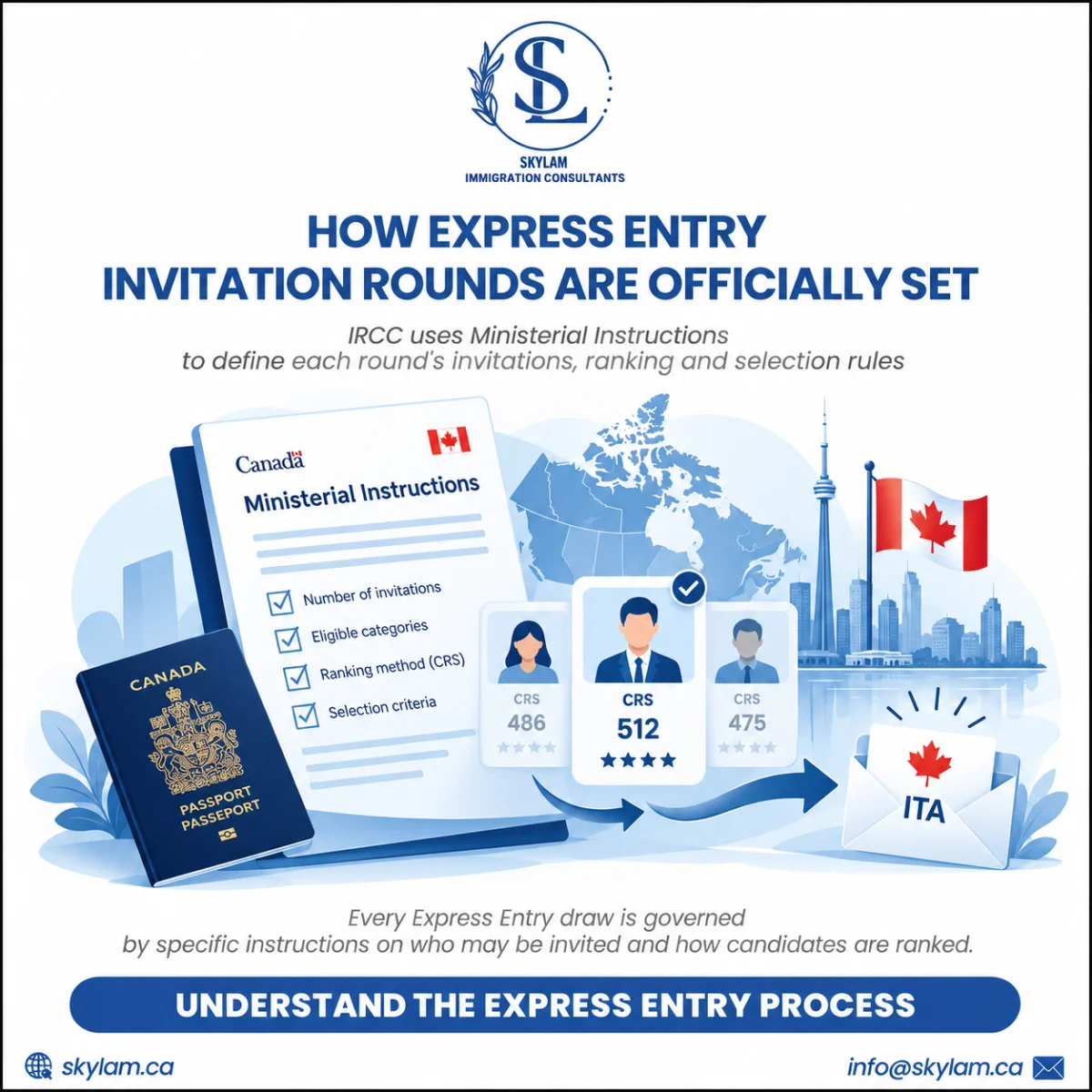
Canada’s Express Entry system uses official Ministerial Instructions to establish how Invitations to Apply for permanent residence are issued.
These instructions provide the legal and procedural framework behind each Express Entry invitation round.
They identify which candidates may be considered, how candidates are ranked, how many invitations may be issued and which rules apply if multiple candidates have the same Comprehensive Ranking System score.
For Express Entry candidates, understanding the Ministerial Instructions can help clarify how invitation rounds actually work.
It is particularly important because Express Entry results are often reduced to a single headline number such as a CRS cut-off.
However, the official framework shows that each round involves more than one number.
Candidates must consider the type of round, eligibility requirements, ranking rules, invitation numbers and tie-breaking provisions.
What Are Express Entry Ministerial Instructions?
Ministerial Instructions are official directions issued by the Minister of Citizenship and Immigration under the authority of Canada’s immigration legislation.
In the Express Entry context, they provide the legal basis for conducting a round of invitations.
The source text states that the Minister issues the instructions pursuant to the Immigration and Refugee Protection Act.
These instructions are then used to determine which eligible foreign nationals in the Express Entry pool may receive Invitations to Apply.
The Ministerial Instructions are therefore not simply informational notices.
They form part of the legal framework used to operate the Express Entry invitation system.
What Information Can an Express Entry Round Include?
The results section of an Express Entry Ministerial Instruction can include several important pieces of information.
These include:
Number of invitations issued
Rank required to be invited to apply
Date and time of the round
CRS score of the lowest-ranked candidate invited
Tie-breaking rule
These details allow candidates to understand exactly how the round was conducted.
However, the source text you provided does not contain completed values for these fields.
Therefore, the exact draw-specific results cannot be determined from this source alone.
Why the Number of Invitations Matters
The number of Invitations to Apply issued in a round is one of the most closely watched Express Entry figures.
A larger round may reach further down the ranking of eligible candidates.
A smaller round may only reach the highest-ranking candidates within the eligible group.
However, invitation volume should not be analyzed on its own.
The type of round and the number of eligible candidates also matter.
For example, a category-based round may consider only a specific group of candidates.
A program-specific round may only consider candidates eligible under a particular immigration program.
This means the number of invitations must always be understood together with the eligibility conditions of the round.
What Does “Rank Required to Be Invited” Mean?
Express Entry candidates are ranked against other eligible candidates.
The Ministerial Instructions can specify the rank required to receive an invitation.
This reflects the position of the lowest-ranked candidate who received an Invitation to Apply in that round.
The ranking is therefore linked to the number of candidates IRCC decides to invite.
If 1,000 candidates are invited in a particular eligible group, the system identifies the highest-ranking eligible candidates until the specified number is reached.
The rank requirement helps show where the round stopped.
What Is the CRS Score of the Lowest-Ranked Candidate?
The Comprehensive Ranking System score of the lowest-ranked candidate invited is commonly referred to as the CRS cut-off.
This is one of the most widely reported Express Entry draw statistics.
However, the CRS cut-off must always be interpreted carefully.
It applies only to the eligible candidates considered in that particular round.
A CRS score from one category or program-specific draw does not automatically represent the minimum score required for every Express Entry candidate.
This is especially important when IRCC conducts category-based or program-specific rounds.
What Is the Tie-Breaking Rule?
The source confirms that when more than one candidate has the same lowest CRS score, the cut-off is determined by the date and time their Express Entry profiles were submitted.
This is known as the tie-breaking rule.
The rule becomes relevant when multiple candidates have the same CRS score at the bottom of the invitation range.
For example, suppose the CRS cut-off is 480.
If multiple eligible candidates have CRS 480, IRCC may not need to invite all of them to reach the specified number of invitations.
The tie-breaking timestamp is then used.
Candidates who submitted their profiles before the specified date and time may rank ahead of otherwise equal candidates who submitted later.
Why the Tie-Breaking Rule Is Important
Express Entry candidates often focus only on the CRS score.
However, a candidate who is exactly at the cut-off should also review the tie-breaking rule.
Two candidates can have the same CRS score but receive different results because their profiles were submitted at different times.
This means profile submission timing can become relevant when candidates are tied at the lowest invited score.
Candidates above the CRS cut-off are generally not affected by the tie-breaking rule in the same way.
The rule is most important for candidates whose CRS score exactly matches the lowest invited score.
What Is an Eligible Foreign National?
The source defines an eligible foreign national as a foreign national whose expression of interest is in the Express Entry pool established under the Express Entry Instructions.
This definition is important because only candidates in the Express Entry pool can be considered under the invitation framework described.
However, simply being in the pool does not guarantee an invitation.
Candidates must also satisfy the requirements of the specific round.
What Does “Specific Ranking” Mean?
The Ministerial Instructions define “specific ranking” as a ranking established only among eligible foreign nationals who qualify for the particular immigration class being considered.
This is one of the most important concepts in understanding modern Express Entry.
It means that candidates may not always be ranked against the entire Express Entry pool.
Instead, some rounds may rank candidates only within a specific eligible group.
This helps explain why CRS cut-offs can differ significantly between invitation rounds.
For example, one round may consider one class of candidates while another considers a completely different group.
The resulting CRS scores are therefore not directly interchangeable.
Why Draw Type Matters
Express Entry can include different types of invitation rounds.
Depending on the round, IRCC may focus on a particular immigration program, category or group of eligible candidates.
When specific ranking applies, candidates are ranked only against others who meet the requirements of that round.
This means a candidate’s CRS score must always be evaluated together with round eligibility.
A CRS score that is sufficient in one round may not be sufficient in another.
Similarly, a candidate with a high CRS score may not be considered in a particular category-based round if the candidate does not meet the category requirements.
Why CRS Scores Should Not Be Read Without Context
Express Entry draw headlines often focus heavily on the CRS cut-off.
However, the Ministerial Instructions demonstrate why this can be misleading if the round type is not mentioned.
Suppose a category-specific round has a CRS cut-off of 410.
That does not mean every candidate with CRS 410 is eligible for an invitation.
Only candidates who satisfy the eligibility requirements of the selected round are considered.
Likewise, a different program-specific round could have a CRS cut-off above 700.
That does not mean all Express Entry candidates need a score above 700.
The eligibility group and scoring context are different.
This is why Express Entry results should always be read in full.
How Express Entry Invitations Are Legally Structured
The Ministerial Instructions include provisions that establish the period during which invitations may be issued.
They can also specify the number of invitations and the ranking conditions.
This structure gives IRCC a formal mechanism for conducting invitation rounds.
Instead of issuing invitations informally, each round is tied to official instructions.
These instructions provide transparency around the selection process.
Candidates can review the published results to understand:
Who was eligible
How many invitations were issued
What ranking threshold applied
What CRS score represented the lowest invited candidate
Which tie-breaking rule was used
What period applied to the round
Why the Immigration Class Matters
The Ministerial Instructions can identify the immigration class or classes included in the round.
This determines which candidates can be considered.
A candidate may be in the Express Entry pool but still not qualify for a particular round if they are not eligible under the selected class or category.
This is why candidates need to understand both:
Their CRS score
Their program or category eligibility
A strong CRS score without eligibility for the selected round may not result in an invitation.
Similarly, category eligibility alone may not be enough if the candidate’s CRS ranking is below the cut-off.
What Is an Invitation?
The source states that the term “invitation” has the same meaning as defined in the Express Entry Instructions.
In practical terms, an Invitation to Apply allows a selected Express Entry candidate to proceed with an application for permanent residence.
Receiving an invitation is therefore an important stage.
However, it does not mean permanent residence has already been approved.
Candidates still need to submit the required application and supporting documentation.
IRCC then assesses the application.
Why Supporting Documents Still Matter
Express Entry profiles are initially based on information entered by candidates.
After receiving an Invitation to Apply, candidates generally need to provide documentation supporting the information they claimed.
This is why accuracy is essential.
Candidates should not enter information simply to increase a CRS score unless they can properly support that information.
Incorrect information may create problems during the permanent residence application stage.
Can a CRS Cut-Off Predict the Next Draw?
Not reliably.
Previous draw results can provide useful context, but they do not guarantee future invitation thresholds.
Future CRS cut-offs can be influenced by:
The number of invitations issued
The type of round
The eligible candidate population
The CRS distribution of eligible candidates
New profiles entering the pool
Profiles expiring
Changes in candidate scores
IRCC’s selection decisions
Ministerial Instructions apply to specific invitation rounds.
Candidates should therefore avoid treating one draw’s CRS cut-off as a permanent benchmark.
Why the Round Date and Time Matter
Each Express Entry round has a specific date and time.
This identifies exactly when the invitation round occurred.
It also provides context for the candidate pool and ranking system used at that moment.
Candidates’ CRS scores can change over time.
Profiles can also enter or leave the pool.
The date and time of the round therefore matter when interpreting the results.
Why the Source You Provided Cannot Confirm a Specific Draw
The Ministerial Instructions text you supplied contains the framework and headings used for an invitation round.
However, several important fields are blank.
These include:
Number of invitations issued
Rank required
Date and time of round
CRS score of lowest-ranked candidate
Tie-breaking rule timestamp
The document also does not identify the specific immigration class in the completed results section.
Because these values are absent, it would be inaccurate to assign a CRS score, invitation count or draw date to this particular text.
Those details would need to come from a completed Ministerial Instruction or another official IRCC source.
How Candidates Should Read an Official Express Entry Draw
When IRCC publishes a completed invitation round, candidates should review the entire result.
Start with the round type.
Then check the number of invitations.
Next, review the CRS score of the lowest-ranked candidate.
If your CRS score matches the cut-off, review the tie-breaking rule.
Finally, confirm that you actually meet the eligibility requirements for the program or category included in the round.
This provides a much more accurate interpretation than looking at the CRS score alone.
What Should Candidates Review in Their Own Profiles?
Express Entry candidates should regularly review:
CRS score
Program eligibility
Language test validity
Education information
Educational Credential Assessment validity where applicable
Work experience
National Occupational Classification
Canadian work experience
Provincial nomination status
Category eligibility
Profile submission date
Other personal information affecting CRS
An accurate and current profile is important for both ranking and later documentation.
Why Category Eligibility Has Become Important
Modern Express Entry selection increasingly involves targeted invitation rounds.
This means candidates may have opportunities based on attributes beyond their overall CRS ranking.
Depending on IRCC’s selected categories, characteristics such as language ability or occupational experience can influence eligibility for particular rounds.
The specific ranking concept in the Ministerial Instructions supports this structure.
Candidates are ranked among the eligible group selected for the round.
This is why understanding category eligibility has become an important part of Express Entry planning.
Does a High CRS Score Guarantee an Invitation?
Not necessarily.
The candidate must first be eligible for the round.
A candidate with a very high score who does not belong to the selected program or category may not be invited in that specific round.
The same candidate could still be considered in another type of invitation round.
This demonstrates the importance of understanding both eligibility and ranking.
Does a Low Category Cut-Off Mean Express Entry Has Become Easier?
Not necessarily.
A lower CRS cut-off in a targeted round applies only to the eligible group being considered.
Candidates outside that group cannot automatically benefit from the lower score.
For this reason, category-based CRS scores should not be presented as universal Express Entry thresholds.
What Should Candidates Do After a Draw?
After an invitation round, candidates should first confirm whether the round applied to them.
If they received an Invitation to Apply, they should carefully review the next steps and documentation requirements.
If they were not invited, they can assess whether their profile can realistically be improved.
Potential areas may include:
Language results
Education
Work experience
Provincial nomination
Category eligibility
Profile accuracy
However, no strategy can guarantee an invitation.
Frequently Asked Questions
What are Express Entry Ministerial Instructions?
They are official instructions issued under Canada’s immigration legislation that govern Express Entry invitation rounds.
What information can a round contain?
It can include the number of invitations, ranking requirement, date and time, CRS cut-off and tie-breaking rule.
What is the tie-breaking rule?
When multiple candidates have the same lowest CRS score, the date and time their Express Entry profiles were submitted can determine who receives an invitation.
What is specific ranking?
It is ranking candidates only among the eligible foreign nationals who qualify for the particular immigration class or group included in the round.
Does every candidate compete against the entire Express Entry pool?
Not necessarily. Specific ranking can apply only within the group eligible for the round.
Does the source provided contain a CRS cut-off?
No. The CRS field is blank in the text provided.
Does the source show the number of invitations?
No. The number of invitations is also missing.
Can a specific draw result be written from this source?
Not accurately without another official source containing the missing figures.
Does a CRS cut-off apply to every Express Entry candidate?
No. It applies to the eligible candidates in that specific invitation round.
Final Takeaway
Express Entry invitation rounds are governed by official Ministerial Instructions.
These instructions provide the legal framework for selecting candidates from the Express Entry pool.
A completed round can identify:
The number of invitations issued
The required rank
The date and time of selection
The CRS score of the lowest-ranked candidate
The tie-breaking rule
The eligible immigration class or group
One of the most important concepts in the source is specific ranking.
Candidates may be ranked only against other foreign nationals who are eligible for the class or group selected for that invitation round.
This explains why Express Entry CRS cut-offs can differ significantly from one draw to another.
Candidates should therefore avoid looking at a CRS number without also reviewing the type of round and its eligibility conditions.
The source you provided explains the official structure of an invitation round but does not contain the completed draw-specific figures.
For an exact draw analysis, the completed invitation count, CRS score, date, rank, category and tie-breaking timestamp would need to be provided.
Planning Your Express Entry Pathway?
Understanding how IRCC conducts invitation rounds can help you interpret Express Entry results more accurately.
Skylam Consultancy & Immigration Services can help you understand your CRS profile, program eligibility and category-based opportunities within Canada’s Express Entry system.
Always rely on completed official IRCC draw results when assessing a specific invitation round.