
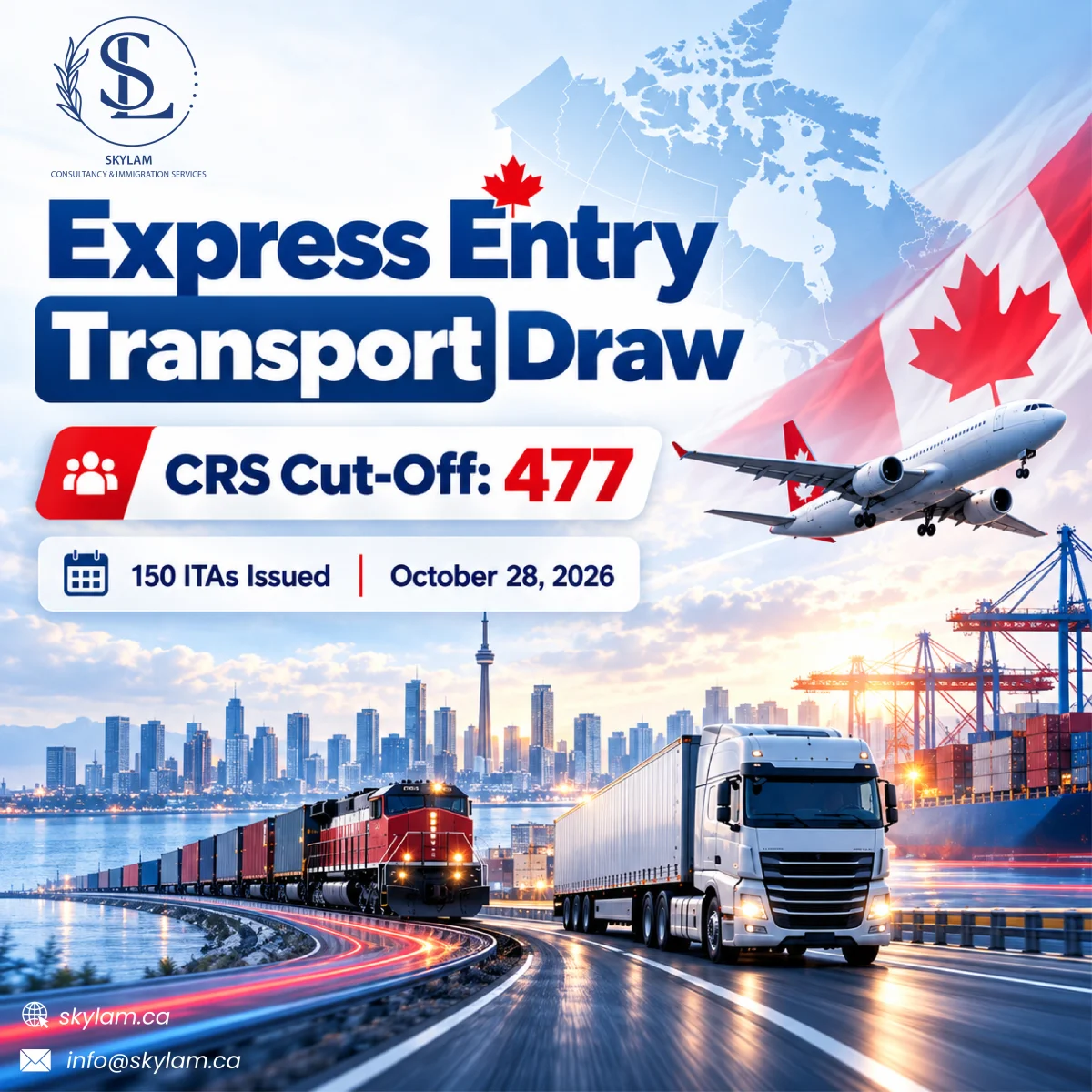
Express Entry Transport Occupations Draw 2026: 150 ITAs Issued at CRS 477
Canada has conducted a new Express Entry category-based round targeting candidates in Transport Occupations.
According to the latest Express Entry round information published by Immigration, Refugees and Citizenship Canada, the draw took place on October 28, 2026.
IRCC issued 150 Invitations to Apply, commonly known as ITAs, to eligible candidates under Transport Occupations, 2026-Version 2.
The Comprehensive Ranking System score of the lowest-ranked candidate invited was 477.
The round required candidates to rank 150 or above among those eligible for the selected category.
The tie-breaking rule was June 4, 2026 at 21:48:22 UTC.
For Express Entry candidates working in qualifying transport occupations, this draw is an important reminder that category-based selection remains an active part of Canada’s federal economic immigration system.
However, a category-based draw should not be interpreted simply as a CRS score competition.
Candidates must first be eligible for an Express Entry-managed immigration program and then meet the specific eligibility requirements for the category selected in the invitation round.
This article explains the October 28 Transport Occupations draw, how Express Entry rounds work, what the CRS cut-off means, why the tie-breaking rule matters, what the current pool distribution looks like and what candidates should consider when assessing their Express Entry strategy.
Latest Express Entry Transport Occupations Draw: Key Details
The October 28, 2026 round was specifically identified as:
Transport Occupations, 2026-Version 2
The official draw details were:
Date: October 28, 2026
Time: 10:34:14 UTC
Invitations issued: 150
CRS score of lowest-ranked candidate invited: 477
Rank required: 150 or above
Tie-breaking rule: June 4, 2026 at 21:48:22 UTC
These figures provide several important pieces of information for Express Entry candidates.
First, the round was not a general Express Entry draw.
It was a category-based round for eligible candidates in Transport Occupations.
Second, only 150 invitations were issued.
Third, the lowest CRS score among the candidates invited was 477.
This means candidates needed to satisfy the category requirements and rank highly enough within the eligible group to receive an invitation.
What Is Express Entry?
Express Entry is Canada’s application management system for several federal economic immigration programs.
Candidates who qualify for one of the programs managed through Express Entry can create a profile and enter the Express Entry pool.
Candidates in the pool are ranked using the Comprehensive Ranking System.
The CRS awards points based on different factors connected to a candidate’s profile.
These may include:
Age
Education
Official language ability
Canadian work experience
Foreign work experience
Spouse or common-law partner factors, where applicable
Provincial or territorial nomination
Other qualifying factors recognized under the Express Entry system
Candidates do not automatically receive an invitation simply because they enter the pool.
IRCC conducts rounds of invitations throughout the year.
During each round, the department determines which group of candidates will be considered and how many invitations will be issued.
What Is an Invitation to Apply?
An Invitation to Apply is an invitation from IRCC allowing an eligible Express Entry candidate to submit an application for permanent residence.
Receiving an ITA is therefore a major step in the Express Entry process.
However, it is not the same as receiving permanent residence.
After receiving an invitation, the candidate must submit a complete permanent residence application and provide the required documents.
IRCC then assesses the application according to the applicable immigration requirements.
A candidate must therefore make sure that the information used in the Express Entry profile is accurate and can be supported by documentation.
What Is the Comprehensive Ranking System?
The Comprehensive Ranking System, or CRS, is the points-based system used to rank Express Entry candidates.
Candidates receive a CRS score based on different characteristics in their profile.
During a round of invitations, IRCC identifies eligible candidates according to the round type and ranking requirements.
For the October 28 Transport Occupations draw, the CRS cut-off was 477.
That means the lowest-ranked candidate who received an invitation had a CRS score of 477.
However, a score of 477 alone does not mean every Express Entry candidate with that score received an invitation.
The candidate also had to meet the eligibility requirements of the Transport Occupations category.
Why Was the October 28 Draw Category-Based?
IRCC conducts different types of Express Entry invitation rounds.
These include:
General rounds
Program-specific rounds
Category-based rounds
In a category-based round, IRCC selects candidates who meet the eligibility requirements of a category established to support a specific economic objective.
The October 28 round was a category-based draw for Transport Occupations, 2026-Version 2.
This means the eligible group was narrower than the entire Express Entry pool.
Only candidates who met the Transport Occupations category requirements and were otherwise eligible within Express Entry could be considered for invitations.
What Does a CRS Cut-Off of 477 Mean?
A CRS cut-off of 477 means that 477 was the score of the lowest-ranked candidate invited in that specific round.
Candidates above 477 who were eligible for the category could potentially receive an invitation, depending on their ranking.
Candidates at exactly 477 were also subject to the tie-breaking rule.
Candidates below 477 were not invited in that round.
It is important to understand that a CRS cut-off is specific to an individual invitation round.
It does not establish a permanent minimum CRS score for Express Entry.
Future draws can have higher or lower cut-offs depending on several factors, including:
The number of invitations issued
The type of round
The number of eligible candidates
The CRS scores of eligible candidates
The category selected
Changes in the Express Entry pool
What Is the Tie-Breaking Rule?
The tie-breaking rule for the October 28 draw was:
June 4, 2026 at 21:48:22 UTC
The tie-breaking rule is used when multiple candidates have the same CRS score as the lowest-ranked candidate invited.
For example, if several eligible candidates had a CRS score of 477, IRCC would use the date and time their Express Entry profiles were submitted.
Candidates who submitted their profiles before the specified tie-breaking time would rank ahead of candidates who submitted later, assuming they otherwise met the requirements.
This means the profile submission date can matter when a candidate is exactly at the CRS cut-off.
Why Does the Tie-Breaking Rule Matter?
Many Express Entry candidates focus only on the CRS score.
However, the tie-breaking rule can become important when someone’s score exactly matches the cut-off.
Imagine two eligible candidates both have a CRS score of 477.
If one submitted an Express Entry profile before June 4, 2026 at 21:48:22 UTC and the other submitted after that point, the earlier profile could rank ahead under the tie-breaking rule.
Candidates should therefore understand that the cut-off score and tie-breaking date work together.
A score equal to the cut-off does not automatically guarantee an invitation.
150 Invitations Were Issued
The October 28 round issued 150 invitations.
This is a relatively targeted invitation round compared with some larger Express Entry draws.
The number of ITAs matters because it can influence how far down the ranking IRCC needs to go to reach the required number of candidates.
When IRCC issues a smaller number of invitations to a particular category, the resulting CRS cut-off can remain relatively competitive.
By contrast, a larger invitation round may reach more candidates within the eligible group.
However, invitation numbers and CRS thresholds vary between draws.
Candidates should therefore avoid trying to predict a future draw solely from the results of one previous round.
Express Entry Pool Had 228,724 Candidates
According to the pool distribution published for October 25, 2026, there were 228,724 candidates in the Express Entry pool overall.
The distribution was:
601–1200: 787 candidates
501–600: 20,535 candidates
451–500: 71,112 candidates
401–450: 63,505 candidates
351–400: 47,911 candidates
301–350: 17,247 candidates
0–300: 7,627 candidates
These figures show how competitive the Express Entry pool can be.
However, the total pool distribution should not be interpreted as the number of candidates competing directly in the Transport Occupations draw.
A category-based draw only considers candidates who meet the eligibility requirements for that category.
Still, the distribution provides useful context about how candidates are positioned across different CRS ranges.
The 451–500 CRS Range
The largest relevant band around the transport draw cut-off was the 451–500 range.
There were 71,112 candidates in this score range as of October 25, 2026.
The detailed breakdown was:
491–500: 12,162 candidates
481–490: 12,342 candidates
471–480: 16,330 candidates
461–470: 15,803 candidates
451–460: 14,475 candidates
The October 28 cut-off of 477 falls within the 471–480 group.
There were 16,330 candidates in that overall CRS band.
However, this does not mean all 16,330 candidates were eligible for the Transport Occupations category.
Many could have occupations or profiles that did not qualify for that specific round.
This is why category eligibility matters in addition to CRS ranking.
Is a CRS Score of 477 Good Enough for Express Entry?
There is no universal CRS score that guarantees an invitation.
A score of 477 was sufficient for the lowest-ranked eligible candidate in this specific October 28 Transport Occupations round.
That does not mean 477 will be enough in another Transport draw.
It also does not mean 477 will be enough in a general, Canadian Experience Class, Provincial Nominee Program, French-language or another category-based round.
Every invitation round has its own result.
Candidates should therefore assess their score in the context of:
The immigration program they qualify for
Their occupation
Their category eligibility
Current invitation patterns
Their CRS ranking
Any potential opportunities to improve their profile
What Is a Category-Based Express Entry Draw?
Category-based selection allows IRCC to invite candidates who have particular attributes or experience relevant to an identified economic objective.
Instead of considering the entire Express Entry pool in the same way, IRCC can identify candidates eligible for a particular category.
The department then invites top-ranking candidates within that group.
Candidates still need to qualify for one of the immigration programs managed through Express Entry.
Category-based selection does not replace the basic Express Entry eligibility requirements.
It adds another layer to the invitation process.
Why Transport Occupations Matter
Transport is an important part of Canada’s economy.
The sector supports the movement of people and goods, supply chains, logistics and economic activity across the country.
By conducting a Transport Occupations category-based draw, IRCC can target eligible Express Entry candidates whose occupational backgrounds fit the category requirements established for that round.
However, candidates should not assume that every job connected with transportation automatically qualifies.
The category is based on specific eligibility criteria and qualifying occupations.
Candidates should review the current official category requirements when determining whether their work experience may qualify.
How Do Express Entry Rounds Work?
IRCC explains the invitation process in several stages.
First, IRCC chooses which type of round it will hold.
Second, it decides how many candidates it wants to invite.
Third, the Express Entry system identifies the highest-ranking candidates who are eligible for that specific round.
Fourth, IRCC issues invitations to those candidates.
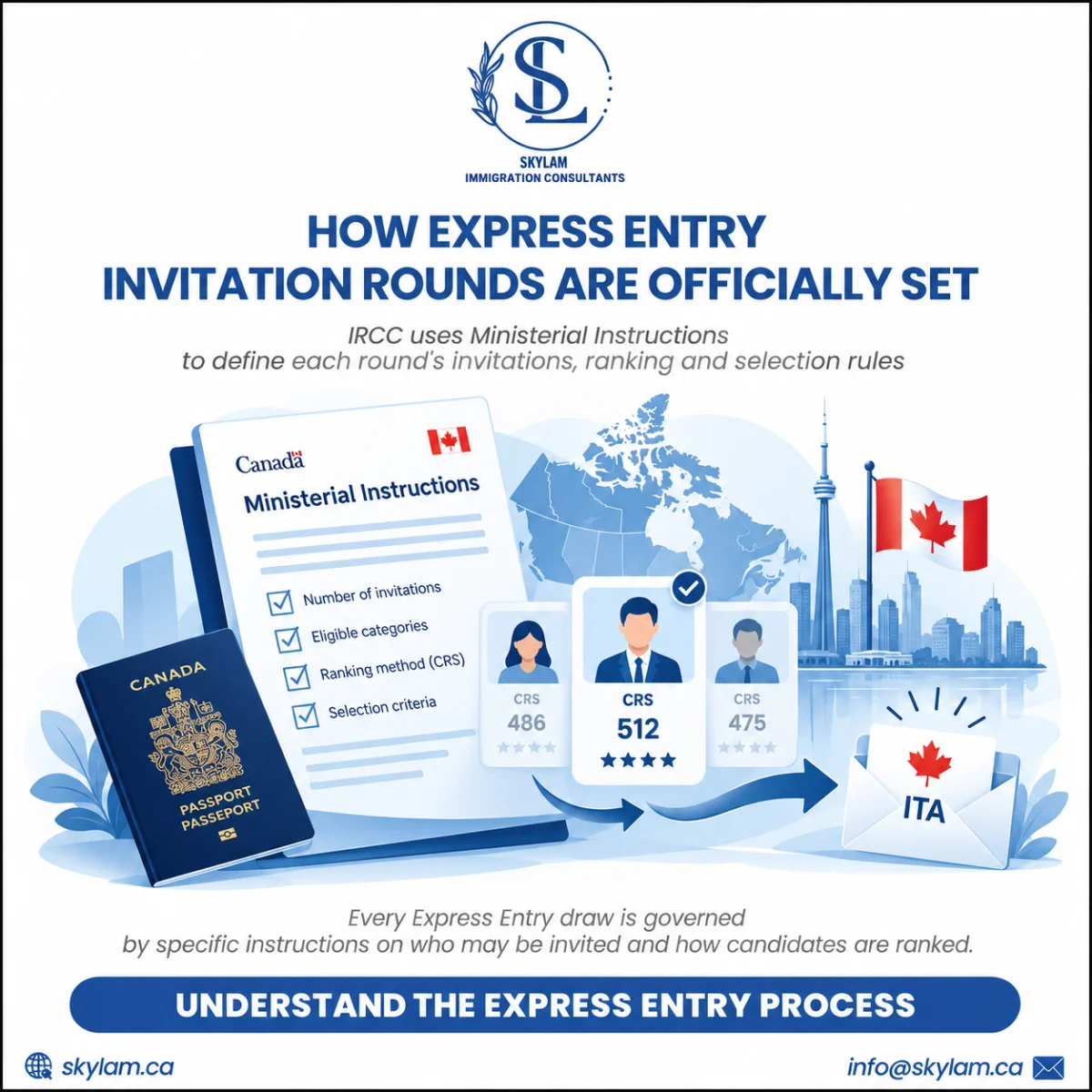
Each round has its own Ministerial Instructions.
These instructions establish details such as:
The date and time of the round
The number of invitations
The round type
The programs included, where applicable
The eligibility requirements for a category-based round
Candidates should therefore look beyond the CRS number and understand the type of draw being conducted.
General Express Entry Rounds
In a general round, IRCC invites top-ranking candidates who are eligible for one of the programs managed through Express Entry.
The selection is based primarily on ranking among the eligible pool.
General rounds are different from category-based rounds because they are not limited to a specific occupational or attribute-based category.
Program-Specific Express Entry Rounds
IRCC can also conduct program-specific rounds.
In these rounds, only candidates eligible for a particular Express Entry program are considered.
For example, a Provincial Nominee Program-specific round only considers candidates who are eligible under that program.
The CRS scores in program-specific rounds can differ significantly from other draw types.
Category-Based Express Entry Rounds
Category-based rounds select candidates who meet the criteria for a designated category.
Transport Occupations is one such category used in 2026.
In these rounds, the candidate must both qualify under Express Entry and meet the category conditions.
That is why two candidates with the same CRS score may not have the same invitation prospects.
One may qualify for the selected category while the other does not.
What Should Transport Candidates Review?
A candidate hoping to benefit from a Transport Occupations draw should review several areas of their Express Entry profile.
First, confirm Express Entry eligibility.
The person must qualify for one of the programs managed through the system.
Second, review the occupation.
The candidate should verify whether the relevant work experience falls within a qualifying occupation for the current Transport category.
Third, confirm the work experience requirements.
Category-based eligibility may require qualifying work experience over a particular period.
Fourth, review the CRS score.
Even if someone meets the category requirements, they still need to rank highly enough during a draw.
Fifth, make sure the profile information is accurate and current.
Changes in work experience, education, language scores, marital status or other factors may affect the profile.
Can You Enter Express Entry Only Because You Work in Transport?
No.
Working in a transport occupation does not, by itself, make someone eligible for Express Entry.
The person must first meet the eligibility requirements of at least one of the immigration programs managed through Express Entry.
Only after entering the pool can category eligibility become relevant for a category-based draw.
The occupation category is therefore not a separate permanent residence program.
It is a method IRCC uses to select certain candidates from the existing Express Entry pool.
Can a Higher CRS Score Guarantee an Invitation?
Not necessarily.
In a category-based round, category eligibility still matters.
For example, a candidate may have a CRS score above 477 but not qualify under the Transport Occupations category.
That candidate would not receive an invitation in a transport-specific round solely because the CRS score is high.
The same person could potentially be considered in another type of Express Entry draw if they meet the applicable eligibility requirements.
This demonstrates why both CRS and draw type need to be considered together.
How Can Candidates Potentially Improve Their CRS?
Depending on individual circumstances, there may be several ways to improve an Express Entry profile.
Language results can be especially important.
Improving English or French test scores may increase CRS points.
Education can also affect ranking.
Candidates who completed education outside Canada may need an Educational Credential Assessment where applicable.
Additional qualifying work experience may affect certain CRS components.
French-language ability can also create additional opportunities under Express Entry.
A provincial or territorial nomination can substantially change a candidate’s CRS ranking.
However, every profile is different.
Candidates should not make immigration decisions based on one general strategy.
The correct approach depends on personal qualifications, occupation, experience, language results and immigration goals.
Why Candidates Should Keep Their Express Entry Profile Updated
Express Entry profiles should remain accurate.
If a candidate’s circumstances change, the information in the profile may need to be updated.
Relevant changes can include:
New language test results
Additional work experience
Education
Marriage or relationship status
New Canadian experience
Provincial nomination
Changes affecting eligibility
Accurate information becomes especially important when a candidate receives an ITA.
The permanent residence application must support the information used to obtain the invitation.
What Happens After Receiving an ITA?
Receiving an Invitation to Apply means the candidate can proceed to the permanent residence application stage.
The candidate must submit the required application and supporting documents within the applicable timeframe.
Documents can include evidence relating to:
Identity
Work experience
Education
Language results
Police certificates
Medical requirements
Proof of funds where applicable
Other program-specific information
The exact document requirements depend on the applicant’s circumstances.
IRCC then assesses the permanent residence application.
An ITA is therefore an opportunity to apply, not an automatic permanent residence approval.
What Does This Draw Mean for Candidates Below CRS 477?
Candidates below 477 were not invited in this particular Transport Occupations round.
However, that does not mean they will never receive an invitation.
Future CRS thresholds can change.
IRCC may conduct different categories of draws and issue different numbers of invitations.
Candidates below a recent cut-off can continue to:
Maintain an eligible Express Entry profile
Improve their language scores
Build qualifying work experience
Explore provincial nomination pathways
Review French-language opportunities
Assess other applicable immigration pathways
The best approach depends on the person’s actual profile.
What Does This Draw Mean for Candidates Above CRS 477?
Candidates above 477 may have a competitive score relative to this specific draw, but score alone is not enough.
They still need to qualify for the Transport Occupations category to have been considered in this round.
A candidate with CRS 500 who does not meet the category conditions would not automatically receive an invitation from a transport-specific round.
This is why candidates should identify which types of Express Entry draws they may actually qualify for.
Should Candidates Use Previous Draws to Predict the Next One?
Previous draws can provide context, but they cannot guarantee future results.
IRCC controls:
The timing of invitation rounds
The type of round
The number of invitations
The category
The ranking threshold
Changes in the Express Entry pool can also affect future cut-offs.
For this reason, historical draws are useful for understanding patterns, but candidates should not treat them as guaranteed forecasts.
Frequently Asked Questions
When was the latest Transport Occupations Express Entry round in the information provided?
The round took place on October 28, 2026 at 10:34:14 UTC.
How many invitations were issued?
IRCC issued 150 Invitations to Apply.
What was the CRS cut-off?
The CRS score of the lowest-ranked candidate invited was 477.
What was the required rank?
Candidates needed to rank 150 or above within the eligible group.
What was the tie-breaking rule?
The tie-breaking rule was June 4, 2026 at 21:48:22 UTC.
What type of draw was this?
It was a category-based round for Transport Occupations, 2026-Version 2.
Does CRS 477 guarantee an invitation in the next transport draw?
No.
Future draw scores, invitation numbers and category requirements can change.
Does every transport worker qualify?
No.
Candidates need to meet the applicable Express Entry and category-based eligibility requirements.
How many candidates were in the Express Entry pool as of October 25, 2026?
The overall pool contained 228,724 candidates.
How many candidates had scores between 451 and 500?
There were 71,112 candidates in that range.
How many were between CRS 471 and 480?
There were 16,330 candidates in the overall pool within that score range.
Does receiving an ITA mean permanent residence is approved?
No.
An ITA allows the candidate to submit an application for permanent residence. IRCC must still assess and approve the application.
Final Takeaway
Canada’s October 28, 2026 Express Entry round targeted eligible candidates in Transport Occupations.
IRCC issued 150 Invitations to Apply.
The CRS score of the lowest-ranked candidate invited was 477.
The tie-breaking rule was June 4, 2026 at 21:48:22 UTC.
The draw demonstrates an important feature of the current Express Entry system: candidates are not assessed only by CRS score.
The type of invitation round also matters.
For a category-based Transport Occupations round, candidates must meet the applicable category requirements in addition to qualifying under Express Entry.
The overall Express Entry pool contained 228,724 candidates as of October 25, 2026, including 71,112 candidates in the CRS 451–500 range.
However, those overall pool figures should not be confused with the number of candidates eligible for the transport category.
For candidates considering Express Entry, the most useful approach is to understand the complete profile.
This includes:
CRS score
Express Entry program eligibility
Occupation
Category eligibility
Work experience
Language ability
Education
Potential provincial nomination opportunities
Keeping the profile accurate and understanding which invitation categories may apply can help candidates make more informed immigration decisions.
Planning Your Express Entry Pathway?
If you are considering Canadian permanent residence through Express Entry, understanding both your CRS score and your eligibility for different types of invitation rounds is important.
Skylam Consultancy & Immigration Services can help you review your Express Entry profile, understand your potential category eligibility and explore the Canadian immigration pathways relevant to your circumstances.
Express Entry draw results, category requirements and CRS thresholds can change. Always review the latest official IRCC information before making an immigration decision.