
Ontario Workforce Priority Stream EOI Scoring: How Ontario Ranks Candidates in 2026
Ontario’s Workforce Priority stream is designed for eligible skilled foreign workers with a qualifying job offer and for eligible self-employed physicians. For applicants using the job-offer route, the process includes employer participation, registration of an Expression of Interest, and an invitation to apply before a full provincial nomination application can be submitted.
One of the most important parts of this process is the Expression of Interest, or EOI, scoring system. Ontario assigns points to an EOI based on several factors connected to employment, work experience, earnings, education, language ability, legal status and regional location.
This means candidates should not focus on only one number. A strong profile may come from a combination of factors. Canadian earnings can contribute points, but so can hourly wage, Ontario work experience, language ability, Canadian education and employment outside Toronto.
Understanding how these factors work can help applicants assess their position more accurately before entering the Ontario Immigrant Nominee Program process.
What Is the Ontario Workforce Priority Stream?
The Ontario Workforce Priority stream provides a pathway for eligible foreign workers who have qualifying employment in Ontario. It is also open to certain self-employed physicians who meet the specific requirements established by the province.
For job-offer applicants, an Ontario employer begins the process by submitting information about the position through the Employer Portal. After the employer submits the job offer, the candidate receives a job offer ID and can register an Expression of Interest within the required timeframe.
An EOI is not the same as an application for nomination.
It is a profile used by Ontario to rank potential candidates. If Ontario issues an invitation to apply, the candidate and employer must then complete their respective applications within the applicable deadlines.
The province makes it clear that scoring factors are not the same as eligibility requirements.
A candidate must still satisfy the stream’s full eligibility criteria and provide the required supporting documents. Receiving points in the EOI system does not, by itself, establish eligibility or guarantee an invitation.
How Does the Ontario Workforce Priority EOI Scoring System Work?
Once an EOI is registered, Ontario assigns points according to several categories.
These include:
Employment and labour-market factors
Education
Language ability
Legal status
Canadian earnings history
Ontario work experience
Regionalization
The total EOI score is therefore built from multiple parts of a candidate’s profile.
For job-offer applicants, some information is prepopulated from the employer’s job-offer submission. Other information must be entered or supported by the applicant.
If a candidate is invited to apply, Ontario can require documents proving each scoring factor that the candidate claimed and for which points were awarded.
Accuracy is therefore extremely important.
Applicants should avoid estimating wages, work experience, earnings, education or language levels. Information provided through an EOI should be consistent with the documents that may later be requested during the application process.
NOC TEER Category Points
The National Occupational Classification, or NOC, system organizes occupations according to different TEER categories.
TEER refers to Training, Education, Experience and Responsibilities.
Under the Ontario Workforce Priority EOI scoring system, the points are:
NOC TEER 0 or 1 — 9 points
NOC TEER 2 or 3 — 6 points
NOC TEER 4 — 0 points
NOC TEER 5 — 0 points
The points are linked to the TEER category of the qualifying employment position.
Candidates should make sure that the NOC code connected with their employment accurately represents their actual job duties.
Choosing a NOC should not simply be based on which category provides more points. The occupation must accurately correspond with the employment position and supporting documentation.
NOC Broad Occupational Category Points
Ontario also awards points according to the broad occupational category associated with the NOC.
The current scoring is:
Occupational Category 3 — 10 points
Occupational Category 7 — 8 points
Occupational Category 2 — 6 points
Occupational Categories 0, 1, 4, 8 and 9 — 4 points
Occupational Categories 5 and 6 — 2 points
This is another reason why correct NOC classification matters.
A candidate’s EOI score can be affected not only by the TEER category but also by the broad occupational category associated with the employment position.
Hourly Wage Can Be Worth Up to 15 Points
Hourly wage is another significant scoring factor for candidates applying with a job offer.
The current scoring structure is:
$40 per hour or higher — 15 points
$35 to $39.99 per hour — 12 points
$30 to $34.99 per hour — 10 points
$25 to $29.99 per hour — 8 points
$20 to $24.99 per hour — 5 points
Less than $20 per hour — 0 points
For eligible self-employed physicians, the hourly wage scoring factor does not apply.
Candidates should pay close attention to the wage recorded in the qualifying job offer because it can make a meaningful difference to the overall EOI score.
However, EOI wage points should not be confused with the separate job-offer wage requirements that an applicant and employer may need to satisfy.
Ontario Work Experience
Ontario work experience can provide another substantial number of EOI points.
For job-offer applicants who are already working full-time in the job-offer position, Ontario awards:
More than 24 months — 18 points
13 to 24 months — 15 points
6 to 12 months — 12 points
Less than 6 months in the job-offer position, or not currently working in the position — 0 points under this part of the scoring system.
Ontario also provides another scoring structure when an applicant has less than six months of work experience in the specific job-offer position but has qualifying Ontario work experience.
In this situation:
More than 24 months of full-time Ontario work experience, or part-time equivalent — 12 points
13 to 24 months — 9 points
6 to 12 months — 6 points
Less than 6 months, or not currently working in Ontario — 0 points
Eligible self-employed physicians have a separate Ontario medical-practice scoring structure.
More than 24 months of cumulative medical practice in Ontario can provide 18 points, while shorter periods receive fewer points.
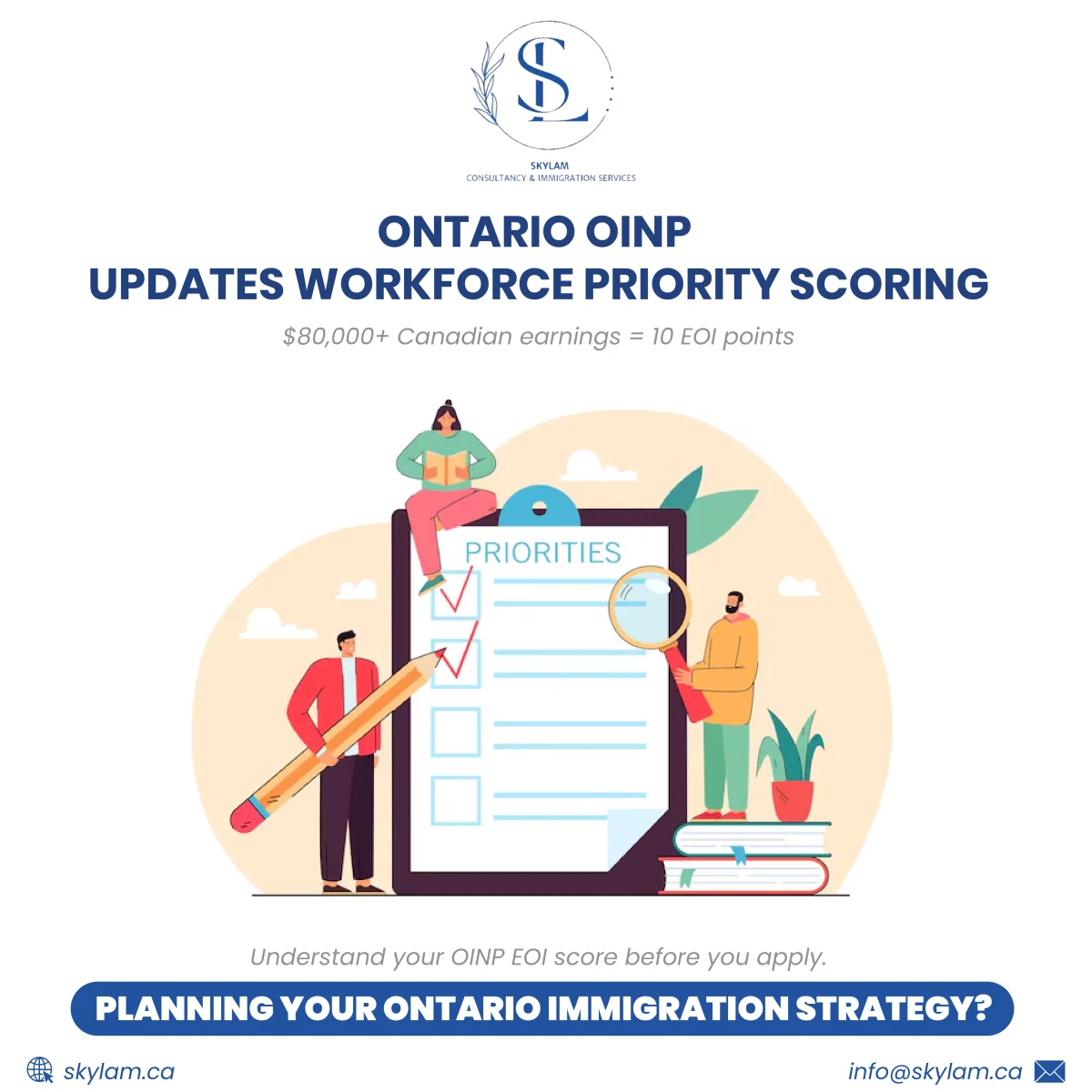
Canadian Earnings History: $80,000 or More Can Receive 10 Points
Canadian work experience earnings history is one of the most notable scoring factors under the current system.
Ontario bases this factor on a Notice of Assessment issued by the Canada Revenue Agency within the last five years.
The scoring is:
$80,000 or more in earnings in a year — 10 points
$70,000 to $79,999 — 8 points
$50,000 to $69,999 — 6 points
$30,000 to $49,999 — 4 points
Under $30,000 — 0 points
This means a candidate with qualifying annual Canadian earnings of at least $80,000 can receive the maximum 10 EOI points available under this factor.
However, candidates should not interpret the $80,000 threshold as a stand-alone qualification for nomination.
It is only one scoring factor.
A candidate’s overall ranking can also be affected by occupation, hourly wage, Ontario work experience, education, language ability, legal status and employment location.
Documentation is also important.
Ontario specifies that the earnings history is based on a CRA Notice of Assessment from the last five years. Candidates intending to claim earnings-history points should therefore make sure their claimed earnings can be supported through the required tax documentation.
Legal Status in Canada
Ontario also awards EOI points according to certain forms of legal status in Canada.
The current scoring is:
Valid work permit — 10 points
Valid study permit — 5 points
Without a valid work or study permit — 0 points
The permit must confer legal status.
Applicants applying from within Canada should also pay close attention to the broader legal-status requirements of the stream.
EOI scoring should never be confused with the underlying eligibility requirements applicable to the candidate’s situation.
Education Points
Education is another component of the EOI scoring system.
Ontario currently provides the following points for the highest level of education:
Doctorate or degree in medicine, dentistry, veterinary medicine or optometry — 10 points
Master’s degree — 8 points
University certificate or diploma above a bachelor level — 6 points
Bachelor’s degree or equivalent — 6 points
Ontario College Graduate Certificate — 5 points
University certificate or diploma below a bachelor level — 5 points
College, CEGEP or other qualifying non-university certificate or diploma — 5 points
Apprenticeship or trades certificate or diploma — 5 points
Less than college or trade certificate — 0 points
A Canadian credential or Educational Credential Assessment may be required, depending on where the candidate completed the education and which credential is being claimed.
Candidates educated outside Canada should therefore check whether an Educational Credential Assessment is required and make sure the assessment remains valid when the application is submitted.
Additional Points for Canadian Education
Ontario separately awards points for the number of qualifying Canadian education credentials.
More than one qualifying Canadian credential — 10 points
One qualifying Canadian credential — 5 points
No Canadian credential — 0 points
A qualifying credential must be a post-secondary credential from an eligible Canadian institution and must meet the program requirements relating to the duration of study.
This factor is different from the points awarded for the highest level of education.
As a result, some candidates may receive points for their educational level and separate points for their qualifying Canadian education credentials.
Language Ability Can Provide Up to 15 Points
Language proficiency is another important part of the Ontario Workforce Priority EOI score.
Ontario uses the candidate’s lowest Canadian Language Benchmark, or CLB, across the four language abilities:
Reading
Writing
Listening
Speaking
The scoring is:
CLB 9 or higher — 15 points
CLB 8 — 12 points
CLB 7 — 8 points
CLB 6 — 4 points
CLB 5 or lower — 0 points
If a candidate has completed both English and French tests, Ontario awards points based on the test with the higher CLB level for this scoring factor.
Applicants should make sure they use an accepted test.
For English, Ontario accepts:
IELTS General Training
CELPIP General
PTE Core
For French, Ontario accepts:
TEF Canada
TCF Canada
Candidates should carefully review test validity and make sure their claimed CLB level accurately corresponds with their official test results.
Additional Points for English and French
Ontario also awards points based on knowledge of Canada’s official languages.
Two official languages — 10 points
One official language — 5 points
To receive points for two official languages, a candidate must have at least CLB 6 across reading, writing, listening and speaking for both tests.
For candidates with strong English and French ability, this factor can therefore add a meaningful number of points to the overall profile.
Regionalization: Toronto Receives 0 Points
Regionalization is another important factor in Ontario’s EOI scoring system.
For applicants with a job offer, regional points are determined by the location of work entered by the employer.
For eligible self-employed physicians, regionalization is based on the Ontario practice address associated with the physician’s OHIP billing number registration.
The scoring is:
Northern Ontario — 15 points
Eastern Ontario — 10 points
Central Ontario outside the Greater Toronto Area — 10 points
Southwestern Ontario — 10 points
Inside the Greater Toronto Area, except Toronto — 5 points
Toronto — 0 points
Toronto receiving zero regionalization points does not mean that someone working in Toronto is automatically ineligible.
It simply means employment in the City of Toronto does not earn points under this specific regionalization factor.
Candidates working elsewhere in Ontario may receive additional regionalization points, but employment location should never be assessed in isolation.
Applicants still need to consider eligibility requirements, their qualifying job offer, employment prospects and the remainder of their immigration profile.
Why Work Location Can Change an EOI Score
Consider two otherwise similar candidates.
One candidate has qualifying employment in Toronto.
Another candidate has qualifying employment in Northern Ontario.
The Toronto candidate would receive zero regionalization points, while the Northern Ontario candidate could receive 15 points.
That creates a potential 15-point difference from work location alone.
Similarly, qualifying employment in Durham, Halton, Peel or York can receive 5 points because these municipalities are within the Greater Toronto Area but outside the City of Toronto.
Applicants should therefore confirm the exact work location entered in the employer’s job-offer information.
They should not assume that all employment within the GTA is treated identically.
How Different EOI Factors Work Together
The Ontario Workforce Priority EOI system evaluates several characteristics together.
For example, a candidate may potentially receive points for:
A TEER 0 or 1 occupation
A qualifying broad occupational category
An hourly wage of $40 or more
More than two years of Ontario work experience
Canadian annual earnings of $80,000 or more
A valid Canadian work permit
A qualifying degree
Canadian education
CLB 9 or higher
Knowledge of both English and French
A qualifying work location outside Toronto
Another applicant may receive fewer points in one category but more points in another.
This is why candidates should assess their entire profile rather than concentrating exclusively on one factor such as Canadian earnings, salary or language ability.
Scoring Factors Are Not the Same as Eligibility Requirements
This distinction is extremely important.
Ontario specifically states that EOI scoring factors are not the same as the stream criteria.
A candidate must satisfy the actual eligibility requirements of the Ontario Workforce Priority stream in addition to receiving an EOI score.
Depending on the occupation and TEER category, eligibility requirements may include:
Qualifying work experience
Language requirements
Education
A mandatory licence or authorization where applicable
Legal status in Canada where applicable
Intention to live and work in Ontario
A qualifying employer and job offer
The employer must also satisfy Ontario’s applicable employer requirements and have its application for approval of the employment position approved.
A high EOI score therefore cannot correct an underlying eligibility problem.
Candidates should first determine whether they qualify for the stream and then assess how competitive their EOI profile may be.
How Does the Application Process Begin?
For candidates applying with a job offer, the Ontario employer begins the process.
The employer submits the job-offer information through Ontario’s Employer Portal.
Once the employer submits the job offer, the candidate receives a job offer ID.
The candidate must use this ID when registering an EOI.
According to the current Ontario requirements, the candidate must register an EOI within 30 calendar days after the employer submits the job offer.
What Happens After an Invitation to Apply?
Receiving an invitation creates deadlines for both the employer and candidate.
The employer must submit its application for approval of the employment position within 14 calendar days from the date Ontario issues the invitation.
The candidate has 17 calendar days from the invitation date to submit the OINP application and pay the applicable fee.
The candidate may work on the application during this period but cannot submit it until after the employer has submitted its application for approval of the employment position.
Because these timelines overlap, coordination between the applicant and employer is important.
Missing a required deadline could affect the application process.
What Happens After an Ontario Nomination?
If the provincial nomination application is successful, Ontario can issue:
A nomination approval letter
A nomination certificate
A work permit support letter, where applicable
The candidate must then proceed with the applicable federal permanent residence process.
Immigration, Refugees and Citizenship Canada, or IRCC, remains responsible for the final decision on permanent residence.
For eligible candidates who use the Express Entry nomination option, Ontario states that accepting a provincial nomination through Express Entry provides an additional 600 Comprehensive Ranking System points.
Candidates must continue to satisfy the relevant federal requirements as well.
What Should You Check Before Registering an EOI?
Before registering an Ontario Workforce Priority EOI, candidates should carefully review their complete profile.
First, confirm that the employment position and employer satisfy the applicable program requirements.
Second, identify the correct NOC and TEER classification based on the actual duties of the position.
Third, confirm the hourly wage entered by the employer.
Fourth, calculate Ontario work experience accurately.
Fifth, review Canadian earnings history against the applicable CRA Notice of Assessment.
Sixth, verify the validity of a work or study permit where applicable.
Seventh, review education and Educational Credential Assessment documentation.
Eighth, confirm the language test type, validity and CLB equivalency.
Ninth, verify the exact Ontario work location used for regionalization.
Finally, make sure every scoring factor claimed through the EOI can be supported with appropriate documentation if Ontario later issues an invitation to apply.
Does $80,000 in Canadian Earnings Guarantee an Invitation?
No.
Annual Canadian earnings of $80,000 or more can provide 10 points under the Canadian earnings-history scoring factor.
However, those 10 points do not guarantee an invitation, provincial nomination or permanent residence.
Canadian earnings are only one part of the overall EOI score.
Ontario can also consider other scoring factors, while invitations may depend on program priorities, available nomination spaces and criteria used in a particular invitation round.
Candidates must also satisfy all applicable eligibility requirements.
Does Working in Toronto Make You Ineligible?
No.
Toronto receiving zero regionalization points does not mean candidates working in Toronto cannot qualify for the Ontario Workforce Priority stream.
It simply means Toronto employment does not provide points under this particular EOI regionalization factor.
A Toronto-based candidate can potentially receive points from occupation, hourly wage, Ontario work experience, Canadian earnings, legal status, education and language factors.
The candidate must still meet all applicable stream requirements.
Is Working Outside Toronto Better for Your EOI Score?
From a regionalization scoring perspective, qualifying work outside Toronto can provide additional points.
However, immigration decisions should not be based only on regionalization.
Candidates should also consider:
Whether the employment position qualifies
The employer
Salary and working conditions
Career opportunities
Cost of living
Work experience requirements
Language ability
Education
Family circumstances
Long-term settlement plans
The strongest immigration strategy is generally based on the entire profile rather than one scoring factor.
Can Improving Your Language Score Help?
Potentially, yes.
Language ability can provide up to 15 EOI points.
For example, moving from CLB 7 to CLB 9 could increase the language component from 8 points to 15 points under the current scoring structure.
Candidates who can demonstrate qualifying ability in both English and French may also receive additional points for knowledge of two official languages.
However, language-test results must remain valid and comply with Ontario’s accepted testing requirements.
Why Professional Assessment Can Be Helpful
An Ontario Workforce Priority profile can involve several connected factors.
These can include:
NOC classification
TEER category
Work experience
Employment position
Hourly wage
Education
Educational Credential Assessment
Language scores
Canadian earnings
CRA documentation
Legal status
Regionalization
Employer eligibility
An error in one area can affect either eligibility or the EOI score.
A structured assessment can help candidates understand which factors apply to their circumstances, which documents may be required and what aspects of the profile need closer review before an EOI or application is submitted.
Final Takeaway
Ontario’s Workforce Priority stream uses a multi-factor Expression of Interest scoring system.
The current system can award points for:
NOC TEER category
Broad occupational category
Hourly wage
Ontario work experience
Canadian earnings history
Legal status
Education
Canadian education credentials
Language ability
Knowledge of both official languages
Regional work location
One important scoring factor is Canadian earnings history.
Annual Canadian earnings of $80,000 or more can provide 10 EOI points when the qualifying earnings are supported through a CRA Notice of Assessment issued within the last five years.
However, this is only one part of the EOI profile.
Hourly wage can provide up to 15 points.
Ontario work experience can provide up to 18 points.
Language ability can provide up to 15 points.
Northern Ontario employment can provide up to 15 regionalization points.
A candidate should therefore assess the entire profile rather than focusing on one headline number.
Eligibility should be reviewed first. Scoring factors should then be calculated carefully, and all information claimed through the EOI should be supported by appropriate documentation.
Planning Your Ontario Immigration Pathway?
Understanding how your employment, earnings, education, language ability, Canadian experience and work location interact can help you better assess your Ontario immigration options.
Skylam Consultancy & Immigration Services can help you understand the factors that may affect your profile and explore the immigration pathway that fits your circumstances.
Immigration programs, criteria, scoring systems and invitation patterns can change. Always review the latest official Government of Ontario information before making an immigration decision.