
Canada Express Entry Changes 2026: New CRS Points for Canadian Work Experience and Job Offers
Introduction
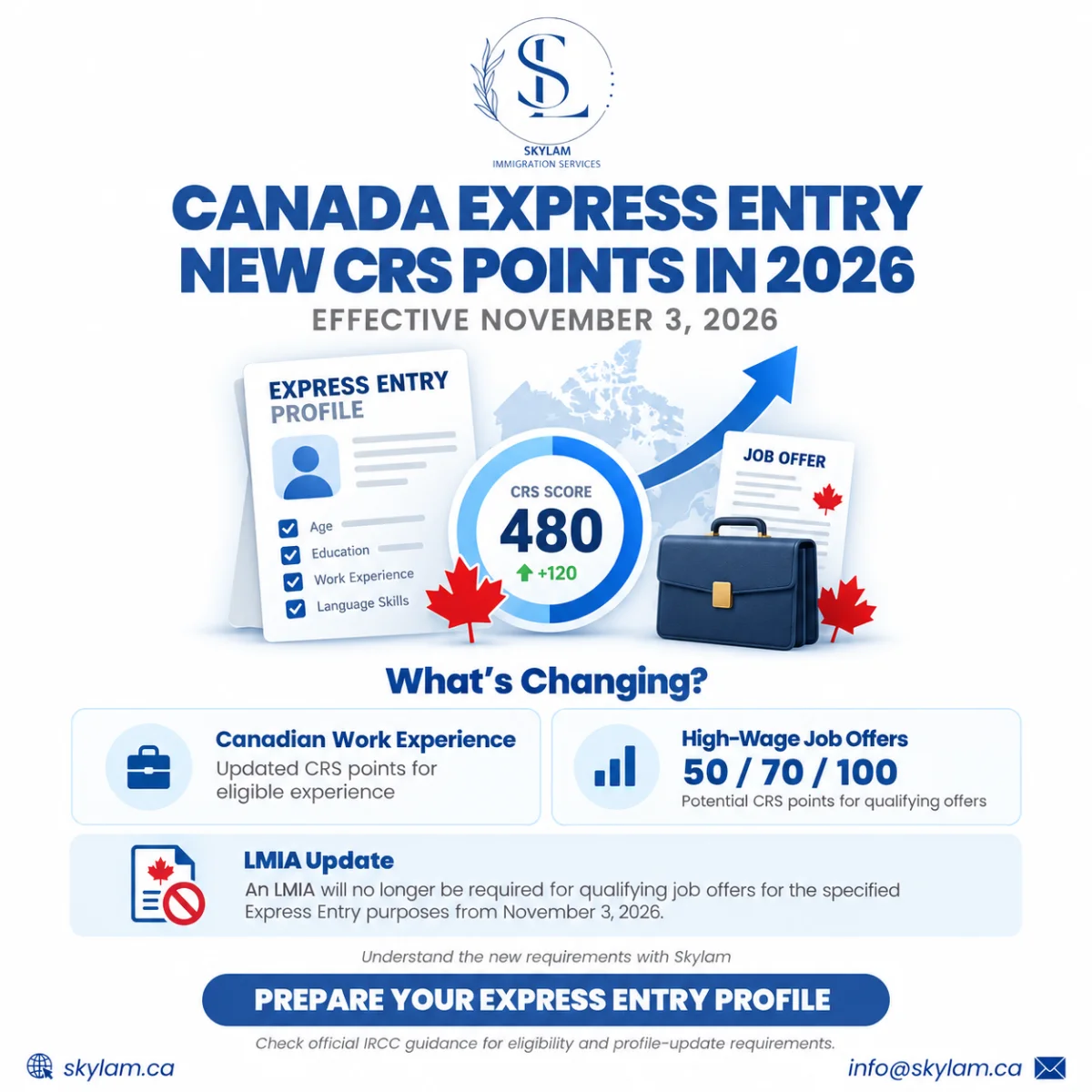
Canada is introducing significant changes to its Express Entry system on November 3, 2026, affecting how candidates receive Comprehensive Ranking System (CRS) points for Canadian work experience and qualifying job offers.
The updated system introduces a new Labour Market Integration factor, which recognizes qualifying Canadian work experience and certain job offers in eligible high-wage occupations. It also changes how job offers are assessed for Express Entry program eligibility and CRS points.
Under the new rules, candidates may receive additional points based on the length of their Canadian work experience and whether that experience was gained in eligible high-wage occupations. Alternatively, candidates with qualifying job offers in eligible high-wage occupations may receive points under the same factor.
However, candidates cannot receive points for both Canadian work experience and a qualifying job offer under this factor. Instead, the system compares the available scores and awards the higher applicable result.
The changes also introduce a different approach to Labour Market Impact Assessments (LMIAs). Under the updated rules, an LMIA is no longer required for a job offer to qualify for program eligibility or CRS points, provided the offer meets the applicable requirements. Having an LMIA will not provide additional CRS points or give a candidate's profile priority.
For foreign workers, international graduates and other prospective permanent residence applicants, these changes make it important to understand how employment history, occupation classification, wages and job offer validity may affect their Express Entry profiles.
This guide explains the November 2026 changes, how the new points system works, which job offers may qualify, and what candidates should consider when preparing or updating their Express Entry profiles.
1. What Is Changing in Express Entry on November 3, 2026?
The new rules introduce a Labour Market Integration factor into the Comprehensive Ranking System.
Previously, candidates needed to understand the separate CRS rules for Canadian work experience and job offers. Under the updated framework, these elements are assessed through the new factor, which compares the points available from qualifying Canadian work experience with those available from an eligible high-wage job offer.
The main changes include:
-
A new Labour Market Integration factor within the CRS.
-
Points for the length of qualifying Canadian work experience.
-
Additional points for Canadian work experience in eligible high-wage occupations.
-
Points for qualifying job offers in eligible high-wage occupations.
-
A maximum of 150 points under the Labour Market Integration factor.
-
Updated job offer requirements that no longer require an LMIA for CRS job offer points or program eligibility.
-
No additional CRS points or profile priority simply for having an LMIA.
-
A temporary pause in invitation rounds while IRCC recalculates existing profiles.
According to the published announcement, IRCC expects the recalculation of existing profiles to take up to two weeks after the changes take effect. Invitation rounds will pause during this period and resume once the process is complete.
Candidates should monitor official IRCC announcements for confirmation of the implementation schedule and the resumption of invitations.
2. Understanding the New Labour Market Integration Factor
The Labour Market Integration factor is designed to recognize certain employment experiences and job offers that may help candidates integrate into Canada's labour market.
Under this factor, candidates may qualify for points through one of two routes:
Route A: Canadian work experience
Candidates may receive points based on how long they have worked in Canada, with additional points available for qualifying experience in eligible high-wage occupations.
Route B: Qualifying job offer
Candidates may receive points for a valid Express Entry job offer in an eligible high-wage occupation.
The system compares the points available under both routes and awards the higher applicable score.
Can candidates receive points for both routes?
No. Candidates can receive points for either qualifying Canadian work experience or a qualifying job offer under the Labour Market Integration factor, but not both.
For example, a candidate with several years of Canadian work experience in an eligible high-wage occupation may qualify for a substantial number of points through the work experience route.
If the same candidate also has a qualifying job offer, the system compares the applicable scores rather than adding the job offer points to the work experience points.
This distinction is important for candidates who are planning their CRS strategy. Having both Canadian work experience and a qualifying job offer does not mean they can combine the two scores under this factor.
The maximum available score under the Labour Market Integration factor is 150 points.
3. How Canadian Work Experience Points Will Be Calculated
Canadian work experience remains an important consideration under the revised CRS framework.
The work-length points are based on qualifying Canadian work experience in occupations classified under National Occupational Classification (NOC) TEER 0, 1, 2 or 3, subject to the existing eligibility requirements.
The November 2026 changes do not alter the eligibility requirements for qualifying Canadian work experience.
However, the new framework combines work-length points with additional points for qualifying experience in eligible high-wage occupations.
Work-length points with a spouse or common-law partner
Candidates who have an accompanying spouse or common-law partner may receive the following work-length points under the Labour Market Integration factor.
| Qualifying Canadian work experience | CRS points |
|---|---|
| None or less than one year | 0 |
| One year | 35 |
| Two years | 46 |
| Three years | 56 |
| Four years | 63 |
| Five years or more | 70 |
The maximum work-length score for candidates with a spouse or common-law partner is 70 points.
Work-length points without a spouse or common-law partner
Candidates without an accompanying spouse or common-law partner may receive the following points.
| Qualifying Canadian work experience | CRS points |
|---|---|
| None or less than one year | 0 |
| One year | 40 |
| Two years | 53 |
| Three years | 64 |
| Four years | 72 |
| Five years or more | 80 |
The maximum work-length score for candidates without a spouse or common-law partner is 80 points.
These points are only one component of the Labour Market Integration factor. Candidates may also qualify for additional points if their Canadian work experience meets the requirements for eligible high-wage occupations.
4. Additional Points for Canadian Experience in High-Wage Occupations
One of the most important elements of the new system is the introduction of additional CRS points for qualifying Canadian work experience in eligible high-wage occupations.
Candidates may receive these points in addition to their work-length points, provided they satisfy the relevant requirements.
To qualify for high-wage occupation points, a candidate must have at least 12 months of qualifying Canadian work experience, equivalent to 1,560 hours, in one or more eligible high-wage occupations.
The experience must also meet the existing requirements for Canadian work experience under Express Entry.
Eligible experience may be continuous or non-continuous, full-time or an equivalent amount of part-time work. Qualifying experience may also be combined across more than one eligible high-wage occupation.
However, where multiple jobs overlap, the hours counted cannot exceed the equivalent of full-time work at 30 hours per week.
How many additional points are available?
The number of points depends on the wage threshold associated with the eligible occupation.
| Eligible high-wage occupation threshold | Additional CRS points |
|---|---|
| Median wage at least twice the overall Canadian workforce median | 70 |
| Median wage at least 1.5 times, but less than twice, the overall median | 40 |
| Median wage at least 1.3 times, but less than 1.5 times, the overall median | 20 |
| Less than 12 months of qualifying experience | 0 |
Candidates receive the applicable score according to the relevant category. The 70-, 40- and 20-point categories are not cumulative bonuses.
For example, a candidate who qualifies for the 70-point category does not receive an additional 40 and 20 points on top of those 70.
What does this mean for foreign workers in Canada?
Foreign workers already employed in Canada may want to review their NOC classification and employment history to determine whether their experience falls within an eligible high-wage occupation.
However, the occupation's eligibility is not determined solely by the salary offered to one employee. IRCC uses the applicable occupation classification and wage thresholds for the relevant category.
Candidates should check the official eligible occupation list rather than assuming their role qualifies because they earn a high salary.
Official reference: Check eligible high-wage occupations under Express Entry.
5. What Counts as a High-Wage Occupation?
Under the updated Express Entry framework, an occupation is considered high-wage when the median wage of people working in that occupation across Canada reaches at least 1.3 times the overall median wage of the Canadian workforce.
This assessment is based on the occupation's National Occupational Classification code and the applicable wage data.
It is not determined simply by comparing an individual candidate's salary with the average wage.
Eligible high-wage occupations are grouped into three levels, with different points available depending on the wage threshold.
Why does the NOC code matter?
The NOC system classifies occupations according to their main duties, responsibilities and other employment characteristics.
Candidates must identify the occupation that accurately reflects their work rather than choosing a code solely because it appears on an eligible list.
A job title alone may not be sufficient to establish that an occupation qualifies. The duties performed and the applicable NOC classification are important considerations.
What should applicants check?
Candidates should:
-
Identify the NOC code that accurately matches their employment duties.
-
Check whether the occupation appears on IRCC's eligible high-wage occupation list.
-
Confirm the applicable wage threshold and point category.
-
Verify that their Canadian work experience meets the required duration and eligibility conditions.
These steps can help candidates understand whether their employment history may qualify for additional CRS points.
6. Express Entry Job Offer Points Are Returning Under New Rules
The revised system reintroduces CRS points for qualifying job offers through the Labour Market Integration factor.
However, not every Canadian job offer will qualify for these points.
The offer must be valid under the applicable Express Entry requirements and must relate to an eligible high-wage occupation.
How many points can a qualifying job offer provide?
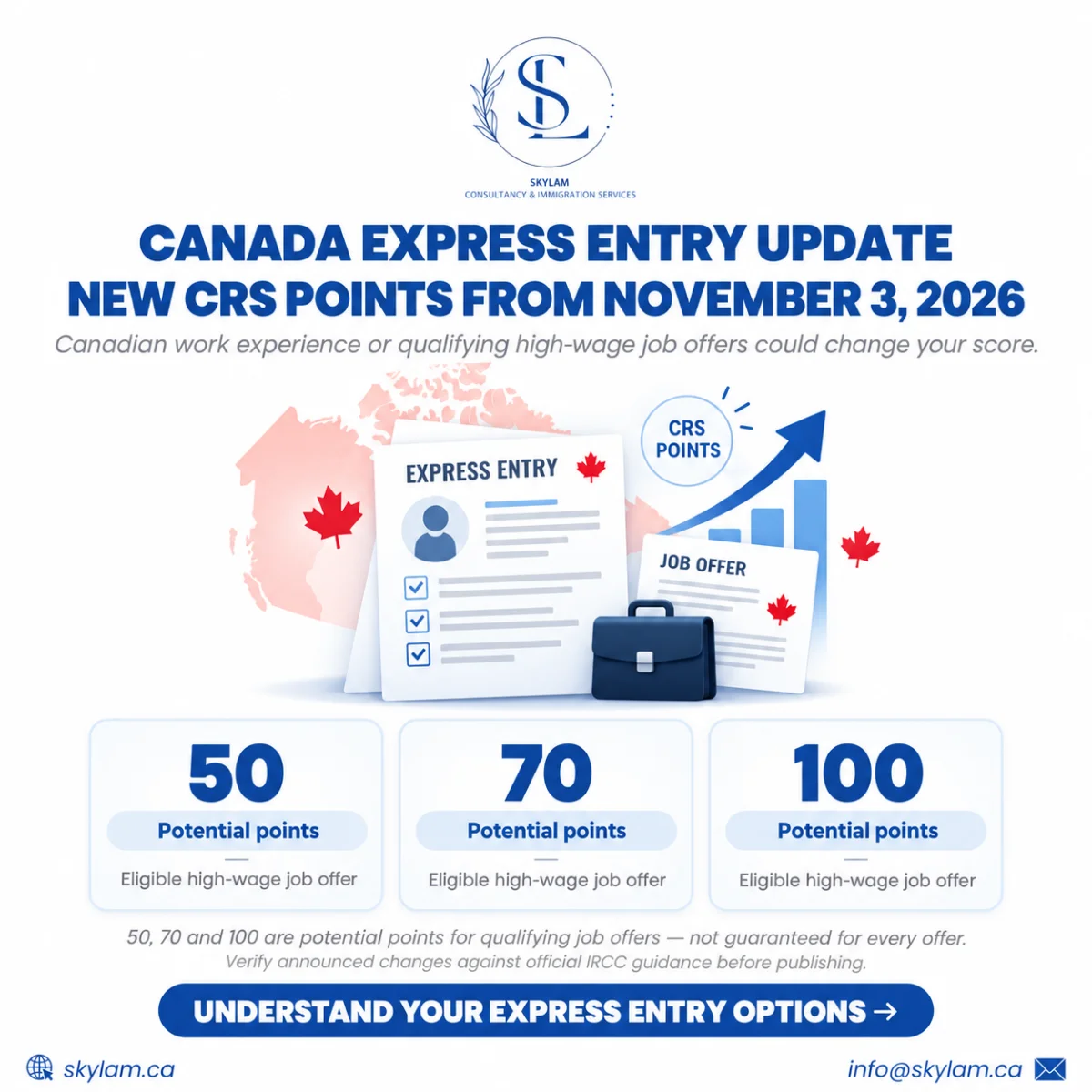
The points depend on the wage category of the eligible occupation.
| High-wage occupation category | CRS points for a qualifying job offer |
|---|---|
| At least twice the overall Canadian workforce median wage | 100 |
| At least 1.5 times, but less than twice, the overall median wage | 70 |
| At least 1.3 times, but less than 1.5 times, the overall median wage | 50 |
| Occupation that does not meet the high-wage criteria | 0 |
These points are assessed under the Labour Market Integration factor. Candidates cannot add job offer points to their Canadian work experience points under the same factor.
For example, a candidate with a valid job offer in an eligible occupation meeting the highest wage threshold may qualify for 100 points through the job offer route.
Another candidate with a qualifying offer in an occupation meeting the lowest eligible high-wage threshold may qualify for 50 points.
The actual result depends on the occupation, the validity of the offer and the applicable rules.
7. LMIA Requirements Are Changing
A Labour Market Impact Assessment, or LMIA, is a document issued through Canada's labour market assessment process in certain employment situations.
Under the revised Express Entry rules taking effect on November 3, 2026, an LMIA will no longer be required for a job offer to qualify for Express Entry program eligibility or CRS points, provided the job offer satisfies the applicable requirements.
The change also means that having an LMIA will not provide additional CRS points or give a candidate's profile priority.
Does this mean every job offer will qualify?
No. The removal of the LMIA requirement does not mean that every job offer is automatically valid for Express Entry.
Candidates must still satisfy the requirements of the relevant immigration program and, where claiming Labour Market Integration points, the eligible high-wage occupation rules.
A qualifying job offer must also be genuine.
How will IRCC assess whether an offer is genuine?
When an applicant applies for permanent residence, an officer will assess the job offer and determine whether it meets the relevant requirements.
This assessment may consider whether:
-
The employer is actively operating its business.
-
The employer can fulfil the terms of the offer.
-
The position meets the employer's genuine business needs.
-
The employer follows applicable employment and recruitment laws.
-
The candidate has the qualifications and ability to perform the work.
-
The candidate is likely to accept the offer and carry out the job.
These checks remain important even when an LMIA is not required.
Applicants should not assume that a job offer from a Canadian employer will automatically qualify for CRS points or program eligibility.
8. Can a Job Offer Still Help Without CRS Job Offer Points?
Yes. A job offer may still be relevant to immigration program eligibility even when it does not qualify for points under the Labour Market Integration factor.
This distinction is particularly important for applicants considering the Federal Skilled Worker Program or Federal Skilled Trades Program.
Under the updated framework, job offers that satisfy the relevant program requirements may support eligibility even if the occupation is not included in the eligible high-wage list.
For example, a valid job offer in an eligible TEER 0, 1, 2 or 3 occupation may help a candidate meet applicable program eligibility requirements, depending on the specific rules.
However, if the occupation does not meet the high-wage criteria, the offer will not provide points under the Labour Market Integration factor.
Program eligibility and CRS points are different
Program eligibility determines whether a candidate qualifies to enter a particular immigration program.
The CRS, on the other hand, ranks eligible candidates in the Express Entry pool according to their scores.
A job offer may therefore be relevant to one assessment without generating additional CRS points under the new factor.
Candidates should review both sets of requirements instead of assuming that a job offer either qualifies for every purpose or has no immigration value at all.
9. Will Skills Transferability Points Change?
According to the published changes, the rules governing skills transferability factors will remain unchanged.
Canadian work experience will continue to be assessed for skills transferability purposes using the existing work experience requirements.
The new high-wage occupation point requirements will not be used to determine eligibility for these skills transferability points.
This means candidates should not assume that the introduction of the Labour Market Integration factor replaces all existing CRS rules connected to Canadian work experience.
The CRS remains a broader ranking system, and candidates should review the applicable criteria for each component of their score.
10. What Happens to Existing Express Entry Profiles?
IRCC has announced that it will recalculate CRS points for existing profiles when the changes take effect on November 3, 2026.
The recalculation could take up to two weeks.
During this period, invitation rounds will be paused and will resume after the recalculation process is complete.
What should candidates do?
Candidates with an existing Express Entry profile should:
-
Monitor official IRCC announcements about the implementation.
-
Review their Canadian work experience and employment information.
-
Check whether their NOC code appears on the eligible high-wage occupation list.
-
Confirm that any job offer information is accurate and meets the relevant requirements.
-
Review their profile after the recalculation is complete.
Applicants should not assume that their CRS score will necessarily increase. The impact will depend on their work experience, occupation, job offer and other applicable factors.
Important note about the online profile system
The published guidance indicates that the online system may not immediately reflect all updated job offer requirements when the changes take effect.
If IRCC provides temporary instructions for entering job offer or LMIA information, candidates should follow the exact instructions published on the official website at that time.
Because profile fields and technical procedures can change, applicants should verify the current instructions before entering information. They should not invent an LMIA number or provide inaccurate information unless the official system guidance explicitly directs a particular temporary entry procedure.
11. How Candidates Can Prepare for the November 2026 Changes
Candidates can use the transition period to review their employment history and understand how the new factor may affect their profiles.
Review your Canadian work experience
Confirm the length of your qualifying Canadian work experience and ensure that your employment records support the dates, hours and duties reported.
Remember that the eligibility requirements for Canadian work experience are not changing under the announced measures.
Check your occupation classification
Compare your actual job duties with the appropriate NOC description.
If you are considering high-wage occupation points, confirm that the occupation is included on IRCC's eligible list.
Review any job offer
If you have a Canadian job offer, check whether it is valid under the relevant Express Entry program and whether the occupation meets the requirements for job offer points.
A genuine offer must meet the applicable requirements even if an LMIA is not needed.
Reassess your CRS score
Once the new rules have been implemented and your profile has been recalculated, review the score displayed in your account.
Do not rely solely on an older CRS estimate if the calculation rules have changed.
Keep your information accurate
Make sure the details in your Express Entry profile match your supporting documents.
Incorrect NOC classifications, incomplete employment histories or inaccurate job offer details can create problems when an officer reviews an application.
Seek qualified guidance where necessary
If your situation involves overlapping work experience, complex employment arrangements or uncertainty about program eligibility, consider consulting a qualified Canadian immigration professional.
A careful review can help you understand the rules relevant to your circumstances without relying on assumptions about how the changes will affect every applicant.
Frequently Asked Questions
1. When will the Express Entry changes take effect?
The announced changes are scheduled to take effect on November 3, 2026. Candidates should consult IRCC for confirmation of implementation details.
2. What is the Labour Market Integration factor?
It is a new CRS factor that awards points based on qualifying Canadian work experience or a qualifying job offer in an eligible high-wage occupation. Candidates receive the higher applicable score rather than points from both routes.
3. What is the maximum number of points available?
The maximum under the Labour Market Integration factor is 150 points.
4. Will every Canadian job offer receive CRS points?
No. Job offer points under this factor are limited to qualifying offers in eligible high-wage occupations. Other job offers may still be relevant to immigration program eligibility if they meet the applicable requirements.
5. Will an LMIA still be necessary for job offer points?
Under the announced changes, an LMIA will no longer be required for a job offer to qualify for program eligibility or CRS points. The offer must still meet the applicable requirements, including genuineness and any relevant occupation criteria.
6. Does an LMIA provide additional CRS points?
No. Under the new rules, having an LMIA will not provide extra CRS points or give a profile priority.
7. Can I combine Canadian work experience points and job offer points?
No. Under the Labour Market Integration factor, IRCC compares the applicable scores and awards the higher one. Candidates cannot combine points from both routes.
8. Will the Canadian work experience eligibility requirements change?
No. The announced changes do not alter the existing eligibility requirements for qualifying Canadian work experience.
9. Will Express Entry invitations stop in November?
IRCC has announced a temporary pause in invitation rounds while existing profiles are recalculated. The process could take up to two weeks, with invitation rounds expected to resume when it is complete.
10. Can a job offer help me qualify for the Federal Skilled Worker Program if it is not on the high-wage list?
Potentially, yes. Program eligibility and CRS job offer points are assessed separately. A job offer may meet the eligibility requirements of a federal program even if it does not qualify for Labour Market Integration points.
Conclusion: Prepare for Canada's Express Entry Changes in 2026
The November 3, 2026 Express Entry changes introduce a new approach to recognizing Canadian work experience and qualifying job offers through the Labour Market Integration factor.
Eligible candidates may receive points based on the length of their Canadian work experience, additional points for qualifying experience in high-wage occupations, or points for a qualifying high-wage job offer.
At the same time, the revised rules remove the LMIA requirement for job offers to qualify for program eligibility or CRS points, while maintaining checks to establish whether offers are genuine.
For candidates already in the Express Entry pool, the announced recalculation of CRS scores makes it important to review employment records, occupation classifications and job offer details.
However, the impact will differ from one candidate to another. A job offer does not automatically generate CRS points, and meeting program eligibility requirements does not guarantee an invitation to apply for permanent residence.
Planning to apply for Canadian permanent residence?
Skylam Immigration Services can help you understand relevant Canadian immigration pathways, review official program requirements and prepare for your next steps.
Contact Skylam Immigration Services to explore your Canadian immigration options and plan with confidence.
Disclaimer: This article is for general informational purposes only and does not constitute legal or immigration advice. Express Entry rules, CRS calculations and application procedures may change. Verify the latest requirements with Immigration, Refugees and Citizenship Canada before updating a profile or submitting an application.
Official resources
SEO publishing tip: Use “Canada Express Entry Changes 2026” as the primary keyword in the page title, introduction and a relevant subheading. Add internal links to Skylam's Express Entry, Canadian work permit and Provincial Nominee Program articles. Verify the official implementation page before publishing, particularly any temporary instructions relating to online profile fields.