
Canada Express Entry New High-Wage CRS Scoring: 100 Additional Points for Qualifying Job Offers
Canada has introduced significant changes to its Express Entry Comprehensive Ranking System (CRS), effective November 3, 2026. Immigration, Refugees and Citizenship Canada (IRCC) has introduced a new Labour Market Integration factor that gives additional importance to eligible Canadian work experience and qualifying job offers in high-wage occupations.
The changes are designed to better align Canada's economic immigration selection system with labour market needs and attract skilled workers whose experience and occupations can contribute to the Canadian economy.
Under the new framework, eligible candidates may receive additional CRS points based on their Canadian work experience in high-wage occupations or a qualifying job offer in an eligible high-wage occupation.
One of the most significant changes is that qualifying high-wage job offers can now provide up to 100 additional CRS points.
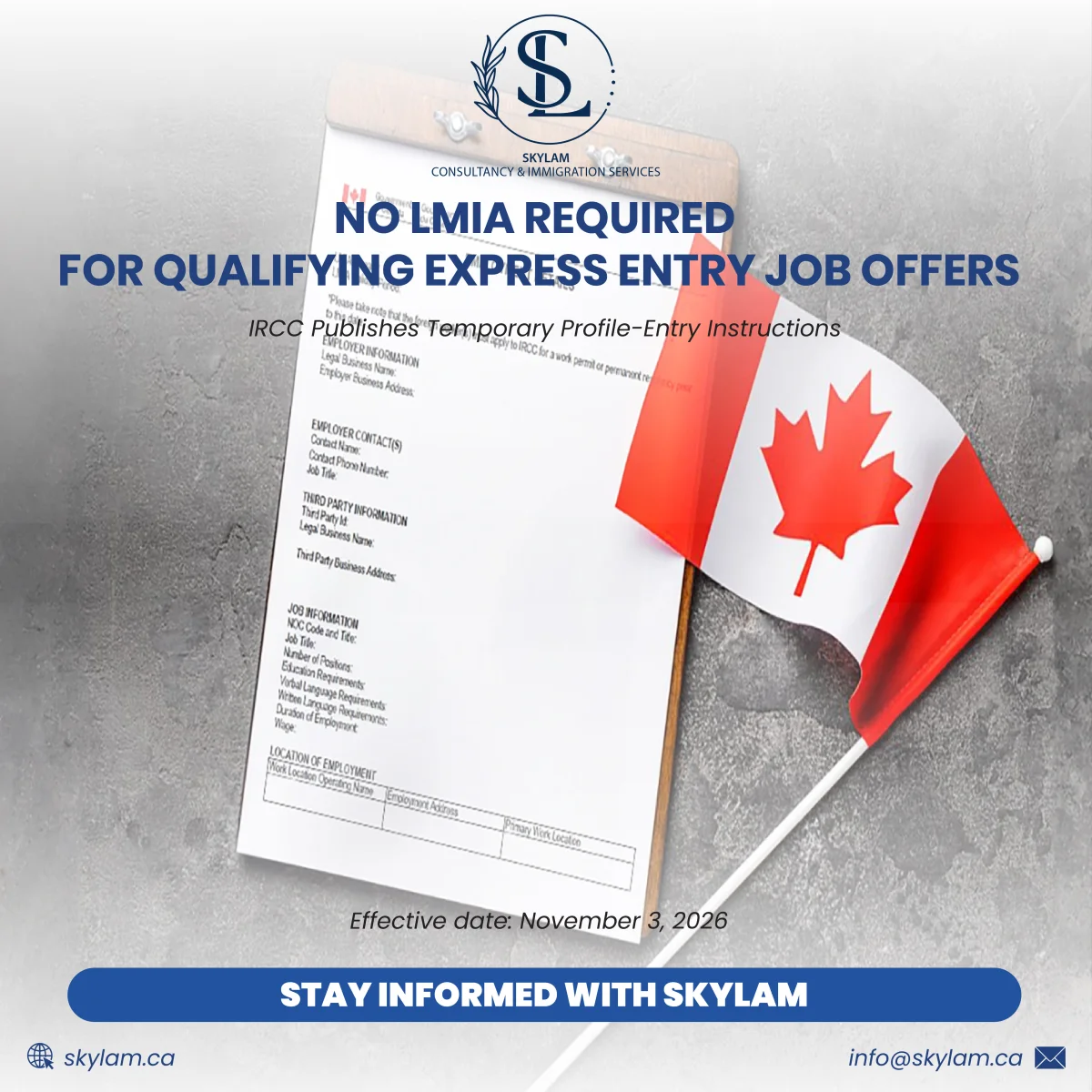
IRCC has also changed how it assesses job offers by removing the Labour Market Impact Assessment (LMIA) requirement for qualifying Express Entry job offers.
For candidates already in the Express Entry pool, the new rules also mean that their existing profiles will be recalculated automatically.
This article explains the new high-wage CRS scoring system, eligibility considerations, LMIA changes and what Express Entry candidates should understand following the November 3 implementation.
What Changed in Canada's Express Entry System on November 3, 2026?
The new Express Entry changes introduce a Labour Market Integration factor into the Comprehensive Ranking System.
This factor recognizes two different pathways:
-
Eligible Canadian work experience in high-wage occupations.
-
Qualifying job offers in high-wage occupations.
Previously, job offer points were removed from the CRS in March 2025. The November 2026 reform introduces a new approach that focuses on qualifying high-wage occupations.
Under the new framework, candidates may receive additional points depending on the occupational wage classification.
The important distinction is that candidates can qualify through Canadian work experience or a qualifying job offer, but cannot combine both scoring options under this factor.
IRCC will award the higher applicable score.
Understanding the New High-Wage CRS Scoring System
The new scoring framework uses three occupational wage levels.
The available points depend on the occupation's median wage compared with the national median wage benchmark.
Here is the new scoring structure:
|
Occupational wage classification |
Additional Canadian experience points |
Qualifying job-offer points |
|---|---|---|
|
At least 2 times the median wage |
70 |
100 |
|
At least 1.5 times the median wage |
40 |
70 |
|
At least 1.3 times the median wage |
20 |
50 |
Candidates with qualifying Canadian work experience may receive additional points according to their occupation's wage classification.
Candidates with qualifying job offers may receive 50, 70 or 100 CRS points under the new system.
These points can make a meaningful difference to a candidate's overall CRS ranking.
However, the Canadian work experience points shown above are additional points. They are separate from the points candidates may already receive based on the duration of their eligible Canadian work experience.
What Are High-Wage Occupations Under the New Rules?
An important part of the new Express Entry framework is understanding how IRCC determines whether an occupation qualifies as high-wage.
The classification is not based on how much an individual applicant earns.
Instead, IRCC evaluates the median wage of people working in the same National Occupational Classification (NOC) occupation across Canada.
The occupational classification is determined by comparing that median wage with the average median wage of the overall Canadian workforce.
The three occupational levels are:
Level 1: At least 2 times the national median wage
Occupations meeting this highest threshold can qualify for:
-
70 additional Canadian work experience points.
-
100 qualifying job-offer points.
Level 2: At least 1.5 times the national median wage
Occupations meeting this threshold can qualify for:
-
40 additional Canadian work experience points.
-
70 qualifying job-offer points.
Level 3: At least 1.3 times the national median wage
Occupations meeting this threshold can qualify for:
-
20 additional Canadian work experience points.
-
50 qualifying job-offer points.
IRCC uses published occupational wage information and data sources, including Job Bank, the Labour Force Survey and the Census of Population.
The current high-wage occupation list is based on data from 2023 to 2025.
This means an applicant's personal salary alone does not determine whether their occupation qualifies for additional CRS points.
How Can Canadian Work Experience Increase CRS Points?
The new Labour Market Integration factor also gives additional importance to eligible Canadian work experience.
Candidates with at least 12 months of eligible Canadian work experience in high-wage occupations may receive additional points depending on their occupational classification.
The additional points are:
-
70 points for qualifying experience in occupations at least twice the median wage.
-
40 points for qualifying experience in occupations at least 1.5 times the median wage.
-
20 points for qualifying experience in occupations at least 1.3 times the median wage.
These points are added to the CRS points already available for the duration of eligible Canadian work experience.
Eligible Canadian work experience generally needs to have been acquired in Canada within the previous 10 years in a TEER 0, 1, 2 or 3 occupation, subject to applicable program rules and specific provisions.
The new framework can therefore improve the CRS scores of candidates who have qualifying Canadian work experience in high-wage occupations.
How Can a High-Wage Job Offer Provide 100 CRS Points?
One of the most important developments is the introduction of additional CRS points for qualifying job offers in high-wage occupations.
Under the new framework, the points are:
|
Occupational wage level |
Job-offer CRS points |
|---|---|
|
At least 2 times the median wage |
100 |
|
At least 1.5 times the median wage |
70 |
|
At least 1.3 times the median wage |
50 |
A qualifying job offer generally needs to be for full-time, continuous employment in Canada for at least one year after the candidate becomes a permanent resident.
The job offer must also meet applicable program requirements and pass IRCC's genuineness assessment.
IRCC officers may examine whether:
-
The employer is actively operating the business.
-
The job offer reflects the employer's genuine employment needs.
-
The employer can meet the terms of the offer.
-
The candidate has the qualifications and ability to perform the work.
-
The employer complies with applicable employment and recruitment laws.
A job offer that does not meet the applicable requirements will not automatically qualify for these additional CRS points.
Important: Canadian Work Experience and Job-Offer Points Cannot Be Combined
Candidates should understand one important feature of the new Labour Market Integration factor.
The two scoring options cannot be added together.
IRCC awards points based on whichever option provides the higher applicable score:
-
Eligible Canadian work experience, including its duration and applicable high-wage additional points.
-
A qualifying high-wage job offer.
For example, a candidate may have qualifying Canadian work experience in an occupation that meets the 1.5-times median wage threshold.
That experience may provide 40 additional high-wage points, along with the applicable work-duration points.
Alternatively, the candidate may have a qualifying job offer in an occupation meeting the same wage threshold, which provides 70 points.
IRCC uses the higher applicable Labour Market Integration score rather than adding both options together.
This distinction is important when calculating a candidate's expected CRS score.
LMIA Requirements Have Changed for Express Entry Job Offers
Another major part of the November 3, 2026 reform concerns Labour Market Impact Assessments.
Under the new rules, an LMIA is no longer required for a qualifying Express Entry job offer to receive the new CRS points.
The change also applies to qualifying job offers used to establish eligibility under:
-
Federal Skilled Worker Program.
-
Federal Skilled Trades Program.
A temporary public policy addresses the relevant LMIA and LMIA-exemption requirements for candidates invited to apply on or after November 3, 2026, subject to the policy's conditions.
However, removing the LMIA requirement does not mean that job offers are automatically accepted.
IRCC will continue to assess whether job offers are genuine and meet the applicable immigration requirements.
Employers and candidates must still provide accurate information and satisfy the relevant program conditions.
It is also important to distinguish Express Entry job-offer rules from general work permit requirements. This reform does not eliminate LMIA requirements for work permits generally.
Existing Express Entry Profiles Will Be Recalculated Automatically
Candidates who already have profiles in the Express Entry pool do not need to create new profiles simply because the CRS scoring framework has changed.
IRCC has confirmed that existing profiles will be automatically recalculated under the new system.
The recalculation process may take up to two weeks.
During this period, IRCC has temporarily paused invitation rounds and will resume them once the recalculation process is complete.
Candidates should understand that automatic recalculation does not necessarily mean every profile will receive additional points.
The actual score depends on whether the candidate meets the requirements for the new Labour Market Integration factor.
Candidates who wish to receive points for a qualifying job offer should ensure that their profile includes the required job-offer information.
What Should Express Entry Candidates Do Now?
The new CRS framework makes it important for candidates to review their profiles and understand how their qualifications fit into the updated scoring system.
Here are some practical considerations.
1. Review your Canadian work experience
Check whether your Canadian work experience meets the applicable eligibility requirements.
Candidates should consider the duration of their qualifying work experience and whether their occupation falls within the high-wage classification.
2. Check your NOC classification
The NOC code associated with your occupation is important because the high-wage classification is based on occupational wage data.
Candidates should ensure that their occupation and job duties are accurately represented.
3. Review your job-offer information
If you have a qualifying job offer, ensure that the necessary details are included in your Express Entry profile.
These may include the employer's information, job details and relevant NOC classification.
4. Understand the new LMIA rules
Candidates should understand that an LMIA is no longer required for qualifying Express Entry job offers under the new rules.
However, other job-offer conditions and genuineness assessments continue to apply.
5. Reassess your CRS score
The new Labour Market Integration factor may affect your overall CRS ranking.
Candidates should review the applicable scoring criteria rather than assuming that every high-wage occupation automatically provides additional points.
Does the New High-Wage CRS System Guarantee an Invitation?
No.
Receiving additional CRS points does not guarantee an Invitation to Apply (ITA) for permanent residence.
Express Entry invitations continue to depend on the applicable invitation round, program requirements and CRS cut-off scores.
The new framework can improve the relative ranking of eligible candidates, but the final outcome depends on the complete immigration profile and selection criteria.
Candidates should therefore assess their entire Express Entry profile rather than focusing only on the new high-wage points.
Frequently Asked Questions (FAQs)
1. When did the new high-wage CRS scoring system take effect?
The new Express Entry Labour Market Integration scoring framework took effect on November 3, 2026.
2. How many additional CRS points can a qualifying high-wage job offer provide?
Candidates may receive 50, 70 or 100 CRS points depending on the occupational wage classification.
3. Can Canadian work experience provide additional CRS points?
Yes. Eligible Canadian work experience in qualifying high-wage occupations may provide an additional 20, 40 or 70 points, depending on the occupational wage level.
4. Can candidates combine Canadian work experience points and job-offer points?
No. IRCC awards points based on whichever of the two Labour Market Integration options provides the higher applicable score.
5. Is the high-wage classification based on an applicant's personal salary?
No. IRCC uses the median wage for the occupation across Canada compared with the overall Canadian workforce median wage benchmark.
6. Is an LMIA still required for qualifying Express Entry job offers?
No. Under the new rules effective November 3, 2026, an LMIA is no longer required for qualifying Express Entry job offers used for the relevant program eligibility and CRS purposes.
7. Will existing Express Entry profiles be recalculated automatically?
Yes. IRCC will automatically recalculate existing profiles. The process may take up to two weeks.
8. Are Express Entry invitation rounds continuing during recalculation?
No. Invitation rounds are temporarily paused during the recalculation process and will resume when it is complete.
9. Does receiving 100 additional CRS points guarantee permanent residence?
No. Additional points can improve a candidate's ranking but do not guarantee an invitation or approval for permanent residence.
Final Takeaway
Canada's new Express Entry high-wage CRS scoring framework, effective November 3, 2026, introduces a significant change to how eligible Canadian work experience and qualifying job offers are assessed.
The new system provides:
-
Up to 70 additional points for eligible Canadian work experience in qualifying high-wage occupations.
-
Up to 100 points for qualifying high-wage job offers.
-
Automatic recalculation of existing Express Entry profiles.
-
Removal of the LMIA requirement for qualifying Express Entry job offers under the new rules.
The reform creates new opportunities for some skilled workers, but eligibility depends on occupational classification, work experience, job-offer requirements and the complete CRS profile.
Candidates should carefully review the updated IRCC requirements before making immigration decisions.
Skylam Immigration Services — helping you understand Canadian immigration changes and plan your pathway with confidence.