
Canada Introduces Major Express Entry CRS Changes in 2026: New Points for Canadian Work Experience and Job Offers
Canada has introduced significant changes to its Express Entry Comprehensive Ranking System (CRS), affecting how candidates receive points for Canadian work experience and qualifying job offers.
Effective November 3, 2026, Immigration, Refugees and Citizenship Canada (IRCC) has introduced a new Labour Market Integration factor. The updated system awards points based on qualifying Canadian work experience or a qualifying job offer in an eligible high-wage occupation.
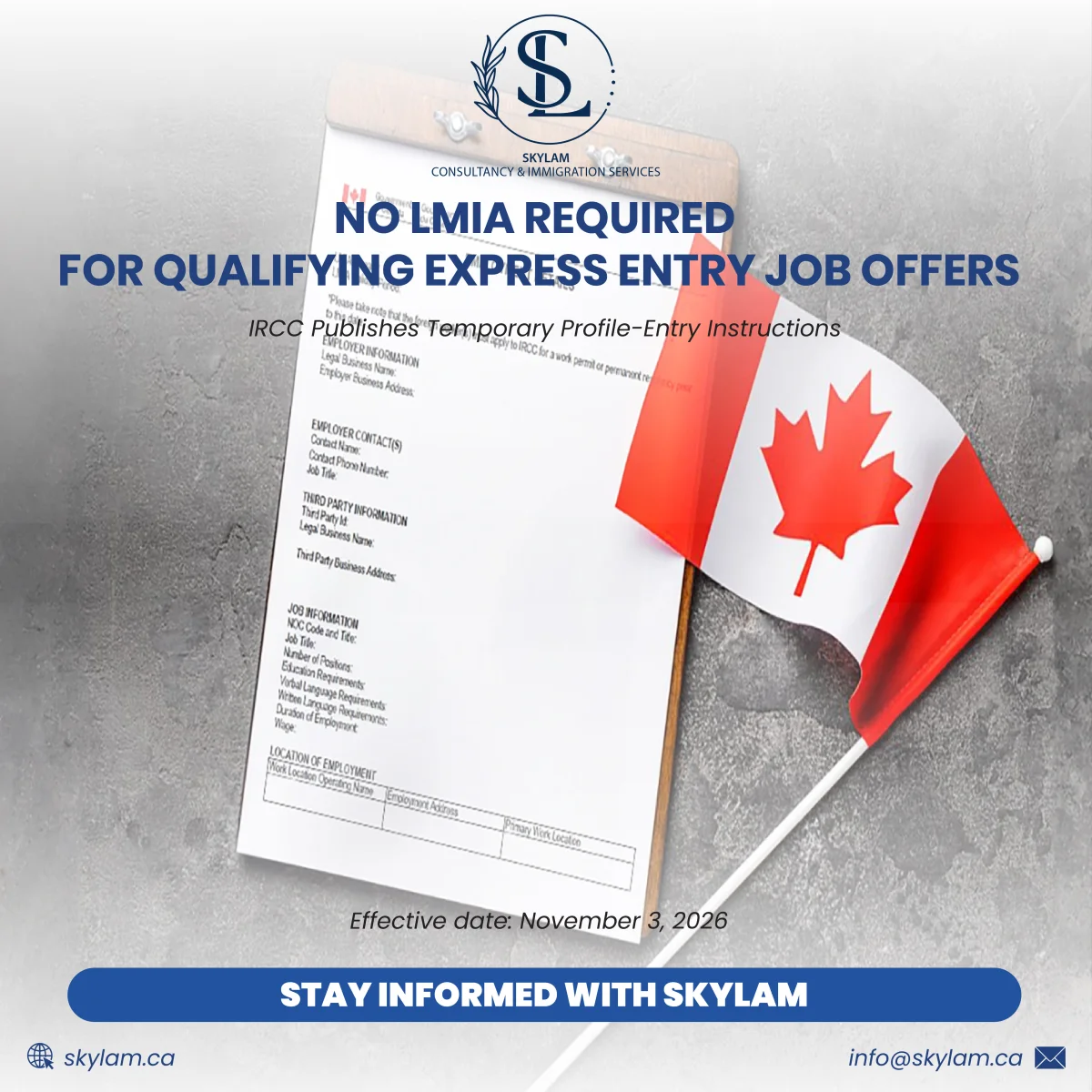
The changes also reintroduce CRS job offer points and remove the Labour Market Impact Assessment (LMIA) requirement for qualifying job offers under Express Entry.
For candidates already in the Express Entry pool and those preparing to create a profile, understanding the new scoring structure is important.
This guide explains the major changes, how the new points are calculated and what candidates should know about job offer eligibility.
1. What Has Changed in Canada's Express Entry System?
As of November 3, 2026, IRCC has introduced a new Labour Market Integration factor within the CRS.
This factor recognizes candidates' connections to Canada's labour market through either qualifying Canadian work experience or an eligible high-wage job offer.
The main changes include:
-
Introduction of the Labour Market Integration factor.
-
New CRS points for Canadian work experience.
-
Additional points for qualifying high-wage Canadian occupations.
-
Reintroduction of job offer points.
-
Removal of the LMIA requirement for qualifying Express Entry job offers.
-
Automatic recalculation of existing Express Entry profiles.
The new factor allows candidates to receive a maximum of 150 CRS points, depending on their circumstances.
However, candidates cannot receive points through both Canadian work experience and a qualifying job offer under this factor. IRCC compares the two options and awards the higher applicable score.
2. Understanding the New Labour Market Integration Factor
The Labour Market Integration factor is designed to recognize candidates who have relevant Canadian work experience or qualifying employment opportunities.
There are two scoring routes:
Option 1: Canadian work experience
Candidates may receive points based on the length of their qualifying Canadian work experience, with additional points available for experience in eligible high-wage occupations.
Option 2: Qualifying job offer
Candidates may receive points for a valid job offer in an eligible high-wage occupation.
IRCC calculates the points available through both routes and awards the higher score.
The maximum points available are:
|
Candidate situation |
Maximum points |
|---|---|
|
With a spouse or common-law partner |
140 |
|
Without a spouse or common-law partner |
150 |
This means candidates should assess both their Canadian work experience and any qualifying job offer before estimating their CRS score.
3. Canadian Work Experience Points Under the New CRS
The new framework includes two components for Canadian work experience:
-
Work-length points.
-
High-wage occupation points.
The work-length points are based on the number of years of qualifying Canadian work experience.
The existing eligibility requirements for Canadian work experience remain unchanged.
Work-length points
The following table shows the CRS points available based on Canadian work experience.
|
Canadian work experience |
With spouse or partner |
Without spouse or partner |
|---|---|---|
|
None or less than 1 year |
0 |
0 |
|
1 year |
35 |
40 |
|
2 years |
46 |
53 |
|
3 years |
56 |
64 |
|
4 years |
63 |
72 |
|
5 years or more |
70 |
80 |
Candidates with more qualifying Canadian work experience can receive higher work-length points.
The maximum is 70 points for candidates with a spouse or common-law partner and 80 points for candidates without one.
4. Additional CRS Points for High-Wage Occupations
The new framework also introduces additional points for qualifying Canadian work experience in eligible high-wage occupations.
To qualify, candidates must have at least one year of qualifying Canadian work experience, equivalent to:
-
12 months; or
-
1,560 hours.
The experience must meet existing Express Entry requirements and must have been gained in one or more eligible high-wage occupations.
Eligible experience can be:
-
Continuous or non-continuous.
-
Full-time or an equivalent amount of part-time work.
-
Combined across more than one eligible high-wage occupation.
If a candidate worked multiple jobs at the same time, the hours counted cannot exceed the equivalent of 30 hours per week.
High-wage occupation points table
|
Qualifying Canadian work experience |
CRS points |
|---|---|
|
At least 12 months in occupations with median wages at least 2 times the overall average median wage |
70 |
|
At least 12 months in occupations with median wages at least 1.5 times the overall average median wage, if not eligible for 70 points |
40 |
|
At least 12 months in occupations with median wages at least 1.3 times the overall average median wage, if not eligible for 40 points |
20 |
|
Less than 12 months of qualifying experience |
0 |
These additional points are awarded on top of work-length points.
For example, a candidate with five years or more of qualifying Canadian work experience may receive up to 70 or 80 work-length points, depending on their family situation, plus up to 70 high-wage occupation points.
However, the total awarded under the Labour Market Integration factor is subject to the applicable maximum.
5. What Are High-Wage Occupations Under Express Entry?
IRCC uses a specific wage-based definition to determine which occupations qualify for additional points.
An occupation is considered high-wage when the median wage of people working in that occupation across Canada is at least 1.3 times the overall average median wage of the Canadian workforce.
An important distinction is that the calculation is based on the occupation's National Occupational Classification (NOC), not simply the salary offered to an individual candidate.
High-wage occupations are divided into three levels based on their median wage:
-
At least 1.3 times the overall average median wage.
-
At least 1.5 times the overall average median wage.
-
At least 2 times the overall average median wage.
Only occupations included in IRCC's eligible high-wage occupation lists can qualify for these additional points.
Candidates should check their NOC code against the official IRCC list before estimating their potential score.
Official occupation list:
Check Eligible High-Wage Occupations
6. CRS Job Offer Points Are Being Reintroduced
Another important development is the reintroduction of CRS job offer points.
Under the new Labour Market Integration factor, candidates may receive points for a valid job offer in an eligible high-wage occupation.
The points depend on the occupation's median wage compared with the overall average median wage in Canada.
Job offer CRS points
|
Job offer category |
CRS points |
|---|---|
|
Occupation with median wages at least 2 times the overall average median wage |
100 |
|
Occupation with median wages at least 1.5 times but less than 2 times |
70 |
|
Occupation with median wages at least 1.3 times but less than 1.5 times |
50 |
|
Occupation that is not high-wage |
0 |
To receive these points, the job offer must be valid under Express Entry and relate to an eligible high-wage occupation.
Candidates should understand that simply receiving a job offer does not guarantee additional CRS points.
The occupation must meet the relevant criteria, and the job offer must pass IRCC's assessment.
7. LMIA Is No Longer Required for Qualifying Express Entry Job Offers
One of the most important changes concerns the Labour Market Impact Assessment.
As of November 3, 2026, candidates no longer need an LMIA for a qualifying job offer to meet applicable Express Entry program eligibility requirements or receive CRS points.
Other important changes include:
-
Having an LMIA will not provide additional CRS points.
-
An LMIA will not give a candidate priority in the Express Entry pool.
-
Job offers may be for existing or new positions.
-
Job offers may come from existing or new employers.
-
IRCC officers will continue to assess whether a job offer is genuine.
This is an important distinction for candidates who have genuine qualifying employment offers but do not have an LMIA.
How IRCC assesses job offers
Removing the LMIA requirement does not mean that all employment offers will automatically qualify.
An immigration officer must be satisfied that the job offer is genuine.
The assessment includes the employer's ability to fulfill the employment terms, whether the offer meets the employer's business needs and whether applicable employment and recruitment laws are being followed.
IRCC also assesses whether the candidate is qualified to perform the work and is likely to accept the offer and carry out the job.
8. Temporary IRCC Instructions for Job Offers Without an LMIA
Although the new requirements took effect on November 3, 2026, the online Express Entry profile system has not yet been fully updated.
As a result, candidates with qualifying job offers without an LMIA may still be required to complete the existing LMIA-related fields.
IRCC has published temporary instructions for this situation.
Candidates are instructed to enter the following details under the Work History section of their Express Entry profile:
|
Profile question or field |
IRCC instructed response |
|---|---|
|
Was a positive LMIA issued for the job offer in Canada? |
Yes |
|
LMIA Number |
00000 |
|
LMIA Issuance Date |
2026-01-01 |
|
LMIA Expiry Date |
2029-01-01 |
These are official temporary system-entry instructions.
Candidates should follow IRCC's published guidance and should not independently invent LMIA information or use these values for situations outside the specified instructions.
9. Job Offer Eligibility and CRS Points Are Different
A particularly important clarification concerns the difference between immigration program eligibility and CRS job offer points.
A job offer may qualify a candidate for the Federal Skilled Worker Program or Federal Skilled Trades Program even if the occupation is not included in the eligible high-wage occupation list.
This means:
-
A job offer may satisfy program eligibility requirements but receive zero additional CRS job offer points.
-
CRS job offer points and immigration program eligibility are assessed separately.
For the Federal Skilled Worker and Federal Skilled Trades Programs, qualifying job offers are not restricted to high-wage occupations.
They may be in any eligible TEER 0, 1, 2 or 3 occupation, provided the relevant program requirements are met.
Candidates should therefore avoid assuming that a job offer that does not qualify for additional CRS points is automatically unsuitable for Express Entry.
10. What Happens to Existing Express Entry Profiles?
IRCC has confirmed that existing Express Entry profiles will be automatically recalculated when the new CRS changes take effect.
The recalculation process may take up to two weeks.
During this period:
-
Existing profiles are being updated under the new scoring framework.
-
Invitation rounds are paused.
-
Invitation rounds will resume after the recalculation process is complete.
Candidates already in the Express Entry pool should monitor their accounts and official IRCC announcements for updates.
The recalculation is important because candidates' scores may change under the new Labour Market Integration factor.
11. Are the Skills Transferability Rules Changing?
No. According to IRCC, the existing rules for skills transferability factors are not changing.
Canadian work experience will continue to be assessed for skills transferability using the existing work experience length requirements.
The new high-wage occupation points requirements will not be used when assessing Canadian work experience for skills transferability factors.
This means the new Labour Market Integration factor and the existing skills transferability factors remain separate parts of the CRS calculation.
12. What Should Express Entry Candidates Do Now?
Candidates should review their profiles and understand how the new rules may affect their eligibility and CRS scores.
Here are some important considerations:
1. Review your Canadian work experience
Check whether your Canadian work experience meets the existing Express Entry requirements.
2. Check your NOC code
Confirm whether your occupation appears on IRCC's eligible high-wage occupation list.
3. Review your job offer
Check whether your job offer meets the applicable Express Entry requirements and whether the occupation qualifies for additional CRS points.
4. Understand the LMIA changes
Candidates with qualifying job offers without an LMIA should follow IRCC's temporary profile-entry instructions.
5. Compare your scoring options
The new framework compares points from Canadian work experience and a qualifying job offer. Candidates receive the higher applicable score, not both.
6. Monitor your Express Entry profile
Existing profiles are being recalculated automatically. Candidates should check their accounts for updated information.
7. Seek professional guidance when necessary
Individual circumstances can affect eligibility, job offer validity and CRS calculations. Candidates with complex cases should consider consulting an authorized Canadian immigration professional.
13. Frequently Asked Questions
Q1. When did the new Express Entry CRS changes take effect?
The changes took effect on November 3, 2026.
Q2. What is the Labour Market Integration factor?
It is a new CRS factor that awards points for either qualifying Canadian work experience or a qualifying job offer in an eligible high-wage occupation.
Q3. What is the maximum number of points available?
The maximum is 150 points for candidates without a spouse or common-law partner and 140 points for candidates with a spouse or common-law partner.
Q4. Can candidates receive points for both Canadian work experience and a job offer?
No. IRCC compares the two scoring options and awards the higher applicable score.
Q5. How much Canadian work experience is required for high-wage occupation points?
Candidates need at least 12 months, equivalent to 1,560 hours, of qualifying Canadian work experience in one or more eligible high-wage occupations.
Q6. Is an LMIA still required for qualifying Express Entry job offers?
No. As of November 3, 2026, an LMIA is no longer required for qualifying job offers under the updated Express Entry requirements.
Q7. Does having an LMIA provide additional CRS points?
No. Having an LMIA does not provide additional CRS points or give a candidate priority in the Express Entry pool.
Q8. Can a job offer qualify for the Federal Skilled Worker Program without high-wage CRS points?
Yes. A qualifying job offer may meet program eligibility requirements even if it does not qualify for additional CRS job offer points.
Q9. Are existing Express Entry profiles being recalculated?
Yes. IRCC is automatically recalculating existing profiles. This process may take up to two weeks.
Q10. Are invitation rounds continuing during recalculation?
No. IRCC has indicated that invitation rounds will be paused during recalculation and resume when the process is complete.
Conclusion
Canada's November 2026 Express Entry changes introduce a new approach to recognizing Canadian work experience and qualifying employment opportunities.
The Labour Market Integration factor, reintroduced job offer points and removal of the LMIA requirement for qualifying Express Entry job offers are important developments for candidates planning to apply for permanent residence.
However, candidates should carefully distinguish between program eligibility and CRS scoring. A job offer may help someone qualify for an immigration program without necessarily providing additional CRS points.
Understanding the new scoring rules, checking eligible NOC occupations and following IRCC's official profile instructions can help candidates prepare for the updated Express Entry system.
Skylam Immigration Services is committed to sharing reliable Canadian immigration updates and helping individuals better understand the requirements that may affect their immigration journey.