
Canada Immigration Levels Plan 2027–2029: PR Targets, Economic Immigration and Temporary Resident Arrivals
Canada has released its 2027–2029 Immigration Levels Plan, outlining its targets for permanent resident admissions and new temporary worker and international student arrivals over the next three years.
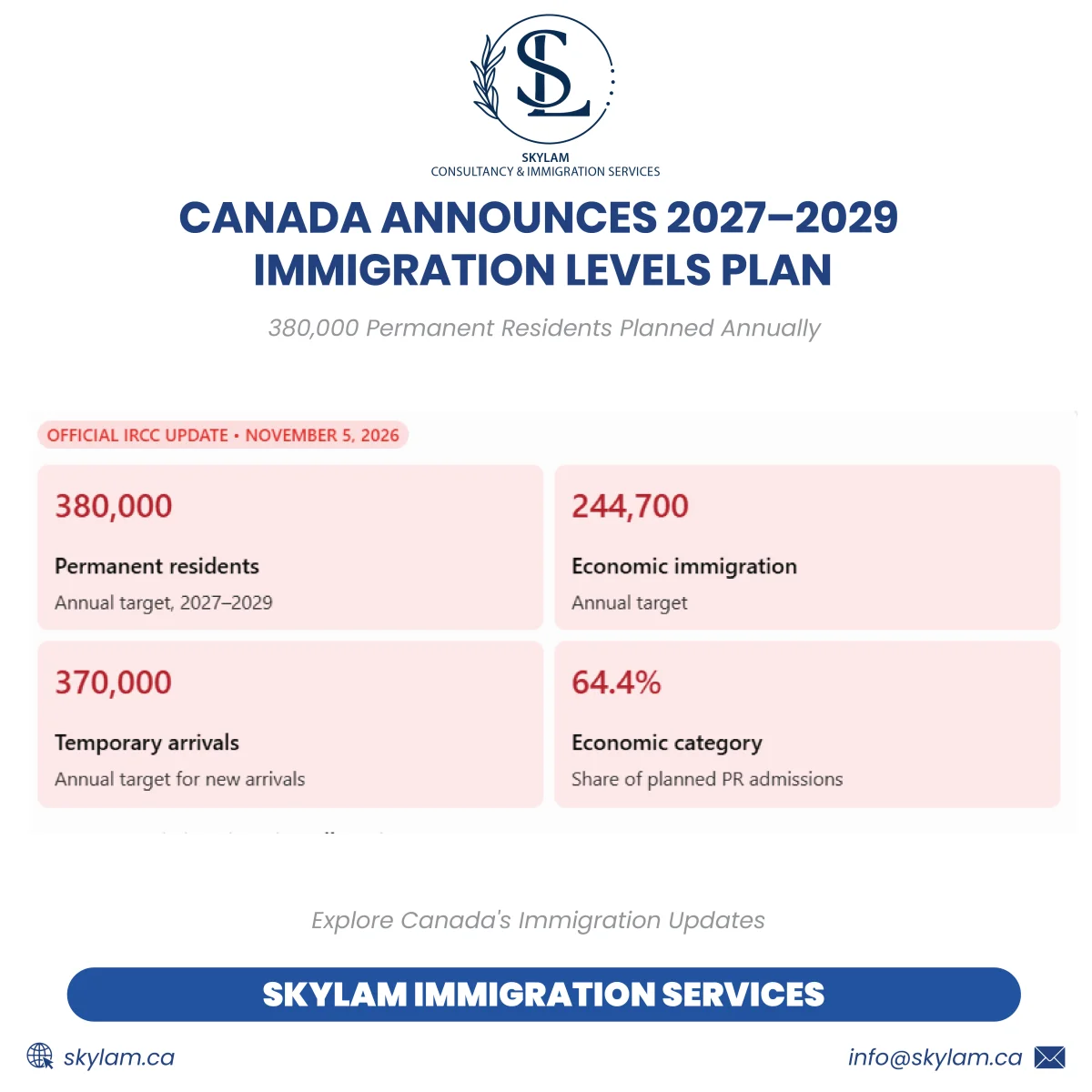
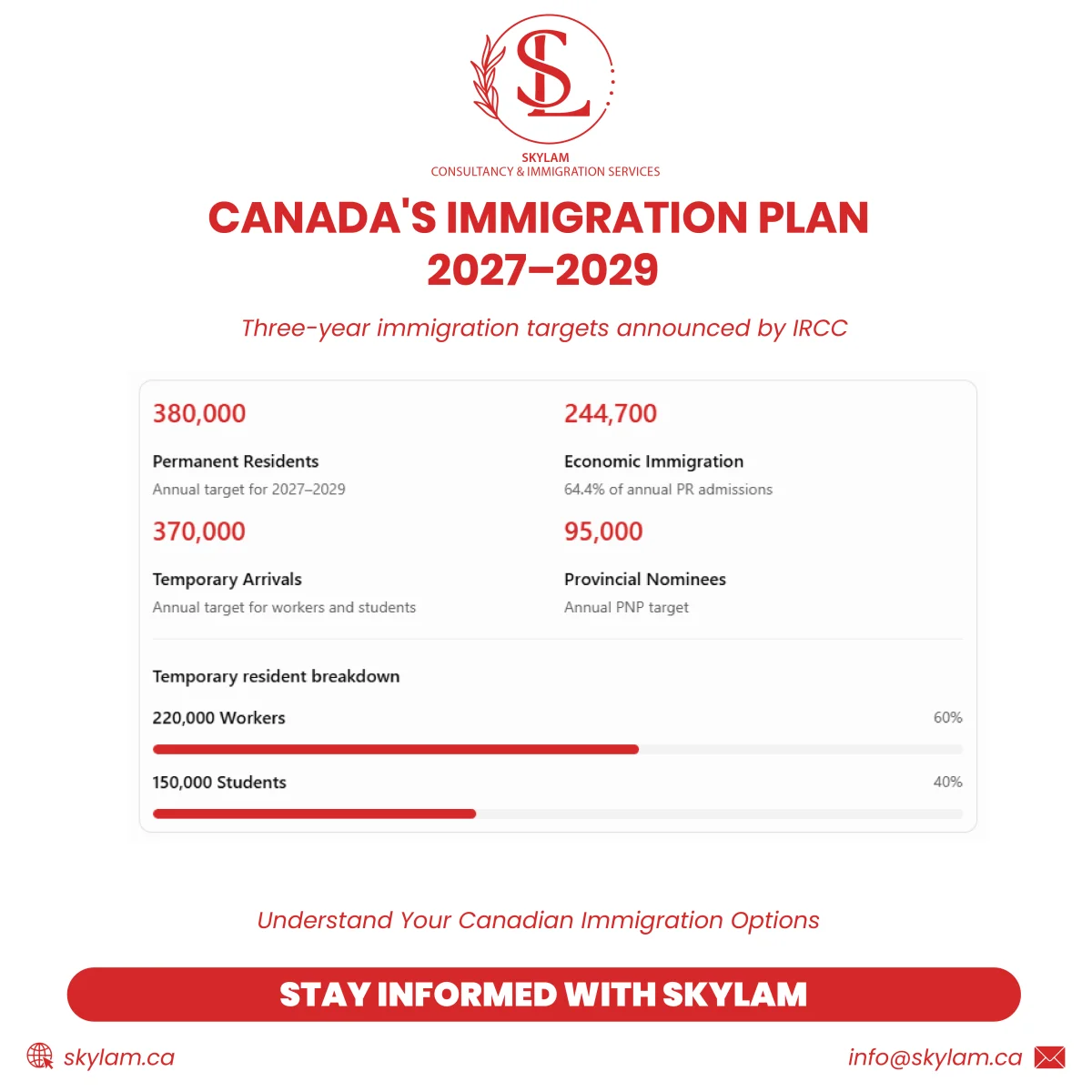
Published by Immigration, Refugees and Citizenship Canada (IRCC), the plan maintains Canada's annual permanent resident admission target at 380,000 for 2027, 2028 and 2029. Economic immigration will remain the largest category, representing 64.4% of planned permanent resident admissions each year.
The government has also established an annual target of 370,000 new temporary resident arrivals, consisting of 220,000 workers and 150,000 international students.
The announcement is important for people considering Canadian permanent residence, skilled worker immigration, provincial nomination, study permits and temporary work opportunities. It also introduces a new time-limited measure for certain individuals already living in Canada who may transition to permanent residence in 2027.
This article explains the key figures, immigration categories and potential implications of Canada's 2027–2029 Immigration Levels Plan.
1. Overview of Canada's 2027–2029 Immigration Plan
The new Immigration Levels Plan is designed to support a more sustainable and predictable immigration system while addressing Canada's economic and regional labour market priorities.
According to IRCC, the government aims to attract the talent and skills needed to complement Canada's domestic workforce, support major investments, strengthen regional communities and respond to ongoing labour market needs.
The plan establishes two major sets of targets:
-
Permanent resident admission targets.
-
New temporary resident arrival targets for international students and temporary workers.
The annual targets are structured as follows:
| Immigration category | Annual target |
|---|---|
| Permanent resident admissions | 380,000 |
| Economic immigration | 244,700 |
| Family immigration | 81,000 |
| Refugees and Protected Persons | 49,300 |
| Humanitarian & Compassionate and Other | 5,000 |
| New temporary resident arrivals | 370,000 |
These figures represent the planned annual targets. The permanent resident plan also includes operational ranges that give IRCC flexibility to respond to changing circumstances and program pressures.
2. Permanent Resident Target Remains at 380,000
One of the most important announcements is that Canada will maintain its overall permanent resident admission target at 380,000 annually for all three years.
This means the planned annual admissions are:
-
2027: 380,000
-
2028: 380,000
-
2029: 380,000
The published overall range is 352,500 to 422,000 each year. This range provides operational flexibility and does not mean that the government has guaranteed admissions at either end of the range.
For applicants, maintaining the same overall target provides a predictable planning framework. However, the number of available admissions under an individual immigration program can vary, and the overall target does not guarantee an invitation or approval.
Applicants should therefore pay attention to individual program requirements, selection criteria and future IRCC announcements rather than relying only on the overall admission figure.
3. Economic Immigration Represents 64.4% of Admissions
Economic immigration remains the largest category under Canada's 2027–2029 plan.
IRCC has set an annual economic immigration target of 244,700, representing approximately 64.4% of planned permanent resident admissions.
This reflects the government's focus on selecting skilled workers and other candidates who can contribute to Canada's economy.
The economic immigration category includes several federal and regional programs.
Federal High Skilled: 100,000 Admissions Annually
The Federal High Skilled category has an annual target of 100,000 admissions.
It includes:
-
Federal Skilled Worker Program (FSWP)
-
Federal Skilled Trades Program (FSTP)
-
Canadian Experience Class (CEC)
These programs are managed through the Express Entry system.
IRCC states that Express Entry categories are established based on labour market information, projections and input from partners and stakeholders.
The selection process can consider candidates' skills, training and language ability to respond to labour market needs.
For prospective applicants, this makes it important to understand the eligibility requirements of the relevant Express Entry program and keep their profiles accurate and updated.
Provincial Nominee Program: 95,000 Admissions Annually
The Provincial Nominee Program (PNP) has an annual target of 95,000 permanent resident admissions.
Provincial nomination allows participating provinces and territories to select candidates who meet their regional economic and labour market priorities.
Different provinces operate their own nomination streams, which may focus on factors such as:
-
Skilled workers.
-
Canadian work experience.
-
Occupations in demand.
-
Regional employment opportunities.
-
Provincial labour market needs.
The 95,000 annual target highlights the continued importance of provincial immigration programs.
However, a national PNP target does not guarantee that every province will maintain the same stream requirements or nomination opportunities. Applicants should review the latest official information from the province or territory they are interested in.
Federal Business Immigration
The Federal Business category includes admissions through the Start-up Visa Program and the Self-employed Persons Program.
The targets are:
| Year | Target |
|---|---|
| 2027 | 1,500 |
| 2028 | 2,725 |
| 2029 | 1,000 |
The figures show that the planned admissions under this category vary across the three years.
Federal Economic Pilots
The Federal Economic Pilots category includes several programs and initiatives, including:
-
Home Care Worker Immigration pilots.
-
Agri-Food Pilot.
-
Economic Mobility Pathways Pilot.
-
Francophone Community Immigration Pilot.
-
Francophone Minority Communities Student Pilot.
The annual targets are 7,900 in 2027, 6,175 in 2028 and 7,400 in 2029.
The category also includes applications from previous caregiver programs that are being processed to completion.
Rural Community Immigration Program
Canada continues to allocate admissions to support smaller communities and regional labour markets.
The Rural Community Immigration Program targets are:
-
2027: 5,500
-
2028: 6,000
-
2029: 6,500
These targets include remaining applications under earlier rural immigration initiatives as well as future admissions through the Rural Community Immigration Program.
Atlantic Immigration Program
The Atlantic Immigration Program has an annual target of 6,000 admissions for each year from 2027 to 2029.
The program supports immigration to Canada's Atlantic provinces. Applicants interested in this pathway should review the current eligibility requirements and designated employer information.
Quebec Immigration Targets
Quebec has responsibility for selecting economic immigrants destined for the province under the Canada–Quebec Accord.
The federal Levels Plan lists Quebec skilled worker and business targets as to be determined. Applicants intending to settle in Quebec should therefore also consult Quebec's own immigration levels plan and selection requirements.
4. Family Immigration Targets Remain Stable
Family reunification remains an important part of Canada's immigration system.
The 2027–2029 plan sets an annual family immigration target of 81,000 admissions.
The allocation is divided into two main groups.
| Family immigration category | Annual target |
|---|---|
| Spouses, Partners and Children | 66,000 |
| Parents and Grandparents | 15,000 |
| Total Family | 81,000 |
These targets remain consistent throughout the three-year plan.
Spousal and Family Sponsorship
Canadian citizens and permanent residents may be eligible to sponsor qualifying family members, subject to the applicable program requirements.
The annual target of 66,000 for spouses, partners and children demonstrates the continued allocation for family reunification.
People considering family sponsorship should review the relationship requirements, sponsor eligibility, financial obligations where applicable and document requirements before submitting an application.
Parents and Grandparents Sponsorship
The Parents and Grandparents category has an annual target of 15,000.
This figure represents planned admissions under the category. It should not be interpreted as an open application opportunity for everyone.
Prospective sponsors should monitor official IRCC announcements for details about application intake, invitations and eligibility.
5. Refugees and Protected Persons
Canada has allocated 49,300 permanent resident admissions annually to Refugees and Protected Persons.
This category includes:
-
Protected Persons in Canada and Dependants Abroad.
-
Government-Assisted Refugees.
-
Privately Sponsored Refugees.
The annual allocation is structured as follows:
| Category | Annual target |
|---|---|
| Protected Persons in Canada and Dependants Abroad | 20,000 |
| Government-Assisted Refugees | 11,750 |
| Privately Sponsored Refugees | 17,550 |
| Total | 49,300 |
The plan also includes humanitarian commitments and protection-related admissions, including certain streams for human rights defenders in need of protection.
6. Humanitarian and Compassionate Immigration
The Humanitarian & Compassionate and Other category has an annual target of 5,000 admissions.
This category includes people selected on humanitarian and compassionate grounds, for reasons of public policy and under the permit holder class.
The target remains unchanged for 2027, 2028 and 2029.
These provisions are assessed under their own legal and program requirements. The annual target should not be understood as an automatic pathway or guarantee of permanent residence.
7. Temporary Resident Targets: 370,000 New Arrivals Annually
Alongside permanent resident targets, IRCC has established an annual target of 370,000 new temporary resident arrivals for 2027, 2028 and 2029.
This target covers new arrivals under temporary worker programs and the International Student Program.
The allocation is:
| Temporary resident category | Annual target |
|---|---|
| Workers | 220,000 |
| International Students | 150,000 |
| Total | 370,000 |
Workers are expected to account for approximately 60% of new arrivals, while students are expected to represent approximately 40%.
Temporary Workers: 220,000
The annual worker target is divided between two programs.
International Mobility Program (IMP): 170,000
The International Mobility Program includes work permit streams that do not require a Labour Market Impact Assessment (LMIA), including certain agreements with partner countries and other eligible work permit categories.
The program includes Post-Graduation Work Permits within its broader collection of streams. However, IRCC specifically excludes Post-Graduation Work Permits from these new-arrival targets because they are treated as an extension or change of status rather than new arrivals to Canada.
The IMP target also excludes seasonal and short-duration streams.
Temporary Foreign Worker Program (TFWP): 50,000
The Temporary Foreign Worker Program is based on employer demand to fill specific positions when qualified Canadians or permanent residents are not available.
An LMIA is required to issue closed work permits under this program.
The target includes non-seasonal workers who remain in Canada for longer than one year. Certain seasonal workers who enter and leave Canada within the same calendar year are excluded from the target.
International Students: 150,000
Canada has set an annual target of 150,000 new international student arrivals.
Study permits are issued to eligible foreign nationals studying for six months or more at a Designated Learning Institution (DLI) approved by the relevant provincial or territorial government to host international students.
Students considering Canada should carefully review:
-
Whether their chosen institution is a Designated Learning Institution.
-
The current study permit requirements.
-
Financial documentation requirements.
-
The purpose and details of their proposed studies.
-
Any applicable provincial or federal requirements.
The annual target does not guarantee study permit approval. Every application must meet the relevant requirements.
8. Important Clarification: What Does the 370,000 Temporary Resident Target Include?
The 370,000 figure is an important part of the announcement, but it is essential to understand what it actually represents.
It covers new arrivals under the temporary worker programs and the International Student Program.
According to IRCC, the target does not include:
-
Visitors arriving with temporary resident visas.
-
Visitors arriving with electronic travel authorizations (eTAs).
-
Temporary permit extensions.
-
In-Canada study permit applications.
-
In-Canada work permit applications.
-
Asylum claimants.
IRCC also explains that asylum claimant volumes and in-Canada study and work permit applications are considered in the broader methodology used to reach the less-than-5% non-permanent resident target.
Therefore, the 370,000 figure should not be described as a limit on every temporary resident already living in Canada or on all temporary status extensions.
Understanding this distinction is important for workers, students, visitors and people already residing in Canada.
9. New Time-Limited Measure for People Already in Canada
Another important development in the 2027–2029 plan is the introduction of a new time-limited measure for 2027.
The measure will provide additional space to process permanent residence applications for two groups of people already living in Canada.
Workers Cohort
The first group consists of in-Canada workers and their accompanying family members.
IRCC plans to work with provinces and territories to transition eligible individuals to permanent residence in a way that supports regional labour market needs.
This approach is intended to help address regional workforce requirements.
Humanitarian Cohort
The second group consists of individuals already living in Canada who have been waiting for many years.
The measure aims to provide fairness, keep families together and fulfil some of Canada's existing humanitarian commitments.
Does This Mean Every Temporary Worker Can Receive PR?
No.
The announcement describes a targeted, time-limited measure for two specific cohorts. It does not establish a general automatic permanent residence pathway for every temporary worker, international student or temporary resident in Canada.
The supplementary information does not provide detailed individual eligibility criteria or an application process for these two cohorts.
Applicants should wait for further official instructions before assuming that they qualify.
Existing One-Time Initiatives
IRCC also confirms that it will continue delivering existing one-time initiatives announced in Budget 2025.
These initiatives aim to accelerate the transition to permanent residence of:
-
Up to 115,000 Protected Persons in Canada and their in-Canada dependants.
-
33,000 work permit holders.
The initiatives are scheduled for 2026 and 2027. They are separate from the new time-limited measure described in the 2027 Levels Plan.
10. Increased Targets for French-Speaking Permanent Residents Outside Quebec
The plan also reinforces Canada's commitment to Francophone minority communities outside Quebec.
IRCC has established the following targets for French-speaking permanent resident admissions outside Quebec:
| Year | Target | Planned admissions |
|---|---|---|
| 2027 | 9.5% | 31,825 |
| 2028 | 10.5% | 35,175 |
| 2029 | 12% | 40,200 |
The increasing targets demonstrate the government's intention to support the vitality and economic development of French-speaking communities outside Quebec.
French-language ability may be relevant to certain immigration programs and selection categories. However, applicants must still meet the specific eligibility requirements of the pathway they intend to use.
11. What Does the 2027–2029 Plan Mean for Prospective Applicants?
The new plan provides an overview of Canada's immigration priorities. However, its impact will depend on each applicant's circumstances, qualifications and intended immigration pathway.
Here are several areas prospective applicants may want to understand.
Skilled Workers
The economic category represents 64.4% of planned permanent resident admissions. The Federal High Skilled category has an annual target of 100,000.
People with relevant education, skilled work experience and language ability may wish to assess their eligibility under the Federal Skilled Worker Program, Canadian Experience Class or Federal Skilled Trades Program.
Candidates Interested in Provincial Nomination
With 95,000 annual admissions allocated to the Provincial Nominee Program, provincial pathways remain an important part of Canada's immigration system.
Applicants should identify provinces where their qualifications and employment background may match regional needs.
International Students
The annual target of 150,000 new international student arrivals makes it important for prospective students to prepare carefully.
Choosing an eligible institution, understanding study permit requirements and preparing accurate supporting documents remain essential.
Temporary Workers
The annual target of 220,000 new worker arrivals includes both the International Mobility Program and Temporary Foreign Worker Program.
People interested in working in Canada should understand which program applies to their circumstances and whether an LMIA or another work permit requirement is relevant.
Family Sponsorship Applicants
The annual family immigration target remains at 81,000.
People planning to sponsor eligible relatives should review the current sponsorship rules and monitor IRCC announcements about application intake.
People Already Living in Canada
The new time-limited measure may be relevant to certain in-Canada workers and humanitarian applicants.
However, the government has not provided detailed individual eligibility criteria in the supplementary information. People should avoid relying on unofficial claims that everyone living in Canada will receive permanent residence through this measure.
12. How Should Applicants Prepare for Canada's Immigration Changes?
An Immigration Levels Plan provides targets and broad policy direction. It does not replace the eligibility requirements of individual immigration programs.
Applicants should take a structured approach.
Step 1: Identify your immigration objective
Determine whether you are interested in permanent residence, a work permit, a study permit or family sponsorship.
Step 2: Review your eligibility
Check the requirements of the relevant federal or provincial program. Consider your education, employment history, language ability and other applicable factors.
Step 3: Monitor official announcements
Immigration program requirements, application intake periods and selection procedures can change. Always refer to the latest information published by IRCC and relevant provincial authorities.
Step 4: Prepare accurate documentation
Keep your educational documents, employment records, language test results and other supporting information organized. The required documents depend on the specific application.
Step 5: Avoid making decisions based only on target numbers
A high admission target does not guarantee selection, an invitation or approval. Your eligibility and the requirements of the specific program remain important.
13. Frequently Asked Questions (FAQs)
1. What is Canada's permanent resident target for 2027?
Canada has set an annual permanent resident admission target of 380,000 for 2027. The same target is planned for 2028 and 2029.
2. How many economic immigrants does Canada plan to admit annually?
The economic immigration target is 244,700 admissions annually, representing approximately 64.4% of planned permanent resident admissions.
3. What is the Federal High Skilled target?
The Federal High Skilled category has an annual target of 100,000 admissions. It includes the Federal Skilled Worker Program, Federal Skilled Trades Program and Canadian Experience Class.
4. What is the PNP target for 2027–2029?
The Provincial Nominee Program has an annual target of 95,000 permanent resident admissions for each year from 2027 to 2029.
5. How many international students will Canada target annually?
The plan sets an annual target of 150,000 new international student arrivals.
6. How many temporary workers will Canada target annually?
The annual target is 220,000 new temporary worker arrivals, divided into 170,000 under the International Mobility Program and 50,000 under the Temporary Foreign Worker Program.
7. Does the 370,000 target include visitors and permit extensions?
No. The target covers new arrivals under the temporary worker programs and the International Student Program. Visitors, permit extensions and certain in-Canada applications are not included in this arrival target.
8. Will all temporary workers in Canada receive permanent residence in 2027?
No. The new time-limited measure is intended for specific cohorts of people already in Canada. The supplementary information does not establish automatic permanent residence for all temporary workers.
9. What is Canada's family immigration target?
The annual family immigration target is 81,000, consisting of 66,000 spouses, partners and children and 15,000 parents and grandparents.
10. Are the immigration targets guaranteed?
No. These are planned admission targets, not guarantees of invitations or approvals. Applicants must meet the eligibility requirements of their chosen immigration program.
Conclusion: Understanding Canada's Immigration Priorities for 2027–2029
Canada's 2027–2029 Immigration Levels Plan maintains annual permanent resident admissions at 380,000 while allocating 64.4% of admissions to economic immigration.
The plan also maintains annual new temporary resident arrival targets at 370,000, including 220,000 workers and 150,000 international students. Provincial nomination, skilled worker selection, family reunification and regional immigration remain important parts of the overall strategy.
For prospective applicants, the most important step is to understand how these national priorities relate to individual immigration program requirements. The right preparation begins with accurate information, a realistic assessment of eligibility and careful documentation.
Your Canadian immigration journey deserves the right information and preparation. Skylam Immigration Services is here to help you understand your options and take informed steps toward your future in Canada.
Official Sources
-
Immigration, Refugees and Citizenship Canada (IRCC) – Supplementary Information for the 2027–2029 Immigration Levels Plan
-
IRCC – Immigration Levels Plan
-
IRCC – Canada Is Refocusing Express Entry on Top Talent That Drives Economic Growth
This article is based on IRCC's published supplementary information for the 2027–2029 Immigration Levels Plan. Program requirements and operational details may be updated by the Canadian government.