
Canada Releases 2027–2029 Immigration Levels Plan: 380,000 Permanent Residents Annually
Canada has officially released its 2027–2029 Immigration Levels Plan, outlining the government's immigration targets for permanent residents and new temporary-resident arrivals over the next three years.
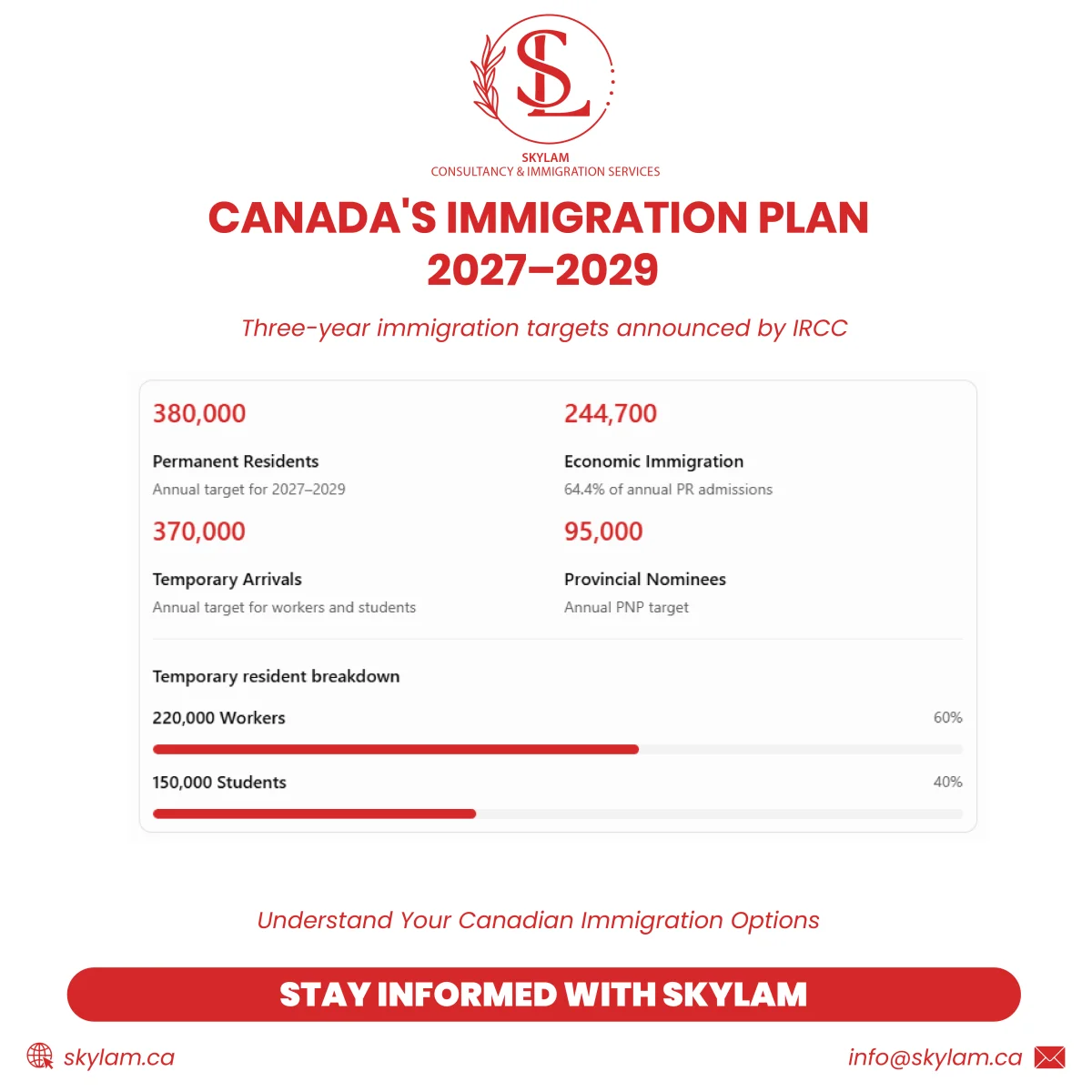
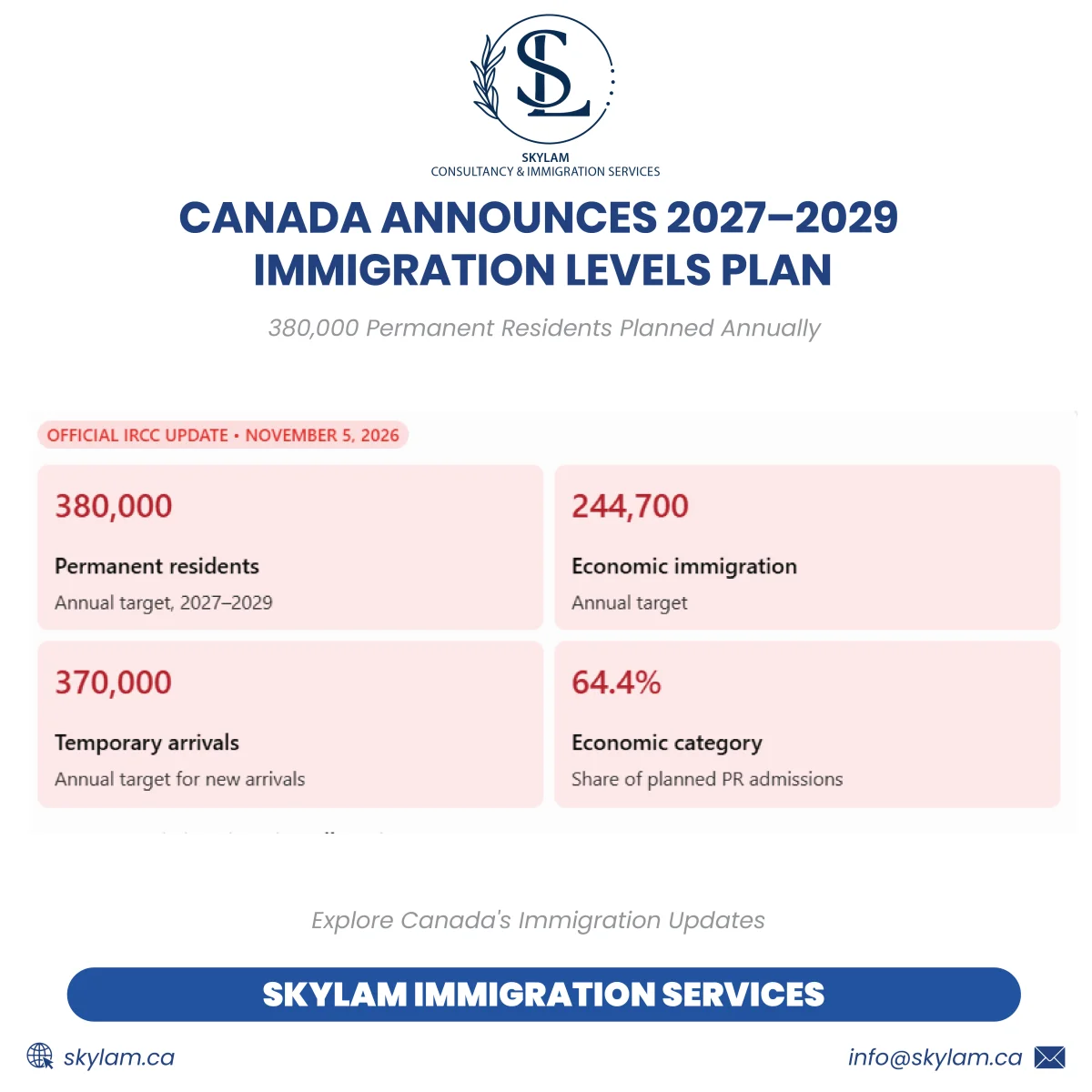
Published by Immigration, Refugees and Citizenship Canada (IRCC) on November 5, 2026, the plan maintains annual permanent resident admissions at 380,000 while continuing to prioritize economic immigration.
The government has allocated 244,700 annual admissions to the economic immigration category, representing approximately 64.4% of planned permanent resident admissions.
The new plan also establishes an annual target of 370,000 new temporary-resident arrivals, including 220,000 workers and 150,000 international students.
Another important development is a time-limited measure intended to provide additional permanent residence processing space in 2027 for up to 200,000 people already living in Canada through two separate cohorts.
For individuals considering Canadian immigration, studying or working in Canada, these targets provide important information about the country's immigration priorities.
This guide explains the major allocations, economic immigration targets, temporary-resident numbers and other important developments in the 2027–2029 plan.
1. Canada's Permanent Resident Target Remains at 380,000 Annually
One of the most important announcements is that Canada will maintain its overall permanent resident admissions target at 380,000 for each year from 2027 to 2029.
This continues the government's approach of stabilizing permanent resident admissions while adjusting the distribution of places across immigration categories.
The annual permanent resident target is:
|
Year |
Planned permanent resident admissions |
|---|---|
|
2027 |
380,000 |
|
2028 |
380,000 |
|
2029 |
380,000 |
Although the overall target remains unchanged, the plan continues to emphasize economic immigration and regional workforce requirements.
The government intends to select skilled workers who can contribute to Canada's economy, address labour shortages and support communities across the country.
The plan also maintains allocations for family reunification, refugees, protected persons and humanitarian cases.
Important: The plan provides annual targets and operational ranges. Actual admissions may vary within the published ranges according to immigration priorities and processing requirements.
2. Economic Immigration Receives 64.4% of Planned Admissions
Economic immigration remains the largest category in Canada's 2027–2029 Immigration Levels Plan.
IRCC has allocated 244,700 permanent resident admissions annually to this category.
This represents approximately 64.4% of Canada's total annual permanent resident target.
The economic immigration category includes several programs designed to attract skilled workers, business applicants and candidates who can contribute to regional labour market needs.
The government's continued emphasis on economic immigration reflects its objective of attracting talent, supporting innovation and filling persistent workforce shortages.
Major economic immigration allocations
|
Immigration category |
Annual target |
|---|---|
|
Federal High Skilled |
100,000 |
|
Provincial Nominee Program |
95,000 |
|
Federal Business |
1,500 |
|
Federal Economic Pilots |
7,900 |
|
Rural Community Immigration Program |
5,500 |
|
Atlantic Immigration Program |
6,000 |
|
Total Economic Immigration |
244,700 |
The economic category also includes Quebec Skilled Workers and Business admissions, which are determined through the Canada–Quebec Accord. The detailed category allocations and ranges should therefore be read alongside IRCC's complete supplementary tables.
These allocations show the importance of skilled immigration, provincial selection and regional economic development in Canada's immigration planning.
3. Federal High Skilled Immigration Target: 100,000
Canada has allocated 100,000 annual permanent resident admissions to the Federal High Skilled category for 2027, 2028 and 2029.
This category includes three major Express Entry programs:
-
Federal Skilled Worker Program (FSWP)
-
Federal Skilled Trades Program (FSTP)
-
Canadian Experience Class (CEC)
These programs provide pathways for eligible skilled workers to apply for permanent residence.
The Federal High Skilled allocation reflects Canada's continued interest in selecting candidates with relevant skills, education, language ability and work experience.
IRCC also uses Express Entry category-based selection to invite eligible candidates with particular skills, training and language abilities that respond to labour market needs.
However, the annual allocation should not be interpreted as a guaranteed number of invitations for every Express Entry candidate.
Eligibility requirements, CRS scores, invitation categories and selection rounds continue to influence who receives an invitation.
4. Provincial Nominee Program Receives 95,000 Annual Admissions
The Provincial Nominee Program (PNP) has an annual target of 95,000 permanent resident admissions throughout the 2027–2029 plan.
This reflects the importance of provincial and territorial immigration selection in responding to regional labour market needs.
Under the PNP, participating provinces and territories can nominate eligible individuals who meet their economic and workforce priorities.
Depending on the particular stream, candidates may be selected based on factors such as:
-
Relevant work experience.
-
Education and qualifications.
-
Employment opportunities.
-
Language ability.
-
Connections to a province or territory.
-
Regional labour market requirements.
PNP streams have different eligibility criteria and application procedures.
Some are connected to Express Entry, while others operate outside the Express Entry system.
The increased focus on provincial selection also supports Canada's objective of attracting and retaining skilled workers in communities beyond its largest cities.
Candidates interested in provincial immigration should review the official requirements of their intended province or territory.
5. Family Immigration: 81,000 Annual Admissions
Family reunification remains an important part of Canada's immigration system.
The 2027–2029 plan allocates 81,000 permanent resident admissions annually to the Family category.
The allocation is divided into two main groups:
|
Family immigration category |
Annual target |
|---|---|
|
Spouses, partners and children |
66,000 |
|
Parents and grandparents |
15,000 |
|
Total Family |
81,000 |
These pathways support eligible Canadian citizens and permanent residents who wish to sponsor qualifying family members.
Spouses, partners and children
The annual target for spouses, partners and children is 66,000.
Family sponsorship allows eligible sponsors to support qualifying family members seeking permanent residence in Canada.
Applicants must meet the applicable sponsorship and immigration requirements.
Parents and grandparents
The annual target for parents and grandparents is 15,000.
This category supports family reunification through Canada's parents and grandparents immigration arrangements.
However, the annual target should not be interpreted as an open application opportunity for everyone.
Program intake arrangements, invitations and eligibility requirements continue to apply.
6. Canada's New Temporary Resident Target: 370,000 Annually
Alongside permanent resident admissions, the government has established an annual target of 370,000 new temporary-resident arrivals for 2027, 2028 and 2029.
This target includes new arrivals of temporary workers and international students.
The annual allocation is:
|
Temporary resident category |
Annual target |
|---|---|
|
Temporary workers |
220,000 |
|
International students |
150,000 |
|
Total new arrivals |
370,000 |
The government expects workers to account for approximately 60% of new arrivals and students approximately 40%.
This approach is intended to support Canada's workforce requirements while providing more predictable immigration planning for employers, educational institutions and provincial governments.
Important clarification about the 370,000 target
The 370,000 figure does not represent a cap on every temporary resident currently living in Canada.
It concerns specified new arrivals under temporary worker and international student programs.
IRCC also clarifies that the target does not include every category of temporary resident activity, such as visitors arriving with temporary resident visas or electronic travel authorizations, permit extensions, in-Canada study or work permit applications, and asylum claimants.
This distinction is important when interpreting Canada's temporary immigration targets.
7. Temporary Worker Allocation: 220,000
Canada plans to welcome 220,000 new temporary workers annually under the 2027–2029 plan.
The allocation is divided between two major programs.
|
Temporary worker program |
Annual target |
|---|---|
|
International Mobility Program |
170,000 |
|
Temporary Foreign Worker Program |
50,000 |
|
Total |
220,000 |
International Mobility Program
The International Mobility Program (IMP) accounts for 170,000 planned new worker arrivals annually.
The IMP includes different work permit streams that generally do not require an LMIA.
These can include work permits issued under international agreements and other eligible economic or family-related arrangements.
However, the allocation does not include every work permit issued through every IMP stream. IRCC's target methodology excludes certain categories, including Post-Graduation Work Permits, which it treats as extensions or changes of status rather than new arrivals.
Temporary Foreign Worker Program
The Temporary Foreign Worker Program (TFWP) has an annual target of 50,000.
This program allows eligible Canadian employers to recruit foreign workers when they cannot find Canadians or permanent residents available to perform the work, subject to applicable requirements.
The program includes agricultural and non-agricultural streams.
The target allocation supports Canada's approach to addressing specific labour shortages while maintaining employer compliance and worker protections.
8. International Student Target: 150,000 Annually
Canada has set an annual target of 150,000 new international student arrivals for 2027, 2028 and 2029.
These targets apply to new study permit arrivals for individuals studying for six months or more at an eligible Designated Learning Institution (DLI).
The government expects international students to represent approximately 40% of planned new temporary-resident arrivals.
For prospective students, this figure provides an indication of Canada's planned international student intake.
However, it does not mean that every student will have an equal opportunity to receive a study permit.
Applicants must continue to meet the applicable requirements, including admission to an eligible institution, financial requirements and other study permit conditions.
Students should also carefully research their chosen institution and understand the immigration rules that apply to their circumstances.
9. New Time-Limited Measure: Up to 200,000 People Already in Canada
Another significant announcement in the 2027–2029 plan is a new time-limited measure intended to provide additional permanent residence processing space in 2027.
The measure is designed to transition up to 200,000 people already living in Canada through two cohorts.
The two groups are:
-
Workers cohort: Up to 100,000 workers already in Canada, together with their accompanying family members.
-
Humanitarian cohort: Up to 100,000 people already in Canada who have been waiting for many years.
Workers cohort
The government plans to work with provinces and territories to transition up to 100,000 people already in Canada, along with their families, to permanent residence.
The initiative is intended to support regional labour market needs.
Provinces and territories will be able to use additional nomination spaces and identify eligible workers through selected federal immigration programs.
The measure is intended to recognize people who have already established themselves in Canadian communities and contribute to the economy.
Humanitarian cohort
The second cohort will support the transition of up to 100,000 people to permanent residence.
The government describes this group as including people already in Canada who have been waiting for decisions for many years.
The measure is intended to fulfill existing humanitarian commitments, support family unity and reduce outstanding application inventories.
IRCC has identified several groups and pathways for this initiative, including remaining applications under the Hong Kong permanent residence pathways and the Ukraine Family Reunification Pathway, as well as certain applicants already found eligible for permanent residence on humanitarian and compassionate grounds.
It also includes eligible family members of Canadian citizens and permanent residents who are already living in Canada.
Important: This is a time-limited measure, not a general guarantee of permanent residence for every temporary resident or person living in Canada. Eligibility and implementation details depend on the applicable government arrangements.
10. Canada's Focus on French-Speaking Immigration
The new plan also reinforces Canada's commitment to increasing French-speaking permanent resident admissions outside Quebec.
The targets are:
|
Year |
Target outside Quebec |
|---|---|
|
2027 |
9.5% |
|
2028 |
10.5% |
|
2029 |
12% |
These targets are intended to support the vitality and development of Francophone minority communities outside Quebec.
French-speaking immigration can contribute to community development, workforce participation and the delivery of services in French-speaking communities.
For eligible candidates with French-language skills, it is worth reviewing the relevant immigration pathways and selection requirements.
However, language ability alone does not guarantee permanent residence. Applicants must meet the requirements of the relevant program or selection category.
11. What Does the New Immigration Plan Mean for Prospective Applicants?
The 2027–2029 Immigration Levels Plan provides useful information about Canada's immigration priorities.
For different groups, the announcement has different implications.
For skilled workers: The Federal High Skilled allocation and continued emphasis on economic immigration show the importance of skilled worker pathways.
For provincial immigration candidates: The PNP allocation of 95,000 annually highlights the continued role of provincial and territorial selection.
For international students: The annual target of 150,000 new student arrivals provides an indication of planned intake, but applicants must still meet study permit requirements.
For temporary workers: The 220,000 annual worker target reflects continued demand for eligible temporary workers, with allocations through the IMP and TFWP.
For families: The 81,000 annual family category target supports Canada's continued family reunification objectives.
For people already in Canada: The separate time-limited measure may be relevant to certain workers and humanitarian groups, subject to eligibility and implementation details.
The plan does not guarantee that an individual will receive an invitation, nomination, study permit, work permit or permanent residence approval.
Applicants should assess their individual circumstances before choosing an immigration pathway.
12. Frequently Asked Questions
Q1. What is Canada's permanent resident target for 2027–2029?
Canada plans to admit 380,000 permanent residents annually in 2027, 2028 and 2029.
Q2. How many economic immigrants does Canada plan to admit each year?
The annual economic immigration target is 244,700, representing approximately 64.4% of planned permanent resident admissions.
Q3. What is the Federal High Skilled target?
The Federal High Skilled category has an annual target of 100,000 admissions.
Q4. What is the Provincial Nominee Program target?
The PNP target is 95,000 permanent resident admissions annually.
Q5. How many international students does Canada plan to welcome annually?
The plan sets an annual target of 150,000 new international student arrivals.
Q6. What is the annual temporary worker target?
Canada plans 220,000 new temporary worker arrivals annually, including 170,000 under the International Mobility Program and 50,000 under the Temporary Foreign Worker Program.
Q7. Does the 370,000 temporary-resident target include everyone already living in Canada?
No. It refers to specified new worker and international student arrivals. It is not a cap on the entire temporary-resident population or every temporary permit extension.
Q8. What is the new 200,000-person measure?
It is a time-limited initiative intended to transition up to 200,000 people already in Canada to permanent residence in 2027 through workers and humanitarian cohorts.
Q9. Is Canada increasing French-speaking immigration targets?
Yes. The targets for French-speaking permanent resident admissions outside Quebec are 9.5% in 2027, 10.5% in 2028 and 12% in 2029.
Q10. Does the new plan guarantee permanent residence for temporary workers or international students?
No. The plan establishes immigration targets and a separate time-limited measure. Individuals must meet the applicable eligibility requirements to benefit from any immigration pathway.
Conclusion
Canada's 2027–2029 Immigration Levels Plan maintains annual permanent resident admissions at 380,000 while continuing to prioritize economic immigration, skilled workers and regional labour market needs.
With 244,700 annual economic immigration admissions, 95,000 Provincial Nominee Program places and a 100,000 Federal High Skilled target, the plan highlights the importance of economic pathways in Canada's immigration strategy.
The 370,000 annual temporary-resident arrival target also provides a clearer picture of planned new worker and student arrivals.
Additionally, the time-limited measure for up to 200,000 people already in Canada is an important development for certain worker and humanitarian groups.
For anyone planning to immigrate, work or study in Canada, understanding the official targets is a useful starting point. However, individual eligibility, program requirements and application procedures remain essential.
Skylam Immigration Services is committed to sharing reliable Canadian immigration updates and helping individuals better understand the immigration pathways and policy changes that may affect their future plans.